I am SUPER EXCITED to share my first, first-author paper with you all: Strongly Lensed Supermassive Black Hole Binaries as Nanohertz Gravitational-Wave Sources 😎🔍
https://t.co/KVdPAtnoZx
@Dr_CMingarelli@SheerPriya@jacaseyclyde
Congratulations, Bjorn, on being recognized as a "Hero of NANOGrav"! Bjorn works with me at @Yale on searching for gravitational waves in @NANOGrav data and creating custom pulsar noise models. Join me in celebrating his success!!
Happening right now!
It looks like @LIGO is teaming up with (electromagnetic) telescopes tonight to search for the light coming from either a binary neutron star merger or a black hole neutron star merger!!
Wow!!
https://t.co/KM0K202HLr
Congratulations, Bjorn Larsen, on your first 1st author paper appearing today in the Astrophysics Journal!
Bjorn is a member of @NANOGrav and a graduate student in the @YalePhysicsDept. He's also my graduate student!
https://t.co/dmWTqfuwfV
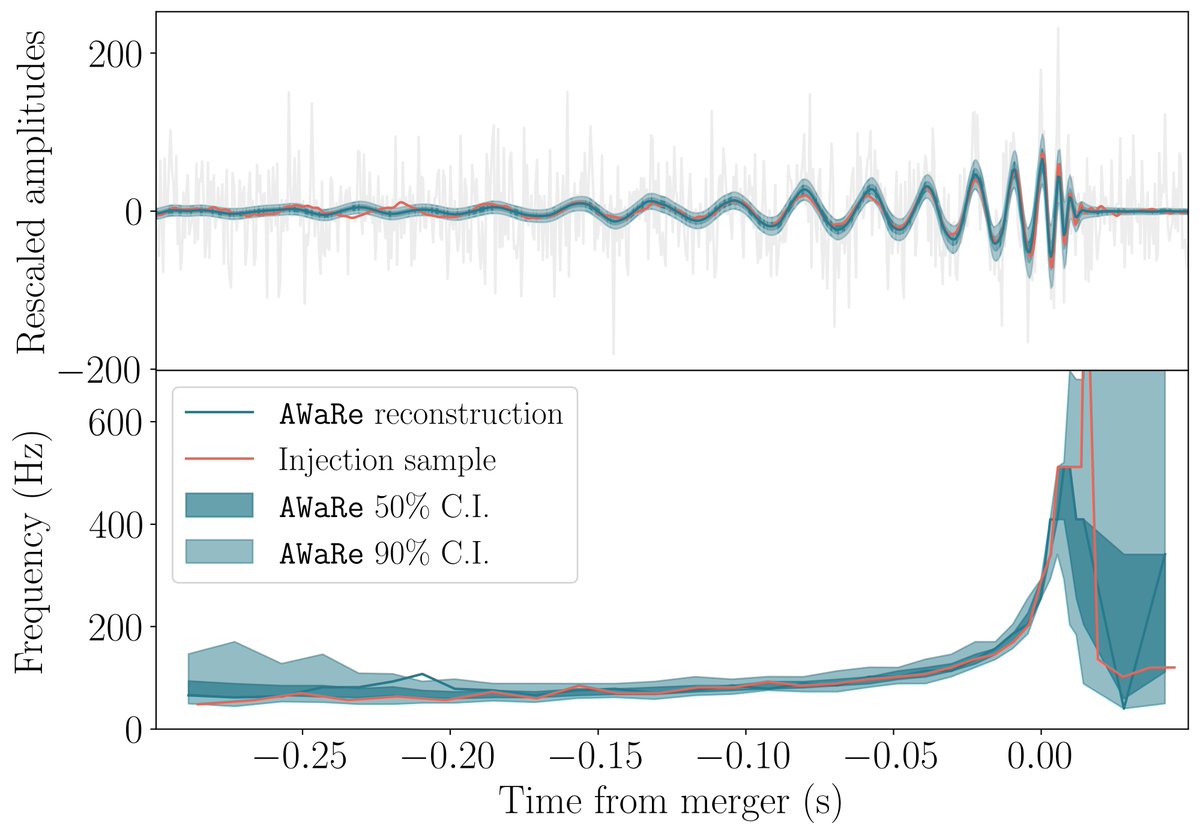
In this work, we show that our deep learning model, AWaRe, can not only reconstruct the underlying GW signal from noisy LIGO data, but can also estimate the reconstruction uncertainty, leading to more robust predictions than standard ML-based approaches!
Abigail Moran -- former @UConn undergraduate, now graduate student at @Columbia -- just had her 2nd first author paper accepted! We present the first data release of direct line-of-sight acceleration measurements for 29 binary pulsars.
https://t.co/3EDd3eQUcj
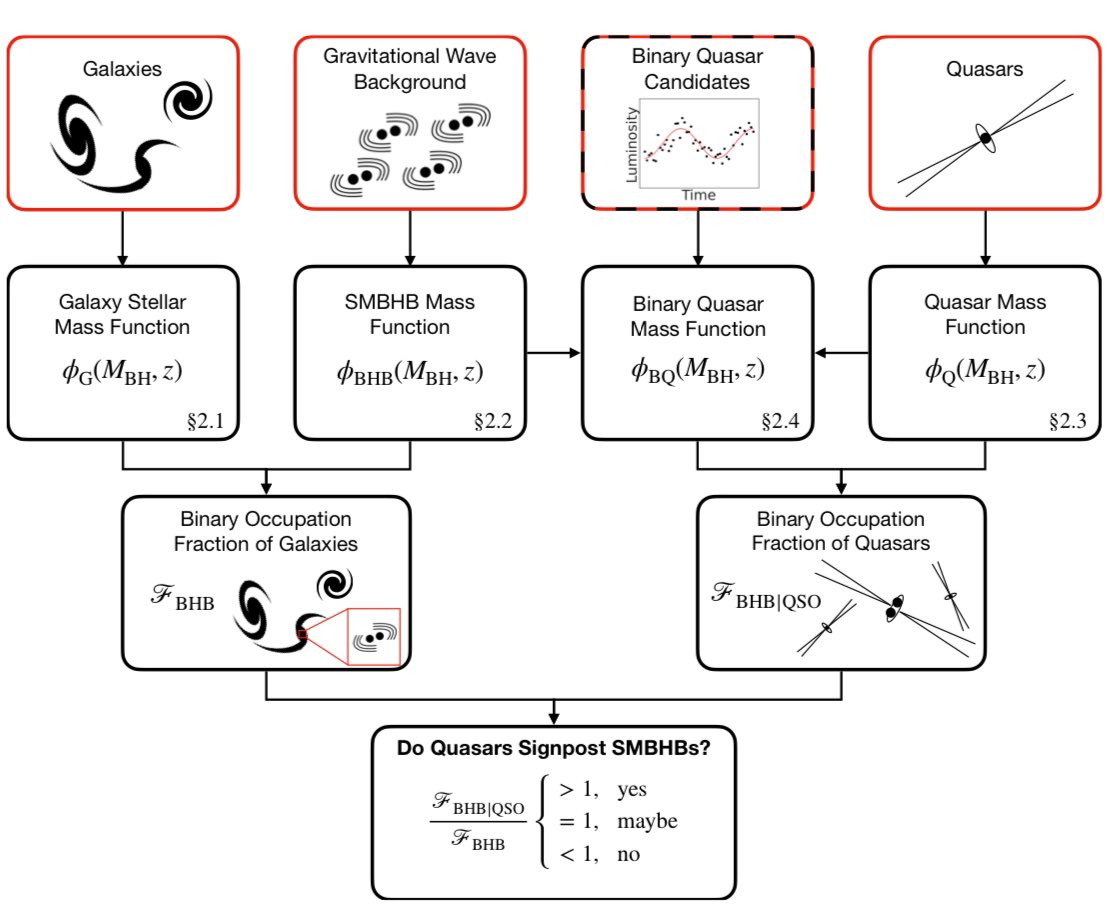
New paper day! My student, @jacaseyclyde, found that quasars are up to 7x more likely to host a pair of merging supermassive black holes than a random galaxy. Congratulations Andrew!
https://t.co/cdhMIqSyj5
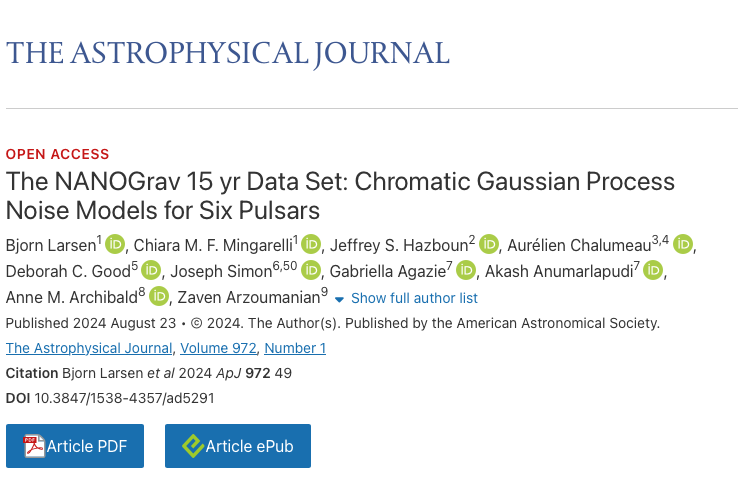
My student, Bjorn Larsen, just had his first paper appear in the @arxiv ! Here we explore custom pulsar noise models for 6 of the @NANOGrav 15 year pulsars.
https://t.co/j6ebMeaya9
Pioneering @Yale astrophysicist and @NANOGrav member, @SheerPriya, was just named as a @TIME 100 most influential people of 2024. Congratulations, Priya!
https://t.co/sLby6nHlqB
In 2024 it will have been 50 years since the Nobel Prize was infamously not awarded to Jocelyn Bell-Burnell for the discovery of pulsars. After 50 years the Nobel Nominations become public, and we’ll get a glimpse at how that decision was made.
https://t.co/xkNIjFrMI3
I gave a colloquium @the_IAS and @PU_Astro about all the cool stuff we are doing in @LIGO at @FlatironCCA and @stonybrooku with gravitational wave cosmology and black hole ringdowns. Check it out if you want to see what we’re up to: https://t.co/pRdLMo4xbi