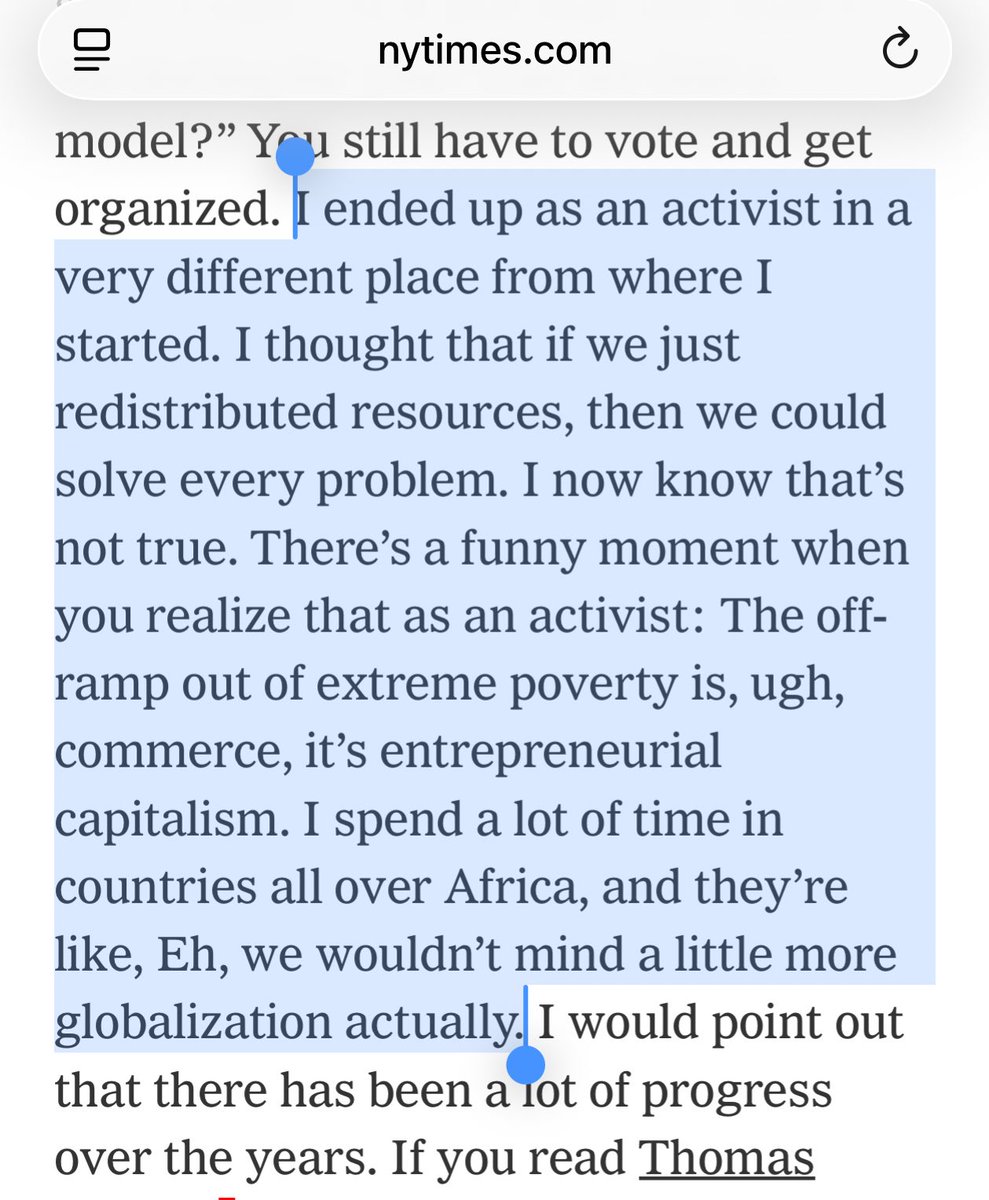
@visakanv Visa, I’m so glad you’ve had a kid so now you are training your sharp mind and curiosity towards raising a human. I’m 2 years behind you (have a newborn) and loving your insights! Please keep sharing
Completely agree. Slow courts mean meaningful economic relationships just don’t get formed and inefficient ones persist too long. Some meaningful innovation happening in this space to speed things up — https://t.co/b80eTMCMAn
It is not inevitable that India be poor. Its people are certainly capable of being extremely productive. Indian immigrants to the United States and elsewhere have been very successful. India’s government has been stable since independence, and largely democratic throughout. While their growth rate has picked up, they have not had the booming success of China. India was socialist for a long time; but then, so was China. Why isn’t India a developed country yet?
To suggest a monocausal explanation would be an exercise in arrogance. India has many problems, and there is no one simple trick to growth. Nevertheless, I hold that much of India’s stagnation is due to its judicial system. Its slowness and inefficiency has far reaching consequences, making it impossible to efficiently run a business.
The facts are simple. There are at least 50 million cases pending — nobody knows how many for sure. The Supreme Court has 69,000 piled up, waiting for resolution. Of these, 18,000 have been pending for more than thirty years. Every family has a horror story. I have a friend whose dad, near the beginning of his career, was named in a suit involving a bank. Growing up, every few years his dad would be called to appear in court. My friend is 40 now. His dad has retired. The suit remains ongoing.
The Indian government estimated that, at current capacity, it would take 324 years to clear all of the cases. That was in 2018. Since then the number of pending cases has doubled. India has one of the lowest ratios of judges to population in the world, with 21 judges for every million people. Surprisingly, this is an improvement over the past — in 2002 the ratio was 10 for every million. The EU average is 200 per million, and the US 150 per million. One reads with grim amusement concern that a low number of judges — say, 100 per million — will endanger the rule of law in Ireland or Denmark. If that is what it takes to endanger, then rule of law in India is positively extinct.
Nobody knows the average time it takes a court case to be resolved for sure, but it is somewhere around five years for it to be resolved by the high courts (the second tier of courts) and 13 years for the Supreme Court. 40,000 new civil suits are filed every day, covering everything from land disputes to layoffs to bankruptcy. 66% of all pending civil cases involve claims and counterclaims over who owns what land. The upshot of this is that firms cannot resolve disputes through the courts. They must instead turn to extrajudicial methods, and the most common of them is keeping the business in the family.
In the late 2000s a team of researchers – Bloom, Eifert, Mahajan, McKenzie, and Roberts – conducted a randomized controlled trial on management quality in Indian textile mills. Prior work by Bloom and Van Reenen had shown that family run firms in the West, in particular those run by an eldest son, were poorly run compared to professionalized businesses. We would not be able to tell in India, however. Of the 126 firms they surveyed — a comprehensive census of the firms in the towns near in and around Mumbai — every single one of them was family run. The single strongest predictor of firm size was not productivity, revenue, or profitability. It was simply the number of male family members in the family. These are not simple mom-and-pop shops either, with but a few employees. As Bloom et al write, “These firms are also complex organizations, with a median of two plants per firm (plus a head office in Mumbai) and four reporting levels from the shop floor to the managing director. In all the firms, the managing director was the largest shareholder, and all directors were family members. Two firms were publicly quoted on the Mumbai Stock Exchange, although more than 50% of the equity in each was held by the managing family.” (p. 9)
The experiment by Bloom et al was to test how much management mattered by randomly assigning some firms to receive management training. They found that a firm receiving the management training increased their annual profits by 17%, or almost $300,000 a year. Since these are extremely simple interventions — things such as “write down what types of yarn you have and how much” and “have a schedule for repairing machines”, one wonders why the companies never adopted them on their own.
You can read the rest here: https://t.co/J1TQsQ2Kn2
Perhaps useful to point out that history rhymes: this is effectively what happened with telephone operators, 100 years ago. Young, entry-level operators, whose work was mainly connecting local calls--the simplest version of the job--and not much else, were wiped out by automatic call switching. More senior operators, who had a wider range of tasks and did more complicated work like information service, emergency service, and long distance calls, were not as affected. Even when local telephone operators were effectively eliminated across AT&T's network, the others remained. Much had to do with the complexity of the work and how entangled it was with the rest of the organization.
Extended discussion in work with @jamesfeigenbaum in @QJEHarvard and Management Science: https://t.co/ZKkH3DyuiR, https://t.co/EJTBbX0nkp
Lots of credit to @joshgans for helping us sharpen some of these ideas in this work as editor of the ManSci paper
Ludwig is genuinely one of the nicest people I’ve met, and not just in our profession ;) I’ve been so happy since hearing this news yesterday! Huge congratulations, @ludwigstraub! (Martin had no trouble getting lots of testimonials to make this presentation)
Wonderful news on @ludwigstraub getting the Clark medal!
When Ludwig got tenure, his @HarvardEcon macro advisees and coauthors put together this slide deck full of anecdotes showing how great Ludwig is as an academic and as a person:
https://t.co/r1XEnUYlkK
Overjoyed that @ludwigstraub has won the Clark medal!
I met Ludwig when he was finishing grad school - we started talking about private debt, that would lead to our paper `indebted demand'. I vividly remember thinking how special Ludwig was - poetic brilliance of an applied theorist that reminded me of Krugman. He is in that league in my view
And what a true gentleman! A great joy to be with. Congrats Ludwig! couldn't be happier
https://t.co/jjjxzvex0f
A 79 year old professor is my current poster girl.
In 2023, Claudia Goldin was awarded the Nobel Memorial Prize in Economic Sciences for her work in women's labor market outcomes, the first woman to win the award solo.
After her win, she was deluged with hundreds of requests of which she accepted just three. I am not sure of the first, but the second was to appear on the NPR quiz show in the US. And the third was advising the WNBA players union as the women prepared to negotiate a new labor deal with the league.
The players union was ecstatic when Goldin replied, assenting to help them with just one requirement, she refused to be paid.
Clearly Goldin is just not a theorist as, thanks to her, the Players Union and the WNBA reached a collective bargaining agreement that gave Women’s National Basketball Association players a nearly 400% raise. Starting this season, players’ average salary will top $580,000.
Goldin has also always had Golden Retrievers and apparently would often read her papers aloud to them while working out models in her head.
Is there anyway she can be more perfect.
Let me use this opportunity to also flag @pawtrammell
's neat model of Workflows and Automation. One of the few models explaining *why* it may be efficient for a single worker to perform a bundle of multiple tasks.
Bad econ. "White collar workers switch to Doordash, driving down real wages there too" is partial equilibrium thinking
Robot firms only grow if they're producing more real goods & services. If production is growing, real incomes are rising not falling. No doom loop!
If production is growing but somehow consumption stalls, that's just a failure of monetary & fiscal policy. Cut rates to zero quickly; below zero, fiscal policy kicks in to redistribute income to consumers & restore consumption growth to trend
Either there's no doom loop in the first place, or else New Keynesian monetary & fiscal policy kicks in to close any emergent wedge between robot output & human consumption
This piece is ultimately just anticapitalist pablum (teasing a belief that most markets are just scams and rent seeking in the intro!)--and after that, the piece simply underrates or misunderstands the stabilizing powers of liberal democratic Keynesian capitalism to keep output & consumption in balance
We don't have to allow what @delong calls "a failure of the exchange mechanism" in the future any more than we did in the 1930s
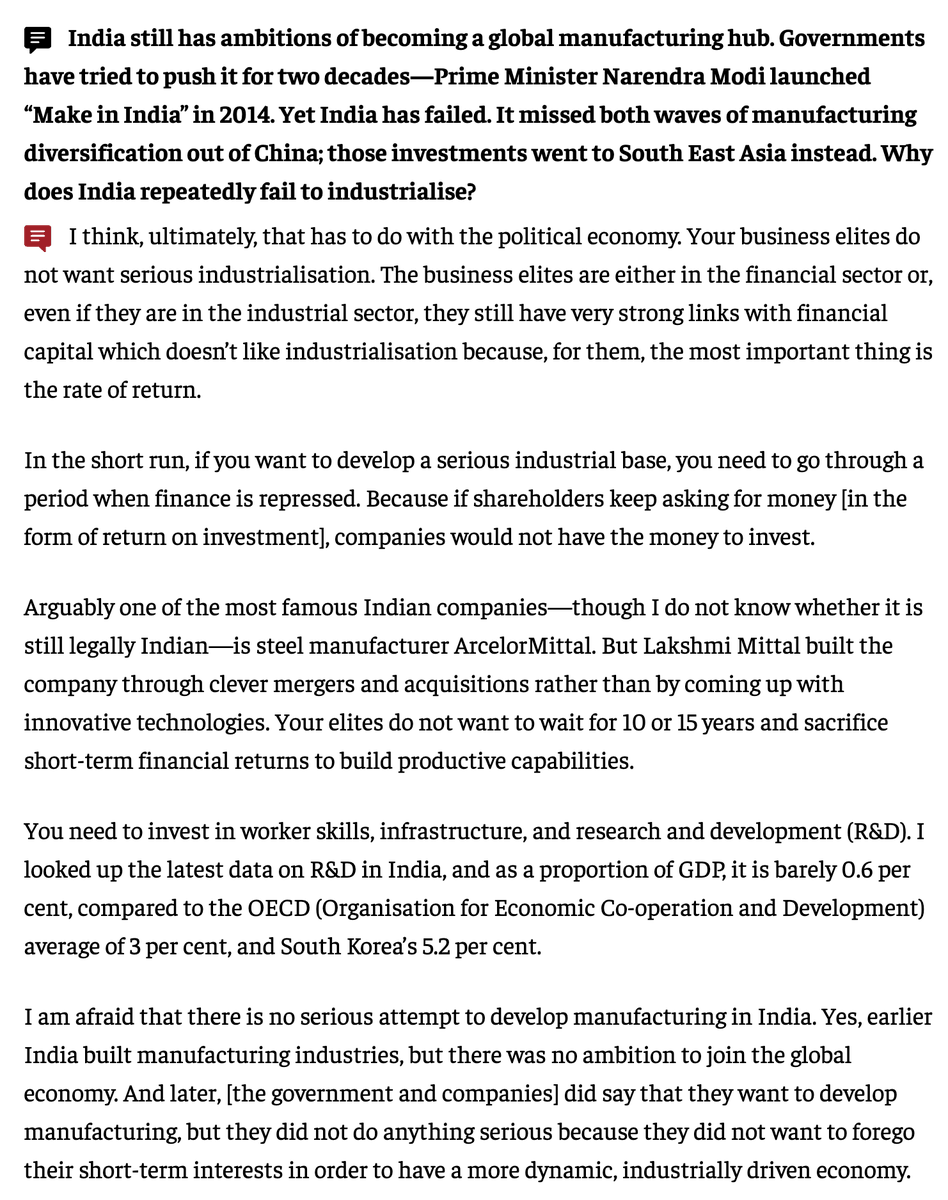
Why has India failed to industrialize?
Ha-Joon Chang argues that it’s because India’s business and financial elites oppose industrialization — and that it won’t happen unless their power is curbed.
@jamespstratton and I put out a working paper a few days ago on exactly this question! We propose a way to answer it using a simple causal analogue of the R² ("Causal R²").🧵(1/12). Paper: https://t.co/FgD8fFIEYj
Hi all, please spread the word and we hope everyone can make good use of this new data drop: https://t.co/1DSR2NZ38p
The full surviving establishment-level Census of Manufactures manuscripts from 1850, 1860, 1870, and 1880!
With all my admiration for Philippe Aghion’s work on the importance of innovation (what he has done with Peter Howitt in the 1990s and what he does these days with his collaborators at the College de France is essential theoretical and empirical work), a caveat.
An economy can grow without being at the frontier. Indeed, most economies in the world are not at the frontier. And most have experienced substantial growth.
More important than being at the frontier, is to be able to use these new technologies in the rest of the economy. This puts the focus on other aspects, the organization of the labor market, bankruptcy codes, a new type of education, etc. Less exciting project than new AI centers, but probably more important.
An analogy. It is nice to be ahead during a bicycle race. But it is easier to be just behind, protected from the wind by the racer who is ahead. One ends up second, but still with an impressive time.
If Europe can be first, then all means let us try. If not, let’s make sure we are a close second.
Say bonjour! This snapshot from one of our newest laureates in economic sciences was taken just after receiving the news.
Stay tuned for our telephone interview with Philippe Aghion.
#NobelPrize
Photo: Mikhaela Aghion
Thrilled about this prize!!! These three people’s papers made me interested in studying the economics of innovation and I couldn’t be happier today. Aghion was also my professor at the LSE (he won’t remember) and he was so so so good. Made me want to pursue a PhD :)
BREAKING NEWS
The Royal Swedish Academy of Sciences has decided to award the 2025 Sveriges Riksbank Prize in Economic Sciences in Memory of Alfred Nobel to Joel Mokyr, Philippe Aghion and Peter Howitt “for having explained innovation-driven economic growth” with one half to Mokyr “for having identified the prerequisites for sustained growth through technological progress” and the other half jointly to Aghion and Howitt “for the theory of sustained growth through creative destruction.”
#NobelPrize
1/ OPT OBSERVATORY
I’ve spent the past year creating *the most in-depth public resource* on how the US retains international students after they graduate.
Today, @IFP is releasing never-before-seen data we obtained from ICE via FOIA.
Check it out: https://t.co/La9FD8zN2j