Countries get the cabinets they pay for. Singapore pays its Foreign Minister about S$1.1m, around US$800,000. The salary is benchmarked to 60% of the median income of the top 1,000 Singaporean earners. That is why you can get Vivian Balakrishnan, former eye surgeon and hospital chief executive, implementing @karpathy's external brain idea (link below). The speech shows deep understanding of AI and fills one with confidence about Singapore's future.
The UK Foreign Secretary earns roughly £165,000: the MP salary plus a ministerial salary of about £67,000. The ministerial part is frozen since the crisis and is down by roughly a third in real terms since 2010. This is what a junior Magic Circle lawyer earns.
Spain pays its ministers around €85,000. So you do not get a surgeon who has run hospitals. You get a party loyalist who has never run anything.
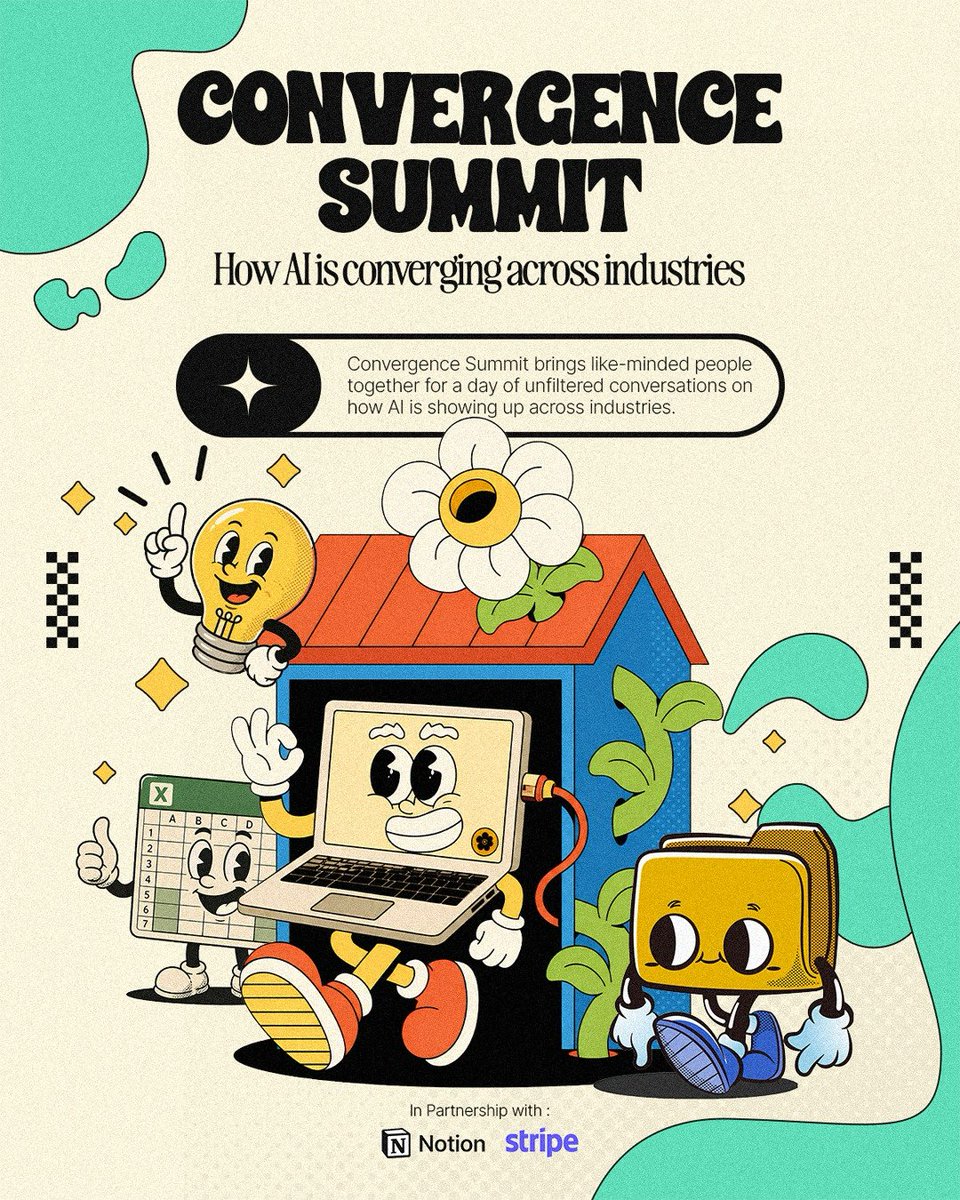
Super excited to be part of Convergence Summit. AI is converging across different industries. Join us to find out who are influencing our future infra & how they are thinking about it!
On June 12, we're bringing together Convergence Summit — a half-day community conference focused on AI, and its role in converging across industries.
Held at Stripe's Singapore office, the conference brings together keynotes, workshops, and panel discussions — with speakers across from @stripe, @NotionHQ, @awscloud, @vercel, @salesforce, @SlackHQ, @StraitsX, @nansen_ai, @coinbase, and many others.
Convergence Summit is brought to you in partnership with Stripe and Notion.
Sign-up 👇
https://t.co/RAcVQfqpHK
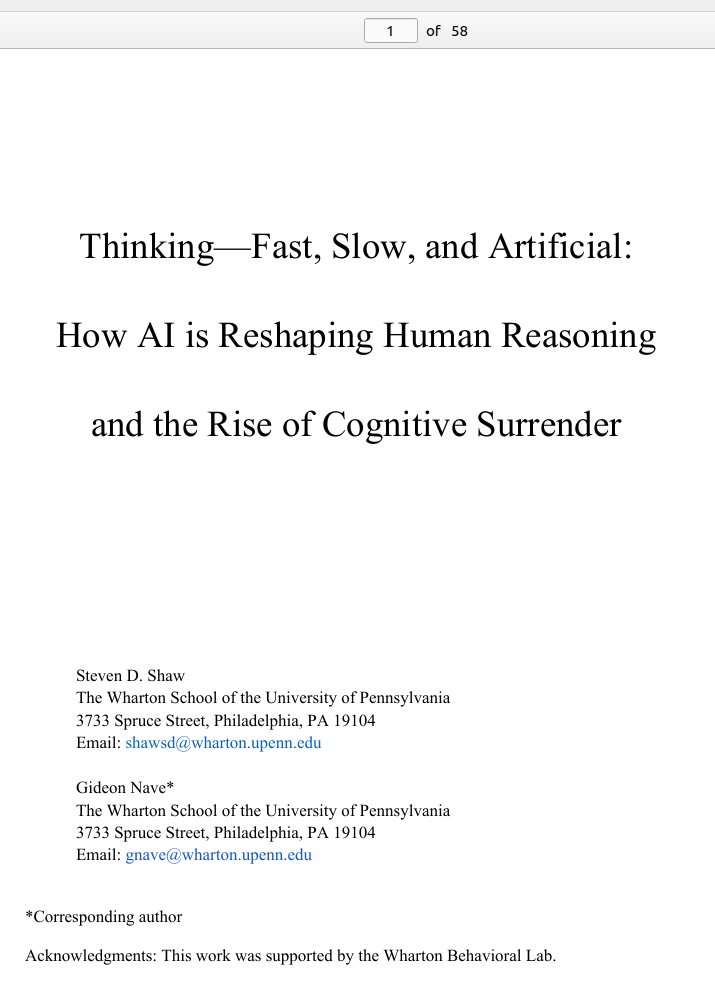
Wharton’s latest AI study points to a hard truth: “AI writes, humans review” model is breaking down
Why "just review the AI output" doesn't work anymore, our brains literally give up.
We have started doing "Cognitive Surrender" to AI - Wharton’s latest AI study points to a hard truth: reviewing AI output is not a reliable safeguard when cognition itself starts to defer to the machine.when you stop verifying what the AI tells you, and you don't even realize you stopped. It's different from offloading, like using a calculator.
With offloading you know the tool did the work. With surrender, your brain recodes the AI's answer as YOUR judgment. You genuinely believe you thought it through yourself.
Says AI is becoming a 3rd thinking system, and people often trust it too easily.
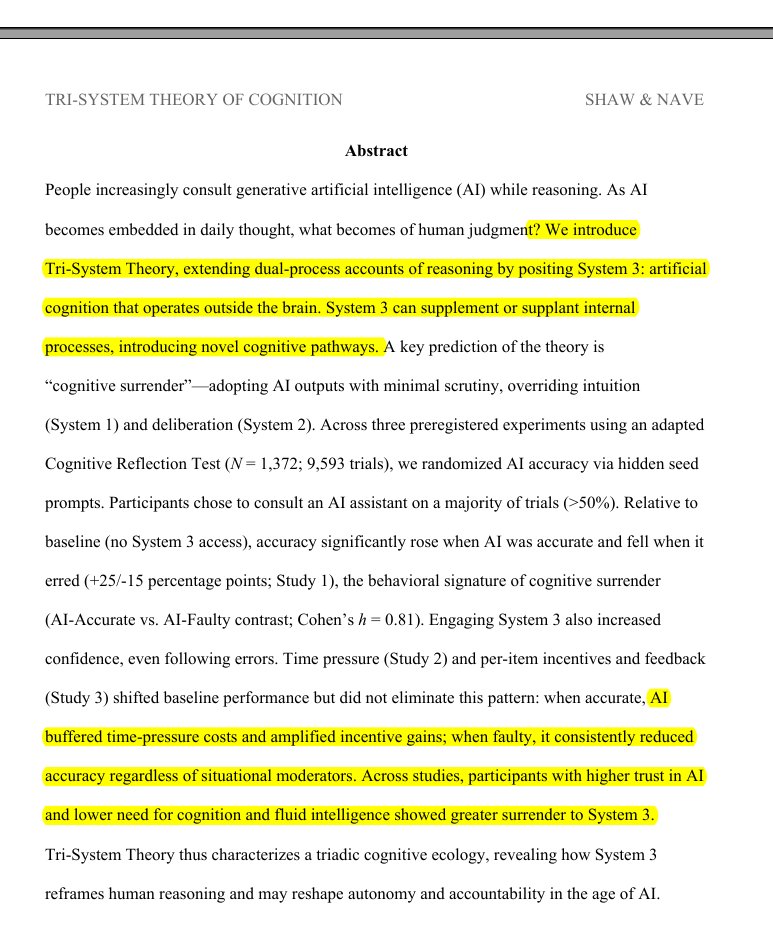
You know Kahneman's System 1 (fast intuition) and System 2 (slow analysis)? They're saying AI is now System 3, an external cognitive system that operates outside your brain. And when you use it enough, something happens that they call Cognitive Surrender.
Cognitive surrender is trickier: AI gives an answer, you stop really questioning it, and your brain starts treating that output as your own conclusion. It does not feel outsourced. It feels self-generated.
The data makes it hard to brush off. Across 3 preregistered studies with 1,372 participants and 9,593 trials, people turned to AI on over 50% of questions.
In Study 1, when AI was correct, people followed it 92.7% of the time. When it was wrong, they still followed it 79.8% of the time.
Without AI, baseline accuracy was 45.8%. With correct AI, it jumped to 71.0%. With incorrect AI, it dropped to 31.5%, worse than having no AI. Access to AI also boosted confidence by 11.7 percentage points, even when the answers were wrong.
Human review is supposed to be the safety net. But this research suggests the safety net has a hole in it: people do not just miss bad AI output; they become more confident in it.
Time pressure did not eliminate the effect. Incentives and feedback reduced it but did not remove it. And the people most resistant tended to score higher on fluid intelligence and need for cognition. That makes this feel less like a laziness problem and more like a cognitive architecture problem.
Very curious how many companies, especially AI-native ones, are piling up "maintenance debt" in prioritising efficiency? If so, when will that catch up and how will that look like in a couple of years?
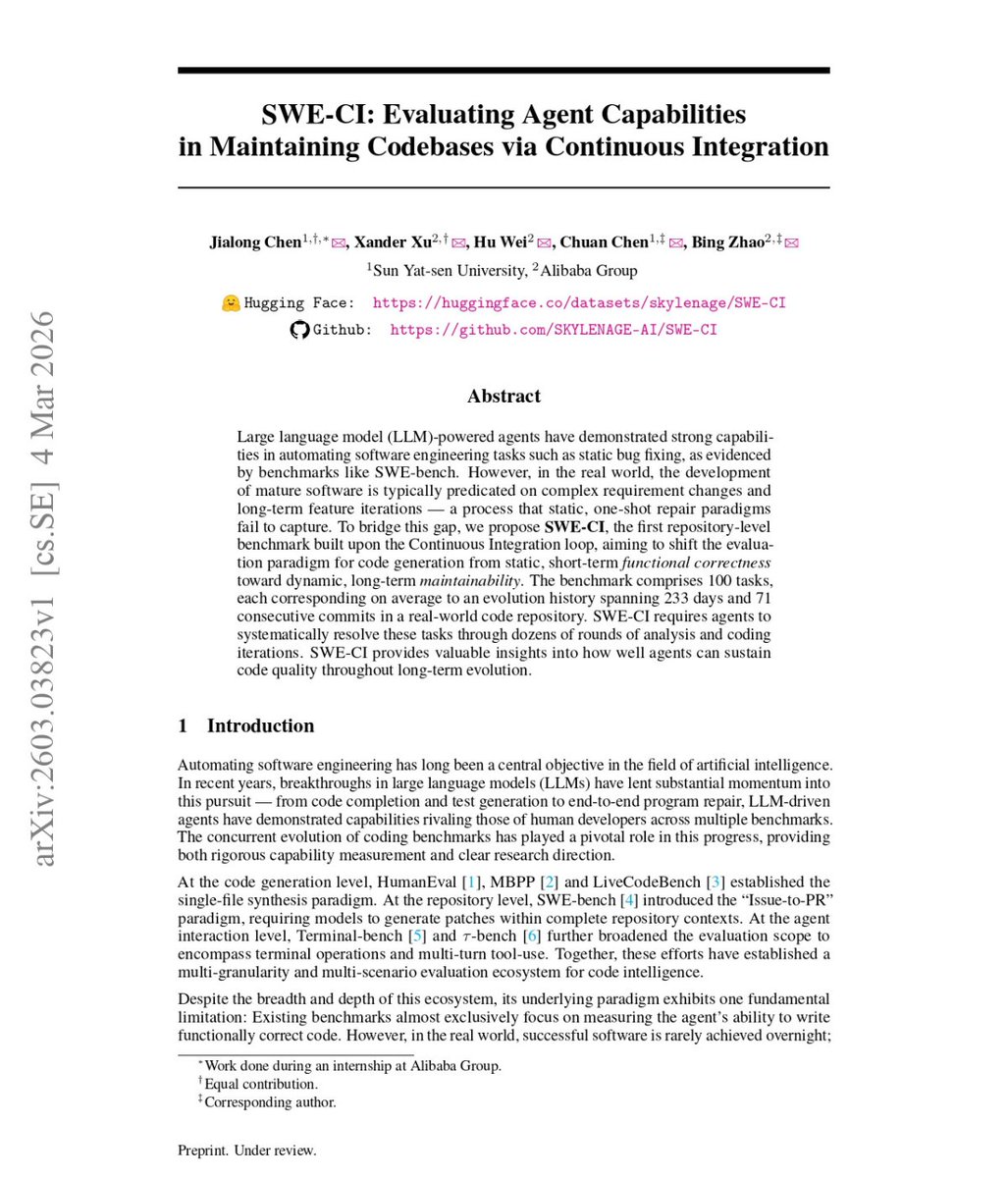
🤯BREAKING: Alibaba just proved that AI Coding isn't taking your job, it's just writing the legacy code that will keep you employed fixing it for the next decade. 🤣
Passing a coding test once is easy. Maintaining that code for 8 months without it exploding? Apparently, it’s nearly impossible for AI.
Alibaba tested 18 AI agents on 100 real codebases over 233-day cycles. They didn't just look for "quick fixes"—they looked for long-term survival.
The results were a bloodbath:
75% of models broke previously working code during maintenance.
Only Claude Opus 4.5/4.6 maintained a >50% zero-regression rate.
Every other model accumulated technical debt that compounded until the codebase collapsed.
We’ve been using "snapshot" benchmarks like HumanEval that only ask "Does it work right now?"
The new SWE-CI benchmark asks: "Does it still work after 8 months of evolution?"
Most AI agents are "Quick-Fix Artists." They write brittle code that passes tests today but becomes a maintenance nightmare tomorrow. They aren't building software; they're building a house of cards.
The narrative just got honest: Most models can write code. Almost none can maintain it.
We’ve trained a multimodal AI model to turn routine pathology slides into spatial proteomics, with the potential to reduce time and cost while expanding access to cancer care.
POV: A guy with ChatGPT and Google AlphaFold just built a custom mRNA cancer vaccine to save his dog.
this story is actually insane.
a tech guy in australia adopted a rescue dog with aggressive cancer and only months to live.
so he did something wild:
> paid ~$3k to sequence the tumor dna
> used chatgpt to analyze the mutations
> used google’s alphafold to model the proteins
> identified drug targets and designed a custom mRNA cancer vaccine
he had zero background in biology.
after months of paperwork, the vaccine was approved and injected.
within weeks the tumor shrank dramatically and the dog started recovering.
meanwhile pharma companies are running $1B trials to do the exact same thing.
the future of personalized medicine with AI is going to be insane.
Perplexity just gave every retail investor a Bloomberg Terminal. For free.
Watch this demo. It's wild.
@perplexity_ai connects to brokerage accounts via @Plaid and builds a custom investment dashboard in seconds.
Perplexity Computer pulls from 40+ live finance tools like:
- SEC filings
- FactSet
- S&P Global
- Coinbase
- LSEG.
75% of Perplexity's paying users were already asking finance questions monthly. The demand existed before the product did.
But you couldn't DO anything with that information.
---
Now you can connect it to your data for better insights.
Connect your brokerage accounts through Plaid, and suddenly an AI agent can see your actual holdings across multiple institutions — then query institutional-grade data against them.
"Show me my sector concentration risk" or "How exposed am I to rising rates" — answered in seconds with your real portfolio, not hypotheticals.
---
It still can't trade for you, though.
That's a deliberate regulatory design choice that lets Perplexity move fast while every neobank and robo-advisor is still waiting for compliance sign-off.
Fintech companies spent a decade building Plaid as pipes for fintech apps to read your bank data.
But I'm much more interested in when we give them to AI
Predicting human behaviours with AI. Current use cases include consumer buying and Q&A.
Other use cases: product development, marketing, policy design, litigation forecasting, public health modelling.
Helping AI reach more people requires deep collaboration across the ecosystem.
Today we’re announcing new investment, with support from @SoftBank, @NVIDIA, and @Amazon, to scale the infrastructure needed to bring AI to everyone.
https://t.co/xW0ItgMTLe
this is fucking hilarious.
a $7B japanese toilet company just discovered its ceramics tool can be used to make bleeding-edge AI chips.
thats a $60 Billion market.
their stock is up 60% on the news.
Professionalism often rewards conformity, not contribution. Learn how hidden norms silence difference and how leaders can unlock authentic performance. https://t.co/c269GtdK4N
De grootste fietsenstalling 🚲🚲🚲 van onze stad opent eind januari de deuren. Om de stalling te bouwen moest het water worden weggepompt uit het Open Havenfront. Bekijk 4️⃣ jaar werk in 6️⃣0️⃣ seconden.
#Gas demand in Europe has fallen, partly as a consequence of the continent’s plans to reduce its dependency on Russian gas. The lesson for decarbonisation: rapid action is possible, if it is prioritised. Read about gas, transistors, Afghanistan here 👉 https://t.co/JSStYGIE1t
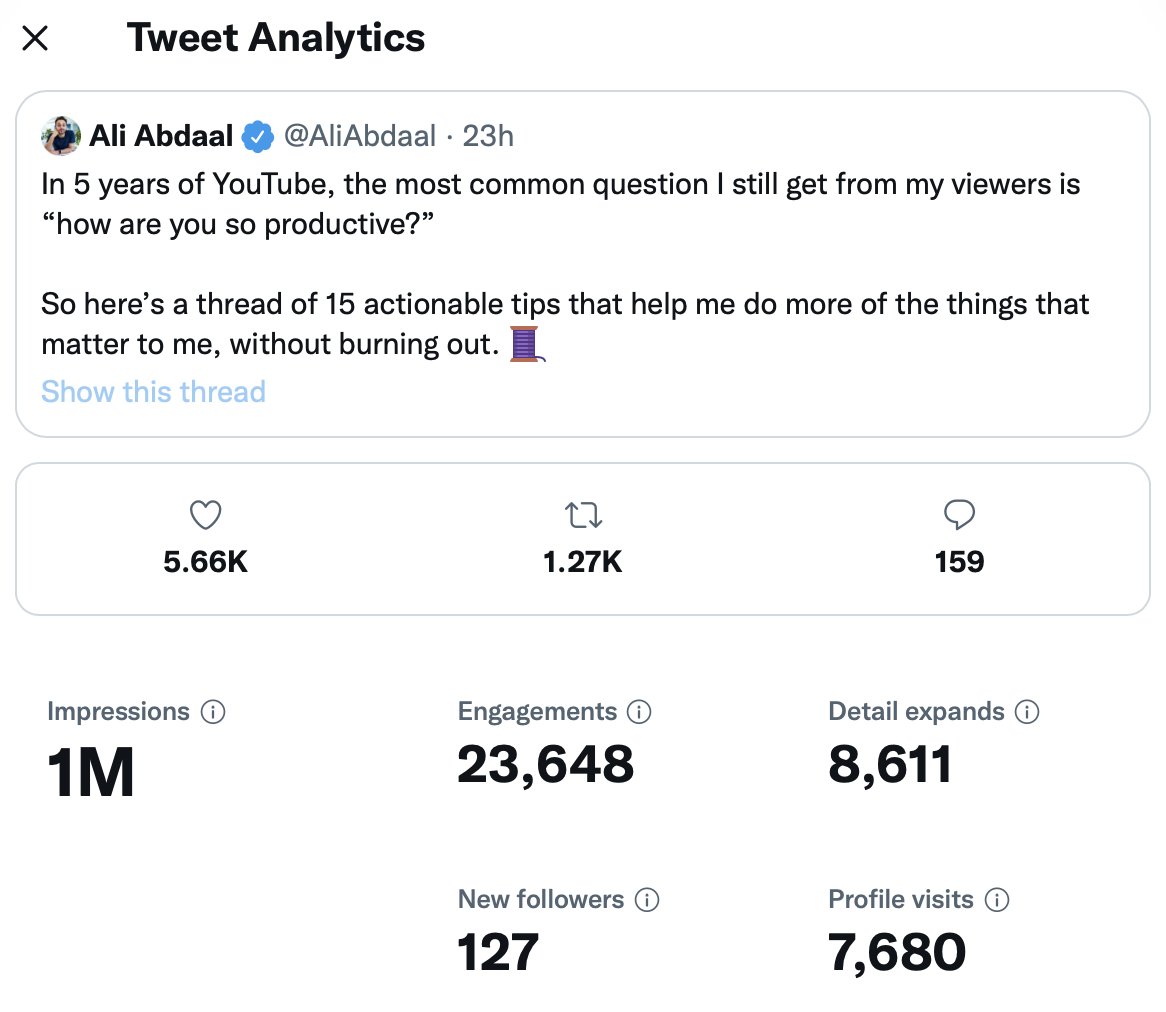
24 hours ago, I tried an experiment - I tweeted a thread with 15 productivity hacks. It’s become one of my highest performing tweets of all time, with over 1 million impressions and 23,648 engagements.
The truth is - the entire thread was written by an AI.
Let me explain… 1/