@cullenroche A correct framing about banks creating money depends on the motive for it. One argument is banks create money from thin air, which is wrong, and then thinking of it as IOUs is a better framing. There are government constraints on banks money creation but not only from reserves
@Th__Nielsen Jeg tror at en del av problemet generelt er at jeg mistenker at de fleste er ganske dypt inne i investeringsverden før man forstår at investering handler like mye om psykologi som finansiell forståelse, og da egen psykologi og ikke bare markedets psykologi
There is a certain prisoners dilemma/tragedy of the commons problem with AI use, which will hinder the predicted increase in productivity. How much is an open question
The job-finding process seems to be an early hint at what AI/automation could do to a lot of things. Both massive, speculative bulk applications and aggressive automated filtering are now very easy. And neither employees nor applicants seem to be happy with the new equilibrium.
@alexolegimas@TheStalwart@f_wintersberger Wouldn’t this come down to complexity theory to a greater extent? How complex are the complex adaptive systems that form economy and society, and are these predictable given omniscience or is just the exact probability distributions predictable, ala blackjack, and not outcome?
@michaeljmcnair I have difficulties seeing this as likely as Covid (assessing COVID as likely ex ante not ex post), but open to missing something. Covid was a runaway train, how is this cybersecurity risk the same? I see the theoretical but difficulties seeing the obvious cascading in practice
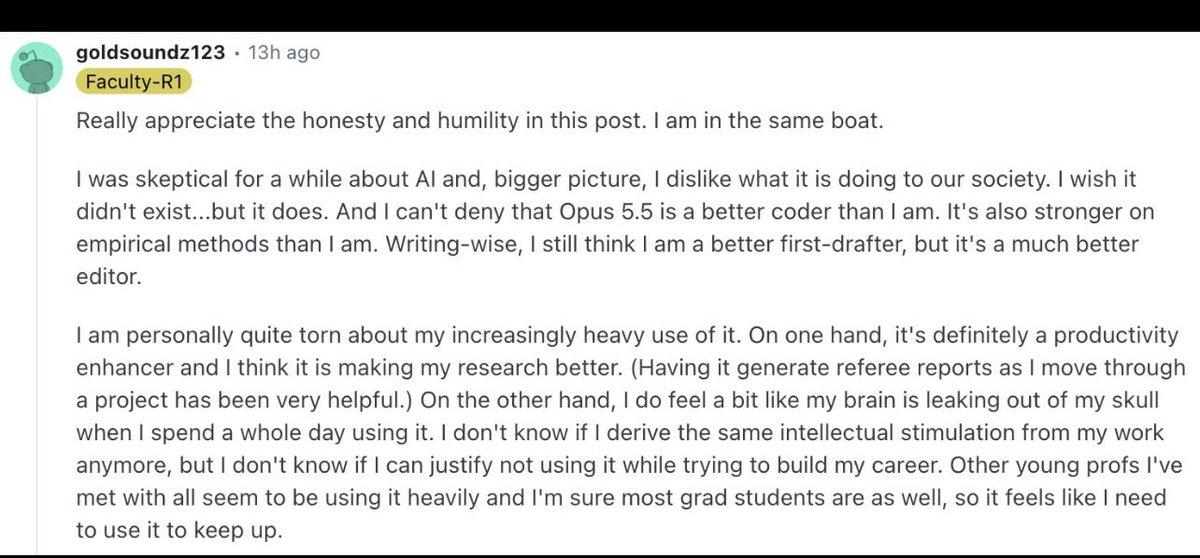
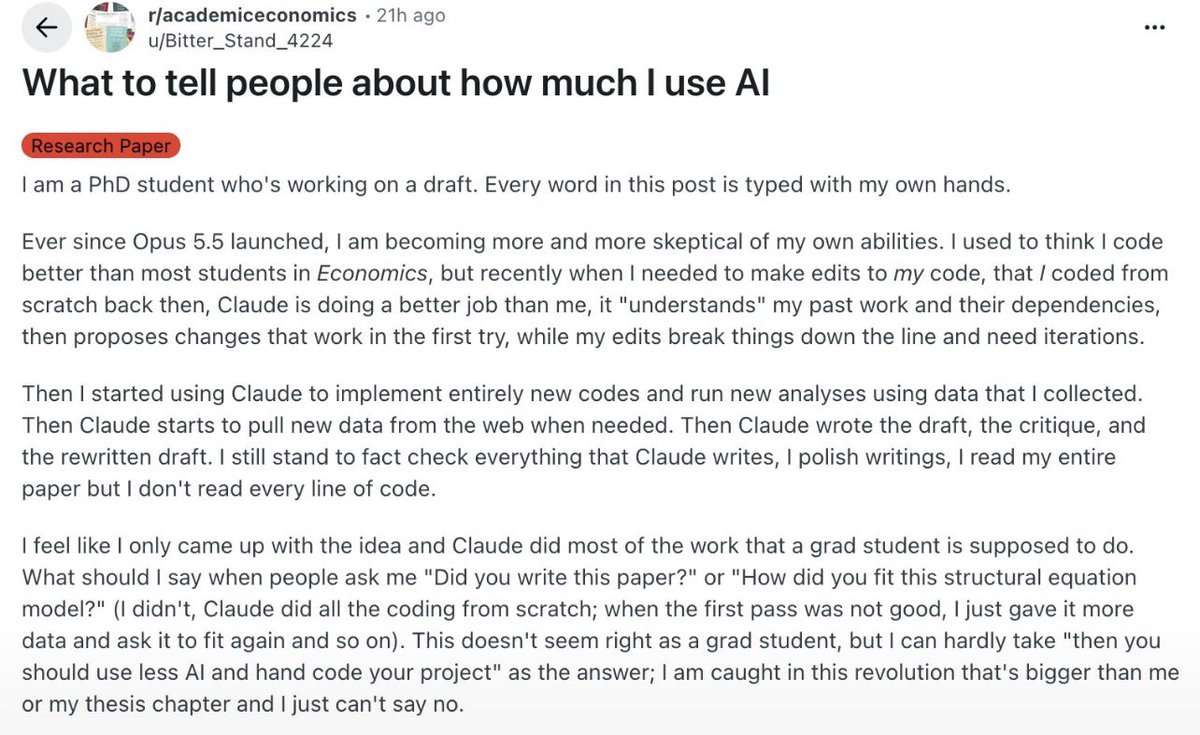
We obviously haven’t had the major jobs wipeout yet. But you read stuff like this. And you read what economics students themselves are saying about working with AI (ht @odavis_h) and it’s hard not to feel like the seismic shift is on its way.
@Th__Nielsen Veksten og dealmakingen er det jo “litt SBB over”, men det i seg selv ser jeg ikke som negativt. Det i kombinasjon med manglende risikokontroll og spenstige gjeldsstrukturer skaper problemene. Med litt iffy makro for tiden synes jeg høy grad av offentlige motparter er positivt
@Th__Nielsen Skjønner. Det er et visst poeng, men med tydelig finanspolicy som de foreløpig viser at de følger (i motsetning til SBB hadde) så er min tanke at det gir tilstrekkelig risikokontroll og da synes jeg verdsettelsen virker attraktiv og en strategi som passer dagens macro environment
@tamarawinter This one and many of your other books looks interesting. I prefer pocket and a smaller size though, say 8-8,5ish inches. Is release of pocket versions on the agenda? I bought Poor Charlie’s Almanack in pocket, which is nice, but felt a bit cramped with the much smaller size.
@bgurley@sapinker Agree, this is too complex to listen to the AI researchers too much and Tetlock’s work is highly relevant. Taleb’s arguments around the precautionary principle is also relevant here though. The probability of doom is of less relevance than the consequence.
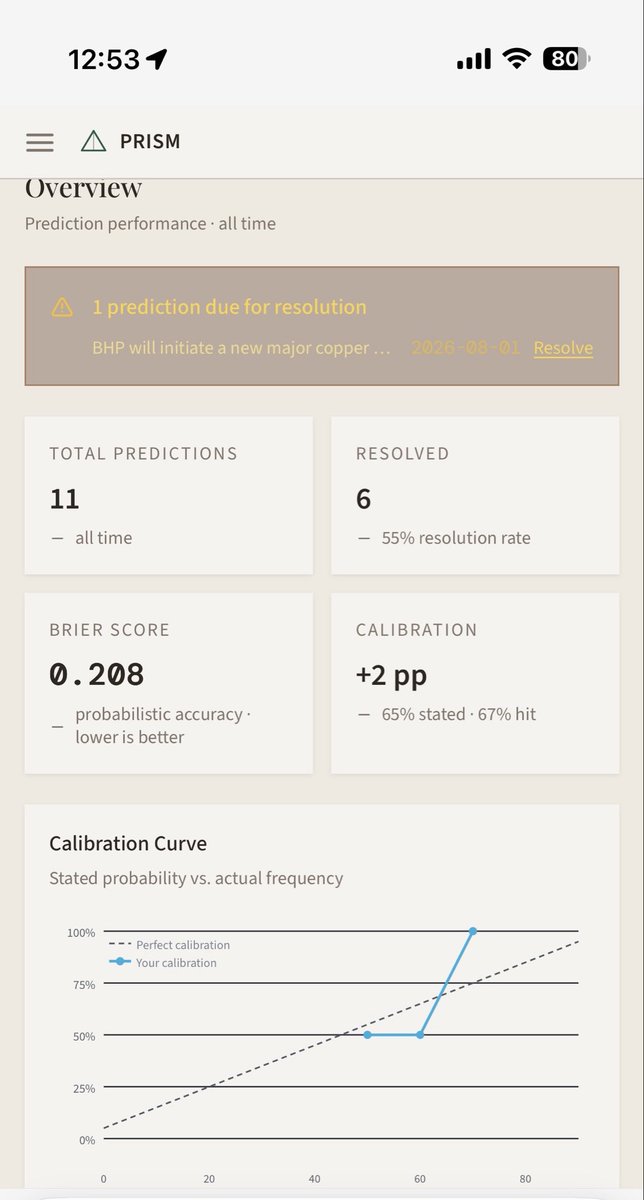
@mjmauboussin@pjmauboussin Where do I get my diploma..? Participation in Good Judgement Project seems to have paid off. I’ve just made a prediction tracker/calibration tool along these lines I can DM you a demo of if you’re interested. Can’t share a link here as the back end isn’t ready for that.
@TheStalwart Op-eds are often written to some or all degree by someone else than the undersigned, such that the difference isn’t that big. I’d prefer that neither AI nor other people write the op-eds, but unfortunately this isn’t the standard. Much more impressed by people writing themself