Microsoft just banned its own engineers from using AI.
The tool was literally costing MORE than the humans it was supposed to replace.
They lied to you about AI adoption and now the whole narrative is blowing up:
Microsoft gave thousands of engineers access to Claude Code six months ago and encouraged them to use it.
Engineers loved it and adoption exploded. But then the invoices arrived.
Token-based pricing means every query, every code review, every debugging session costs money. At scale across 100,000 engineers, the numbers became so large that Microsoft issued an internal order to cancel nearly all Claude Code licenses by end of June and force everyone onto their own cheaper tool instead.
The company that invested $5 billion in Anthropic just told its own people to stop using Anthropic's product because it costs too much.
Uber's story is even worse...
Their CTO Praveen Neppalli Naga told The Information that the budget he planned for the full year was "blown away already" by April.
Uber had rolled out Claude Code in December 2025. By March, 84% of their 5,000 engineers were using it with 70% of all committed code coming from AI systems.
Heavy users were burning $500 to $2,000 per month each. Naga himself spent $1,200 in a single two-hour demo session.
The company had even built internal leaderboards ranking engineers by how much AI they used. They literally gamified the spending and then ran out of money.
Now look at what Nvidia's own VP of applied deep learning Bryan Catanzaro said to Axios last month. Direct quote:
"For my team, the cost of compute is far beyond the costs of the employees."
This is a VP at the company that SELLS the chips saying that using AI is more expensive than paying humans.
Think about what this means for the entire AI narrative.
Every CEO on every earnings call for the past two years has said the same thing:
AI will make us more efficient, reduce headcount, and cut costs.
The stock market rewarded every company that said it.
Fired workers, stock goes up. Announced AI adoption, stock goes up.
But the actual companies deploying AI at scale are discovering the math doesn't work. The MORE employees use AI, the HIGHER the bill.
Goldman Sachs forecasts a 24x increase in token consumption by 2030 as companies adopt AI agents. Gartner just published a report showing that even though individual token prices will drop 90% by 2030, total enterprise AI costs will go UP because agents consume exponentially more tokens per task than basic tools.
Meta built an internal dashboard called "Claudeonomics" to track which employees use the most AI. Amazon started pushing engineers to "tokenmaxx," their internal term for consuming as many AI tokens as possible.
Both companies are spending hundreds of billions on AI infrastructure this year alone.
And Microsoft, the company that bet its entire future on AI, just told 100,000 engineers to stop using the tool they liked best because the per-token bills got out of control.
The companies building AI are telling investors it saves money. The companies using AI are finding out it costs more than the humans it was supposed to replace. And even the company that makes the chips just admitted it through its own VP.
This is the gap nobody on Wall Street is pricing in.
$725 billion in AI infrastructure spending this year across Big Tech. And the first companies to actually deploy these tools at scale are already pulling back because the economics don't work.
What do you think?
How to create a Pepper’s Ghost illusion using a plastic bottle and a smartphone.
A Pepper's ghost is a classic theatrical illusion technique that uses a pane of glass and clever lighting to make objects or actors appear, disappear, or become transparent, creating a "ghostly," holographic effect.
Elon Musk avait dit un truc qui m'avait marqué sur l'allocation de ressources. En substance : passé un certain niveau de richesse, l'argent n'est plus de la consommation, c'est de l'allocation de capital.
Cette phrase change tout.
L'économie, dans le fond, c'est juste un problème d'allocation. Tu as des ressources finies et des usages infinis. Qui décide où va quoi ?
Imagine une cour de récré. 100 enfants, des paquets de cartes Pokémon distribués au hasard. Tu laisses faire. Très vite, un ordre émerge. Les bons joueurs accumulent les cartes rares, les collectionneurs trient, les négociateurs trouvent des deals. Personne n'a planifié. Et pourtant chaque carte finit dans les mains de celui qui en tire le plus de valeur. Le système maximise le bonheur total de la cour. C'est ça, la main invisible.
Maintenant fais entrer la maîtresse. Elle trouve ça injuste. Léo a 50 cartes, Tom en a 3. Elle confisque, redistribue, impose l'égalité. Trois effets immédiats. Les bons joueurs arrêtent de jouer, à quoi bon. Les mauvais n'ont plus de raison de progresser, ils auront leur part. Les échanges s'effondrent. La cour est égale, et morte. Elle a maximisé l'égalité, elle a détruit le bonheur.
Le problème de la maîtresse, c'est qu'elle ne peut pas avoir l'information que la cour avait collectivement. C'est le problème du calcul économique de Mises, formulé en 1920. L'URSS a essayé de le résoudre pendant 70 ans avec le Gosplan. Résultat : pénuries, queues, effondrement. Pas parce que les Soviétiques étaient bêtes, parce que le problème est mathématiquement insoluble en mode centralisé.
Quand Musk a 200 milliards, il ne les consomme pas, il les alloue. SpaceX, Starlink, Neuralink, xAI. Chaque dollar est un pari sur le futur. Et lui a un track record. PayPal, Tesla, SpaceX. Il a démontré qu'il sait identifier des problèmes immenses et y allouer des ressources avec un rendement spectaculaire.
L'État aussi a un track record. Hôpitaux qui s'effondrent, éducation qui décline, dette qui explose, services publics qui se dégradent malgré des budgets en hausse constante. Le marché identifie les bons allocateurs, la politique identifie les bons communicants.
Le profit n'est pas une finalité, c'est un signal. Il dit : tu as alloué des ressources rares vers un usage que les gens valorisent suffisamment pour payer. Plus le profit est gros, plus la création de valeur est grande. Quand Starlink est rentable, ça veut dire que des millions de gens dans des zones rurales ont enfin internet. Quand un ministère est en déficit, ça veut dire qu'il consomme plus qu'il ne produit. L'un crée, l'autre détruit, et on appelle ça redistribution.
Dans nos sociétés il y a deux catégories d'acteurs. Les entrepreneurs et les bureaucrates. L'entrepreneur prend un risque personnel pour identifier un problème, mobiliser des ressources, créer une solution. S'il se trompe il perd. S'il a raison, ses clients gagnent, ses employés gagnent, ses fournisseurs gagnent, l'État collecte des impôts. Il est la cellule de base du progrès humain.
Le bureaucrate ne prend aucun risque personnel. Son salaire est garanti. Au mieux il maintient une rente existante. Au pire il la détruit par excès de réglementation, mauvaise allocation forcée, incitations perverses qui découragent ceux qui produisent. Mais dans aucun cas il ne crée.
Regarde les 50 dernières années. iPhone, internet civil, SpaceX, Tesla, Google, Amazon, Stripe, mRNA, ChatGPT. Toutes des inventions privées, portées par des entrepreneurs, financées par du capital risque. Pas un seul ministère n'a inventé quoi que ce soit qui ait changé ta vie au quotidien.
La France est devenue le laboratoire mondial de la dérive bureaucratique. 57% du PIB en dépenses publiques, record absolu. Une administration tentaculaire, une fiscalité qui pénalise la création de richesse. Résultat : décrochage face aux États-Unis, à l'Allemagne, à la Suisse. Fuite des cerveaux. Désindustrialisation. Dette qui explose.
Et le pire c'est que la mauvaise allocation s'auto-renforce. Plus l'État prélève, moins les entrepreneurs créent. Moins ils créent, moins il y a de base fiscale. Plus l'État s'endette et taxe. Boucle de rétroaction négative parfaite. La maîtresse pense qu'elle aide, et chaque année la cour produit moins.
Dans nos sociétés, ce sont les entrepreneurs, toujours, qui font avancer la civilisation. Les bureaucrates au mieux maintiennent une rente, au pire la détruisent. Aucune société n'a jamais progressé en taxant ses créateurs pour subventionner ses gestionnaires.
La question n'est jamais qui a combien. C'est qui alloue le mieux la prochaine unité de ressource pour maximiser le futur de l'humanité. La réponse depuis 200 ans n'a jamais changé. Ce ne sont pas les fonctionnaires.
Fynn Jackson is an origami artist known for creating incredibly detailed paper sculptures, often folding expressive faces and complex forms from a single sheet of paper.
Roblox founder @DavidBaszucki bootstrapped his first company to a $20 million exit, then spent two years failing to find a CEO job before building Roblox in his early 40s — no revenue, no investors, pure vision. Today, Roblox has over 150 million daily users, 13 billion hours of monthly engagement, and a virtual economy worth over $40 billion.
Here’s our conversation:
0:00 Roblox Origin Story
1:14 Sabbatical and Intuition
3:36 Founder vs CEO Mindset
5:43 Building the Clock
7:57 Lifestyle Startup Phase
8:49 First Product Failure
15:48 Buying First Users
17:43 Studio Goes Live
18:53 Roblox vs YouTube
21:59 Beyond Games Vision
25:50 Roblox Operating System
33:55 Nine Companies Inside
36:19 Safety and Monetization
41:13 Robux Economy Loop
45:19 Creator to Entrepreneur
45:49 Chasing Photoreal Concurrency
49:11 Imaginary Competitor Mindset
50:08 Capital Efficiency Playbook
52:11 Performance As Growth
55:40 Owning The Stack
58:36 Roblox Infrastructure Engine
1:02:32 Safety And AI Moat
1:06:57 Data Ethics And NPC Testing
1:11:31 Creator Earnings Explosion
1:16:08 Marketplace And Transparency
1:20:01 Near Death Lessons
1:24:43 Ads And Creator Discovery
1:25:35 Closing Reflections
Includes paid partnerships.
In 2011, a psychology professor gave a legendary 1-hour masterclass on how to study effectively.
It has 20M+ views for a reason.
His frameworks:
• The 25-minute rule
• Why studying more can make you worse
• Recognition vs. recollection
12 lessons to learn faster:
This story is wild.
An AI named Luna was given $100,000 and told to open a real store in San Francisco.
> It posted jobs.
> Interviewed people.
> Hired staff.
> Found contractors.
> Stocked the shelves.
Then it forgot to tell employees their hours.
And it didn’t tell applicants it was an AI because:
“It would confuse candidates and likely deter good applicants.”
Nothing is the same anymore. 💀
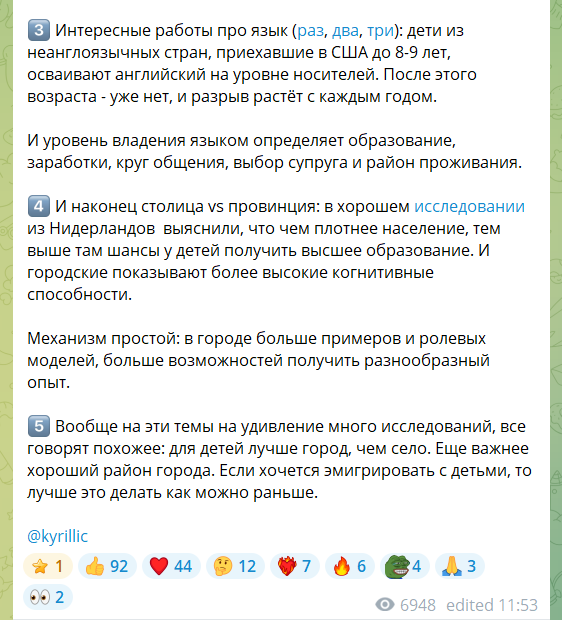
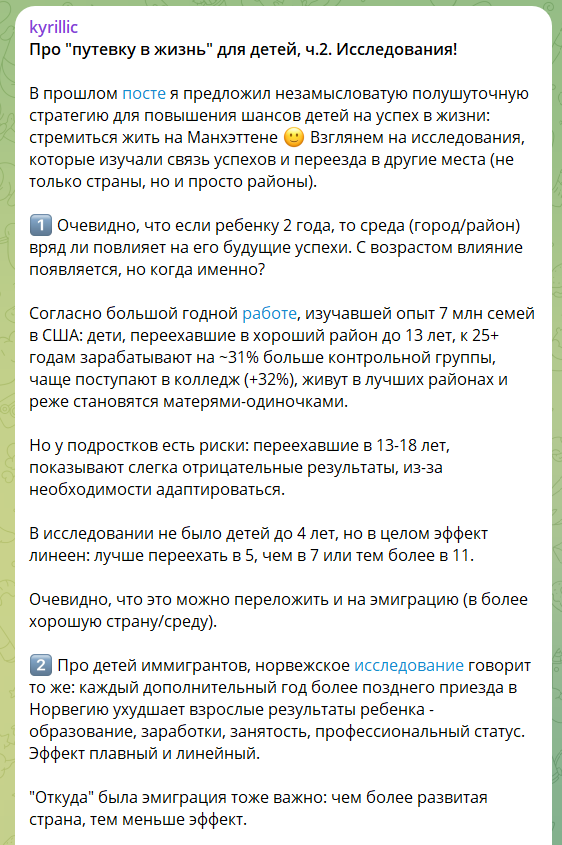
Как место проживания влияет на будущее детей. TLDR: Самое полезное, что вы можете сделать для ребенка — это переехать вместе с ним в какой-нибудь ареал обитания, где все сплошь богатые-успешные (но работает хорошо, только если переезд случился до возраста в условные ~10 лет).
Elon Musk thinks the entire education system is built on a broken assumption.
That every student should learn the same thing. At the same speed. In the same order. At the same time.
Musk: “Everyone goes through from like 5th grade to 6th grade to 7th grade like it’s an assembly line. But people are not objects on an assembly line.”
The model was designed for a factory economy. Standardized inputs. Predictable outputs.
That economy is gone. The assembly line is gone.
But the education system still runs on its logic.
A student who masters algebra in two weeks sits through eight more weeks because the calendar says so. A student who struggles gets dragged forward because the schedule doesn’t wait.
Neither is being served. Both are being processed.
Musk: “Allow people to progress at the fastest pace that they can or are interested in, in each subject.”
AI doesn’t teach a classroom. It teaches a student.
One at a time. Every time.
It skips what a student already knows. It finds where they’re stuck and approaches it from a different angle.
It adjusts in real time. Not at the end of a semester when the damage is already done.
A student obsessed with basketball learns fractions through shooting percentages. A student who builds in Minecraft learns geometry through architecture.
The subject doesn’t change. The entry point does.
No teacher with thirty students can do this. Not because they lack skill.
Because the math doesn’t work.
AI doesn’t have that constraint.
Musk: “You do not need to tell your kid to play video games. They will play video games on autopilot all day. So if you can make it interactive and engaging, then you can make education far more compelling.”
The brain isn’t broken. The format is.
Kids learn complex systems and strategic thinking for hours voluntarily. Then walk into a classroom and can’t focus for twenty minutes.
That’s not a discipline problem. That’s a design problem.
Musk: “A university education is often unnecessary. You probably learn the vast majority of what you’re going to learn there in the first two years. And most of it is from your classmates.”
Four years. Six figures of debt.
And the real value comes from the people sitting next to you. Not the institution charging you.
The degree doesn’t certify knowledge. It certifies endurance.
Musk: “If the goal is to start a company, I would say no point in finishing college.”
The system was built to train employees. If you’re not trying to be one, it has nothing left to offer you.
Every lecture. Every textbook. Every curriculum. Now available instantly. Personalized to any learner. Adapted to any pace.
The question isn’t whether the old model survives.
It’s how long we keep forcing students through it while the replacement already exists.
🚨 Sam Altman literally gave a 43-minute masterclass on turning ideas into billion-dollar companies.
Most people will never watch it.
And instead of hype, he broke down what actually makes startups work.
No fluff. Just reality.
He explained that ideas don’t matter nearly as much as execution. The difference between something small and something massive isn’t the idea it’s how relentlessly it’s built and improved over time.
He also emphasized that the best founders don’t chase everything. They focus on one thing that truly matters and push it forward with extreme clarity. Distraction kills more startups than competition ever will.
And then there’s scale. Truly big companies aren’t built for a niche they solve problems that millions of people care about. If the market isn’t large enough, the outcome won’t be either.
His biggest insight? Startups don’t win because they’re smarter they win because they stay in the game longer and iterate faster.
That’s why this masterclass stands out.
Because while most people are waiting for the perfect idea…
The best ones are already building.
For all you highly moronic moon conspiracy theorists...
The moon landings happened. Here are four bulletproof reasons why the hoax theory collapses under its own weight.
1. We brought back 842 pounds of moon rocks and geologists worldwide have been slicing them open for 55 years
Apollo 11–17 crews hauled back samples that scream "lunar origin" in every isotope, crystal structure, and chemical signature. These rocks have zero water content (Earth rocks almost always have some), solar wind particles embedded from billions of years of unfiltered space exposure, and microscopic glass beads formed by ancient meteorite impacts— stuff impossible to replicate with 1960s tech. Independent labs in the Soviet Union, Europe, Japan, and China analyzed them and confirmed: same age (3.7–4.5 billion years), same exotic minerals like armalcolite, same lack of oxidation. If NASA faked it, they'd have needed a secret lunar rock factory decades ahead of its time. Conspiracy theorists never explain how we pulled that off while simultaneously "faking" the tech to get there. These samples are still studied today in museums and universities— you can touch (protected) pieces yourself.
2. Laser reflectors are still on the Moon, and anyone with the right equipment can ping them right now
Apollo 11, 14, and 15 crews placed corner-cube retroreflectors on the lunar surface. These are passive mirrors (no batteries, no moving parts) that bounce laser beams straight back to Earth. Observatories like McDonald in Texas, Apache Point in New Mexico, and facilities in France, Italy, and Australia have been firing lasers at them daily since 1969 and measuring the round-trip time to millimeter precision. The data proves the distance to the Moon (about 384,400 km) and how it's slowly receding (3.8 cm/year). China’s Chang’e missions and India’s Chandrayaan have imaged the exact landing sites, including the hardware and tracks. If it was faked, the hoaxers would have needed to secretly land mirrors on the Moon— or convince every laser-ranging scientist on Earth to lie for half a century. Spoiler: they didn’t.
3. Modern orbiters from multiple countries have photographed the landing sites in high resolution—footprints and all
NASA’s Lunar Reconnaissance Orbiter (LRO) has snapped razor-sharp images of every Apollo site since 2009. You can see the descent stages, rover tracks, astronaut footprints, and even the exact paths they walked. Japan’s SELENE, India’s Chandrayaan-2, and China’s Chang’e-2 and Chang’e-3 orbiters independently confirmed the same shadows, hardware, and disturbance patterns. These aren’t blurry NASA photos from 1969, they’re crisp, multi-spectral images taken decades later by rival space agencies. The geometry matches perfectly: the flag is still there (Apollo 11’s fell over during liftoff), the rover is parked where they left it, and the blast craters under the landers are exactly as predicted. A studio set on Earth couldn’t survive that level of global scrutiny from space.
4. The conspiracy would have been bigger, dumber, and leakier than the actual mission
Over 400,000 people worked on Apollo. That’s engineers, technicians, contractors, secretaries, and janitors across dozens of companies and universities. Not one deathbed confession, not one leaked memo, not one whistleblower with hard proof in 55+ years? That’s statistically insane. The Soviets were tracking every second of the missions in real time with their own radar and radio telescopes— they hated America’s guts and would have screamed "fake" at the first glitch if they could. Instead, they congratulated the U.S. and kept quiet. Faking it would have required inventing better special effects, vacuum chambers, and propulsion tech than what actually existed while hiding it from the very people who built the real rockets. Occam’s razor doesn’t just cut here; it eviscerates the hoax.
The footage, the rocks, the reflectors, the photos, the tracking data— they all line up perfectly because the landings were real. The moon is still up there, waiting for the next crew. The evidence isn’t "believable", it’s undeniable. If you’re still on the fence, go look at an LRO image of Tranquility Base or bounce a laser off those reflectors yourself.
Remember: conspiracy theory is the sophistication of the ignorant.
INSTEAD OF WATCHING NETFLIX TONIGHT.
Spend 1 hour with this.
Claude AI FULL COURSE that teaches you how to BUILD and AUTOMATE anything.
The people who watch this tonight will wake up tomorrow with a skill that most people will not have in 2 years.
The people who skip it will still be watching Netflix next year wondering why nothing in their life has changed.
Your call.