Applied Compute has signed a definitive agreement to be acquired by Palo Alto Networks for $4.5B!
Rhythm, Linden, and I founded Applied Compute with a belief that was unusual at the time: that every company should own its intelligence. We think training, serving, and improving proprietary models will become a normal part of running a company.
To do useful work, a model needs to access sensitive data and systems, comply with policies, and remain explainable, verifiable, and auditable. This is the reason we've always prioritized security, and why joining Palo Alto Networks will help us go further faster. Customers will still own and control their models, and I'm excited for all the ways our combined capabilities can serve them even better.
Above all, I'm incredibly grateful for the AC team. A few dozen people in just over 18 months grew this company from zero revenue to over $100M in annualized revenue run-rate, working with many of the world's most innovative companies. More to come soon.
Hackers are now using LLMs to continuously scan software updates, spot newly fixed bugs, and build attacks before teams can apply the fix — all without human involvement. That’s according to the latest report from the Google Threat Intelligence Group.
We're helping defenders counter automated threats with Google AI Threat Defense, which combines Gemini and other frontier models to find and fix flaws before attackers can exploit them.
For decades, the idea of AI improving itself was just a thought experiment. Today, AI is already helping researchers at frontier labs run experiments, write code and test ideas faster. So how far are we from AI that can do the research on its own?
In our first episode of Working Theory, a16z General Partner Sarah Wang explores recursive self-improvement with two leading AI researchers: Mark Chen, Chief Research Officer at OpenAI, and John Schulman, co-founder and Chief Scientist of Thinking Machines Lab, and co-founder of OpenAI.
They cover what RSI actually means, why research taste is so hard to teach, and why AI may be one of our best tools for solving alignment.
00:00 The last invention
01:58 What is RSI?
03:21 How far are we?
05:56 Getting to full RSI
10:57 Aligning RSI
15:08 Working theory
YouTube: https://t.co/FSHJdT8Lym
@markchen90@johnschulman2@sarahdingwang
Introducing: Self-Improving Memory 🧠✨📈
We let the model discover its own memory skills, then train them into its weights:
- Meta-optimizes memory from the model's own runs with large gains.
- Distilling these gains works too.
Blog post: 📝 https://t.co/3fNsF13zZ2
🧵1/6
Hello World. Meet OpenVersions, GitHub for research papers.
Science is now moving faster than we can publish it. OpenVersions lets you publish your paper, data, and code in one repository. AI review extracts the claims, checks them against the evidence, and makes them searchable.
Enter a research question and find repositories that have made similar claims, with direct links to the data and code that support them.
Claim your handle at https://t.co/UuNQ07Qqno
[New paper published]
An agent can make the right decision today yet lack the context to repair it tomorrow.
My new paper studies this gap: dependency graphs reduce review work, but missing alternatives can break repair.
https://t.co/P5Ww1IBTKX
We’re building the future of reliable AI in healthcare, starting with the operations that keep hospitals running.
Introducing Scale for Hospital Operations: five agents built to strengthen the care teams behind every patient.
“Always-on” agents aren’t actually always on. They sleep, wake on an event, do a run, save state, and go back to sleep.
Anthropic’s new guide breaks the setup into 5 primitives: event inbox, timers, memory, permissions, outbox.
https://t.co/PlAbItFWSx
Check out our latest work, led by our @ScaleAILabs intern @jaswwei, on “Critic or No Critic?” -understanding when to use PPO vs. GRPO for efficient RL training of agentic tasks.
🚀 As agentic tasks become more complex and trajectories grow longer and more expensive, extracting more learning signal from each rollout becomes increasingly important for efficient RL training.
🔍 The key research question: When do the critic's sample-efficiency gains outweigh its computational cost and potential bias, especially for long-horizon agents?
We investigated this question through 1,200+ training runs across continuous control, mathematical reasoning, and long-horizon tool-using agents. Our study reveal how batch size, critic reliance, and task complexity jointly determine when PPO or GRPO offers better training efficiency.
Great collaboration with @georgepu_@fjxdaisy@ChristyLi0sz0 . Congratulations to @jaswwei and the entire team!
Introducing Claude Meetings: add Claude to your team’s video call and it builds docs, whiteboards, and other artifacts with you while you’re still talking.
Starting to roll out in beta on Team and Enterprise plans.
Introducing Claude Fable 5.2 and Claude Mythos 5.2, designed to tackle the most daunting technical challenges.
They’re capable collaborators on ambitious projects in many fields, and show improvements in areas like coding, reasoning, and vision.
Our latest frontier model Gemini 4 Carbon is rolling out today! Amazing progress from Gemini 3 → Gemini 4 in less than a year… Carbon reverse engineers my original Theme Park binaries, adds a new DeepMind themed ride, and ports it to the web in one shot - kind of mindblowing to see! https://t.co/LceQuUZbTk
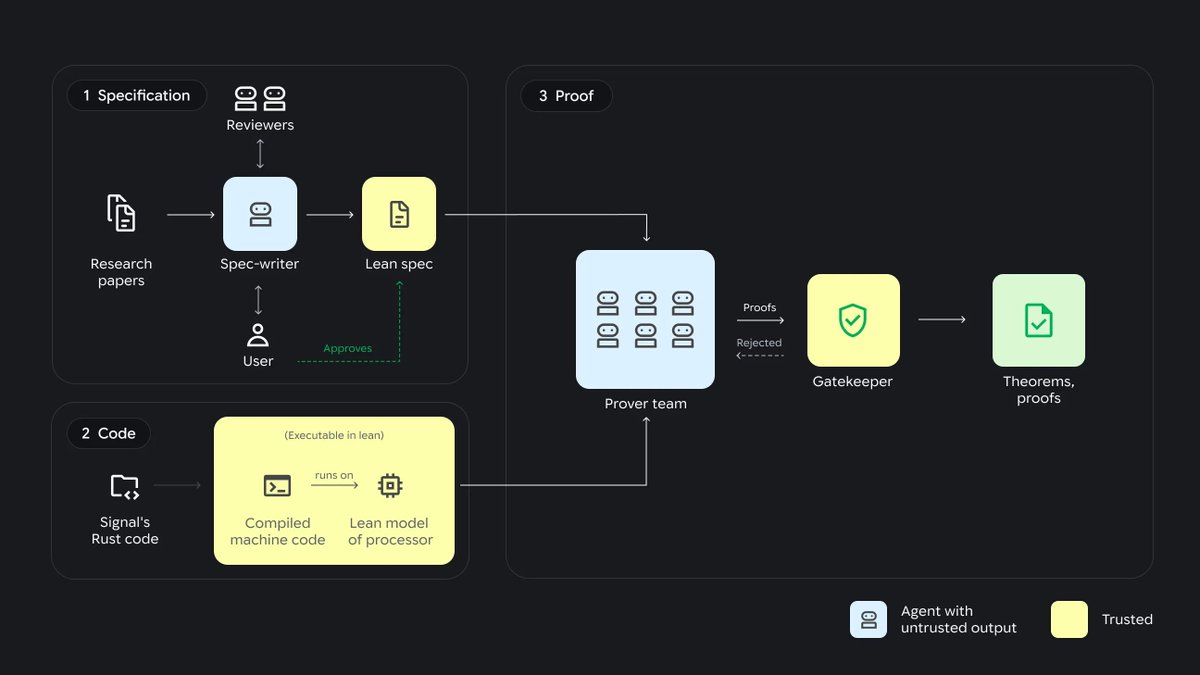
Our teams put Gemini 4 Carbon to work on a major security challenge: mathematically proving the code underlying the Signal protocol.
Using AlphaProof Code, @GoogleDeepMind researchers guided agents to verify the protocol down to compiled device code, closing the gap where real bugs hide. The result:
- Gemini 4 Carbon generated over 6M lines of machine-checked Lean proofs
- years of expert manual verification compressed to just weeks
~1% of the codebase required human review (Lean automatically checked the rest)
This is helping unlock scalable formal verification for building secure software, laying the groundwork to fundamentally shift the advantage to defenders. We’re open sourcing the results for the security community.
🥇 @AnthropicAI's Fable 5.2 takes the top spot on our Remote Labor Index with @CAIS, our leaderboard which compares AI agents' work head-to-head with work by human professionals on real-world remote tasks.
The model successfully automates 41.3% of projects, nearly doubling the performance of the next-best model Opus 5.5, a major leap in AI's ability to handle real-world work.
A closer look at where the biggest jumps are coming from 🧵
Thrilled to announce that our @GoogleDeepMind team has cracked a major challenge in software engineering and cybersecurity: formally verifying a real-world implementation of the #Signal cryptographic protocol at the machine-code level. This proof was done using AlphaProof Code, our new AI framework for formal specification and verification.
* Paper: https://t.co/mq5WyFl4jb
* Lean code: https://t.co/u4UIl154AY
* DeepMind blog post: https://t.co/eBxLMPlIDJ
A huge shoutout to my amazing teammates: @tchajed,
@FerrousAndrew, Jonathan Katz, @pushmeet, @antonkovsharov, Karn Seth, Sam Schlesinger, @RandomlyWalking.
I started working on formal software verification 20+ years ago as a grad student. I was persuaded by Dijkstra and other computer science pioneers’ vision of programming backed up by mathematical theorems. At that time, we had to choose between automated code analysis algorithms that scaled but could only prove shallow properties, and deep manual verification that took decades of expert human work.
Thanks to progress in AI for mathematical reasoning, we don’t have to make that choice any more. Over four weeks in October 2026, AlphaProof Code agents generated more than 6 million lines of machine-checked Lean proof. We proved deep computational and symbolic security properties of the entire protocol core of Signal, all the way down to the ARM machine-code level.
This is just the first step, of course, because our goal is nothing short of verifying the world’s software infrastructure. Most cyberattacks, including the AI-powered ones recently in the news, happen because of preventable code bugs. I expect that agents for formal code analysis will eliminate these bugs one category at a time.
As our paper explains in more detail, this doesn’t at all mean humans are out of the picture! Proofs are now largely automated, but human experts will need to decide what is proved with AI assistance. AlphaProof Code offers an early glimpse of what such human-AI collaboration could look like, but many other proposals of this nature will emerge.
We have released all our Lean specs and proofs and plan to work with the open-source community on improving them. If you are building critical software and would like to apply these ideas, come talk to us!
Memory is what allows Claude to learn from experience. In a new Engineering Blog post, we share how “dreaming” helps Claude organize what it’s learned, correct its mistakes, and find what it needs more easily the next time. https://t.co/uUEN4bNkr9