@MikeFritzell That’s a bit confusing! If the negative thesis is so solid, why the fear of a 'moon-shot'? Are there positive catalysts that didn't make into the analysis? It’s hard to reconcile them with what seems like a low-conviction trade. Anything I’m missing?
@MikeFritzell I’m also keeping an eye on this stock. May I ask whether you’ve added to your short positions recently? Are you considering going all in?
"Chatting" with LLM feels like using an 80s computer terminal. The GUI hasn't been invented, yet but imo some properties of it can start to be predicted.
1 it will be visual (like GUIs of the past) because vision (pictures, charts, animations, not so much reading) is the 10-lane highway into brain. It's the highest input information bandwidth and ~1/3 of brain compute is dedicated to it.
2 it will be generative an input-conditional, i.e. the GUI is generated on-demand, specifically for your prompt, and everything is present and reconfigured with the immediate purpose in mind.
3 a little bit more of an open question - the degree of procedural. On one end of the axis you can imagine one big diffusion model dreaming up the entire output canvas. On the other, a page filled with (procedural) React components or so (think: images, charts, animations, diagrams, ...). I'd guess a mix, with the latter as the primary skeleton.
But I'm placing my bets now that some fluid, magical, ephemeral, interactive 2D canvas (GUI) written from scratch and just for you is the limit as capability goes to \infty. And I think it has already slowly started (e.g. think: code blocks / highlighting, latex blocks, markdown e.g. bold, italic, lists, tables, even emoji, and maybe more ambitiously the Artifacts tab, with Mermaid charts or fuller apps), though it's all kind of very early and primitive.
Shoutout to Iron Man in particular (and to some extent Start Trek / Minority Report) as popular science AI/UI portrayals barking up this tree.
I attended a vibe coding hackathon recently and used the chance to build a web app (with auth, payments, deploy, etc.). I tinker but I am not a web dev by background, so besides the app, I was very interested in what it's like to vibe code a full web app today. As such, I wrote none of the code directly (Cursor+Claude/o3 did) and I don't really know how the app works, in the conventional sense that I'm used to as an engineer.
The app is called MenuGen, and it is live on https://t.co/bQonQT88t0. Basically I'm often confused about what all the things on a restaurant menu are - e.g. Pâté, Tagine, Cavatappi or Sweetbread (hint it's... not sweet). Enter MenuGen: you take a picture of a menu and it generates images for all the menu items and presents them in a nice list. I find it super useful to get a quick visual sense of the menu.
But the more interesting part for me I thought was the exploration of vibe coding around how easy/hard it is to build and deploy a full web app today if you are not a web developer. So I wrote up the full blog post on my experience here, including some takeaways:
https://t.co/2kkQh0ElgB
Copy pasting just the TLDR:
"Vibe coding menugen was exhilarating and fun escapade as a local demo, but a bit of a painful slog as a deployed, real app. Building a modern app is a bit like assembling IKEA future. There are all these services, docs, API keys, configurations, dev/prod deployments, team and security features, rate limits, pricing tiers... Meanwhile the LLMs have slightly outdated knowledge of everything, they make subtle but critical design mistakes when you watch them closely, and sometimes they hallucinate or gaslight you about solutions. But the most interesting part to me was that I didn't even spend all that much work in the code editor itself. I spent most of it in the browser, moving between tabs and settings and configuring and gluing a monster. All of this work and state is not even accessible or manipulatable by an LLM - how are we supposed to be automating society by 2027 like this?"
See the post for full detail, and maybe give MenuGen a go the next time you're at a restaurant!
Whether you like it or not, the future of AI will not be canned genies controlled by a "safety panel". The future of AI is democratization. Every internet rando will run not just o1, but o8, o9 on their toaster laptop. It's the tide of history that we should surf on, not swim against. Might as well start preparing now.
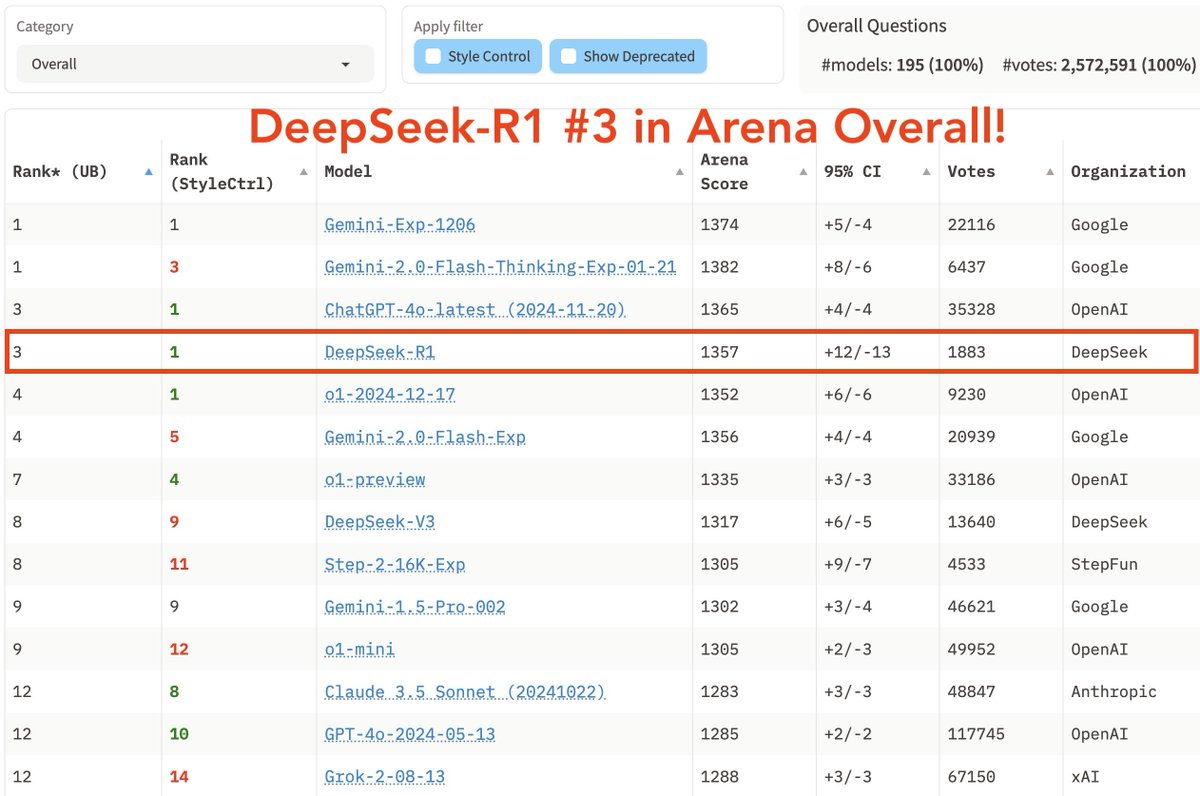
DeepSeek just topped Chatbot Arena, my go-to vibe checker in the wild, and two other independent benchmarks that couldn't be hacked in advance (Artificial-Analysis, HLE).
Last year, there were serious discussions about limiting OSS models by some compute threshold. Turns out it was nothing but our Silicon Valley hubris. It's a humbling wake-up call to us all that open science has no boundary. We need to embrace it, one way or another.
Many tech folks are panicking about how much DeepSeek is able to show with so little compute budget. I see it differently - with a huge smile on my face. Why are we not happy to see *improvements* in the scaling law? DeepSeek is unequivocal proof that one can produce unit intelligence gain at 10x less cost, which means we shall get 10x more powerful AI with the compute we have today and are building tomorrow. Simple math! The AI timeline just got compressed.
Here's my 2025 New Year resolution for the community:
No more AGI/ASI urban myth spreading.
No more fearmongering.
Put our heads down and grind on code.
Open source, as much as you can.
Acceleration is the only way forward.
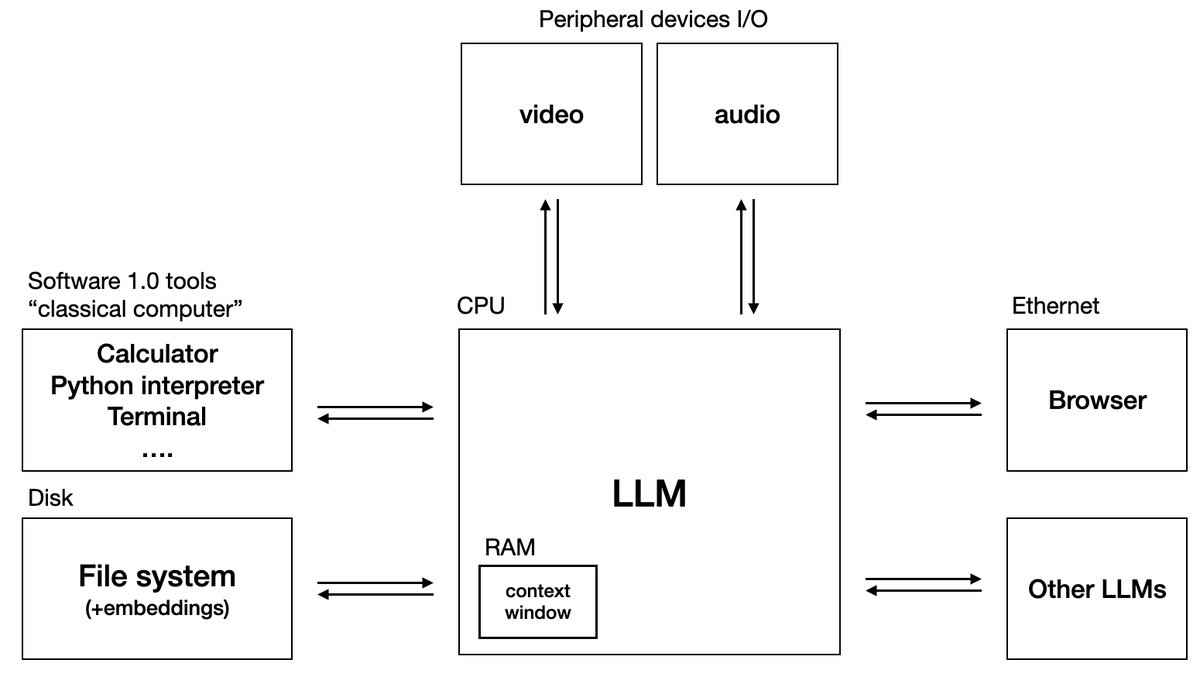
Andrew说的这个概念并不算新, 但是拔到"比 Foundation Model更值得关注"的高度还是少见. 如果参考 Andrej 的 LLMOS, 不难发现, 这个部分实际上就是 OS GUI/Shell, 类似于 MS-DOS或 Win32的位置, 在 LLM (CPU)突破可用性阈值之后, OS Shell 成为推动 AI 应用的主要力量并不奇怪, 类似当年的 Wintel
I think AI agentic workflows will drive massive AI progress this year — perhaps even more than the next generation of foundation models. This is an important trend, and I urge everyone who works in AI to pay attention to it.
Today, we mostly use LLMs in zero-shot mode, prompting a model to generate final output token by token without revising its work. This is akin to asking someone to compose an essay from start to finish, typing straight through with no backspacing allowed, and expecting a high-quality result. Despite the difficulty, LLMs do amazingly well at this task!
With an agentic workflow, however, we can ask the LLM to iterate over a document many times. For example, it might take a sequence of steps such as:
- Plan an outline.
- Decide what, if any, web searches are needed to gather more information.
- Write a first draft.
- Read over the first draft to spot unjustified arguments or extraneous information.
- Revise the draft taking into account any weaknesses spotted.
- And so on.
This iterative process is critical for most human writers to write good text. With AI, such an iterative workflow yields much better results than writing in a single pass.
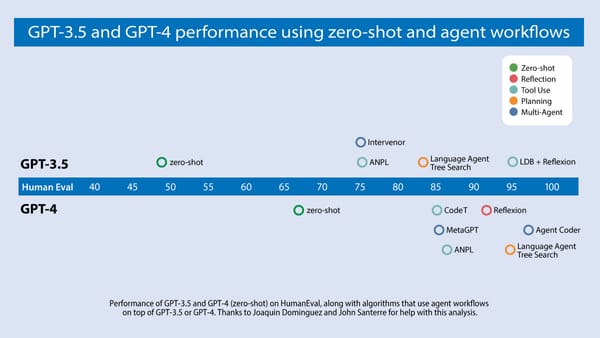
Devin’s splashy demo recently received a lot of social media buzz. My team has been closely following the evolution of AI that writes code. We analyzed results from a number of research teams, focusing on an algorithm’s ability to do well on the widely used HumanEval coding benchmark. You can see our findings in the diagram below.
GPT-3.5 (zero shot) was 48.1% correct. GPT-4 (zero shot) does better at 67.0%. However, the improvement from GPT-3.5 to GPT-4 is dwarfed by incorporating an iterative agent workflow. Indeed, wrapped in an agent loop, GPT-3.5 achieves up to 95.1%.
Open source agent tools and the academic literature on agents are proliferating, making this an exciting time but also a confusing one. To help put this work into perspective, I’d like to share a framework for categorizing design patterns for building agents. My team AI Fund is successfully using these patterns in many applications, and I hope you find them useful.
- Reflection: The LLM examines its own work to come up with ways to improve it.
- Tool use: The LLM is given tools such as web search, code execution, or any other function to help it gather information, take action, or process data.
- Planning: The LLM comes up with, and executes, a multistep plan to achieve a goal (for example, writing an outline for an essay, then doing online research, then writing a draft, and so on).
- Multi-agent collaboration: More than one AI agent work together, splitting up tasks and discussing and debating ideas, to come up with better solutions than a single agent would.
I’ll elaborate on these design patterns and offer suggested readings for each next week.
[Original text: https://t.co/y4McIAjD2m]
a year ago tonight we were probably just sitting around the office putting the finishing touches on chatgpt before the next morning’s launch.
what a year it’s been…
Pushing around these little robot soccer players, from DeepMind’s “Learning Agile Soccer Skills for a Bipedal Robot with Deep Reinforcement Learning” paper.
https://t.co/KzXryyfhCH
https://t.co/VOnhLk0DyY
🔥1/8
Introducing "🤖 Task-driven Autonomous Agent"
An agent that leverages @openai's GPT-4, @pinecone vector search, and @langchain framework to autonomously create and perform tasks based on an objective.
"Paper": https://t.co/MT5WxB0Ebo
[More 🔽]
LlamaAcademy: a factory that teaches LLaMA's how write API code. ChatGPT Plugins, but no manifest file is needed -- it just reads the API docs like a human would!
For example, here is a finetuned model that learned how to talk to Notion by reading its API docs:
For the first time, we will send a helicopter to another planet. Learn about our #Marscopter's mission to study the Red Planet and how it can pave the way for future uses across the solar system https://t.co/BavBkfgs7f