Like it or not, robotics is becoming the next major front in US-China competition, and the two ecosystems are already deeply intertwined.
For years, US robotics companies could make a reasonable tradeoff: build the intelligence in-house, source much of the hardware, and deal with the supply chain later.
That is getting harder. The FCC’s recent decision turned the origin of advanced robotic hardware into a market-access issue in the US.
Localize everything in a humanoid except the joints, and you still only get to ~40% US content. The current threshold is 65%, rising to 75% in 2029.
A few of us at @TheEtnaLabs spent two weeks on the ground across Beijing, Shenzhen, Suzhou, and Shanghai to understand how China’s robotics supply chain actually works—and what it would take for US teams to close the gap.
Here's what we saw. Full report linked at the end.
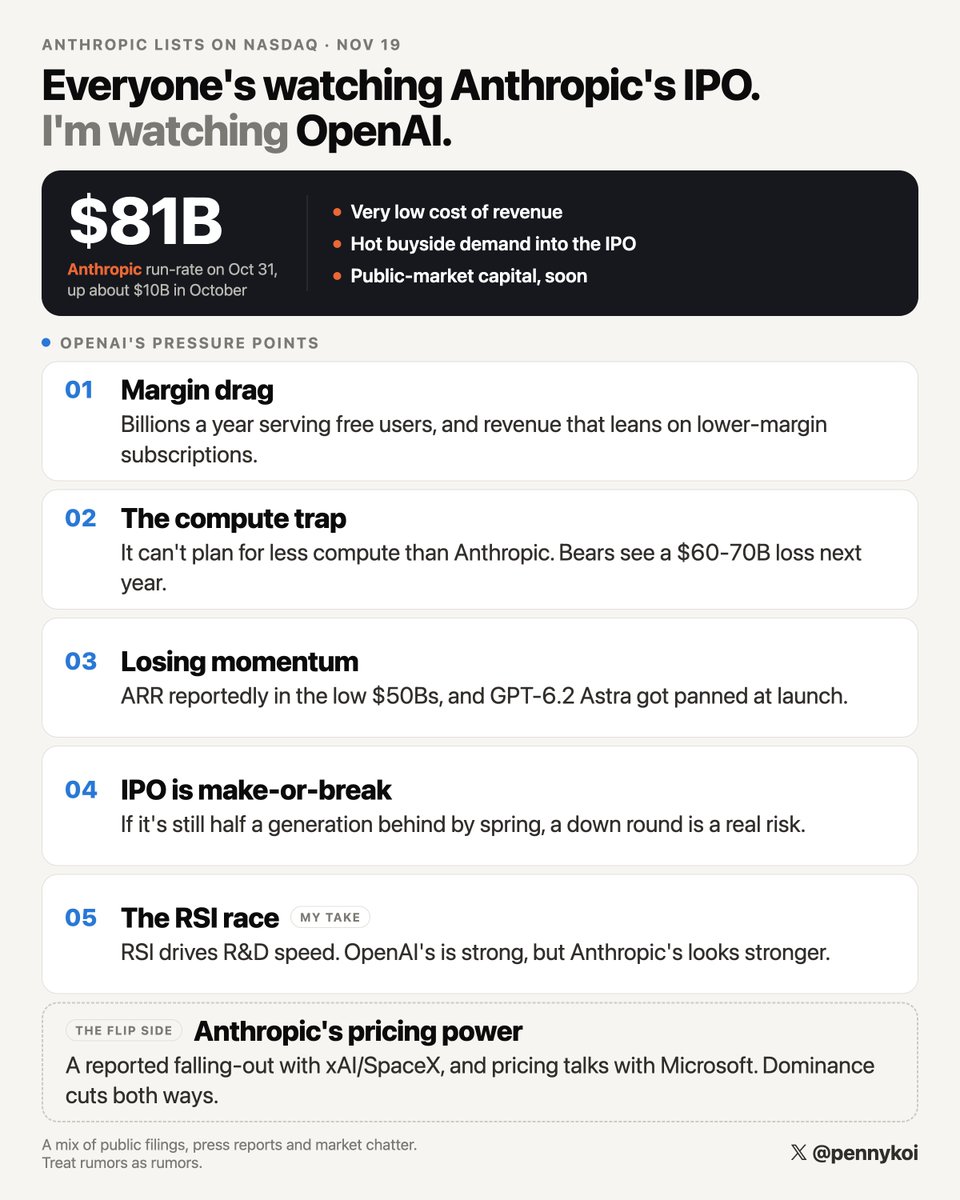
Everyone's watching Anthropic's IPO tomorrow. I'm watching OpenAI.
There's plenty of talk about where the stock will trade. I'm more interested in what Anthropic's numbers mean for OpenAI. Anthropic is growing faster, running much more efficiently, and about to raise money in the public markets.
From talking to people at the labs and tracking the industry, here's why I think OpenAI will be under even more pressure once Anthropic is public.
1. Anthropic's run-rate hit about $81B at the end of October, per its amended S-1, up roughly $10B in October alone. I'm hearing that's ahead of its own guidance. Late November and December should take a real hit from US holidays. So it means Q4 may come in better than feared.
2. Buyside sentiment into the IPO is hot for two reasons. The Jensen problem means less threat from Chinese open source, so less pricing pressure. And OpenAI is struggling to respond with a fable level model.
3. The biggest surprise in the S-1 is how lean Anthropic runs. Inference is a small share of its compute and cost of revenue is very low. The rough industry benchmark is 1GW of compute for about $50B of ARR, and Anthropic's 1GW is just enough. That's a real gross margin edge.
4. OpenAI has three gaps with Anthropic, in infra efficiency, financial efficiency (margins and losses) and, once Anthropic is public, cost of capital.
5. OpenAI has two built-in margin problems. It still spends billions a year serving free users. Its revenue also leans heavily on subscriptions, which earn much lower margins than API. And since Anthropic is strict about bans, a lot of heavy consumer users end up on OpenAI.
6. The Astra 6.2 launch got panned across the internet. People complained about off-putting responses and bad design taste. It felt rushed, with post-training and alignment issues.
7. OpenAI's ARR is reportedly in the low $50Bs, likely short of its year-end target. Across the frontier labs, monthly net adds look to be slowing from roughly $10-15B to $7-8B . Not great for the AI trade.
8. Next year looks rough. As long as it has cash, OpenAI can't plan for less compute than Anthropic, because falling behind on compute means falling out of the race. That means a similar compute bill on smaller, lower-quality revenue, plus a huge free user base to feed. Bears in the secondary market put next year's loss at $70-80B and see the IPO as make-or-break. If OpenAI is still half a generation behind by March or April, with every launch topped by a better one from Anthropic, a down round at IPO is a real risk.
9. Recursive self-improvement (RSI) directly drives how fast a lab's R&D moves. OpenAI's RSI is strong, but my sense is Anthropic's is still ahead. Whoever has the stronger RSI could be the first to reach the singularity.
10. The flip side is that an Anthropic this powerful isn't necessarily good for the AI supply chain as a whole. When one buyer has this much leverage, everyone selling to it feels the squeeze. Its renewal talks with xAI/SpaceX reportedly broke down over pricing, and it may want to renegotiate with Microsoft too.
Curious how others see OpenAI's next six months.
@hwchung27@_jasonwei It’s the first time we’ve seen a researcher with this kind of influence and track record join a data company. Feels like a big moment for the industry.
@2sharkk@SeijinJung my understanding is that Similarweb estimates usage from multiple sources, so the numbers may not be exact. I’ve heard muse’s actual dau is lower, so I wonder if there’s some double counting here.
@kamhossieny Yeah, even going all in on LLMs, we still need to collect and train on real-world robot and UMI data. It's just no one knows the right mix yet (mostly sim with a little real data vs mostly real data).
Everyone is debating what LLMs mean for robotics. After many conversations with friends in robotics and in LLMs, I think computer use is one of the best ways to think about it. Some hot takes:
1. Computer use is the LLM capability closest to robotics. It runs the same loop as a robot: observe, reason, act, then adjust based on what it sees next.
2. Robotics may go from coordinates to intuition, like computer use did. Early computer use had models output "click at (x, y)". It was slow and not very good. Scaling took off once models wrote short code that ran a batch of actions in one go.
3. A robot is the same agent that's already strong in text, stretched in two directions: vision and the physical world.
Vision grounding keeps improving inside LLMs. The real debate is over how physical skill gets learned. The old answer was behavior cloning plus lots of real-world interaction. The new idea is that a coding agent is a robot living in the digital world, and each robot body is just another harness.
4. But the transfer is unproven. There's no data yet on how much computer use helps real robots. The jump from computer use to robotics looks much bigger than the jump from LLMs to computer use. And physical action still has nothing like code.
5. A lot of the robotics ability we're seeing in LLMs comes from coding, especially building 3D scenes in Blender or CAD. Spatial reasoning comes from the procedural code that figures out where objects go and how they fit together, more than from generating shapes or meshes.
6. Nobody agrees on robotics' RL environment. One camp says simulation. You learn in a virtual world, then adapt briefly to reality. The other says the RL environment is robots deployed in the real world.
Where I land: understanding tasks, planning, tool use and error correction become general LLM capabilities, the same way computer use did. Force, friction and contact don't. Those still need dedicated data and training. But the tech is moving really fast. Each side is making a case from first principles. I'm still following the space and the debate pretty closely. If you’re building in this space, would love to hear how you see it.
@NabhaniMehdi That’s good point. I think that’s also why so many researchers keep emphasizing tactile feedback, like friction and pressure. We should be paying more attention to capturing those signals when collecting data.
@KeithZhai Good question! Even with small models like VLAs, robots can already correct their mistakes. LLMs are better at this because they generalize better. They can try something, see what went wrong, and adjust before trying again.
Interesting. I’ve even heard investor friends call some deals “vibe investing”. Honestly that’s pretty accurate. When a deal gets hot, investors tend to do very little diligence, get caught up in the excitement and write a check at a high valuation.
I’ve almost stopped using the term “vibe coding” because there’s a negative connotation to it
It implies that you didn’t put a lot of effort or soul into the output and it’s just AI slop
But oftentimes people ARE putting their heart and soul into the work even when using AI coding tools. The 2 are not contradictory
We need a better word for describing this
My thesis on personal agents: team structure matters as much as model capability.
The company has to really care. Product and post-training need a tight feedback loop: user failures inform training, and model improvements make it into the product.
My read on a few teams:
• Instinct: a researcher-founder building the product.
• Muse: @natfriedman leads the product team. At least four people in post-training work directly with product, with other researchers involved in polishing the details and fixing failure modes users run into.
• Grok bot: already a company-wide priority. Cursor’s CEO put two trusted founding members in charge, and researchers across the company are helping post-train the model.
• Dots: feels more bottom-up. Product and research don’t seem closely connected yet, and the product still seems undecided between work and personal use.
• Duet: strong word of mouth. Anthropic has consistently been good at getting researchers and product teams to work together on the details.
Muse and Grok bot show that big companies can build great products too. What matters is exceptional people, real priority from leadership, and product and research working together like a tight-knit startup team.
Congrats @joshavata and the @MeckaAI team on the Series B. Proud to be backing you.
2026 is the year robotics starts scaling on data. And in the physical world, data, hardware and deployment aren’t separate layers. They’re one loop. We strongly believe Mecka will be essential infrastructure for physical AI.
Today @MeckaAI is announcing a $60M Series B from @sequoia to accelerate the advent of general purpose robotics
This brings our total funding to over $120M to become the data and deployment layer for physical AI
Read more below 🧵
Great to see open source starting to flourish in multimodal AI as it has in LLMs, alongside impressive inference tech.
People still underestimate this space. Short form dramas are already a massive market, and Seedance has crossed $2B in ARR.
5s of video, generated in 1.3s!
Nunchux brings @MiniMax’s MiniMax-H3 to @AMD MI355X with up to 26.7× faster inference than SGLang on 8 GPUs @AMDServer
And with streaming generation, you can change the prompt as the video plays, steering what happens next.
One stack, optimized across hardware.
Free access to MiniMax-H3 is coming soon! Join the waitlist now at https://t.co/PyrPtRRa64.
Our blog: https://t.co/idmFQXFxju
#AI #VideoGeneration #MiniMaxH3