Ten Simple Rules for Reproducible Research in Jupyter Notebook preprint now available: https://t.co/4KZmtvPQkm and example notebooks: https://t.co/eu3Yh689Ar
#jupyter#jupyterproject#mybinderteam#jupytercon
Claude Fable 5: Not So Fabulous (Yet)
Tried Fable 5 for biomedical knowledge graph tasks. Every biology-related request was blocked by safety controls.
Too restrictive for many life-science workflows.
Anyone else seeing this?
#Bioinformatics#BiomedicalAI#AI
Our mcp-genelab AI agent connects AI assistants with the @NASAGeneLab knowledge graph, built from multi-omics spaceflight data, and integrates biomedical context from the SPOKE KG for deeper insights.
https://t.co/cKiM1oGkxo
https://t.co/l6lkBG8VUl #MCP
BREAKING NEWS
The Royal Swedish Academy of Sciences has decided to award the 2024 #NobelPrize in Chemistry with one half to David Baker “for computational protein design” and the other half jointly to Demis Hassabis and John M. Jumper “for protein structure prediction.”
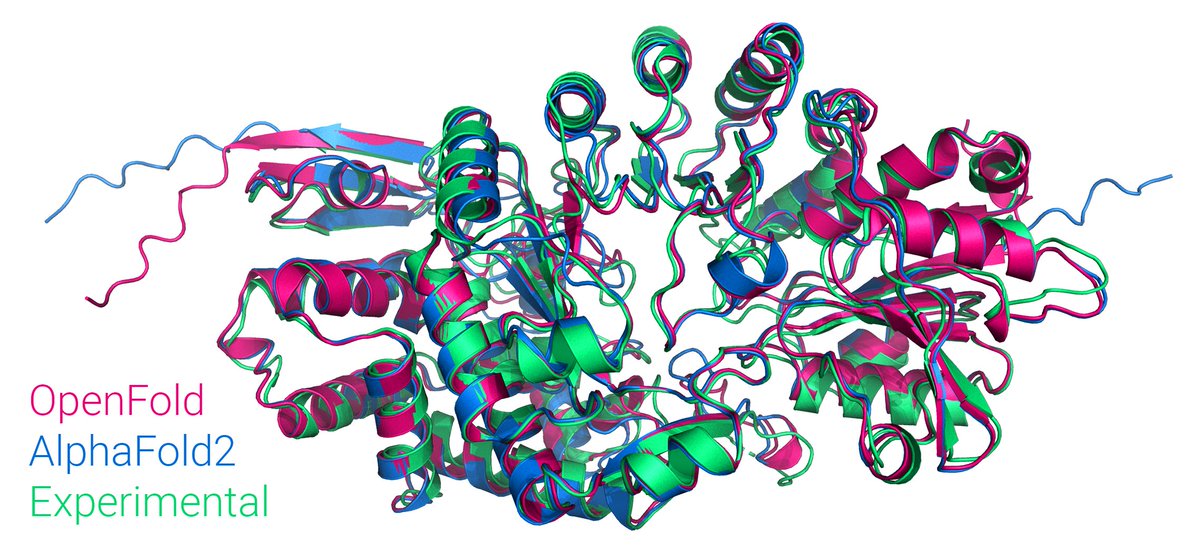
OpenFold paper is now out in @naturemethods. Timely. I’ll say more about AF3 at the end of this thread, but first I wanted to highlight what’s new since our initial release. (1/9)
Today's the day: PDB no longer has 3-character chemical component IDs for incoming depositions. 1st structure with a 5-character CCD has been deposited.
Details at wwPDB: PDB Entries w/Novel Ligands Now Distributed Only in PDBx/mmCIF & PDBML File Formats
https://t.co/J3n5lItu79
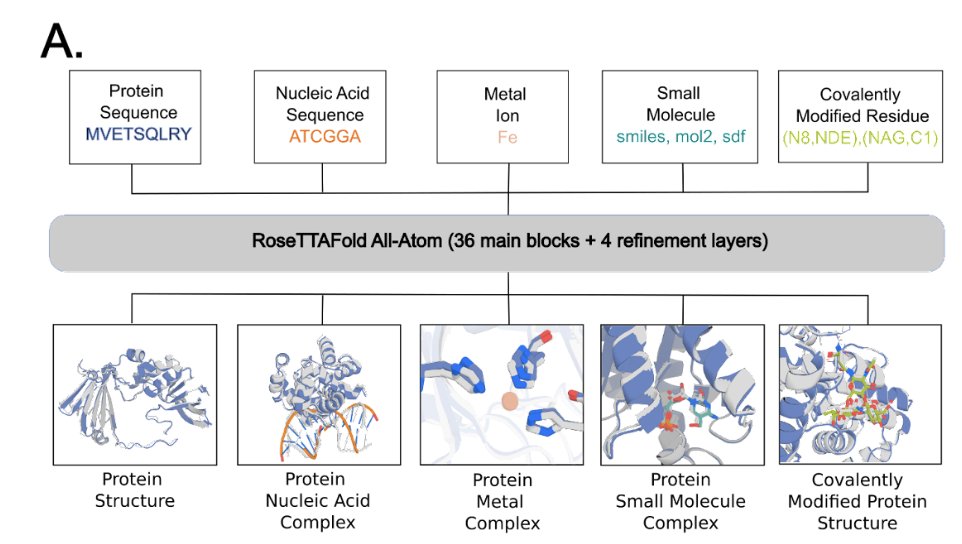
Very excited to share RoseTTAFold All-Atom and RFdiffusion All-Atom, methods for structure prediction and design of biomolecular assemblies! https://t.co/iG6rD0LHsi 1/n
ChatGPT can now see, hear, and speak. Rolling out over next two weeks, Plus users will be able to have voice conversations with ChatGPT (iOS & Android) and to include images in conversations (all platforms).
https://t.co/uNZjgbR5Bm
LLMs can also learn the language of Covid-19. Here, @BioNTech_Group and @instadeepai built a model to predict high-risk Covid-19 variants far before the WHO designated them as variants. The model ingests viral spike protein sequences and predicts their immune escape and fitness.
🪩The @stateofai 2022 is live!🪩
In its 5th year, the #stateofai report condenses what you *need* to know in AI research, industry, safety, and politics. This open-access report is our contribution to the AI ecosystem.
Here's my director's cut 🧵:
https://t.co/QtkXZcQpJj
Today in partnership with @emblebi, we’re releasing predicted structures for nearly all catalogued proteins known to science, which will expand the #AlphaFold database by over 200x - from nearly 1 million to 200+ million structures: https://t.co/GjVES2pBFY 1/
@MelaxTech & SDSC secure a $300,000 Phase I @NIH#SBIR contract focused on the development and enhancement of innovative user-focused informatic tools for basic and clinical research on infectious, immune and allergic diseases.
Read the full story: https://t.co/QvnGyplPkC
#AI
The #AlphaFold database has doubled in size today & now includes more than 800,000 structures. This is just one more step towards releasing 100+ million protein structures over the next year, that will cover almost every sequenced protein known to science!!
Proud of our latest work applying AI to Quantum Chemistry published in @ScienceMagazine! The properties of materials largely depend on their electrons. We introduce a new SOTA functional DM21 (open-sourced) that can accurately model many types of molecules https://t.co/sVLKp5TxMW