@hicasamadim Answer is 4,
3 horizontal lines x 3 vertical lines =9
1 horizontal line x 1 vertical line =1
2 horizontal lines x 2 vertical lines=4
Or
Points where lines meet in:
First diagram =9
Second diagram=1
Third diagram=4
Low budget Voltrons and their defense of “indigenous Lagosians” 😂. If only they knew how absurd their logic sounds.
TL;DR: if the Ekiti and Osun Yorubas are Yoruba enough to share Lagos Yoruba's (or any other Yoruba state's) “guilt,” then they are surely Yoruba enough to share in its voice, opportunities, and leadership. You cannot demand collective blame while enforcing collective exclusion. Deal with it!
The idea that a Yoruba person should “stay out” of Yoruba affairs because they are not from a particular Yoruba state is one of the most ridiculous positions on this street.
Like this clown, these self-appointed defenders of “indigenous” Yoruba rely on a strategy of selective fragmentation that collapses under the weight of its own contradiction.
At the state level, these charlatans perform a deliberate act of ethnic dissection, surgically separating the “indigenous Yoruba group” from the broader Yoruba identity to create a narrow in-group. This allows them to tell a Yoruba person from Ibadan or Ekiti that they are an "outsider" in Lagos, no different from an Igbo or Hausa citizen, and should therefore "face their state." We’ve seen this play out repeatedly: in the politics of Lagos, the debates around Sharia in Oyo, the controversy over GRV’s attendance at the Olubadan coronation, and discussions about Fulani herdsmen aggression in Yoruba communities of Kogi and Kwara.
Yet, in a breathtaking act of intellectual whiplash, when the goal shifts to criticizing federal political appointments, these same voices instantly abandon that distinction and perform a wholesale ethnic amalgamation, collapsing all Yoruba into one bloc to accuse the President of “Yoruba nepotism.” For example, while Tinubu's kitchen cabinet is notably dominated by his long-standing Lagos political allies, these critics do not distinguish them from other Yoruba. Even their Lagos "elite" collaborators do not own it as "Lagos Nepotism". They make no differentiation between Lagos and other Yoruba states, nor do they acknowledge figures like Joash Amupitan (INEC) and Bayo Ojulari (NNPC), Yoruba from Northern Nigeria, who are likewise swept into the same narrative. Everything is conveniently lumped under the label of “Yoruba nepotism.”
Essentially, “Yoruba” becomes a single, culpable entity when it’s time to assign blame for federal patronage or threaten collective punishment, but a fractured, irrelevant identity when it is time to share the spoils or political control of Lagos or any other Yoruba state or community. This transparently contradictory stance is neither innocent nor neutral. It’s the same psychological warfare that fractured the Yoruba during the First Republic, now deliberately being resuscitated. #YorubaRonu
@oMoTonsore@abiodunomisore3 Best moment for me is winning the league with games to spare, not having to worry about the outcomes of the remaining matches.
Lagos Did Not Become Great Because It Was Nigeria's Capital. Rather, Lagos Was Made Nigeria's Capital Because It Was Great
Recently, I have seen a lot of effort put into deemphasising Lagos as part of the Lukumi Yoruba Southwest and instead rebranding it as a No-Man's Land that became what it is because it was once Nigeria's capital.
First of all, we need to understand that Nigeria only exists because three regions, namely the Northern, Western, and Eastern regions, were cobbled together by the British when they amalgamated Northern and Southern Nigeria on January 1, 1914, and made Lagos the capital of the new country. Lagos was already a modern metropolis that could provide all the infrastructure needed by the British to run the new country.
In other words, when the Federal Military Government moved the capital of Nigeria from Lagos to Abuja Federal Capital Territory on Thursday, December 12, 1991, Lagos, as a city, devolved back to the Lagos State Government, which is a member of the Oodua group of states.
When Abacha created the six geopolitical zones in 1997 following Alex Ekwueme's recommendation, Lagos became part of the Southwest.
So Lagos is not a no-man's land.
For those who think they developed Lagos, which is why it became the capital of Nigeria, please note the following:
There is a census of Lagos dating from 1914, and at that time, other than Northerners, Lagos's demographic was dominated almost exclusively by Lukumi Yorubas. And it was already developed.
Lagos became the capital of Nigeria in 1914. Whereas Carter Bridge was built in 1901, and the first electric power generation plant in Nigeria was built in Lagos in 1886. Also, the Iddo rail terminus was built in 1900.
Please fact-check me: The reason Carter Bride was built was because of the heavy vehicular traffic in Lagos, which led to the deaths of pedestrians, even where pedestrian bridges were provided along with bus stops.
Some people say Lagos smells. However, do you see this open defecation leading to arrests in Lagos? Please fact-check me: It is not in the character of Lagos and Lagosians. The behaviour was imported into Lagos by migrants.
How do we know this? Because the first public toilets and night soil disposal unit in Nigeria were built at Ebute-Elefun, Lagos, in 1900 and from there spread to other parts of Lagos.
If Lagos already had the longest bridge in West Africa by 1901, along with a power generating plant, sewer systems, a functioning rail network, a municipal bus service, and a ferry system, it would appear that Lagos's development led to the city's choice to be made the capital of Nigeria, not vice versa.
After all, Calabar was the first capital of Southern Nigeria from 1884 to 1906, yet it is not as developed as Lagos. Also, Lagos stopped being Nigeria's capital thirty-three years ago on December 12, 1991.
However, since that date, Lagos's economy has multiplied by four, and it has grown faster than the economy of the new Federal Capital Territory, Abuja.
This would not have been possible if Lagos's growth had been due to its status as Nigeria's capital. If that were true, Lagos's economy would have atrophied instead of ballooning to a $259 billion GDP.
So, it looks like the capitalisation of Lagos prevented its development rather than the other way around.
Lagos's population increases by 6,000 every day, and most of these migrants come by night bus. Many of these people have no adequate accommodation. They just troop into Lagos, and many of them engage in open defecation and refuse dumping, which they usually do at night.
And after they do this, less informed people will come on social media and say Lagos stinks.
But I have yet to see an Indigenous Lagosian say so. Such comments are usually from non-Lagosians, and I could go on to say they are made by people from outside the Southwest.
This begs the question: If Lagos's stench bothers you, why have you not relocated back to where you originated?
OPEN LETTER TO THE GOVERNORS, MINISTRIES OF EDUCATION, AND ALL THE EDUCATIONAL AGENCIES IN YORUBA LAND!!!!
Esteemed Governors
@jidesanwoolu, @dapoabioduncon, @Aadeleke_01, @seyimakinde, @biodunaoyebanji, @LuckyAiyedatiwa, @RealAARahman
Ministries of Education
@NigEducation, @mte_lagos, @lasgeducation, @Osun_edu, @KWMOEHCD, @KwaraMOTE, @oyostateEST
This is a call to action—a plea to make Yoruba language education compulsory in all schools across the Southwestern State of Nigeria.
As custodians of our rich cultural heritage, we must take bold and decisive action to preserve and promote the Yoruba language within our educational system. The current state of our children's education has become a source of great concern. Our children are growing up disconnected from their roots, feeling ashamed of their identity, and suffering from a profound sense of cultural alienation.
So as not to bore you, our observation will be highlighted under various subtopics for proper understanding and the reason we need to act now.
THE PROBLEM OF NEGLECTING OUR LANGUAGE
Our children are being subjected to a system that prioritizes foreign languages over our native tongue. This system not only undermines their intelligence but also instills a sense of inferiority and self-doubt. When a child excels in the English language but fails in the Yoruba, the message is crystal clear: the Yoruba language is not important.
We, as Custodians of Our Language, Must Act Now By Ending This Mental Brainwashing and Trauma.
Furthermore, this neglect leads to a lack of cultural pride and identity. Our children grow up feeling disconnected from their roots, becoming a shadow of their true selves. They are unable to fully understand or appreciate the richness of their heritage, which is crucial for their personal and collective development. The failure to prioritize our language contributes to a generation that is culturally alienated, unintelligent, and lacking a strong sense of self-confidence.
Again, we, as custodians of our language, must act now by ending this mental brainwashing and trauma.
HIGHLIGHTING THE BEAUTY OF YORUBA
The Yoruba language is not just a means of communication; it is a beautiful and vibrant expression of our cultural values. People are learning in old age to act in Nollywood or speak on the radio, recognizing the value and pride in our native tongue. Our language has been featured in many international films, and our culture has been used to explain life matters in some award-winning movies such as "The Originals." This resurgence in interest highlights the importance of preserving and promoting our language for future generations.
Benefits of Learning through Yoruba
1. Enhanced Cognitive Skills: Learning Yoruba can improve cognitive abilities, including problem-solving and critical thinking.
2. Cultural Connection: It fosters a deeper connection to our culture and traditions.
3. Numerical Proficiency: Within our language's numbering system, children quickly grasp basic arithmetic, including addition, subtraction, multiplication, and division, demonstrating the practical benefits of learning in Yoruba.
4. Mental Well-being: Understanding and speaking Yoruba can reduce feelings of cultural alienation and increase self-esteem and confidence.
A CALL TO ACTION
We must act now to reverse the damage that has been done. We call on the government authorities to:
1. Make Yoruba Language Compulsory: Ensure that Yoruba is taught as a mandatory subject in all schools within Yoruba land, with equal importance as other core subjects.
2. Promote Cultural Pride: Integrate Yoruba cultural studies into the curriculum to foster a sense of pride and belonging among our children.
3. Teacher Training and Resources: Invest in the training of qualified Yoruba language teachers and provide adequate resources and materials for effective teaching.
4. Community Engagement: Encourage community involvement in preserving and promoting the Yoruba language through cultural events, storytelling sessions, and other activities.
THE FUTURE WE ENVISION
Imagine a generation of children who can speak, write, and think in Yoruba with confidence and pride. A generation that is deeply connected to their roots and unafraid to embrace their identity. This is the future we envision for Yoruba land. A future where our language is not just preserved but celebrated and cherished.
Let us stand bold and unashamed. Let us reclaim our heritage and ensure that the Yoruba language remains a vital part of our children's education.
The Time To Act Is NOW
This call to action is never completed if we fail to commend and celebrate those individuals who have tirelessly created content in our language. Just a few out of Many, We praise influencers like @arojinle, @waa_sere, and @lekanfabilola who promote and use Yoruba language, as well as the conservatives in every industry who have encouraged and defended Yoruba conservatism—including the use of the language, its politics, and culture. We honor those like @AKakanfo, @ebirigbonka, @nononsensezone, @AmoduOgunlere, and our isese custodians like @animolenikun, who have fought for us to be here today, still proud to be called the children of the great Ūfe dynasty. Additionally, we extend appreciation to all actors, actresses, and musicians who have used their sectors in We also extend our appreciation to all actors, actresses, and musicians who have used their sectors to promote our language.
@BayoBilisi, @absoluteOMP, @_callmebekky, @Abim65918Akande, @Arakunrin_Dipo, @Arikeventures, @diponet11, @ThinkYoruba_1st, @POLANKLASIQ, @Polymath_16, @pontrol_777, @AdeTop097, @NoNonsensezone, @TIWA_N_TIWA, @AEAdeola, @BokiniKale
Akínkanjú
@Adepeeturn
BREAKING: Bandits kidnapped several villagers in Babban Duhu community, Safana LGA, Katsina State. In retaliation, locals and vigilantes captured the bandits relatives demanding an exchange. Two days later, the abductees were freed, with each receiving ₦30,000 for transport.
Until Nigerians embrace intelligent personalities and project them as the only type of persons worthy of public admiration, our younger ones will continue to suffer intellectually.
@layiwasabi not only tickle your fancy, but also tickles your brain https://t.co/qbhMppJPYB
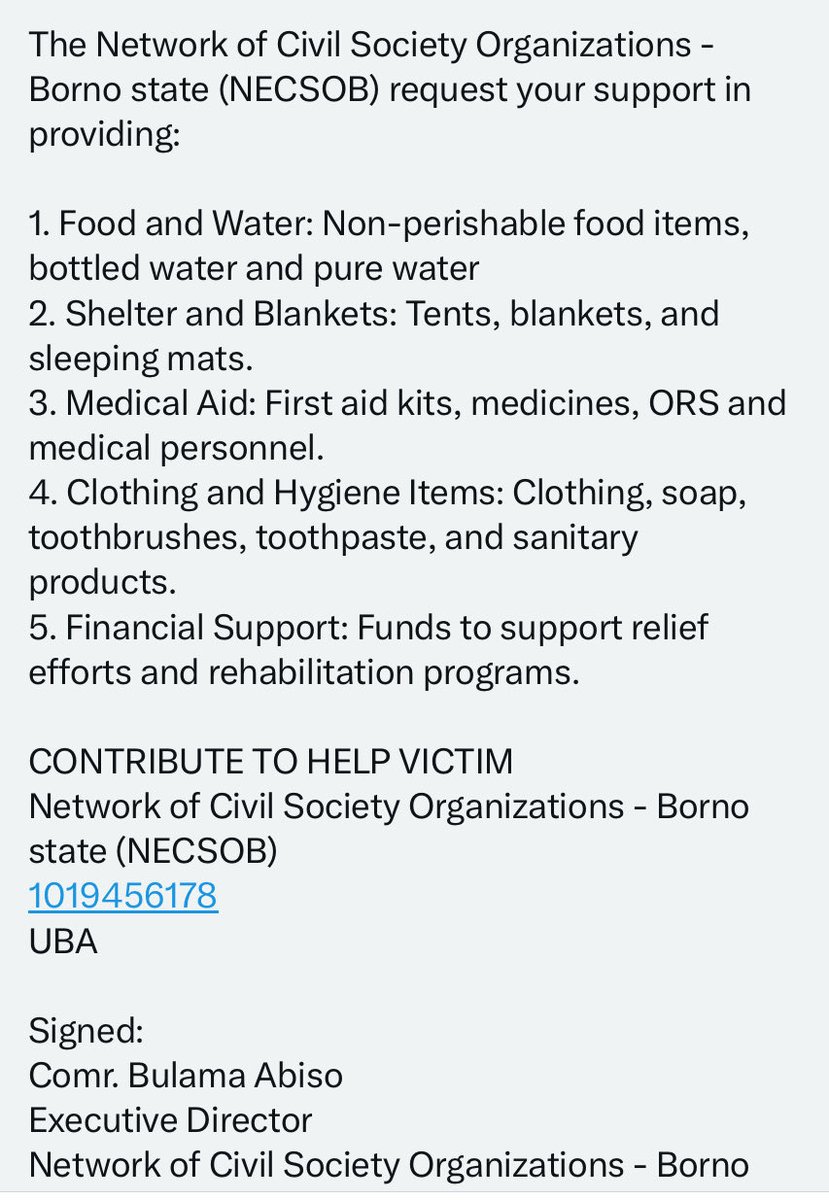
Good morning Patriots. Kindly find the requirements and account details of where to send your noble donation for God and Country . #BornoCaravanOfHope God Bless us all.
Let’s get 1,000,000 Nigerians to donate 1k each towards assisting the 1M people affected by the flood in Borno State. Who’s with me? @YaxsyMand I nominate you as our banker designate. I set the ball rolling with N100k @segalink@DejiAdesogan over to you. Let’s do it!