The demand for AI compute and energy is expected to continue growing, and the Sun is the largest energy source in our solar system. The proposed solution by @Google involves using fleets of satellites equipped with solar arrays.
Why Elon Musk said “Quantum computing is best done in the permanently shadowed craters on the Moon”
At first, it sounds like one of Elon’s wild sci-fi ideas, but there’s deep logic behind it
Quantum computers need extreme cold and perfect stability to work. The Moon’s permanently shadowed craters, like Shackleton, stay at −200°C, with no atmosphere, no noise, no heat, and no weather, the ultimate natural lab for quantum physics
On Earth, we spend millions creating those same conditions artificially.
On the Moon, they already exist
Once again, Elon isn’t just joking, he’s pointing at the future
x402 is working. That's actually the problem
➢ Payments are live. In the last 24H, x402 processed $3M+ transactions onchain
➢ Every second protocol out there is trying to ride the x402 wave by mentioning it
ChatGPT's instant checkout went live in September. The technical problem is solved. That's why the real problems are now visible🧵
➠ Can agents actually shop?
No. An agent can send money but can't evaluate what to buy. API discovery tools exist for devs. OpenAPI standards document endpoints. But no system lets an agent:
‣ Scan available services autonomously
‣ Compare pricing and reliability data in realtime
‣ Make vendor selections without human configuration
➠ What happens when payments fail?
The system breaks down at intent, not execution. Over half of merchants use AI fraud detection. Smart contract dispute clauses exist. But none of this solves the core problem.
When an agent misinterprets what you wanted and buys the wrong thing, who pays is the concern. You authorized the agent, not necessarily the specific transaction it chose. It's not fraud. It's not merchant error. It's intent confusion.
Remember there are no rules that work for agentic transactions. No automated system can decide whether the agent correctly understand what the human wanted.
➠ Is fraud actually concerning?
Yes, measurably. Fraud detection doesn't work for agents. An agent making 1,000 transactions/hour isn't suspicious, it's normal. Geographic signals mean nothing when agents have no location. Consumers can say "I didn't authorize that, my agent did." Liability is unclear across the entire chain.
We also don't know who's liable when agents mess up. Frameworks are being written. None are law. Nobody wants to be the test case, which slows commercial adoption.
@eigencloud will play a big role in the verification part here. But it will need some external help in tackling frauds.
‣ x402 → payments
‣ AP2 → agent protocol
‣ EigenCloud → verification
➠ Where does money actually get made?
Not on payment rails. Those will be free or close to it. The money is in solving problems the protocol creates. New protocols can target these sectors:
➢ Fraud prevention at agent scale
➢ Dispute resolution that works in seconds/minutes
➢ Treasury management for thousands of micropayments daily
We will need reputation scores + regular audits. No machine speed reputation system exists where agents evaluate vendor trustworthiness at transaction speed is there as of now.
The other revenue source is accumulated intelligence. An agent managing your finances for two years knows spending patterns competitors can't quickly replicate. This is where ZK, privacy projects will be crucial moving forward.
➠ Conclusion
Note that realtime failure detection is becoming a regulatory expectation. Agents without failure detection guardrails will likely face pushback.
Systems get built fast, fixed slowly. Payment infra has arrived. Fraud reasons are immense. Disputes are confusing. Legal frameworks are incomplete. And adoption continues anyway because economic incentives are too strong to wait.
So next time you see a protocol saying that they've integrated x402, these are the questions you'll have to ask them instead of blindly hyping th protocol. X402 proved agents can pay. Now we're finding out what happens when they do.
Congrats to @Starcloud_Inc1 on the launch of their first satellite, just 21 months from starting the company.
This is the first NVIDIA H100 in space and paves the way for huge, solar-powered orbital data centers.
7/ These technology flywheels (techplexity, @DrPippaM ) are all interconnected...
The foundational Technologies form the base upon which to build the Future of Space:
Rockets. To bring Satellites et al. into Space, and eventually establish a Moon base.
Connectivity. Satellites forming the critical Communications layer.
Manufacturing. To build Space-based manufacturing, powered by AI + Robots.
Exploration. To eventually use the Moon as a base to expand to Mars and beyond.
Each Layer builds upon the prior... and AI is the glue.
@ARKInvest@wintonARK
Mars isn’t easy.
Orbit gaps could leave explorers out of contact. Power’s always a challenge. And reliable communication is in demand.
Rocket Lab’s Mars Telecommunications Orbiter will change that. Our MTO will bring reliable relay coverage, high-bandwidth communication, and a design built to keep Mars connected. 🌎➡️🔴 https://t.co/gY44HrvfID
.@CrusoeAI CEO @ChaseLochmiller on why they are building data centers in space:
“In outer space… we have access to solar that's powered 24/7 at a very, very low cost”.
Watch the full episode: https://t.co/wI6COESucH
Crusoe is headed to SPACE! 🛰️ Partnering with @Starcloud_Inc1 to be the first public cloud to run AI workloads in orbit.
This is our "energy-first" model extended: harnessing the sun's abundant power for AI, eliminating terrestrial limits. ☀️
Get the details: https://t.co/Xfxtfzd0a2
#AIInfrastructure #SpaceTech #cloudcomputing
Replacing the Mars Relay Network isn’t just about science, it’s about leadership.
NASA’s current relay network is aging. To enable astronauts, rovers, and researchers to stay connected, we need a resilient, high-bandwidth system built for the future.
Rocket Lab’s Mars Telecommunications Orbiter delivers exactly that: a modern, commercial backbone to support every mission on Mars—NASA, academia, and commercial explorers alike.
The U.S. leads when it builds the infrastructure that others depend on. With MTO, Rocket Lab is ready to deliver it – learn how https://t.co/gY44HrvfID
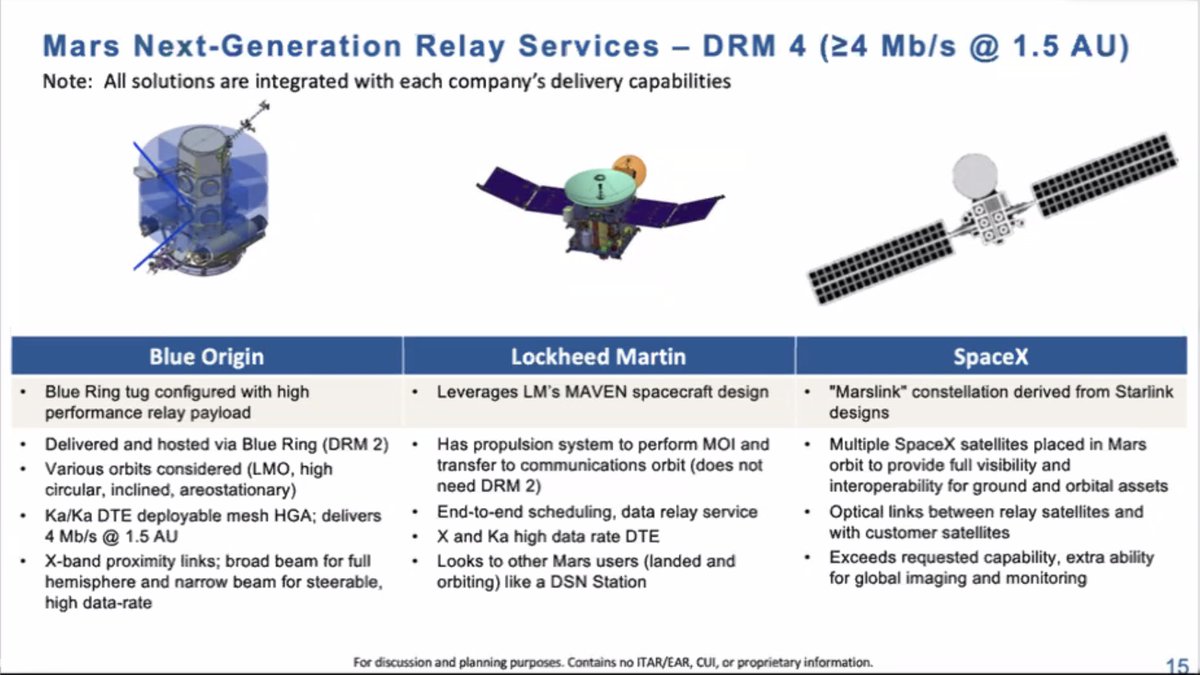
🚨 BREAKING: SpaceX's ‘Marslink’—High-Speed Internet from Mars to Earth!
In a move that feels straight out of sci-fi, SpaceX has proposed “Marslink,” an adaptation of its Starlink satellite network, to deliver internet connectivity on Mars.
Presented to NASA, Marslink aims to establish a high-speed data relay system—capable of transmitting 4 Mbps or more—across 1.5 astronomical units, the distance between Earth and Mars.
The concept envisions multiple satellites in Mars orbit, leveraging Starlink’s advanced laser communication tech to maintain a constant, near-instantaneous data flow between planets.
This network could serve Mars missions, allowing real-time images and data streams from Mars to Earth, as well as supporting future ground operations and Mars orbit assets.
Source: PCMag
Blue Origin’s Mars Telecommunications Orbiter can carry over 1,000 kg of payload mass to Mars orbit, depending on specific mission requirements.
Learn more: https://t.co/J6lBLefOEd
Talk first. Land later.
Rocket Lab’s Mars Telecommunications Orbiter will deliver persistent, high-bandwidth comms between Mars and Earth—keeping future astronauts safe, connected & mission-ready.
This is just a glimpse of what’s coming. 🔗 https://t.co/ocqb1vPaeC
Imagine astronauts calling home from Mars or scientists sharing discoveries in real time. 🌎➡️🔴
That future begins by implementing a modern Mars Telecommunications Orbiter, the communications infrastructure Rocket Lab is ready to build. 🔗https://t.co/ocqb1vPaeC