A little about me and what I'm working on.
I'm 27, a CFA charterholder, and Director of Investments at Promada, our family office based in Quebec, Canada.
I spend most of my time allocating capital across public and private markets, evaluating businesses, and managing real estate investments.
Lately, I've become increasingly interested in how AI could fundamentally change the way investment firms are built and operated.
I'm working on building an AI-native operating system for our family office. Not just to automate research or reporting, but to explore how a small team can manage a growing portfolio and operate at a level that traditionally required a much larger organization.
But that's only part of what I want to build.
Longer term, I want Promada to go beyond allocating capital. I want us to invest in great businesses, partner with exceptional people, and eventually help build companies working at the frontier of technology.
I've always been fascinated by capital allocation, technology, and entrepreneurship. And I think we're entering an incredible period to be involved in all three.
I'm fairly new to posting on X, but I'm hoping to connect with more investors, founders, engineers, and people building interesting things.
That's a bit of what I'm working toward. Looking forward to seeing where it goes.
@KobeissiLetter I wonder how much of this enthusiasm is spilling into private markets, helping support the extraordinary valuations we’re seeing for companies like SpaceX and Anthropic.
@packyM One of the most important distinctions in investing: creating enormous value for society and capturing that value as an investor are two very different things.
A lesson worth remembering as we watch hundreds of billions flow into AI infrastructure.
Warren Buffett 2007 Investor Letter banger:
"The worst sort of business is one that grows rapidly, requires significant capital to engender the growth, and then earns little or no money.
Think airlines. Here a durable competitive advantage has proven elusive ever since the days of the Wright Brothers.
Indeed, if a farsighted capitalist had been present at Kitty Hawk, he would have done his successors a huge favor by shooting Orville down."
What’s striking is the growing concentration of hyperscaler exposure across asset classes.
Equities, investment-grade credit, private credit, infrastructure. Different instruments, but increasingly tied to the same handful of companies and their capex decisions.
Diversification may be more limited than it appears.
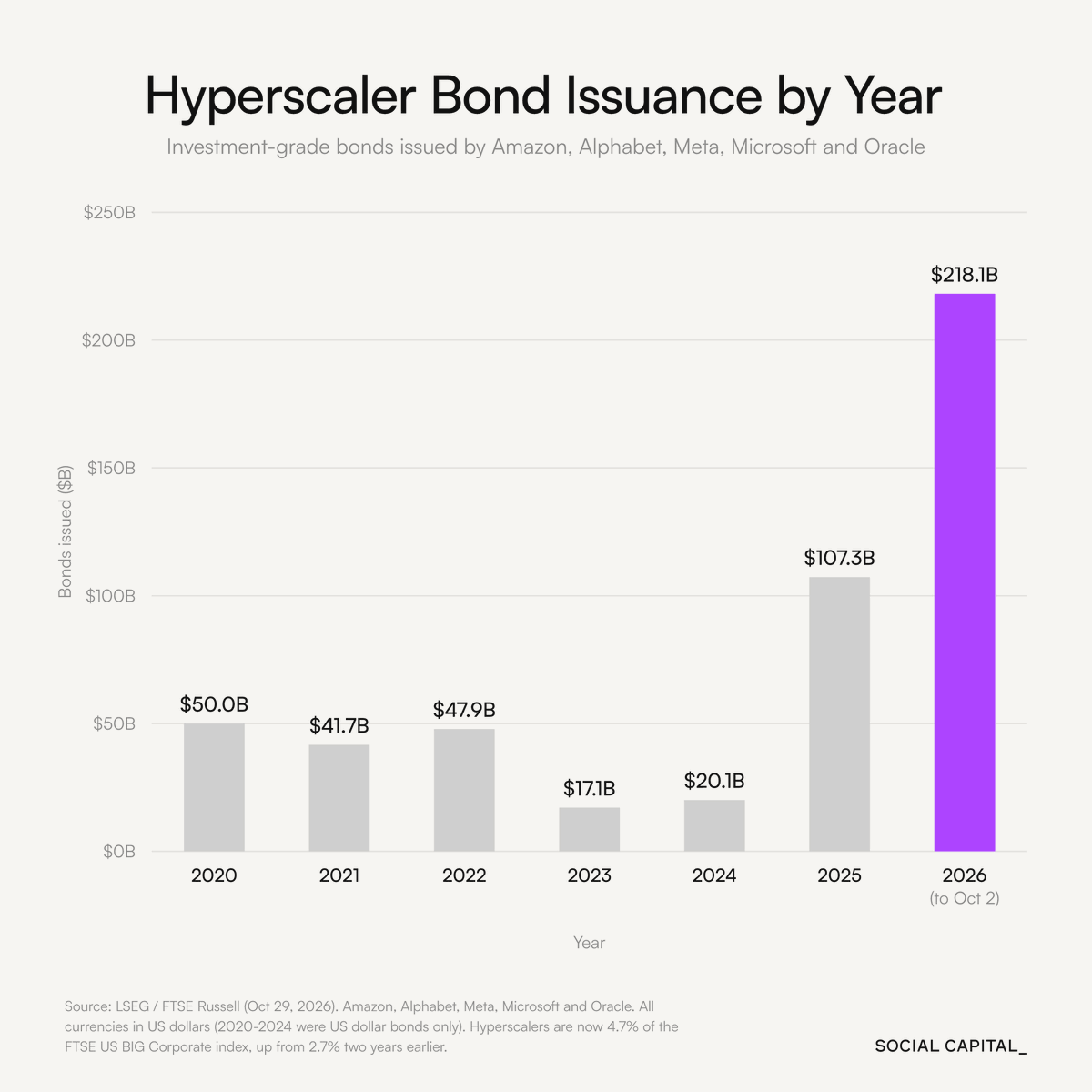
The 5 largest hyperscalers have issued ~$218B of investment-grade bonds this year, ~2x all of 2025.
From 2020-2024, they averaged ~$35B a year.
These 5 companies now make up ~5% of the US investment-grade corporate bond market, up from under 3% two years ago.
What’s interesting is how much AI exposure is quietly moving into credit portfolios.
We’re financing an increasingly capital-intensive buildout with long-term debt, while some of the underlying technology has a relatively short economic life.
The quality of the borrower matters, but so do the economics of the assets being financed.
What if some of the best investments a family office could make are companies that don’t exist yet?
I’ve been thinking about this as we explore what Promada could become over the next decade.
Family offices have an interesting advantage that I think is often overlooked. Through their investments and operating businesses, they get firsthand exposure to problems across different industries.
I see this in industrial real estate. Managing properties exposes you to all kinds of inefficiencies, expensive services and problems that existing software doesn’t really solve.
Normally, you either live with those problems or find someone who can solve them.
But what if you built the solution yourself?
Historically, creating a company around one of these opportunities required significant capital, a dedicated team and considerable time before you could even validate the idea.
AI could change that equation.
A small team can now research markets, build prototypes, automate workflows and test ideas at a fraction of the cost.
Combine that with permanent capital, industry knowledge, existing customer relationships and access to experienced operators, and I think family offices could be in a pretty interesting position.
Not just to invest in companies, but to create them.
Of course, identifying a problem doesn’t mean you can build a successful business around it. You still need exceptional founders, distribution and execution.
But I’m starting to think that some of the most interesting opportunities for family offices might emerge from the businesses and assets they already own.
And with AI lowering the cost of experimentation, the opportunity cost of testing those ideas is changing.
Maybe the next generation of family offices won’t just be better capital allocators.
Maybe they’ll become company builders too.
I don’t think the quality of the capital allocators tells us much about whether the valuation is attractive.
An auction establishes what the marginal buyer is willing to pay, not what the investment will ultimately return.
Anthropic could become one of the most important companies in the world and still be a disappointing investment at the wrong entry price.
What fascinates me about serial founders is how transferable their abilities seem to be across industries.
At some point, the real skill might not be expertise in a particular market, but knowing how to identify opportunities, attract exceptional people and build organizations capable of executing on them.
Interesting data, but there's a pretty significant selection effect here. PE-backed, public and venture-backed software companies are at very different stages of maturity.
And from an investor's perspective, I'd be just as interested in how those growth rates compare to the valuations being paid.
Faster growth doesn't necessarily mean better returns.
What I find most interesting is the willingness to dismantle structures that helped make Sequoia successful in the first place.
As organizations grow, the processes built to coordinate people can eventually become the very things slowing them down.
Makes me wonder how many firms would look completely different if they were designed from scratch today.
@chamath It very well could be, but only for a brief moment in time. Slow moving Monolithic incumbents would either adapt or make way for the new champion.
What concerns me most isn't necessarily the size of the deficit in any single year, but the trajectory.
Persistent deficits can make sense when capital is invested productively. But at some point, we need to measure whether that spending is actually generating an economic return.
I'd like to see much more focus on that in the upcoming budget.
The revenue growth is extraordinary, but those compute commitments are what really catch my attention.
AI demand is clearly there. The question is how revenue, margins and compute efficiency evolve relative to the enormous capacity being committed today.
That's going to be one of the most interesting things to underwrite in the coming years.
@AndreasSteno This is where having patient capital becomes a real advantage.
When leveraged investors are forced to reduce exposure, prices can move independently of fundamentals.
The difficult part is figuring out what's genuinely mispriced versus what the market is correctly reassessing.