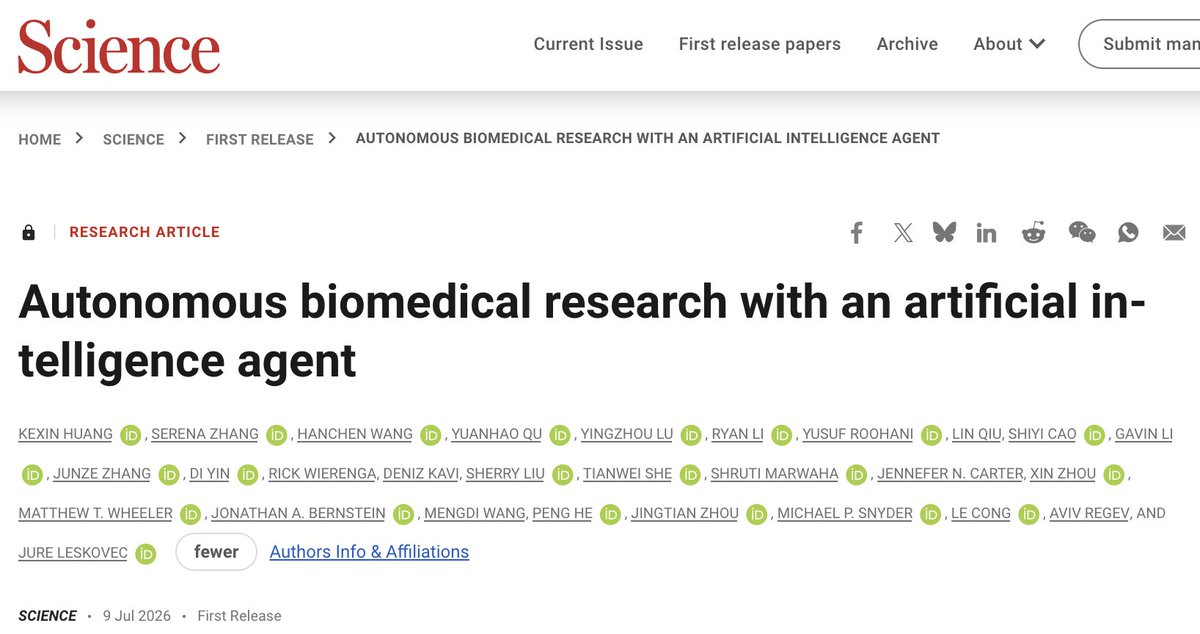
Today, we're excited to share that Biomni is published in @ScienceMagazine.
Biomedical research is still fragmented, manual, and difficult to scale. In this work, we introduce Biomni - the first general-purpose biomedical AI agent with an integrated biology environment that can reason, plan, and execute end-to-end scientific workflows.
We show that, with the right environment and harness, AI can automate large-scale omics analyses, orchestrate laboratory robotics, optimize molecular properties, and even train new AI models for biology.
We also introduce a reinforcement learning recipe for continually improving biomedical AI agents, enabling open-source models to achieve frontier-level performance.
It's surreal to look back. We started the Biomni project in early 2024, when agentic AI was still nascent. It is exciting to see tens of thousands of biologists collaborating with agents every day to accelerate science.
Try Biomni: https://t.co/Pzm8TVlkNA
Read more: https://t.co/pRstxzPKDi
This work is not possible without this truly inter-disciplinary team: @serena2z@hcwww_@YuanhaoQ Minta Lu, Ryan Li, @yusufroohani Lin Qiu @shiyi_c98 Gavin Junze Di @rickwierenga@kavi_deniz Sherry @TianweiShe Shruti Jennefer Xin Zhou @MWheelerMD Jon Bernstein @MengdiWang10@PengHeAtlas@zhou_jingtian@SnyderShot@lecong Aviv Regev @jure@StanfordAILab@genentech@phylo_bio@arcinstitute@UW@berkeley_ai@RetroBio_@tamarindbio@Princeton@UCSF
The aging of our immune system is measurable and modifiable. And a youthful immune system is highly correlated with extended healthspan
https://t.co/azMsfd0qfG
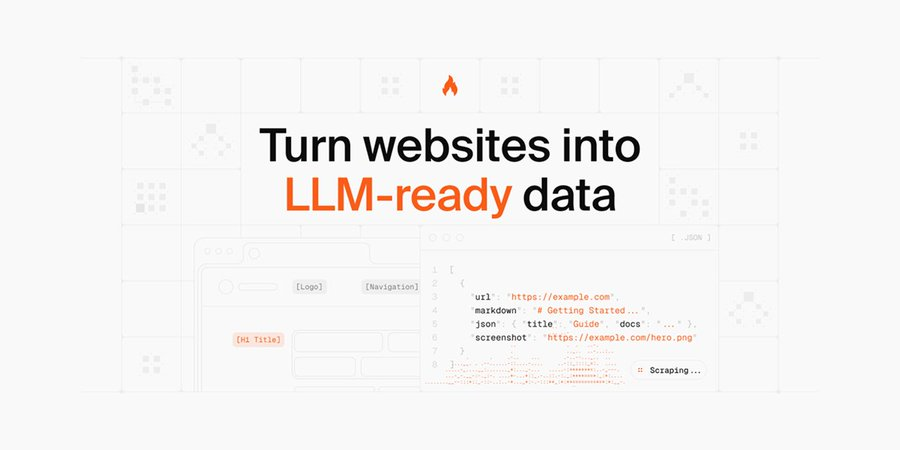
Te comparto 8 de los mejores repos de github para extraer datos de cualquier sitio web automáticamente:
1. Firecrawl
Pasa una URL y recorre automáticamente todo el sitio, convirtiéndolo en datos limpios y listos para IA. Soporta páginas con JavaScript. Más de 140.000 estrellas.
https://t.co/QzjMTH0M98
2. Crawl4AI
Convierte cualquier web en texto que los LLM pueden leer directamente. Sin API key ni pagos. Lo creó un desarrollador que se hartó de los servicios que cobraban 16 $. Más de 70.000 estrellas.
https://t.co/fzDAMr29W4
3. browser-use
Agente de IA que usa el navegador como un humano: clics, login, formularios, todo. Creado por un startup de ETH Zurich. Más de 100.000 estrellas.
https://t.co/MIvcLE7c8E
4. Crawlee
Base completa para scraping con rotación de proxies, reintentos, anti-detección y manejo de colas. Evita bloqueos de forma profesional.
https://t.co/dQLG9NJdjE
5. Scrapy
El clásico framework de Python para scraping a gran escala. Lleva más de 10 años usándose y procesa millones de páginas de forma estable. Totalmente gratis.
https://t.co/aJYE4Uo1Mk
6. Scrapling
Se adapta automáticamente a los cambios de diseño de las webs y evita detecciones de bloqueo. Funcionalidades de nivel pago… pero gratis.
https://t.co/XyqvZR4vXX
7. AutoScraper
Solo le das un ejemplo de los datos que quieres y aprende solo el patrón. Extrae el resto sin escribir selectores. Muy sencillo y potente.
https://t.co/c6D5FS1ZcX
8. curl-impersonate
Imita las peticiones HTTP de un navegador Chrome real para saltarte las protecciones anti-bot más avanzadas.
https://t.co/dcqagz1uK4
Guárdalos todos, super recomendado.
Con estos puedes sacar datos limpios de casi cualquier web sin pagar servicios caros ni depender de apis limitadas.
You're in an ML Engineer interview at Anthropic.
The interviewer asks:
"Our model generates 100 tokens in 42 seconds. How do you make it 5x faster?"
You: "I'll optimize the model architecture and use a better GPU."
Interview over.
Here's what you missed:
The real bottleneck isn't compute. It's redundant computation.
Without KV caching, your model recalculates the same attention keys and values for every single token generation.
That's why a 9-second inference becomes 42 seconds. You're wasting 80% of your time on repeated calculations.
The fundamental issue:
(refer image below as you read ahead)
LLM token generation is autoregressive:
- Generate token 1 from the prompt
- Generate token 2 from prompt + token 1
- Generate token 3 from prompt + token 1 + token 2
At each step, you're reprocessing ALL previous tokens through attention.
Token 50? You've computed attention for token 1 fifty times.
The reality of attention mechanism:
For each token, the transformer computes:
- Query (Q) from current token
- Key (K) from all previous tokens
- Value (V) from all previous tokens
Then: Attention(Q, K, V) = softmax(QK^T)V
Problem: K and V for previous tokens never change. You're recalculating identical matrices every single step.
How KV caching solves this:
Instead of recomputing K and V matrices:
- Cache them after first computation
- Reuse cached values for subsequent tokens
- Only compute K and V for the new token
Without KV caching (token 50):
- Compute Q, K, V for all 50 tokens → O(n²)
With KV caching (token 50):
- Load cached K, V for tokens 1-49
- Compute Q, K, V only for token 50 → O(n)
You've eliminated quadratic redundancy.
So what's the tradeoff:
While KV caching makes the inference faster, it also takes up a lot of memory, so there is always a tradeoff between speed and memory.
Why your first token always takes longer:
KV caching speeds up inference by computing the prompt's KV cache before generating tokens.
This is exactly why ChatGPT takes longer to generate the first token than the rest.
First token: Computing KV cache for entire prompt
Remaining tokens: Just loading cached KVs + computing new token
----
Everything above is how KV caching works inside a single request.
Running it in production is a different problem. Caches break on document reordering, and a single GPU throws away roughly 15 TB of reusable cache per day.
I wrote an article that picks up exactly where this post ends: how a new open-source architecture manages KV cache at production scale, with 14x faster time-to-first-token to show for it.
The article is quoted below.
Experience AI Scientist, a novel multi-agent system designed to automate the end-to-end scientific research pipeline. Meet Jinsung Yoon and Rui Meng today at 6:00pm at the Google booth (#B206) to learn how complex workflows reliably accelerate AI discovery. #ICML2026
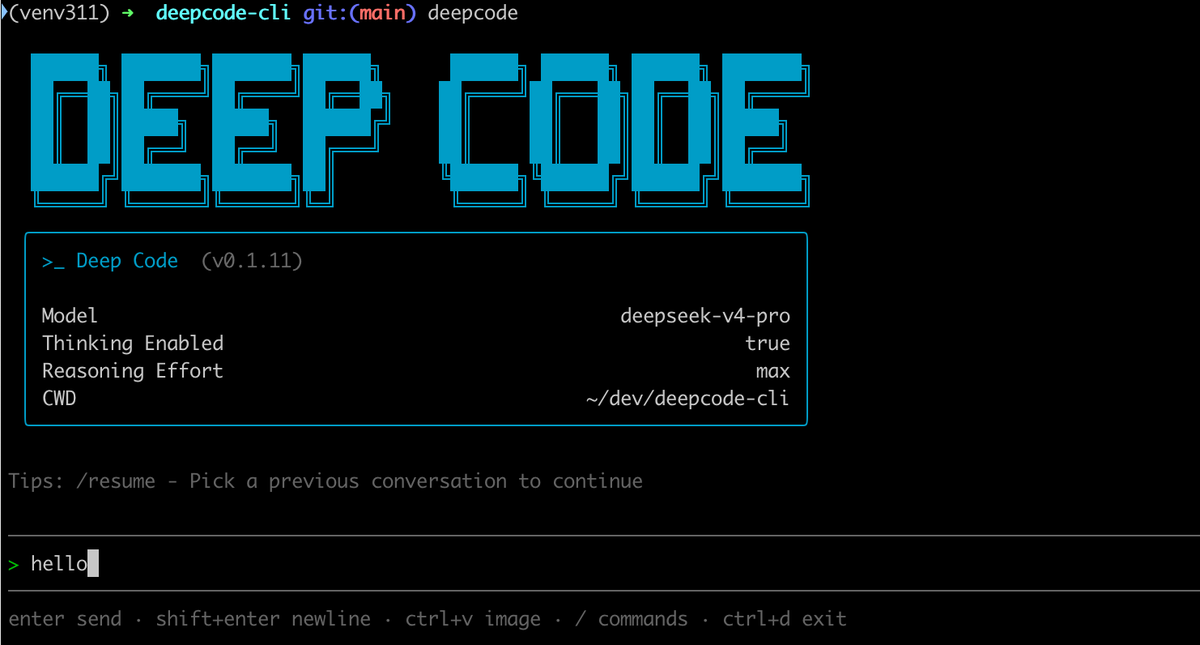
deepseek now has a claude code-style terminal agent...
deep code is an open-source coding assistant built for deepseek-v4.
it supports:
• deepseek-v4-pro and flash
• thinking mode
• reasoning effort control
• agent skills
• mcp integrations
• vscode extension
deepseek moving into the coding-agent layer.
Using AI to improve cancer immunotherapy outcomes, via training from transcriptomes of 10,000 tumor samples, 33 cancer types @NatureMedicine
https://t.co/Q6UfVQ6wMV
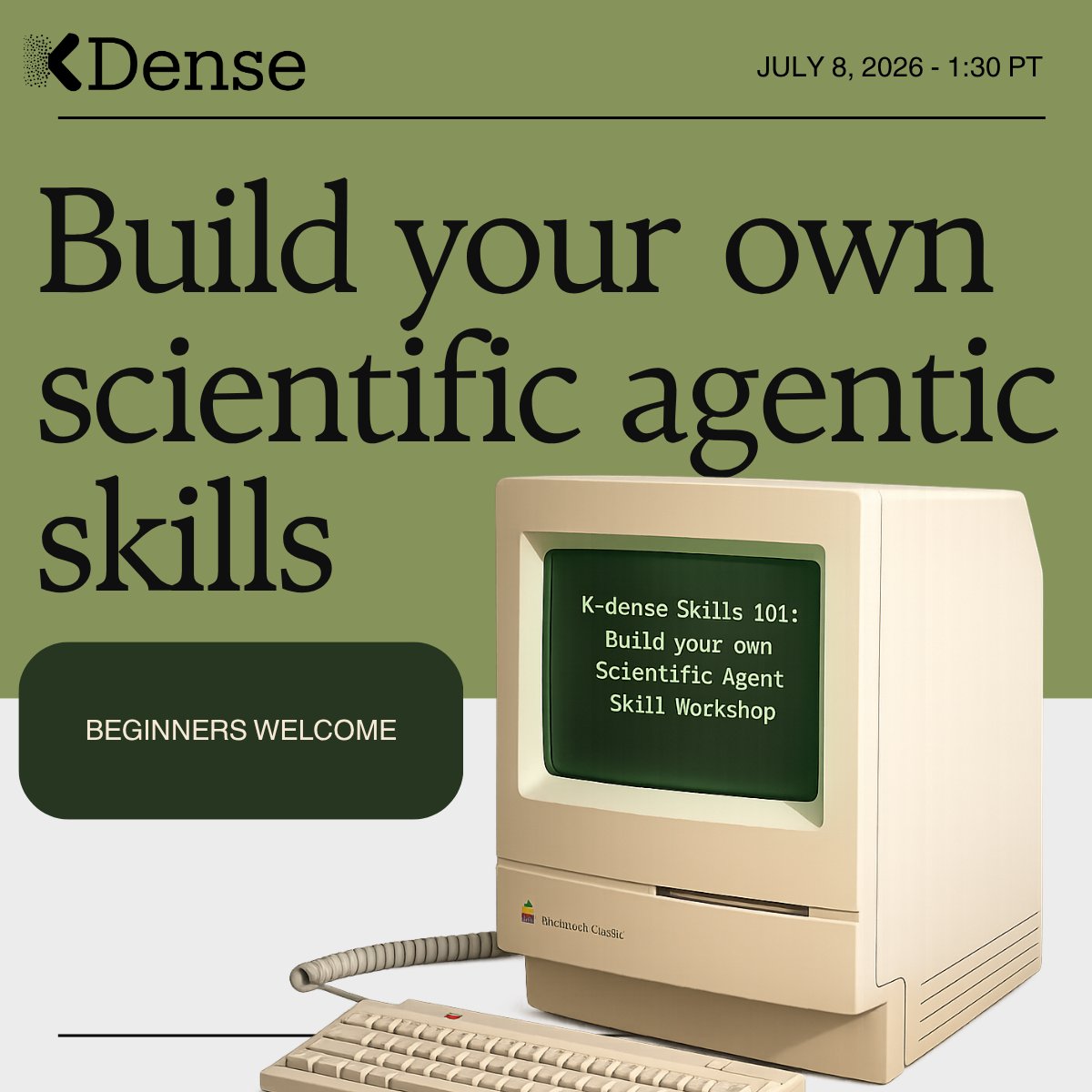
After the Claude Science launch, a lot of people are asking what comes next for agentic scientific workflows. At @k_dense_ai we’re already building there, and we’ll teach you too!
Join us for a free, beginner-friendly workshop on building skills.
Hosted by our AI Engineer @yhhonx , this informal webinar will walk through how to:
☆ Install a ready-made skill from our open-source BYOK skills kit on GitHub
☆ Build a live skill from scratch: a meeting-notes formatter that turns messy notes into a clean, structured summary
☆ Run a real before/after test to see how the skill changes model outputs
To build along, you’ll need:
→ Claude Code
→ Claude Pro or Max
→ An IDE with an integrated terminal, like VS Code or Cursor
→ Node.js 18+
We’ll share the workshop pack in advance, including sample inputs, templates, and prepared before/after reports, so you’re ready to go on day one.
Register here: https://t.co/OXQQZoRO2m
Karpathy just wrote the manual for Claude + Obsidian as a real second brain.
Most vaults die the same way. A year of saved articles and highlights. None of it linked. The graph rots while it still looks impressive.
So he moved the upkeep to the model. You curate sources and ask questions. Claude files, links, and reconciles. You keep judgment. It keeps the books.
raw belongs to you and never gets edited. wiki belongs to Claude. It isn't RAG. Your sources compile once into linked pages and compound from there.
9 rules. Start with 10 sources, not 10,000.
Most people hoard notes. This turns them into a brain that maintains itself.
Introducing OpenPaper: Claude Code for research papers.
I typed one question. Five minutes later, it handed me a complete 8,330-word research paper with 30 citations.
Every citation is a real published paper with a working DOI, verified against 500M+ academic sources. Zero hallucinated references.
18 specialized agents do the research in parallel. Open source.
https://t.co/bqfWZDY9Z5