Elon Musk reveals the ego-to-ability ratio that predicts whether someone will fail
"You do whatever it takes to succeed, and just always be smashing your ego. Internalize responsibility. A major failure mode is when your ego-to-ability ratio is greater than one"
"If your ego-to-ability ratio gets too high, you break the feedback loop to reality. In AI terms, you break your RL loop. You want a strong RL loop, which means internalizing responsibility and minimizing ego"
"That's why I prefer the term engineering as opposed to research, and I don't want to call xAI a lab, I just want it to be a company. Whatever the simplest, lowest-ego terms are, those are generally a good way to go. You want to close the loop on reality hard"
Friedberg: New study shows enzyme reverses skin age from 70+ years to 31
Chamath: That’s a $2T market.
Did Scientists Just Discover How to Reverse Skin Aging!?
“CML is kind of the predominant molecule that gets formed in this extracellular matrix that's driving aging, and nothing breaks it down.
So these scientists set out to try and create an enzyme, an enzyme is a protein that breaks something down, that can break down CML.
And so these guys kind of went out and they took the target, which is CML, and tried to figure out, ‘Okay, how do we actually degrade CML, clear that extracellular matrix, and reverse aging?’
They started to test it on the proteins that we would find in our body, casein, collagen, retinal proteins, which are in your eye, hemoglobin, and they were able to get rid of 52 to 97% of the CML, just degrade it away.
And then they found several sites where they were able to degrade over 90%.
And then they took actual human skin from elderly patients that had donated their skin, and they put this enzyme onto that skin, and they were able to eliminate 55% of the CML on the skin, basically reverse the skin's age down to the age of a 31-year-old, this is from greater than 70-year-old patients, just by putting this enzyme on the skin.
And so it's kind of a groundbreaking demonstration of combination of AlphaFold, what's called directed evolution, where you change the order of the DNA that changes the structure of the protein to test different proteins, do high throughput screening, and ultimately make a novel protein that doesn't exist in nature today that can do something pretty profound for human health.”
Chamath:
“It will be a trillion-dollar market. If you can create a cream…”
Friedberg:
“I mean, dude, if you could put this enzyme literally on your skin and have it absorb in…”
Chamath:
“Game over. That alone is $2 trillion.”
this is f*cking gold
How to build your first AI agent (Full guide)
if I had this a year ago, I would've shipped my first app in a day instead of 2 weeks
in the right hands, this changes everything:
I genuinely don't understand why everyone isn't using this yet
Andrej Karpathy, a co-founder of OpenAI, posted a simple idea that hit 16 million views: stop using AI to write code, use it to build a second brain.
You point Claude Code at a folder, drop in any source, an article, a transcript, a PDF, and Claude reads it, links it, and files it into a living wiki of everything you know. It compounds like interest, the more you feed it, the smarter it gets.
Here's the whole thing:
> Install Obsidian, create a vault, open it in Claude Code
> Paste Karpathy's wiki idea file and tell Claude to build it
> Claude makes three folders: raw for sources, wiki for its pages, a CLAUDE.md that runs it
> Drop any source into raw and say "ingest this"
> Ask questions across everything, forever
Five minutes to set up, and you never start from a blank chat again.
Full step-by-step guide with Claude and Obsidian, link below.
Bookmark this
What will the future actually look like?
@friedberg and I sat down to discuss.
0:00 Why we fear the future
0:39 The fertilizer crisis solved
2:01 Life is getting better
4:04 East vs. West mindset
6:20 AI centralizes power differently
7:08 Technology always diffuses outward
9:30 CAR-T therapy case study
11:31 Token costs falling 1000x
12:25 The moon explained
13:50 Everyone owning a robot
16:11 Which jobs AI hits first
17:47 Who buys the robots?
19:20 TikTok proves latent entrepreneurship
21:30 Moon as staging ground
23:54 The 9km rail gun
25:46 Self-replicating robots on Mars
27:06 Fusion energy explained
29:04 How the sun works
32:13 AI cracking plasma stability
37:20 Who owns the moon?
44:33 How far is age reversal?
48:38 Yamanaka factors discovered
54:11 Longevity escape velocity
56:15 Careers in a 120-year life
1:00:07 Transhumanism and brain interfaces
1:05:05 Embryo selection and CRISPR
1:10:53 Making X-Men: transgenic humans
1:26:30 David's seed company explained
1:36:25 California's collapse
1:40:47 Unfunded pension crisis
1:41:08 The billionaire tax threat
1:42:59 Origin of the income tax
1:46:17 Wealth tax kills property rights
1:52:29 Why people vote socialist
1:54:43 Government vs. free market prices
2:02:38 The food stamp explosion
2:05:23 AOC as 2028 frontrunner
2:07:02 Tomorrowland's optimism shift
Includes paid partnerships.
Elon Musk avait dit un truc qui m'avait marqué sur l'allocation de ressources. En substance : passé un certain niveau de richesse, l'argent n'est plus de la consommation, c'est de l'allocation de capital.
Cette phrase change tout.
L'économie, dans le fond, c'est juste un problème d'allocation. Tu as des ressources finies et des usages infinis. Qui décide où va quoi ?
Imagine une cour de récré. 100 enfants, des paquets de cartes Pokémon distribués au hasard. Tu laisses faire. Très vite, un ordre émerge. Les bons joueurs accumulent les cartes rares, les collectionneurs trient, les négociateurs trouvent des deals. Personne n'a planifié. Et pourtant chaque carte finit dans les mains de celui qui en tire le plus de valeur. Le système maximise le bonheur total de la cour. C'est ça, la main invisible.
Maintenant fais entrer la maîtresse. Elle trouve ça injuste. Léo a 50 cartes, Tom en a 3. Elle confisque, redistribue, impose l'égalité. Trois effets immédiats. Les bons joueurs arrêtent de jouer, à quoi bon. Les mauvais n'ont plus de raison de progresser, ils auront leur part. Les échanges s'effondrent. La cour est égale, et morte. Elle a maximisé l'égalité, elle a détruit le bonheur.
Le problème de la maîtresse, c'est qu'elle ne peut pas avoir l'information que la cour avait collectivement. C'est le problème du calcul économique de Mises, formulé en 1920. L'URSS a essayé de le résoudre pendant 70 ans avec le Gosplan. Résultat : pénuries, queues, effondrement. Pas parce que les Soviétiques étaient bêtes, parce que le problème est mathématiquement insoluble en mode centralisé.
Quand Musk a 200 milliards, il ne les consomme pas, il les alloue. SpaceX, Starlink, Neuralink, xAI. Chaque dollar est un pari sur le futur. Et lui a un track record. PayPal, Tesla, SpaceX. Il a démontré qu'il sait identifier des problèmes immenses et y allouer des ressources avec un rendement spectaculaire.
L'État aussi a un track record. Hôpitaux qui s'effondrent, éducation qui décline, dette qui explose, services publics qui se dégradent malgré des budgets en hausse constante. Le marché identifie les bons allocateurs, la politique identifie les bons communicants.
Le profit n'est pas une finalité, c'est un signal. Il dit : tu as alloué des ressources rares vers un usage que les gens valorisent suffisamment pour payer. Plus le profit est gros, plus la création de valeur est grande. Quand Starlink est rentable, ça veut dire que des millions de gens dans des zones rurales ont enfin internet. Quand un ministère est en déficit, ça veut dire qu'il consomme plus qu'il ne produit. L'un crée, l'autre détruit, et on appelle ça redistribution.
Dans nos sociétés il y a deux catégories d'acteurs. Les entrepreneurs et les bureaucrates. L'entrepreneur prend un risque personnel pour identifier un problème, mobiliser des ressources, créer une solution. S'il se trompe il perd. S'il a raison, ses clients gagnent, ses employés gagnent, ses fournisseurs gagnent, l'État collecte des impôts. Il est la cellule de base du progrès humain.
Le bureaucrate ne prend aucun risque personnel. Son salaire est garanti. Au mieux il maintient une rente existante. Au pire il la détruit par excès de réglementation, mauvaise allocation forcée, incitations perverses qui découragent ceux qui produisent. Mais dans aucun cas il ne crée.
Regarde les 50 dernières années. iPhone, internet civil, SpaceX, Tesla, Google, Amazon, Stripe, mRNA, ChatGPT. Toutes des inventions privées, portées par des entrepreneurs, financées par du capital risque. Pas un seul ministère n'a inventé quoi que ce soit qui ait changé ta vie au quotidien.
La France est devenue le laboratoire mondial de la dérive bureaucratique. 57% du PIB en dépenses publiques, record absolu. Une administration tentaculaire, une fiscalité qui pénalise la création de richesse. Résultat : décrochage face aux États-Unis, à l'Allemagne, à la Suisse. Fuite des cerveaux. Désindustrialisation. Dette qui explose.
Et le pire c'est que la mauvaise allocation s'auto-renforce. Plus l'État prélève, moins les entrepreneurs créent. Moins ils créent, moins il y a de base fiscale. Plus l'État s'endette et taxe. Boucle de rétroaction négative parfaite. La maîtresse pense qu'elle aide, et chaque année la cour produit moins.
Dans nos sociétés, ce sont les entrepreneurs, toujours, qui font avancer la civilisation. Les bureaucrates au mieux maintiennent une rente, au pire la détruisent. Aucune société n'a jamais progressé en taxant ses créateurs pour subventionner ses gestionnaires.
La question n'est jamais qui a combien. C'est qui alloue le mieux la prochaine unité de ressource pour maximiser le futur de l'humanité. La réponse depuis 200 ans n'a jamais changé. Ce ne sont pas les fonctionnaires.
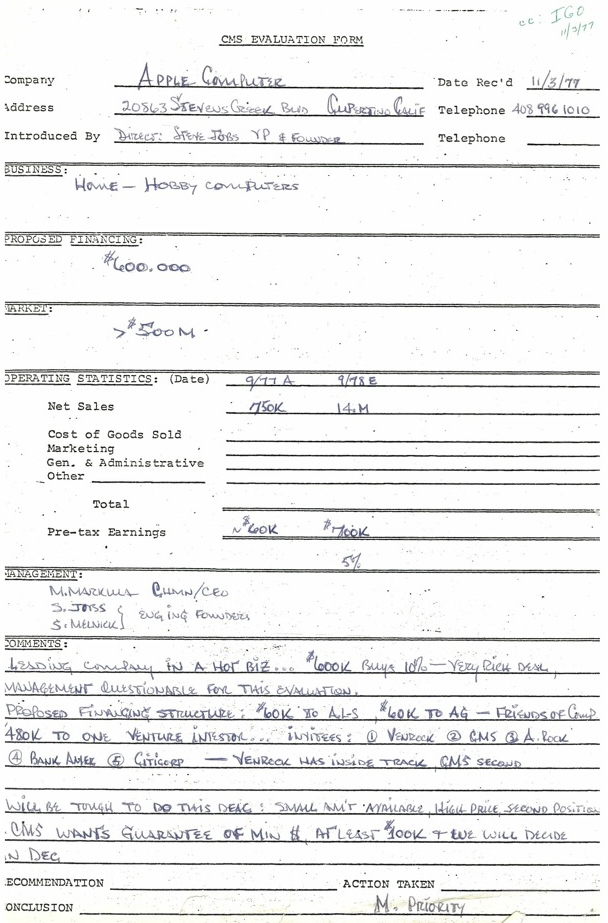
In honor of 50 years of Apple, we're sharing - for the first time ever - Don Valentine's original 1977 memo for Sequoia's investment into Apple Computer. #Apple50
"We look for people that are students of history, that have studied the markets and all prior attempts."
David Haber on what great founders do before building a company:
"If you're going to spend the next 10 years of your life building a company, why wouldn't you spend time studying every prior attempt?"
"It always gives me much more discomfort when somebody is saying, 'All those people are idiots. We're the smarter team.'"
"I think having respect for prior attempts, and in some cases even having spoken to the former entrepreneurs in that category."
"And then having a very clear articulation of what you're going to do differently or why now is different."
@dhaber on The High Flyers Podcast with @vidags10
New episode: "How Elon Works"
This episode covers the insanely valuable company-building principles of Elon Musk
A few notes from the episode:
1. The mission comes first.
2. Retreat is not an option.
3. A maniacal sense of urgency is our operating principle.
4. Product design should be driven by engineers.
5. You should not separate engineering from product design.
6. Having separate design and production departments is bullshit. Keep everything together and feedback immediate.
7. The leader should be on the front lines. You should be a battlefield general.
8. "If they see the general out on the battlefield, the troops are going to be motivated. Wherever Napoleon was, that's where his armies would do best."
9. Apply The Algorithm constantly. (1) Question every requirement. (2) Delete any part of the process you can. (3) Simplify and optimize. (4) Accelerate cycle time. (5) Automate.
10. Repetition is persuasive. "I became a broken record on the algorithm. I think it's helpful to say it to an annoying degree."
11. You should go ultra-hardcore on deletion and simplification.
12. Camaraderie is dangerous. It makes it hard for people to challenge each other’s work. (Refer to point #1)
13. Never ask your troops to do something you wouldn’t do.
14. Hire for attitude. Skills can be taught. Attitude changes require a brain transplant.
15. Good attitude = A desire to work maniacally hard.
16. The only rules are the ones dictated by the laws of physics. Everything else is a recommendation.
17. Keep your entire company committed to a common goal.
18. If things aren’t going well, throw away the existing design, start from first principles, question every requirement based on fundamental physics.
19. Find the limit. You want to delete as much as possible and you can’t do that unless you find the limit.
20. If you aren’t adding back at least 10% of the things you deleted, then you didn’t delete enough.
21. Maintain control. Avoid joint ventures. Eliminate middlemen.
22. Have a relentless dedication to questioning every requirement.
23. No work about work, just work.
24. Go to the problem. Get on the plane. Fly to the source. Go to the exact location in the factory. Go to the problem and stay there until it's resolved.
25. The best part is no part.
26. Be wired for war.
27. Do not fear losing. It hurts the first 50 times but then you’ll be able to play with less emotion. You will take more risks.
28. Stay heads down focused on doing useful things for civilization.
29. When something is important and has to be done quickly, have meetings every 24 hours to run the algorithm and check on the previous days progress. You'll be shocked at how fast this speeds things up.
30. Life needs to be interesting and edgy.
31. Delete, delete, delete, delete.
There are 100 more ideas in the episode. I hope you listen to it. 30 years of Elon’s career + 60 hours of reading and research and me just absolutely ripping through idea after idea at 2x speed for 90 minutes.
It will be hard to find a better use of time.
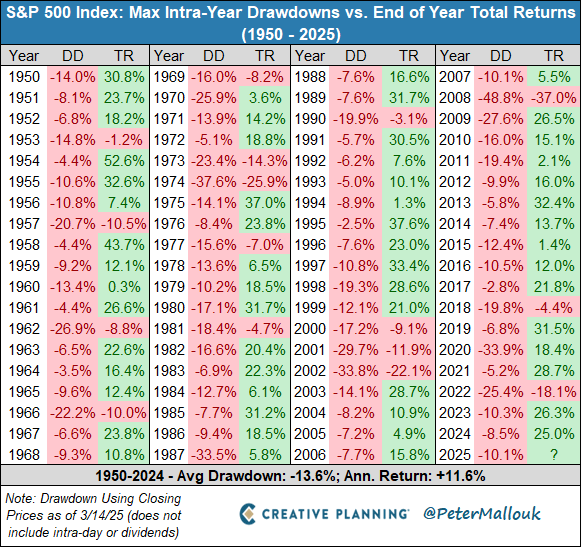
Over the last 75 years, the average intra-year market drop has been 14%. If you are overly stressed out about the current 10% drawdown, the stock market isn’t for you. Downside volatility is the price investors pay for long-term outperformance.
Chess prodigy Josh Waitzkin developed a process to achieve peak performance in any craft or career. He’s applied it to the world of investing, professional sports, science and more. The MIQ Process. It is not a quick fix, but rather a rewiring of your default settings.
State's decades-long inability to cultivate foreign language speakers is one of these invisible state capacity failures that pops up everywhere once you see it.