introducing mjorbit: an open-source simulator for space robotics that runs thousands of worlds in parallel on a GPU.
here, a single RL policy trained in mjorbit flies in from kilometers away in LEO, grabs a satellite with both arms, and points it at earth 🧵
In OATH, we introduce a single reference-, object-, geometry-, and task-agnostic policy that achieves physically feasible retargeting by leveraging contact error as a feedback signal. Excited to share our work!
Sharing OATH: Object-Agnostic Tracking for Dexterous Hands.
We found that observing the error to reference contact points, a single residual policy can track grasps on completely unseen objects, enabling rapid physics-based retargeting.
Humanoids can learn new skills by tracking high-quality reference motions, which today come from humans through motion capture or video. Routing every reference through a human proxy limits scalability and compounds reconstruction errors with the embodiment gap. KinoGen synthesizes loco-manipulation references directly for the target robot through kinematically grounded video generation. 🧵 (1/7)
Great collaboration! BRACE presents you a whole-body controller that can exerts force/torque to its environment while adapting to terrains at the same time!
Excited to share 𝗕𝗥𝗔𝗖𝗘: a whole-body tracker for humanoids that can exert forces from diverse poses and adapt to varied terrains.
Humanoid whole-body trackers are typically trained to follow references recorded on flat ground, carrying nothing. As a result, they know 𝗻𝗲𝗶𝘁𝗵𝗲𝗿 𝘁𝗵𝗲 𝗳𝗼𝗿𝗰𝗲𝘀 𝘁𝗵𝗲 𝗿𝗼𝗯𝗼𝘁 𝗺𝘂𝘀𝘁 𝗲𝘅𝗰𝗵𝗮𝗻𝗴𝗲 𝘄𝗶𝘁𝗵 𝗼𝗯𝗷𝗲𝗰𝘁𝘀 𝗻𝗼𝗿 𝗰𝗮𝗻 𝘁𝗵𝗲𝘆 𝗮𝗱𝗮𝗽𝘁 𝘁𝗼 𝗱𝗶𝘃𝗲𝗿𝘀𝗲 𝘁𝗲𝗿𝗿𝗮𝗶𝗻𝘀. BRACE closes both gaps in a single tracker.
Our key innovation is a 𝗿𝗲𝗳𝗲𝗿𝗲𝗻𝗰𝗲-𝗮𝗱𝗮𝗽𝘁𝗮𝘁𝗶𝗼𝗻 𝗳𝗼𝗿𝗺𝘂𝗹𝗮𝘁𝗶𝗼𝗻. Given humanoid reference trajectories, we adapt them to the terrain and the commanded force, then train the controller on these adapted references. Tracking them naturally produces the stance and bracing needed to handle the terrain and exert the force (or compensate for external loads). 𝗧𝗵𝗲 𝗿𝗲𝘀𝘂𝗹𝘁𝗶𝗻𝗴 𝗰𝗼𝗻𝘁𝗿𝗼𝗹𝗹𝗲𝗿 𝗱𝗲𝗽𝗹𝗼𝘆𝘀 𝗱𝗶𝗿𝗲𝗰𝘁𝗹𝘆 𝗼𝗻 𝘁𝗵𝗲 𝗿𝗲𝗮𝗹 𝗿𝗼𝗯𝗼𝘁.
To know more, please visit our:
Project page: https://t.co/YXmt6GZoFp
Interactive demo: https://t.co/UP6CDAKr8C
More details in this thread🧵
1/n
Introducing TANGO 💃🏻, our #CoRL2026 work on whole-body VLA for humanoid navigation.
TANGO maps RGB directly to 29-DoF actions, enabling coordinated whole-body navigation through cluttered 3D spaces.
Trained entirely in simulation, zero-shot in the real world. 🤖🚀
🤖 One brain, for any robot. But how does a generalist robot achieve mastery on a specific task?
🚀 Introducing CLIFT (Closed-Loop Iterative Fine-Tuning), a framework that turns Gemini Robotics On-Device into a humanoid specialist using only a managed fine-tuning API. [1/6]
🌐 https://t.co/Uts9KDEY8s
📄 https://t.co/Pjvjcr1rSN
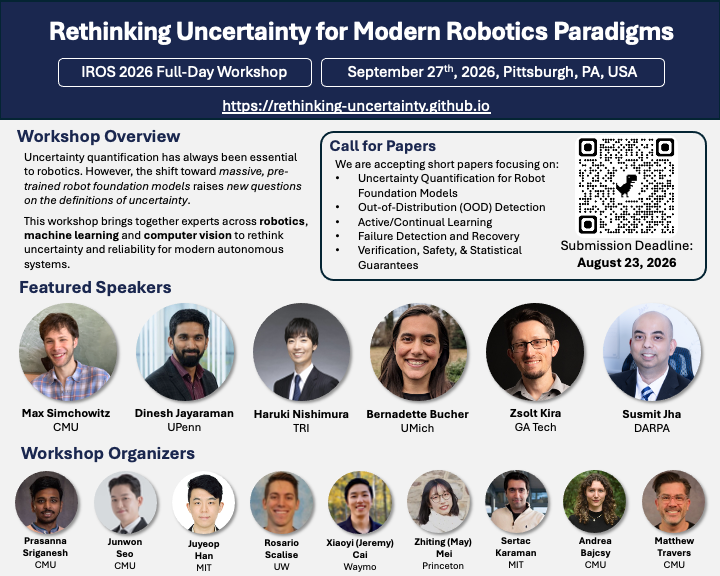
Do we still need Uncertainty Quantification for robotics? What does uncertainty mean in the modern robotics paradigm?
💡 We are organizing a workshop “Rethinking Uncertainty for Modern Robotics Paradigms” @ IROS 2026
Submit your work by Aug 23! 👇 (https://t.co/AUhtTyDmnK)
Super excited to share CHORD, our work on learning bimanual manipulation from human demonstrations.
CHORD demonstrates strong capabilities in mimicking human dexterity from both egocentric and third-person-view videos, across platforms including mobile manipulators and humanoid.
What’s the right representation for a world model? 3D, pixels, or something else?
Excited to release our new paper “Forecasting Motion in the Wild” where we propose point tracks as tokens for generating complex non-rigid motion and behavior
From @GoogleDeepmind@Berkeley_AI@TTIC_Connect
Very honored to get a sneak peek at this early prototype; the potential for dexterous hand research is enormous.
@tom_jiahao and the Daxo team are building something truly novel.
Introducing Muscle v0 -- infinite degrees of freedom, from @DaxoRobotics. A different mountain to climb - with a far more beautiful peak.
We built this from the ground up:
- Ultra-dexterous
- Built for machine learning
- Durable and robust
More below (1/n)
We interact with dogs through touch -- a simple pat can communicate trust or instruction. Shouldn't interacting with robot dogs be as intuitive? Most commercial robots lack tactile skins. We present UniTac: a method to sense touch using only existing joint sensors!
[1/5]
Our paper is accepted to T-RO @IeeeTro! Code for the learning algorithm is now open-source: https://t.co/3BUtTo12NN
Train your own extreme-adaptive policy today! 🚁🔥
After more than a year of work, we're excited to present a stronger, faster, and more general drone controller! We extend the adaptation range of almost 10X and included the ability to track arbitrary trajectories at up to 3.5 m/s.
Paper link: https://t.co/LxUD9bGRlV
This innovative flying cargo transport system is called Palletrone.
Researchers at Seoul National University of Science and Technology (SeoulTech) put a cage around a drone, clever.
Interesting work by @rzhang_official: robust control against air turbulence due to extreme proximity between drones. Spoiler: we even test with drone docking in the air!
TLDR: Can the quadcopters fly in extreme proximity without accurate model and any communication? In our newest preprint, we explore the potential of residual RL for UAV hovering, trajectory tracking and midair docking.
Code: https://t.co/vB6mxRcHcq
Paper: https://t.co/ncnDMglmFg
After more than a year of work, we're excited to present a stronger, faster, and more general drone controller! We extend the adaptation range of almost 10X and included the ability to track arbitrary trajectories at up to 3.5 m/s.
Paper link: https://t.co/LxUD9bGRlV