Moving from chatting back and forth with agents, to having agents that you spin up in the background to do useful work for you is probably on the order of 100X or 1000X more token consumption than what we’re seeing today.
Most work right now is essentially rate limited by our ability to process and work with information. Moving data between systems. Reviewing a document. Looking through code for security issues. Processing log data to look for even patterns. Looking up information about a prospective client. Almost all of knowledge work is constrained by these steps, and AI has become a huge unlock to that.
So our first step was to use AI to do these individual tasks much faster for us. That was the chatbot phenomenon that we have been experiencing for the past 3+ years. But we can still then only augment the work that we remain in the loop for, and we’re highly limited by our ability to parallelize this work by our own bandwidth and context.
But where we’re going is quite different. As AI models continue to improve at incredible rates, we can hand off more and more work to the agent. First it’s letting the agent run with a harder problem. Then it’s giving a few agents multiple parts of a task at once. But we’re not far off from being able to throw an arbitrary number of agents at a problem and just say “come back when you’ve accomplished this goal”.
Now imagine that agent swarm for any problem we can think of. Protecting our codebases, data, and systems. QAing every change we make and make sure all our infrastructure is robust and does what it should. Looking through every document for potential risks. Auditing this company with vastly more data reviewed. And on and on. Most of this isn’t even replacing existing work we do, it’s all net new.
These agents will get deployed as swarms by people, by workflows, by triggers, and by other agents. And none of this would be possible if the models weren’t getting better, and if the cost of AI didn’t make it affordable. Both of those trends though are playing out. Now the next frontier is just having enough compute. But this is where it’s heading.
Dusting off this tweet from April because this gap in shared understanding of LLM capability is *widening*. It's now less "two groups of people speaking past each other" and more a sharp funnel.
- Napkin math somewhere around 6B people (~75% of the population) have barely come in contact with LLMs at all.
- Around 1-2B (~20%) are casual and infrequent users of free-tier ChatGPT-like products. This group sees derpy chatbots and treats them a bit like a better Google search, a writing aid, or etc. Maybe an agent tries to book you a flight. I have non-tech friends who (reasonably, imo) say they have not much use for it at all. Even many professionals outside of math&code are in this tier. For example, execs and many other functions spend a lot of their time talking to other people, so while they understand what is happening intellectually, it is still second-hand and a bit abstract.
- Now we get to professional use of frontier-grade LLMs in math&code. Somewhere around 20M people (0.2%) see first-hand that large, complex projects that used to take them weeks/months can now be completed by agents with a prompt. Building apps, copying apps, translating apps, decompiling apps from binaries... This has all happened very quickly and recently - less than 1 year ago, I was writing code manually by hand, typing memorized computer code commands into a code editor character by character, occasionally pressing Tab to autocomplete a little chunk of code.
- And finally we get to the ~5,000 people (~0.00006%) with access to frontier-grade systems internally. The external world has seen the preview. It looks like swarms of thousands of agents collaborating over weeks on software mega projects: minting zero days, running cyber attacks and defenses at machine speeds, discovering new science, advancing the frontier of mathematics. Things that would have taken top professionals in the industry years of work. Meanwhile, human review and comprehension are starting to fall behind. For example, people are still involved in the "archeology" of the OpenAI-HF incident from many months ago. Mathematicians may be poring over the 722 manuscripts on frontier mathematics for a while.
The funnel is driven by a combination of factors:
1. The impact scales with ambition, problem size, and horizon. A question with a paragraph answer barely stresses the system. You need a reservoir of big, difficult problems that you really care about. This aspect drives the consumer / professional dimension of the funnel.
2. The jaggedness of the system (which I have written about a lot separately). Capability peaks in domains that are digital, verifiable and economically valuable. This is because LLM capability emerges from reinforcement learning on verifiable rewards on a curated environment mixture driven by revenue potential. This aspect primarily drives the area (e.g. math&code) dimension of the funnel.
3. Access. Free-tier, paid-tier, internal.
So this is the weirdness of the moment. The general public has mostly not interacted with these systems. When they have, it looks like a derpy chatbot. The majority of professionals still see only a modest uplift. And a small sliver of professionals are experiencing the vertigo of the curve going vertical. And it is all happening at the same time.
it’s clear we need to retire the term vibe coding because the models now produce better architecture & way more coherent code than an average software engineer.
perhaps even better than top software engineers too because unlike a human, ai has a much much larger context window.
this ain’t vibe coding at all. it’s precision engineering.
I think we should all be mourning the world we knew. Even if Opus 5.5 is the best model ever made and nothing ever surpasses it the world we knew is gone forever
It seems a common experience in the lives of people with high agency is that they, at some point, metaphorically, lean against a wall and discover that there is a hidden door. That some constraint they’ve been told about turns out not to hold, and this allows them to experience something positive. And from this they get into the habit of testing if walls are actually doors, and the more they do so, the more examples of hidden doors they find, and the more inclined they are to look for them. Far from the only thing that sets them apart, but having that experience can be transformative
— Henrik Olof Karlsson
This is exactly right. Source code is on the verge of becoming like assembly.
The next step is getting rid of “source code” entirely and just making an efficient binary directly with AI.
"You need to make yourself a big target for luck, and the way to do that is to be curious. Try lots of things, meet lots of people, read lots of books, ask lots of questions."
— Paul Graham, How to Do Great Work
https://t.co/AyIk5fnKZL
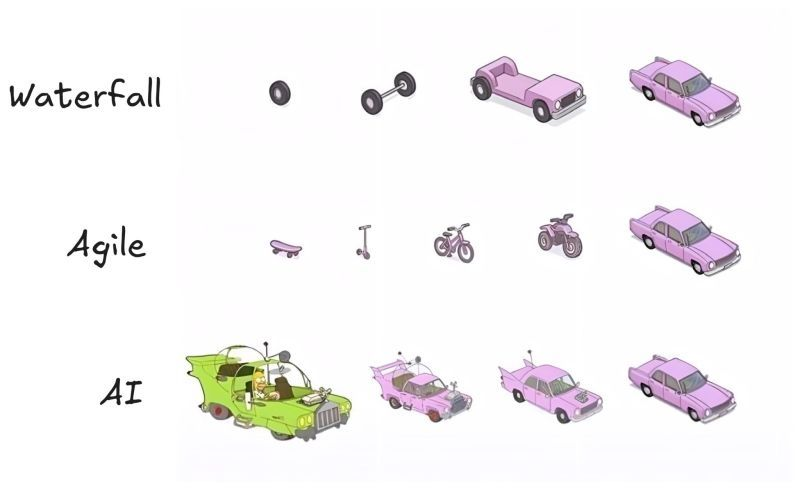
Honestly, this is the most accurate diagram I've seen.
Waterfall: You plan for 18 months and deliver exactly what nobody needs anymore.
Agile: You deliver something usable at every step, but the CEO keeps asking, "Where's the car?"
AI: You get the car on day one. It has six wheels, the doors are on backwards, and it has a rocket launcher. You spend more time making it yours than actually "building"; it's shaping. owning. verifying. That's what the best AI developers do now. They don't build. They shape and own.
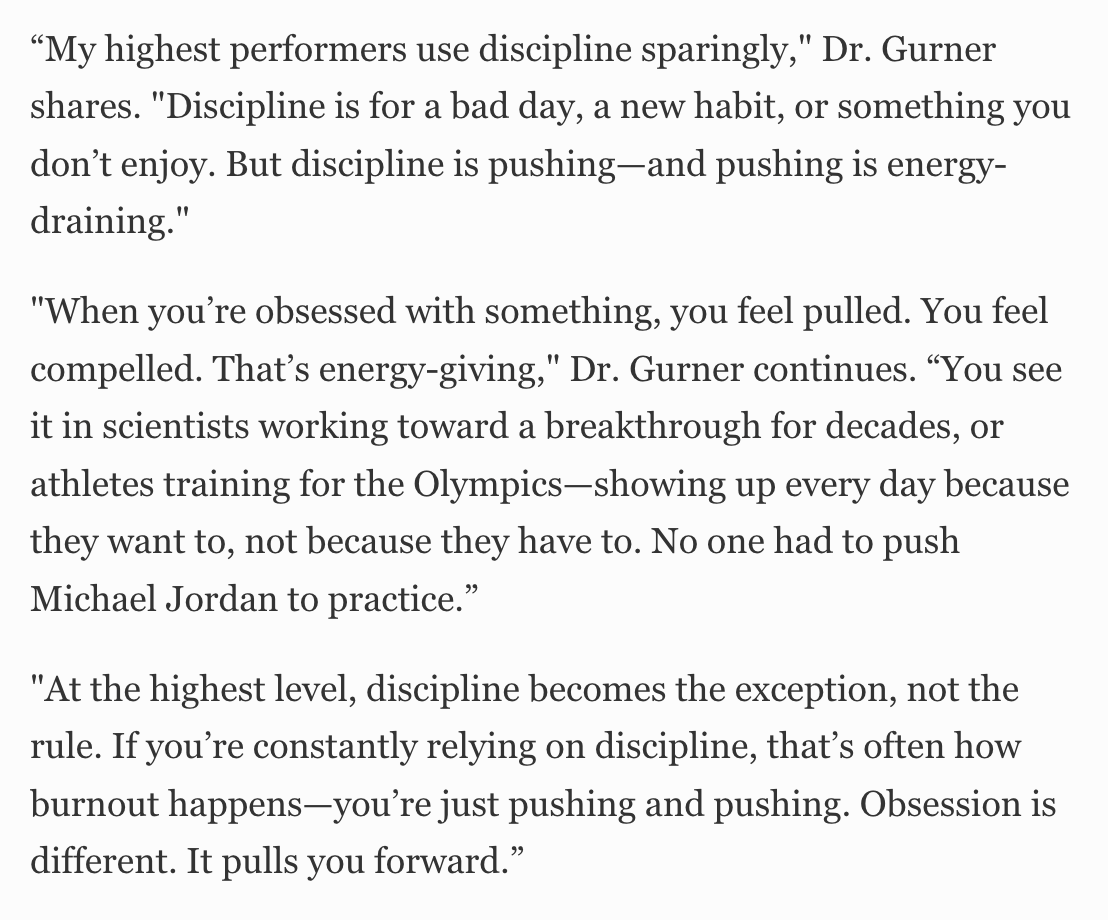
"Go all the way until it hurts. If you're doing something and it's easy, it's not valuable." - @travisk
"If anyone says a strategic thing was easy, I'm like, 'You messed up. You could have gone way further. More competitive advantage. More differentiation. Get it together.'"
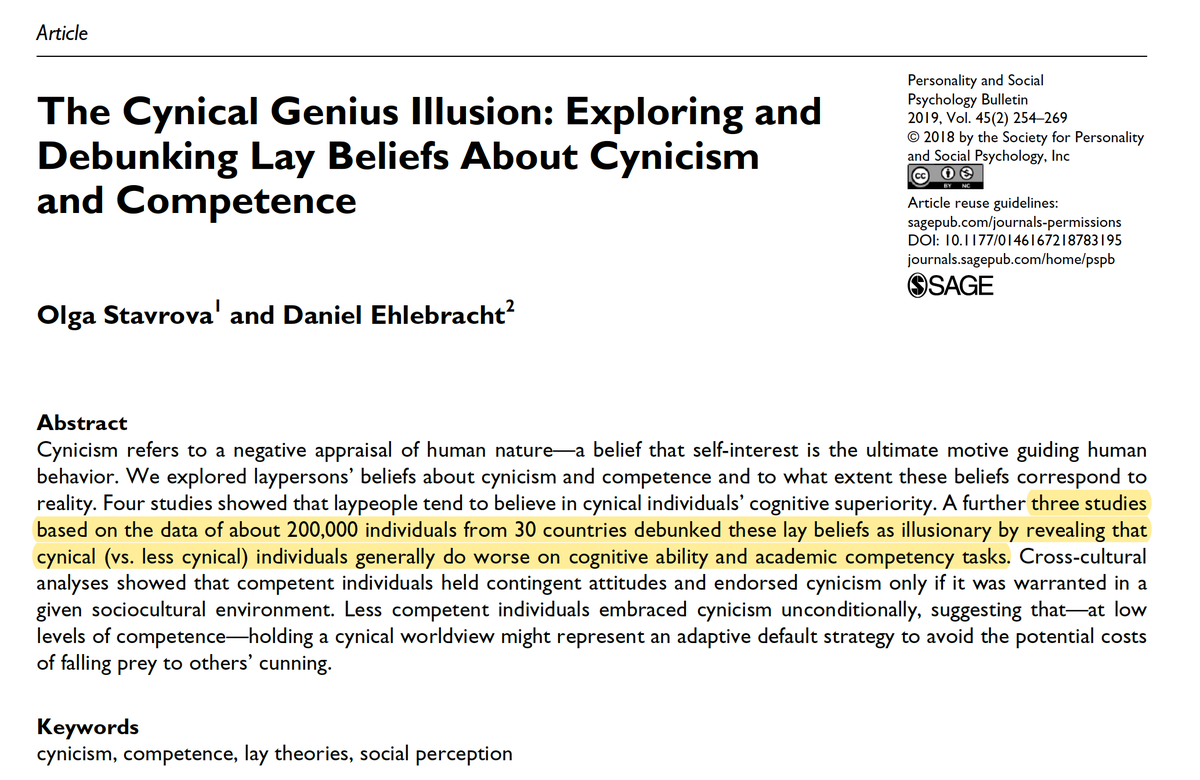
Cynicism is associated with lower IQ, lower literacy, lower numeracy, and lower earnings.
"the idea of cynical individuals being more competent appears to be widespread, yet largely illusory"
https://t.co/QuuSTQxUkJ
Tobi built the original Shopify codebase himself in 2004. Then he spent 20 years doing what every founder-CEO does: slowly drifting into meetings, board decks, and strategy docs while the thing that made him dangerous collected dust.
94 commits in 2024. That’s a CEO who codes occasionally on weekends. 833 in 2025. That’s someone who found a way back in. 957 in 45 days of 2026. That’s a builder again.
The pattern repeating across tech right now is something nobody predicted about AI. Everyone focused on which jobs AI would replace. The bigger story is which skills AI is resurrecting. Founders who stopped coding a decade ago are shipping features. Executives who used to need a team of three to prototype an idea are doing it over lunch. The distance between “I have an idea” and “I built the thing” collapsed from weeks to hours.
Tobi’s been porting his own tools across languages using Claude as a compiler, publishing CLI utilities, and writing open source on his personal GitHub. The CEO of a $150B company is personally shipping to package managers on weekends.
That’s the part worth paying attention to. AI gave Tobi back the part of the job he loved and had to abandon to scale. The best founders were always builders first. The ones who drifted away didn’t want to. They just ran out of hours.
Now they have the hours back.