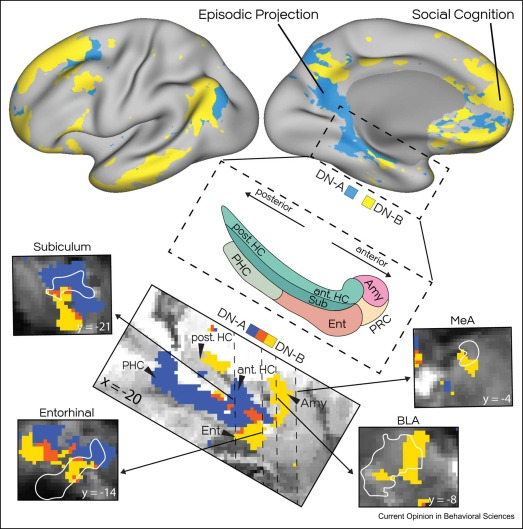
How can the "default network" support many forms of introspective thought? Our new review argues these functions rely on distinct MTL connections:
https://t.co/H9JiOgMHM9
Thanks to Deniz Vatansever & Jess Andrews-Hanna for the invitation to this Special Issue!
Please RT - We are looking for someone who wants to establish and lead a cutting-edge neuroimaging center at Northwestern, working closely with multiple labs, including my own, in neuroscience research broadly construed.
If you are curious, dm me and Im happy to answer questions
We are hiring an Associate or Full Professor to lead the neuroimaging research program at Northwestern's Center for Translational Imaging in the Department of Radiology
https://t.co/cVKYrJzf5y
We are hiring an Associate or Full Professor to lead the neuroimaging research program at Northwestern's Center for Translational Imaging in the Department of Radiology
https://t.co/cVKYrJzf5y
Northwestern scientists suggest that higher‑level #brain systems that interpret and organize perception may play a central role in #imagination in addition to sensory systems, per @NeuroCellPress. https://t.co/Cv3UB9SDI2
This is the strongest ephys evidence so far for a generative model in the brain that I know of.
Congratulations @WadiaVarun! Wonderful collaboration with @UeliRutishauser on science that could only be done in humans.
And please check out Fig. 5FG. This is new since biorxiv and really surprised me: the mean response to imagery and viewing is actually the same & there are many cells that respond only during imagery--challenging the idea that signal strength is what distinguishes reality from imagination.
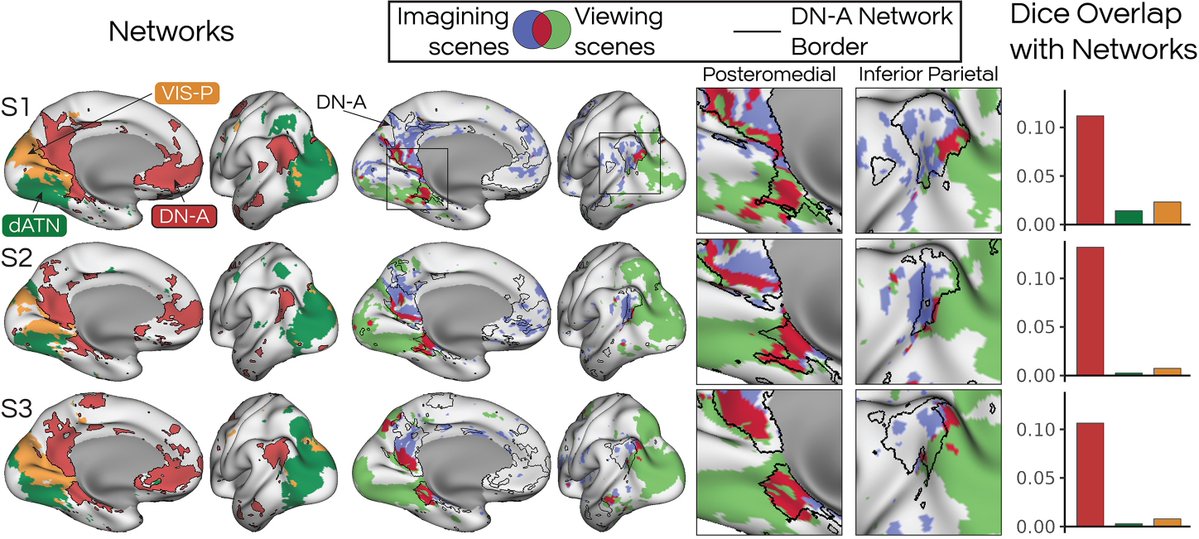
Our new paper on brain networks engaged during imagining is out now in Neuron!
Here is a download link (free for 50 days):
https://t.co/xQOEH0CkvJ
Congratulations to Nate Anderson for leading this work @rementurus.bsky.social
����
Our paper is out! This has been years in the making.
We found that mental imagery and perception do share a neural substrate, but we see it in in higher-order transmodal networks rather than earlier sensory systems. Check it out!
https://t.co/3JAnn0gTNi
We dedicate this paper to Jonny Smallwood (1975-2025), who was instrumental in this project from inception to submission.
Jonny thank you for your mentorship & you are dearly missed!
Our new paper on brain networks engaged during imagining is out now in Neuron!
Here is a download link (free for 50 days):
https://t.co/xQOEH0CkvJ
Congratulations to Nate Anderson for leading this work @rementurus.bsky.social
🧵
The same principle was seen for imagining scenes or speech, even though different sensory systems (visual, auditory) and transmodal networks (DN-A, LANG) were implicated in each.
Lots more figures in paper, and longer thread on b-sk
Thanks to participants, reviewers & editors
When we imagine we re-activate brain regions used during perception, an idea called "sensory reinstatement". However, our results suggest this overlap is actually in transmodal association networks, not sensory areas.
Perception culminates in transmodal networks
1/8. New preprint!
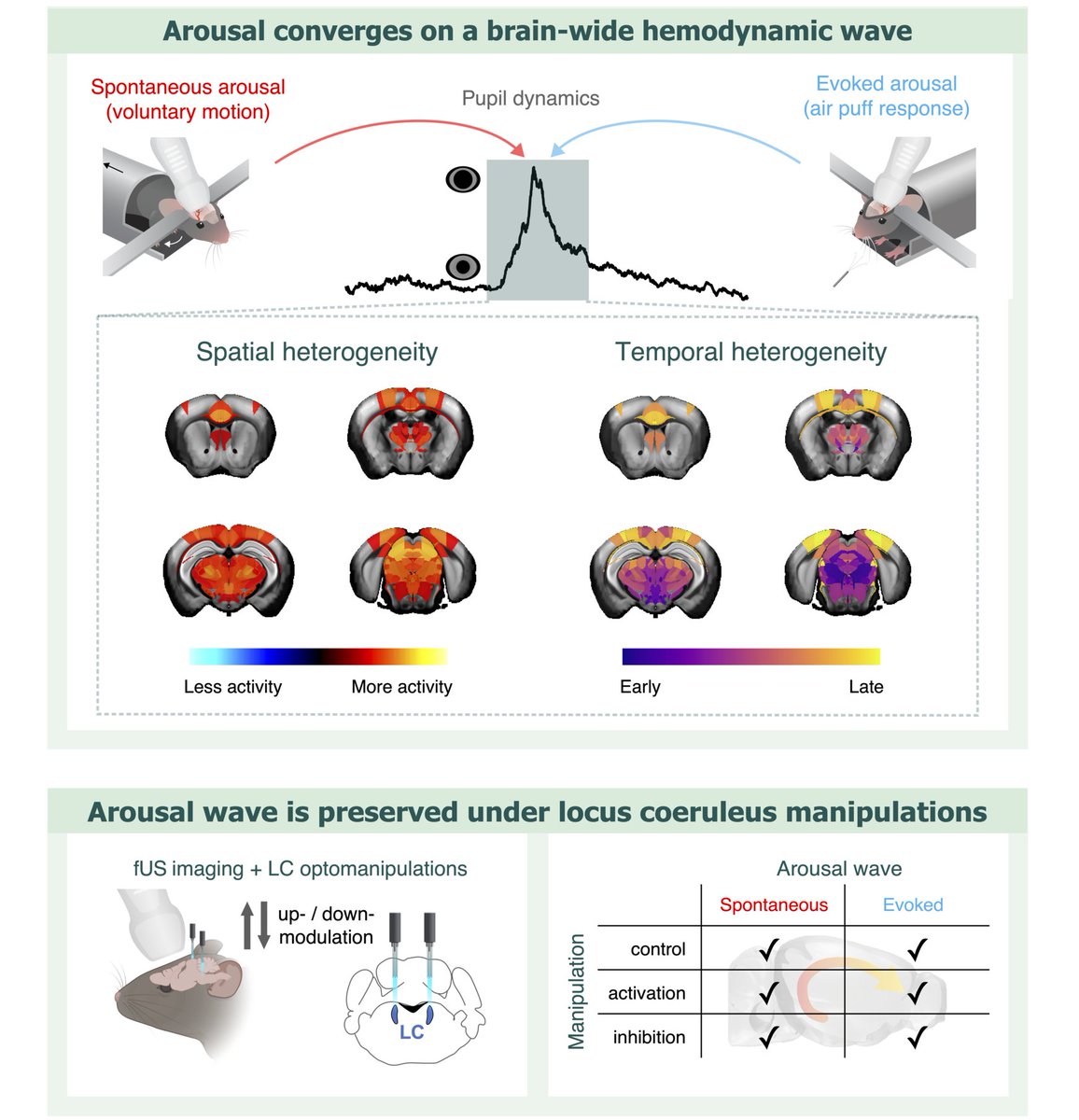
Using fUSi in head-fixed mice🐭, we found that arousal events trigger a brain-wide wave of activity 🌊🧠.
Surprisingly, this pattern was preserved during manipulations of the locus coeruleus, pointing to a minor role for noradrenaline.
https://t.co/TqB8VgQ4Hp
I’ll be speaking at CNS 2026 in Symposium Session 6: “Not Your Average Brain: Individual-Level fMRI as a Paradigm Shift for Cognitive Neuroscience” on Monday, March 9, 10am–12pm. Excited for a session centered on how individual-level fMRI can reshape cognitive and clinical neuroscience.
https://t.co/ERnKuHEodQ
This symposium has an all-star group of presenters covering cutting-edge work in precision and individual-level neuroimaging. It should be a really fun and substantive discussion.
@RodBraga@ArielleKeller@jingnandu049
Andre Zamani