Single-cell and spatial transcriptomics of cellular heterogeneity in Alzheimer disease — a Review by Nora Emerson, Kristen Vallejo, Negin Rahimzadeh, Nellie E. Kwang & Vivek Swarup
https://t.co/6OAFmh58yo
🧠 Migraine is a chronic neurological disorder that affects over 1 billion people globally each year, with women predominantly affected.
A new Seminar discusses typical symptoms, mechanisms, and treatment options: https://t.co/hkFcWfhG6m
Esteban-García et al. show that using focused ultrasound combined with microbubbles to temporarily open the BBB over the substantia nigra reduces neuromelanin accumulation and associated pathological changes in a primate model of Parkinson’s disease. https://t.co/YKkPNlP59v
Karl Deisseroth, MD, PhD, winner of the Nobel Prize in Physiology or Medicine 2026, describes the science behind a study of intravitreal delivery of an AAV vector encoding a light-gated ion channel in 10 blind patients with advanced retinitis pigmentosa.
Read the editorial “Optogenetics in Sight”: https://t.co/efK5Hs2igp
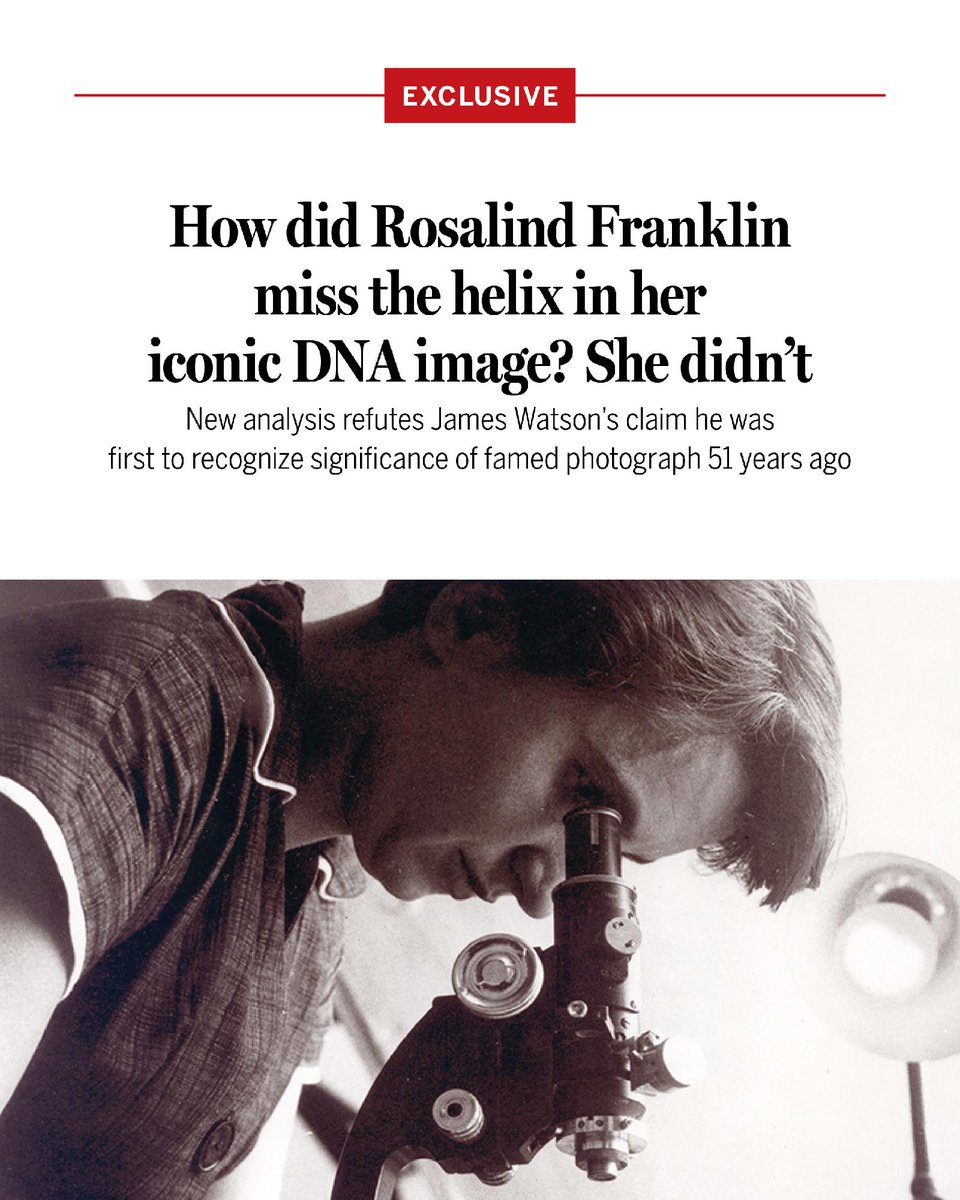
Exclusive: “The instant I saw the picture my mouth fell open and my pulse began to race.” So wrote James Watson in The Double Helix: A Personal Account of the Discovery of the Structure of DNA, his controversial account of how he and Francis Crick deciphered the structure of DNA in 1953.
The image, now known as photograph 51, showed an elegant, symmetrical pattern of spots formed by x-rays diffracted from strands of DNA—the fingerprint of the molecule’s helical structure.
Rosalind Franklin, an x-ray crystallographer, had produced the image in the spring of 1952. But Watson’s 1968 book, amid other slights and sexist language directed at Franklin, implied the flash of insight was his alone.
Popular accounts still routinely suggest Franklin missed the significance of the photo. She never had a chance to challenge Watson’s dismissive narrative; she died of cancer in 1958, a decade before his memoir was released and became a bestseller.
But a new analysis of her notes on another x-ray image, which she made just days earlier using the same DNA sample, offers a firm rebuttal.
Learn more: https://t.co/M7Jm1ykMkT
Premio Nobel de Medicina para Karl Deisseroth, Peter Hegemann y Georg Nagel por la técnica que permite controlar el cerebro con luz https://t.co/aOscEnZho8 via @el_pais
#lipidtime: It's a lipid universe. Today in Nature we publish the Lipid Brain Atlas, the first map of membrane lipid composition across the entire mouse brain, a layer of organisation that cell-type and transcript maps had left out. #lipidomics#neuroscience#BrainAtlas
Las edades del cerebro: el atlas más detallado de la corteza prefrontal revela cómo cambia y envejece a lo largo de la vida https://t.co/ycNbjfy4dC via @el_pais