Futurist and Tech leader; Venture Capitalist and entrepreneur in Spatial / AI / Blockchain / Frontier Tech; former investment banking and private equity
Spoke at the AI club at Stanford last night. 1000 people tried to attend. Seating was capped at 250.
It was pandemonium at the end! If you’re a resilient, gritty engineer, PM, designer or GTM person, please consider working with us:
- We have no org chart - everyone reports to me. We do this to minimize politics, titles and force natural leaders to self organize.
- We are severely under manned for the work we have (by design) so you are forced to engineer your way out. Build solutions not orgs.
- We will book nine figures this year and are growing very quickly. Our customers span all major parts of the US Economy.
[email protected]
Genie3 generates videos. We generate 𝟯𝗗 𝘄𝗼𝗿𝗹𝗱𝘀 you can actually use.
Launching tomorrow — Tencent #HYWorld 2.0, an engine-ready World Model🚀
This isn't a video. It's a real 3D scene, all generated & editable. One image in. A whole 3D world out.
🔥Open-source tomorrow
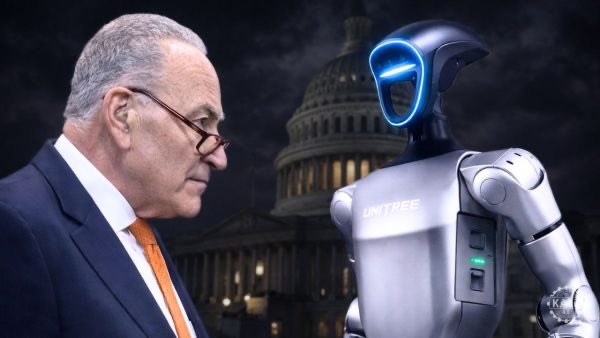
Chinese robots appear headed for a federal ban in the United States.
The bipartisan American Security Robotics Act of 2026, introduced by Republican Tom Cotton of Arkansas and Democrat Chuck Schumer of New York, targets unmanned ground vehicle systems (UGVs), which includes everything from wheeled surveillance robots to legged humanoid and robodogs. If passed, it would prohibit federal money from going toward robots manufactured or assembled by companies tied to China and designated foreign adversaries. GOP Congresswoman Elise Stefanik has introduced companion legislation in the House.
The legislation does not propose a blanket consumer ban but it could have a major impact on federally funded research at universities where Hangzhou-based Unitree’s G1 has become the default humanoid development platform thanks to its relatively low entry price.
Concerns about China’s aggressive robotics push have risen sharply among US officials after Unitree’s viral display during the 2026 Spring Festival Gala on primetime Chinese TV. A fleet of Unitree’s compact G1 and full-sized H2 humanoids stunned audiences with their advanced Kung Fu and acrobatic capabilities.
“The Chinese Communist Party has shown that they are willing to lie and cheat to get ahead at the expense of the American people and our national security,” Schumer said in a press release. “They are running their standard playbook – this time in robotics – trying to flood the US market with their technology, which presents real security risks and threats to Americans’ privacy and American research and industry. We must protect our country from these threats, starting with a ban on the federal government buying CCP technology.”
The bill’s language provides wiggle room for the Department of Homeland Security, the DoD, and the DOJ. They can still use the systems if it services national interests or if they’ve been modified to eliminate any data-sharing risk with foreign entities and are certified as secure.
The proposal has a moderate chance of making it to President Trump’s desk for approval. Whether he signs it probably depends on his relationship with Chinese President Xi Jingping when it hits his desk.
It’s a politically safe move for both major parties in the US, where attitudes about artificial intelligence have soured significantly since it captured the cultural zeitgeist in late 2022. Democratic Congresswoman Alexandria Ocasio-Cortez and Independent Sen. Bernie Sanders have proposed a moratorium of new AI datacenter construction until comprehensive federal regulations are considered.
🚀 Unitree open-sources UnifoLM-WBT-Dataset — a high-quality real-world humanoid robot whole-body teleoperation (WBT) dataset for open environments.
🥳Publicly available since March 5, 2026, the dataset will continue to receive high-frequency rolling updates. It aims to establish the most comprehensive real-world humanoid robot dataset in terms of scenario coverage, task complexity, and manipulation diversity.
👉 Explore the dataset here: https://t.co/8RpMI4qsGG
Haptic scraped all 64 episodes of @RoboPapers (@chris_j_paxton + @micoolcho) and ranked every pain point in physical AI research. The top 10, by mention frequency:
1. Scalable data collection
2. Generalization / zero-shot robustness
3. Dexterous manipulation
4. Teleoperation / whole-body data
5. Sim-to-real transfer
6. Evaluation / benchmarking
7. VLAs / foundation models for control
8. Human video to robot transfer
9. Long-horizon memory
10. RL scaling / offline-to-online
Code keeps getting cheaper. Atoms stay expensive. That's the entire startup opportunity in physical AI right now.
https://t.co/HZGBsk7OXS
$39 billion. That's what investors think Figure is worth right now. Their only completed deployment so far: two robots loading metal parts at a BMW factory for 11 months.
The robots came back from BMW covered in scratches and dents. Figure pulled the entire line out of service. And the CEO has admitted he doesn't leave the robots unsupervised around his own children.
So what's actually behind this living room demo? Figure built its own factory in San Jose called BotQ. The plan is 12,000 robots a year, eventually scaling to 100,000. They don't sell the robots outright. Companies rent them for about $1,000 a month. That's the real business model: recurring revenue from industrial customers long before any robot shows up at your door.
The home play is even more interesting. Figure partnered with Brookfield, one of the biggest real estate firms on the planet (they own over 100,000 apartments worldwide). Brookfield is allowing Figure to record how people move through its buildings, kitchens, hallways, and offices. That data trains Helix, the robot's AI brain. Without it, these robots can't generalize beyond a controlled demo room. That data collection just started.
Here's the pricing problem. About 15,000 humanoid robots were shipped globally last year. China made 90% of them. Tesla is shutting down its Model S and Model X lines at Fremont to convert them into an Optimus robot factory. They already have over 1,000 units inside their own plants collecting training data. @elonmusk says Optimus will cost $20,000 to $30,000. Unitree sells one starting around $16,000. 1X has pre-orders open at $20,000. Figure 03? Estimated at $50,000 to $100,000. Three to five times pricier than everyone else going after the same living room.
The demo is real progress. But Goldman Sachs doesn't expect consumer humanoid sales to ramp until the early 2030s. Between here and a robot tidying your apartment, there's a factory that hasn't scaled, a price tag most households can't touch, and training data that's still being collected.
🚨 BREAKING:
Rhoda AI raises $450M at $1.7B valuation!
That means another unicorn in robotics industry (at Series A)! 🦄
Rhoda AI just raised $450 million in Series A funding at a $1.7 billion valuation and unveiled FutureVision, a robot intelligence system that handles the unpredictability of industrial environments.
Let's take a look, at how it works. First, it studies hundreds of millions of internet videos to learn how objects move and how the physical world behaves. Then it uses that knowledge to constantly anticipate what's about to happen around it and translate those predictions into physical movements, repeating this cycle dozens of times per second.
Most machines perform well in controlled, predictable environments but struggle when something unexpected happens. FutureVision targets this longstanding robotics problem.
The platform integrates with a wide range of robotic hardware, allowing manufacturers and logistics operators to deploy intelligent robots without rebuilding existing systems.
Breakthroughs in AI models that help robots understand language, interpret visual information, and predict how the physical world behaves, combined with growing investment from major tech and robotics companies, are driving robotics adoption.
This is world models for robotics entering production. Learn physics and object dynamics from internet videos, then use that model to predict and act in real-time.
The same pattern as language models: pre-train on massive internet data, then deploy for specific tasks.
Congrats @startupjag! 🔥
Read more here: https://t.co/AJH6X7GAtq
~~
♻️ Join the weekly robotics newsletter, and never miss any news → https://t.co/GoA3ZuwoPB
Advanced Machine Intelligence (AMI) is building a new breed of AI systems that understand the world, have persistent memory, can reason and plan, and are controllable and safe.
We’ve raised a $1.03B (~€890M) round from global investors who believe in our vision of universally intelligent systems centered on world models. This round is co-led by Cathay Innovation, Greycroft, Hiro Capital, HV Capital, and Bezos Expeditions, along with other investors and angels across the world.
We are a growing team of researchers and builders, operating in Paris, New York, Montreal and Singapore from day one.
Read more: https://t.co/kyVAL7EoFx
AMI - Real world. Real intelligence.
Boost team energy with FluidStance Fleet: dynamic standing decks for focused workdaysBoost team energy with FluidStance Fleet: dynamic standing decks for focused workdays.
The dream of robots helping people live and work better in the physical world begins with helping robots to become more spatially intelligent by learning from the infinitely diverse and intricate environments of the 3D/4D worlds 🤖🤩
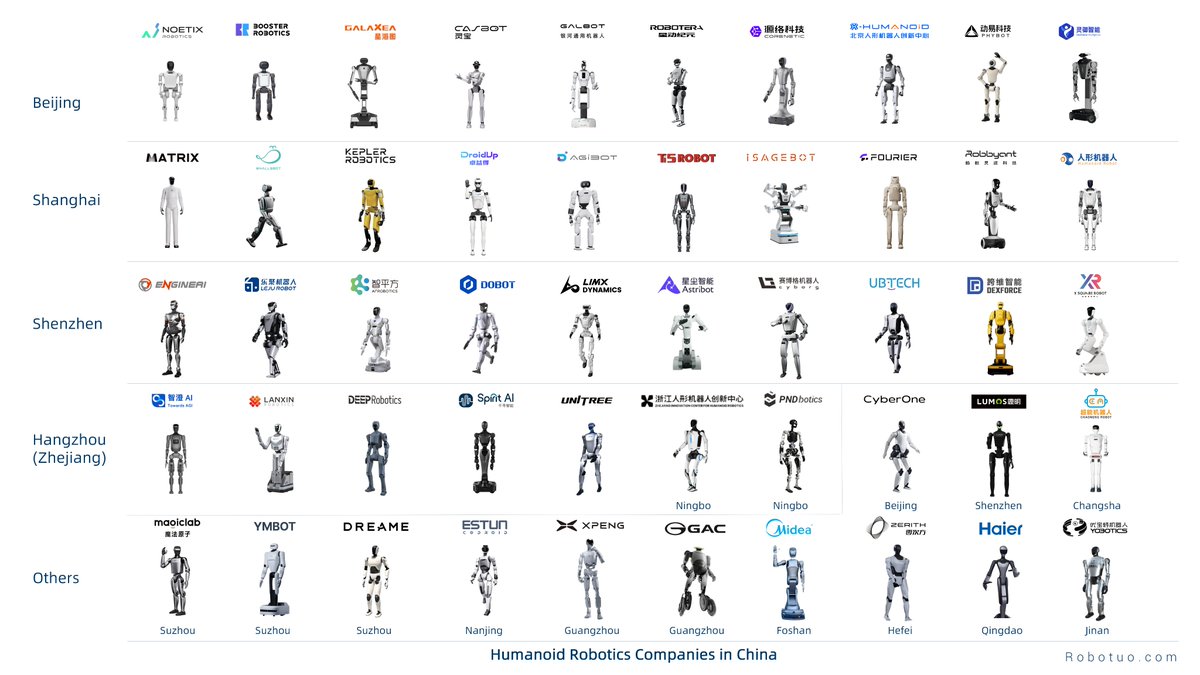
Many cities in China are developing humanoid robots. Here’s a list of about 50 companies working on humanoids that we selected.
With so many robotics companies, we’ll inevitably miss quite a few, but this gives a full picture of how fast and large the industry is growing here.