Really touched by this award from @ForbesPolska. This is what was said that evening:
“It takes imagination, intelligence, and sheer audacity to go to Silicon Valley and tell the world’s leading AI labs they’ve got it wrong. Together with her co-founders, tonight’s winner has developed a new AI architecture - one that could prove far more efficient than the Transformer architecture behind models from OpenAI and Anthropic.”
What we do at @pathway_com is difficult, especially on a human level.
Big thanks to Krzysztof Domaradzki and the community in Poland and beyond for your support. It really means so much. To the Team at Pathway that makes the dragons fly. And to my co-founder and friend @JChorowski for accepting the award on my behalf (also, best dressed 😍😍😍).
“It would take someone with a lot of patience, budget, and conviction to push forward approaches that go beyond Transformers, approaches that don’t give you immediate gains on benchmarks. Those approaches are unfortunately cut out because of incentives in Machine Learning.” — Peter Norvig at the Open Source AI Summit in SF.
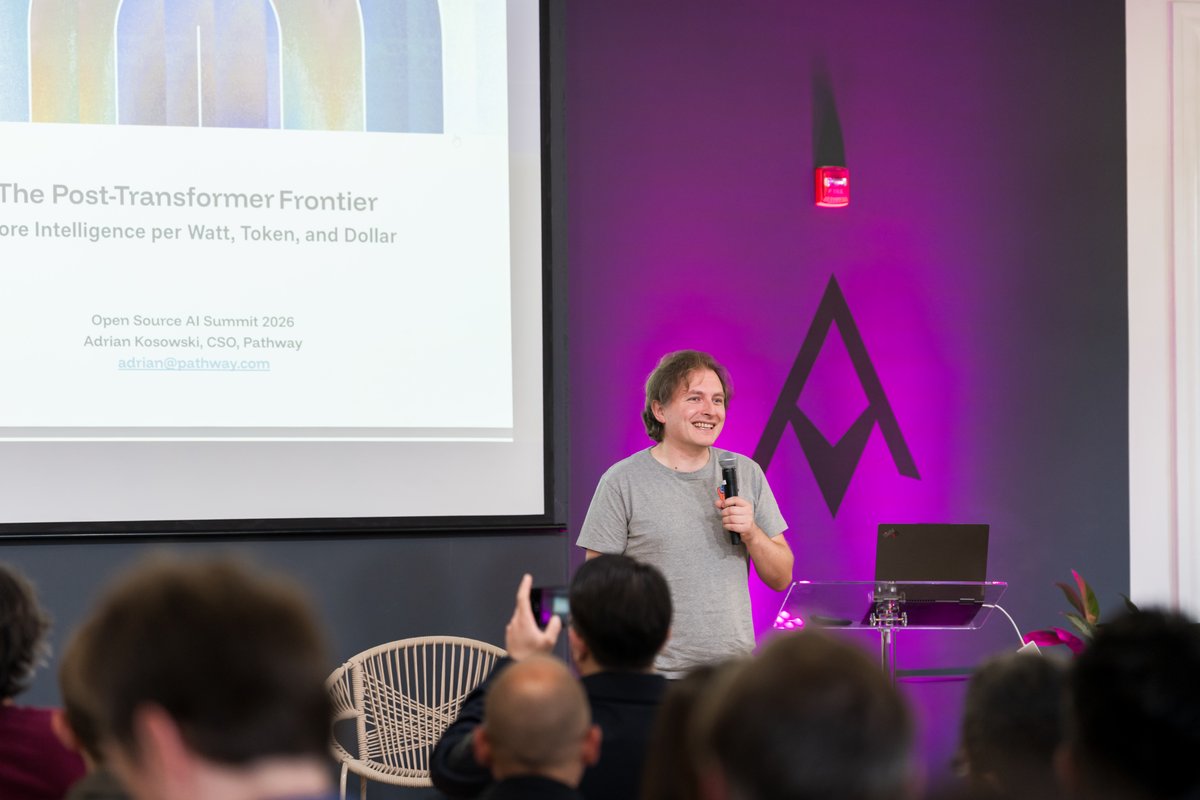
And then @adrian_pathway took the stage to talk about the Post-Transformer Frontier :)
For me, it was pretty incredible to see the three “big moments in AI” jamming together at a cosy meetup in the middle of a calm afternoon in the Presidio. Peter (shaped the field of AI) - Illia (co-invented Transformers) - Adrian (leads Post-Transformers).
This event was an absolute gem. I genuinely had fun, took notes and photos of slides (!)
The next generation of AI is inevitable. It is being built on efficiency, not brute force. The first generation of AI won by massively scaling the Transformer. At Pathway, we are here to change this.
Thank you to @ilblackdragon, @ekang426, @build_planet, @near_ai, and @open_intel_fdn for bringing the community together!
The conclusion connects this to BDH-CQ, which learns from examples in context and works through problems in a continuous latent space.
Read the series on @pathway_com's website: https://t.co/u2L9zju6MG
Transformers have reshaped AI, but they were never designed as a foundation for intelligence that must persist and grow over time. The next frontier in AI will come from architectural breakthroughs that produce more intelligence per watt, token, and dollar.
Last year, we introduced the Dragon Hatchling (BDH) architecture.
Our three-part explainer brings together the motivation and mathematics behind BDH, along with what we observe in trained Post-Transformer models.
What will it take to build AI infrastructure that can keep up with the latest frontier?
I’m joining @mlech26l, @pilarmanchon and @readkrystalhu at @onewayvc’s One Way Summit to discuss what it will take to power the next leap in intelligence.
📅 Oct 29, 10 AM
📍 Commonwealth Club, SF
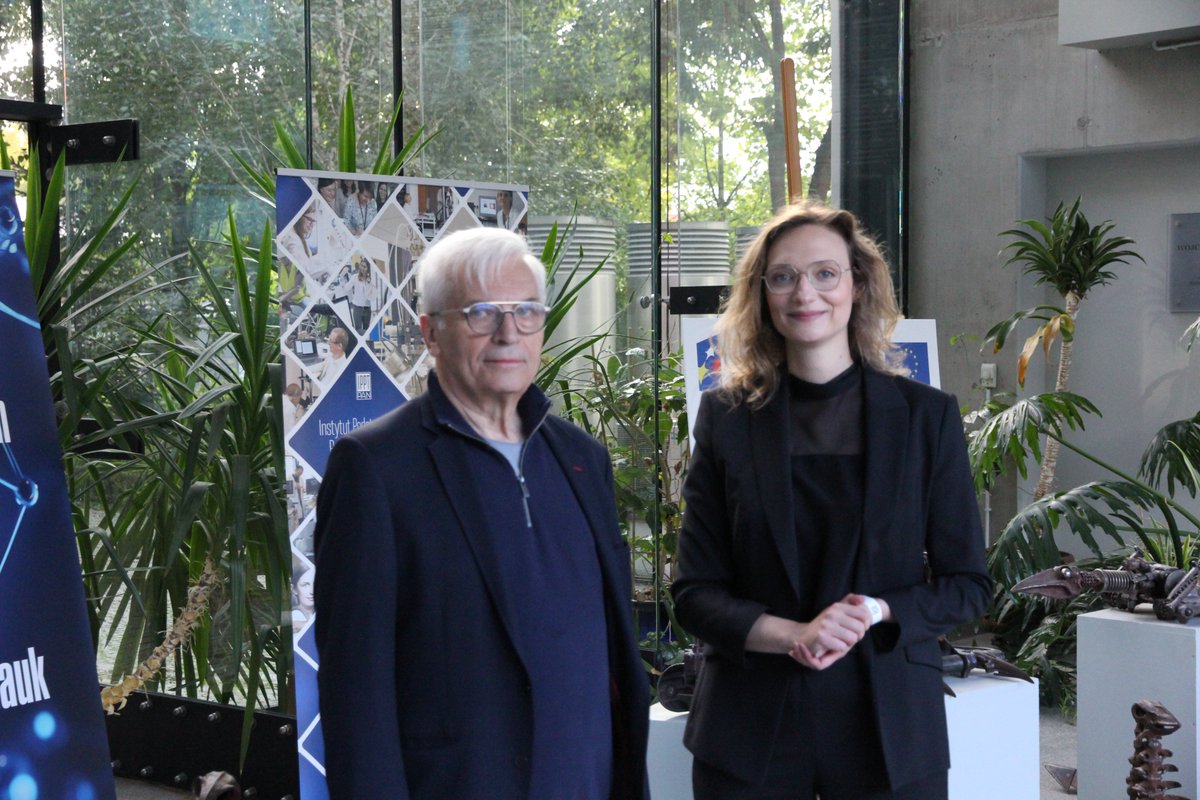
IPPT PAN and Pathway explore new opportunities for cooperation
On September 23, 2026, IPPT PAN welcomed dr Zuzanna Stamirowska, CEO and co-founder of @pathway_com, and co-architect of the Dragon Hatchling (BDH) architecture.
The visit provided an opportunity to present the Institute’s current work, particularly in artificial intelligence, robotics, and autonomous systems. Discussions focused on potential applications of the BDH architecture in research and engineering, covering topics such as model reasoning mechanisms, inference control, safety in agentic systems, and generalization theory.
The Institute was represented by its Director, Prof. Janusz Szczepański, Deputy Directors: dr hab. inż. Łukasz Jankowski and dr hab. inż. Tomasz Mościcki, alongside Prof. Tadeusz Burczyński and dr hab. inż. Iwona Pokorska-Służalec.
Follow-up discussions will continue at the working level between research teams from both organizations.
How do we get more intelligence from every data sample and every dollar?
Last week at TechCrunch Disrupt, I joined @vipulved (CEO, @togethercompute) and @mojomaa0 (Partner, @CapitalG) on a panel moderated by @etherington about how leading AI companies navigate a multi-model world.
We discussed model routing, inference costs, and how builders can maximize value from AI.
Today's AI reminds me of the early steam engines, burning coal by the ton. Greater efficiency contributed to paving the way for the Industrial Revolution. We're heading toward a similar shift in AI.
@adrian_pathway, @pathway_com's co-founder and Chief Scientific Officer, will join @ilblackdragon and others on stage to discuss putting the Post-Transformer era into practice at the Open Source AI Summit.
🕓Oct 22, 4:10 PM
📍 The House by Edge & Node, SF
In my new piece for @Forbes, I make the case that Transformers won’t be enough to get us to Superintelligence.
They’ve taken AI extraordinarily far. The shift from models that retrieve to models that learn from experience will enable a wide range of applications that must reason reliably as information and constraints change, from cybersecurity incident response to real-time industrial operations.
Our own bet is that the next leap in AI reasoning won’t come from making transformer-based models bigger. It will come from building AI that remembers, reasons and becomes more capable with use.
These systems will bring structural efficiency to the picture.
Transformers defined this era of AI. That doesn’t mean they get to define the next one.
What can we learn from the brain when building Post-Transformer AI models? 🐉
@JChorowski joined the @OpenComputePrj Foundation community to unpack Dragon Hatchling (BDH) and the engineering behind it.
Learn how BDH stores information, how “neurons that fire together, wire together” becomes a learning rule, and how we translate these into computations modern GPUs can run.
For anyone wondering what Post-Transformers are about, this is a great place to start.
Our CSO @adrian_pathway took the stage at the AI Conference to explore the Post-Transformer landscape.
With BDH, we’re uniting memory, reasoning, and adaptation. Call it intelligence-maxxing: more intelligence per watt, token, and dollar.
Watch below 👇
We need more intelligence per watt!
"The next generation of models is not about scale, it's about something different"
Great presentation from @adrian_pathway from @pathway_com
Full 20 mins presentation in comments, time to look at post transformers architecture!
A reasoning model should learn from its hardest tasks and carry that experience into the future. I joined @bigdata on The Data Exchange to discuss continual learning, latent reasoning, and BDH-CQ’s ARC-AGI-1 cost-efficiency result.
Thanks, Ben! Full episode below.
OpenAI just announced a breakthrough in matrix multiplication - the critical building block of countless algorithms, including how all of the AI works. Like, if you were wondering what @nvidia's chips are doing - this is what they're doing.
We could argue that slashing the theoretical efficiency exponent from 2.371339 to 2.25 for square matrices represents a tectonic shift in both computer science and the economics of artificial intelligence.
Over lunch, my colleague at @pathway_com just extended the result to rectangular matrices, slashing the exponent to ω=2 for the other most used matrix shape (n × √n matrix by a √n × n matrix). Here is the paper (in replies). You're welcome.
What beautiful times we live in, when you can get results like these while chewing on your burrito. Cheers to Przemysław Uznański (@PrzemekUzn25621)! 🍻
Human mathematicians can still be somewhat useful ;-)
*The remarkable part is the equality: two is the smallest possible exponent, matching the lower bound imposed by the n^2-entry output. For this matrix shape, this result settles the exponent exactly, once and for all.
@stevenstrogatz Another amazing consequence of this result is that alpha>=0.5 [the dual exponent]. It can be achieved with a little bit of massaging of their analysis. https://t.co/XaWZQro5RE
Transformers have become the dominant architecture in AI, but fundamental questions remain around memory, continual adaptation, reasoning, efficiency, and learning from experience.
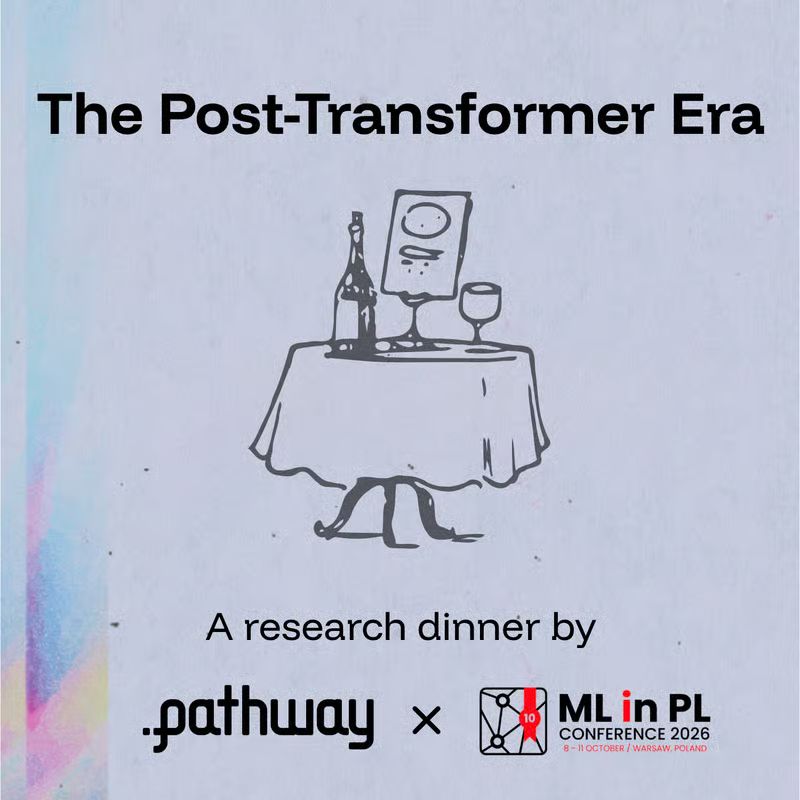
During ML in PL Conference 2026, @pathway_com is hosting a research dinner bringing together experienced researchers and technical practitioners to discuss where current approaches fall short, which alternatives look most promising, and what it will take to evaluate them at scale.
The discussion will be led by @JChorowski, CTO and co-founder of Pathway, and is intended as an exchange among peers working on advanced AI research and systems.
📆 Friday, 9 October | 18:00-20:00
📍 Powiśle, Warsaw
Dinner and drinks are hosted by Pathway. Registration is free and subject to approval — please check the registration details before applying.
https://t.co/WhfAbKDKHt
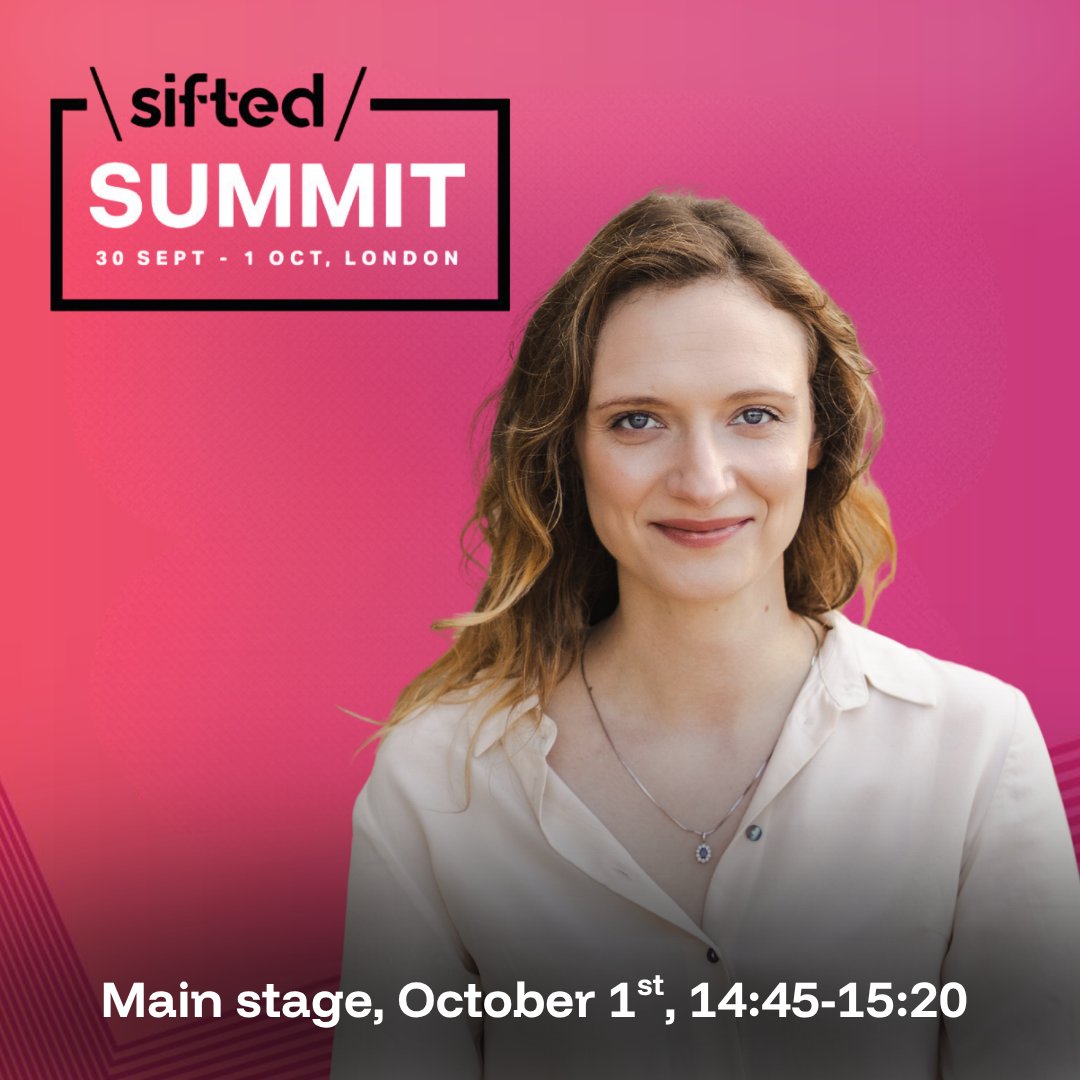
What infrastructure will the next wave of AI models require? I’ll discuss it on the Main Stage of the Sifted Summit with Enrique Lizaso Olmos (@MultiverseCompu), and @GautierCloix (@hcompany_ai), moderated by Daphné Leprince-Ringuet.
⏰ Thursday, October 1, 14:45-15:20
🆕 Post-Transformer AI: Reasoning Without Language
Pathway's CEO Zuzanna Stamirowska on why transformers aren't enough for true reasoning. Their BDH model reasons in latent space, learns from experience, and maintains state over long horizons
https://t.co/pM65IPxqaW