Tottenham Hotspur | Set Piece Analysis Thread
An analysis of Tottenham’s attacking & defensive set pieces this season
19 goals in the Premier League- 18 from corners!
Great work by @georgson82
Follow this thread 🧵
@tacticlipfutbol
In build-up situations, when the opponent is referencing players during their press, the pressed player won't be able to progress by carrying the ball, but can release others if the opponent isn't defending man-to-man across the whole field.
Against a high press, we can make 2 different decisions:
Sometimes we avoid the pass that triggers the press.
Sometimes we trigger the press on purpose.
The players’ positioning can manipulate the defenders and create the advantage we want to attack.
Brentford v Leicester 2022/23 short corner goal
4v2 outside the box to attack the blindside of the defender
6v4 overload on Leicester’s man markers
Using the swarming concept to disguise two decoy runners away from the target zone
Offside players lost by Leicester’s line
Beating the line not just with the ball, but also off it, moving into space where that dynamic superiority creates a numerical equality (3v4 to 4v4), being harder to defend.
Counter Pressing: 8V8
Simple player cue “When we lose it, we hunt it. Nearest player presses, others lock the exits.”
Key coaching phrase “Don’t just run at the ball. Press the ball, block the pass, protect the middle.”
✅React immediately after losing the ball
The first 3–5 seconds are key. Players closest to the ball must press right away before the opponent can lift their head and play forward.
✅Nearest player presses the ball
The closest player must apply quick pressure to stop the forward pass, delay the attack, and force the opponent into a mistake.
✅ Second and third players support the press
Players around the ball must close passing lanes, especially inside passes. Do not all run to the ball. One presses, others lock the opponent in.
✅ Protect the middle first
Force play wide or backward. The central pass is usually the most dangerous because it can break the whole team.
✅ Compact around the ball
The team must squeeze together quickly. Small distances between players make it easier to win second balls and stop the counterattack.
✅Press with body shape
Angle your run to show the opponent where you want them to go. Do not press straight on and allow them to play through you.
✅Communication is key
✅Players must shout: “Press,” “Step,” “Cover,” “Left shoulder,” “Inside,” or “Force wide.” The press dies when players stay quiet.
@JB_SoccerCoach@TheS_Resource@JustcoachMD@SessionShareNet@205_Academy@Coach_Osku @rf_fc1o
Passing Football Drill - Back-Pedalling To Progress
A good one for all ages, especially with younger players, as we look to develop movement, support and receiving skills.
In our latest Tactical Classroom, we discussed a build-up solution against a 4-4-2 diamond.
All seven Tactical Classrooms are now available on our platform. Link in bio.
@Ruxiiii4 & @MeiaArmador__
#Emery’s principles of positional play, which come into play under pressure & in final third, are based on relational methods. The clip also shows how difficult it has become for teams when they press in -1 and why so many end up in pure 1-on-1 situations
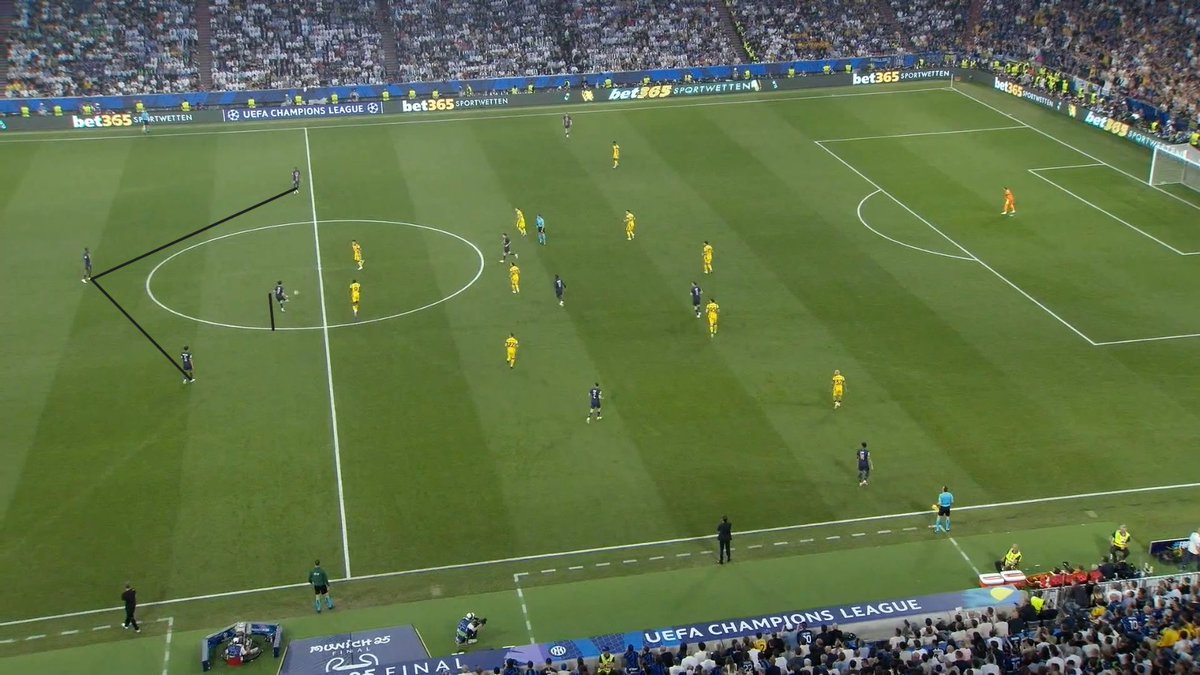
Only a couple of years ago, almost every top club used a 3-2-5 as their primary in-possession structure. We are now seeing the 3-1-6 become the dominant shape at elite level. It is no surprise that both Champions League finalists use it as their base structure.
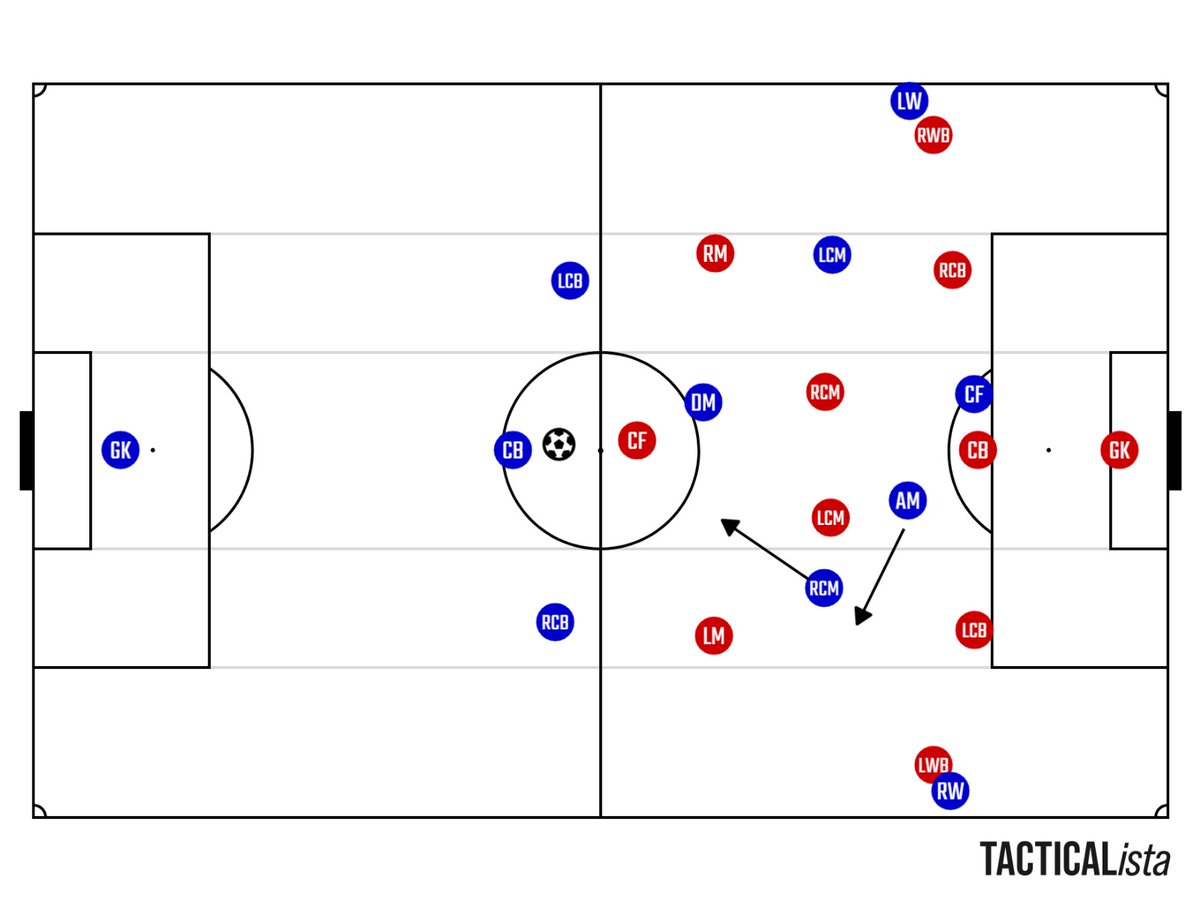
The 3-2-5 initially gained hegemony because of the tensions it created against the classic 4-4-2 zonal block. It created a 3v2 in the first line of buildup, a 5v4 numerical superiority against the opposition defensive line, and shifting the 4-4-2 horizontally would usually generate positional superiority in the far-side half-space. It was the simplest and most effective structural solution against the dominant out-of-possession approach of the time.
But while the 3-2-5 gained positional superiorities, it also lost a degree of dynamic superiority.
The natural response against it was for teams to become increasingly man-oriented, especially in midfield, which made positional superiorities much less effective. Teams also started using situational or permanent back fives, removing the original numerical advantage on the last line.
That is where the 3-1-6 started becoming more common.
On a basic level, it allowed teams to overload the increasingly common back fives. But the more important reason is that it created far greater dynamism with drops and arrivals from the forward players without clogging central spaces.
For example, when a half-space player drops in a 3-2-5, the distance to the pivot on his side is often too small to generate a meaningful advantage. There is very little free space to drop into. This was one of Cruyff’s criticisms of the double pivot, that it naturally clogged the centre.
In a 3-1-6, the forward players can drop next to the single pivot, manipulate opposition references, create hesitation within man-oriented structures, and then dynamically attack the blindside afterwards. The extra mobility and spacing create more dynamic advantages.
Essentially, the 3-1-6 is a countermeasure against increased man orientation while still maintaining the positional advantages created through width, depth, and occupation of the pockets.
Written by @MeiaArmador__
Another benefit of inside wingers (esp when the ball is at the feet of a GK who has good range like Martinez) - Great access for second balls/link up play underneath the #9: A concept very common in "Red Bull" teams.
Width as something dynamic rather than a starting position.
5v3 Possession | 5v3 Attack
📌 Directional possession and fast attacks.
🧱Set-Up:
✔️ 36 by 24 pitch split into thirds, plus a pair of mini goals at each end of the pitch.
👕Teams: ⚫️’s vs⚪️’s
🧩 How to Play:
✔️ Practice starts in area A, 5 x ⚫️’s keep possession for 3-5 passes against 3 x ⚪️’s. Once this is achieved the ⚫️’s can attack the mini goals in area C.
✔️ There are x 2 ⚪️’s waiting on the line of area C to delay the ⚫️’s, whilst 1 x⚪️’s can recover back in to help the defence.
✔️ If ⚫️’s score the practice resets in area C and player look to work the ball into the opposite area.
✔️ If the ⚪️’s win the ball in the possession practice they score in the mini goals of area A or C.
✔️ If ⚪️’s win the ball in the 2nd phase of the practice when ⚫️’s are trying to score, the ⚪️’s score in the opposite goals to the ⚫️’s.
🚧 Constraints:
🏆Reward: Double goals for ⚫️’s if they can score without the ⚪️’s getting a touch of the ball.
👨🏫 Review: Composed possession followed by a fast break to goal.
🚫 Restriction: Only 4 players can attack the mini goals for the ⚫️’s, which leaves 1 player behind to defend outnumbered if the ⚪️’s win the ball.
@RF_FC1O @Coach_Osku@LloydOwers@205_Academy@JB_SoccerCoach@TheS_Resource@allenaremania@SessionShareNet
Created On @SSPlanner
Xabi Alonso's System,Intentions, Ideas...
-structure
-half space manipulation
-central threat to pin
-potential diagonality
(video 🧵- quick compilation of all of my old analysis videos done during his period at Real Madrid)
APFC Coach's Playbook | Multidirectionality in the Drills
Designing a drill in which players can change direction, while continuing to work on the specific concept we are targeting (beat the line or break the line in that case), fosters creativity in the players.
Switching Play 🔄
🔹 2 teams set up in their tactical shape
🔹 Neutral players mimic FB's/WB's
🔹 Circulate to create space & score in mini-goals
@CoachingFamily@TheS_Resource@SessionShareNet@SundayShare10
Save for next week's sessions 🚀
Xabi Alonso Technical Practice
A passing drill for twelve players used by Alonso to establish passing practices.
12 more Alonso practices are available on the site.