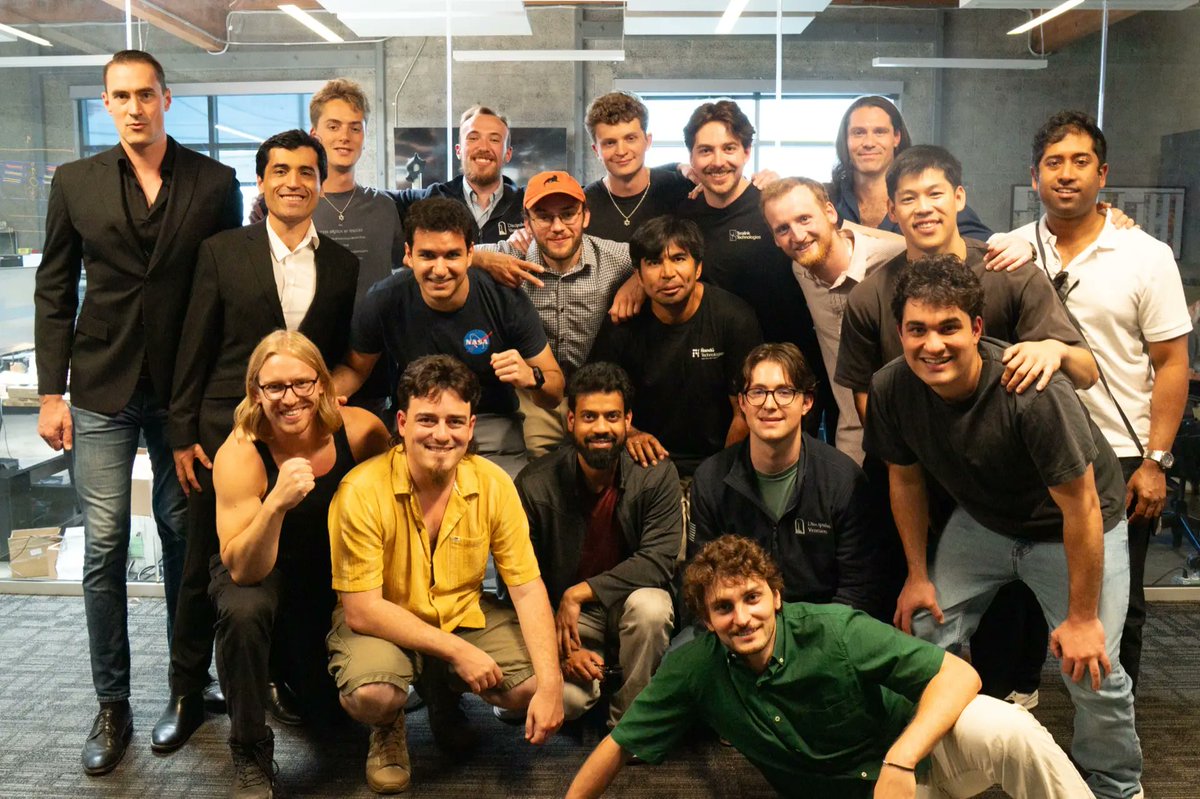
NEW FUND NEWS: Discipulus Ventures (@DiscipulusVent) just closed $30M Fund II.
Led by @jakobdiepen. Hard tech focus - defense, energy, mining, manufacturing, and critical industries. They also run a cohort for early-stage hard tech and national interest founders.
The LP roster says everything: @PalmerLuckey (@anduriltech ) and @brian_armstrong (@coinbase) both wrote checks. Congrats to the team! 🚀
P.S. Raising a fund or fundraising? Your data room has to tell your story. Next gen data rooms → @ThePageform
Raising an impact fund without knowing these institutions is like fundraising with one hand tied behind your back:
- @Temasek (Singapore) - $500M committed to emerging markets impact, anchor LP
- @Alterrafund (Abu Dhabi, UAE) - $5B allocated to Global South climate strategies
- @pivotaldotcom & @melindagates (Seattle, WA) - backs first and second time impact managers
- @RockefellerFdn (New York, NY) - $4.8B AUM, mobilizing private capital for impact
- @macfound (Chicago, IL) - catalytic capital pioneer, repeat impact allocator
- @massmutual (Springfield, MA) - First Fund program, seeds emerging impact managers
- @calvertimpcap (Bethesda, MD) - $3B+ raised, channels capital to emerging markets globally
- @FordFoundation (New York, NY) - 16B endowment, impact investing since inception
P.S. When it comes to funraising, DocSend is a folder dump.@ThePageform is a narrative data room. Your story deserves to be told.
NEW FUND NEWS: @hiFramework just closed a $400M Fund IV and they’re moving beyond crypto.
Started in 2019 as a DeFi-native fund. Early backer of @aave and @chainlink.
Now calling their new mandate “frontier technology”- crypto, AI, robotics, and energy.
LPs include FoFs, Ivy endowment, sovereign wealth funds, and nonprofits.
Go pitch them. Now is the time. @pythianism & @adam_badrawi
P.S. Raising your own fund? Your LP data room should tell a story, not dump files. Build your brand → @ThePageform
Some of the sharpest investors in venture run one-woman funds.
7 female solo GPs worth following in 2026:
1.@caseykcaruso : Topology Ventures. Ex-Google engineer who raised $75M for her first fund. Backs frontier stuff: AI, neurotech, aerospace.
2. @minal_hasan: Cyphr VC. Spent years as a venture lawyer on 150+ financings before she started writing the checks herself. Fintech, AI, anything heavily regulated.
3. @lolitataub: Ganas Ventures. Built a 100k-person founder community first, then raised the fund off the back of it. Invests across the US and Latin America.
4. @KatieS: Moxxie Ventures. On fund three now, $95 M. Ran media at X before this. Proof solo doesn't have to stay small.
5. @PickensAllison: Allison Pickens Ventures. Former Gainsight COO who works with founders like a part-time operator. B2B SaaS and AI.
6. @anneleeskates: Parable. Left a16z, where she backed Whatnot and Cider, to do her own thing in consumer.
7. @paigefinnn: Behind Genius Ventures. Raised her first fund at 23.
Save it for your next raise.
places to meet VCs in SF:
S+ Tier
Raya
S Tier
Blue Bottle (South Park)
Rosewood Sand Hill
A Tier
Blue Bottle (Telegraph Hill)
Loveski
Sightglass
The Battery
B Tier
Bay Club Gateway
Presidio Starbucks
House of Prime Rib
Atlas Cafe
C Tier
Balboa Cafe
Shack 15
Tartine Manufactory
D Tier
Corgi Cafe
Delah Coffee
Equator Coffee
F Tier
SF Public library
Cow Hollow Equinox
At 3pm today I was in Menlo Park and debating heading to SF to work out of a cafe. Then I remembered that there's literally no great cafes to work out of in SF that are open past 5pm. Maybe some meh ones open until 6pm, but def nothing worth the drive. Ironic given that SF is supposed to be the place for building startups.
If you like working out of cafes, SF is surprisingly bad for it. Most cafes are cute little spots that close 3-5pm and barely have seating. I haven't found a single great cafe that combines modern design, ample seating, and remains open past 5pm. Actually I have yet to find a single cafe that even just checks those first two boxes.
The #1 city in the world for working out of cafes is Seoul, and its surrounding suburbs. You could be in a random suburb of Seoul, and within 15 minutes walking distance there will be a quality work cafe with tasteful modern design, ample seating, thriving co-working space vibes, and open 24/7. There are even 24/7 cafes with zero employees - something that could never exist in the U.S.
I was in Tokyo last week and saw the most beautiful and aesthetic co-working space I've ever seen where you can rent by the hour or day, attached to one of the nicest bookstores I've ever seen, two more hip and stylish cafes, all in a beautiful building and beautiful area. A 15 minute walk away was the nicest Starbucks Reserve I've ever seen, with 4 floors. These kind of places don't exist in the U.S, and definitely don't exist in SF.
Ironically, Tokyo and Seoul are probably better places to build a startup if you're just working from your laptop, don't have an office and prefer working out of cafes to holing up in your apartment all day in your pajamas, don't need to beg rich people for funding, and don't care about networking.
Anyways I ended up driving 10 mins to Mountain View to work out of the only cafe I know here with ample seating, modern design, and open till 6pm. Of course it has nothing on what I saw in Asia though (attached photos are from Tokyo)
Some of the best funds in venture are run by exactly one person.
Here are 9 solo GPs worth knowing:
1. Elad Gil (@eladgil)
Raised $1B+ solo. The biggest solo VC there is.
Early in: @stripe, @Airbnb, @Pinterest, @coinbase
2. Oren Zeev (@orenzeev)
Calls himself "One Man VC." Navan's IPO alone was a ~$1B payday, solo.
Early in: @Navan, @Houzz, @Chegg
3. Lachy Groom (@lachygroom)
Ex-Stripe, invests under his own name.
Early in: @figma, @NotionHQ, @workos
4. Josh Buckley (@joshbuckley)
Founder turned solo capitalist. Invests across stages, no firm around him.
5. Packy McCormick (@packyM)
Turned the Not Boring newsletter into Not Boring Capital. Audience first, fund second.
Early in: @tryramp, @scale_AI, @Replit
6. Turner Novak (@TurnerNovak)
Built Banana Capital (@BananaCap_) off his timeline. Memes to a real fund.
Early in: @chainguard_dev, @secureframe, @BrowseAI, @BeReal_App
7. Nichole Wischoff (@NWischoff)
Wischoff Ventures (@WischoffVC). Operator turned solo GP, building in public.
Early in: @Topkey_io, Nickel, Ansa
8. Harry Stebbings (@HarryStebbings)
Started a podcast at 18. Now runs 20VC (@20vcfund), $400M+ raised.
Early in: @airwallex, @BottleCapAI
9. Robby (@robby_mtf)
Modern Technical Fund (@mtf_vc). Solo GP.
Early in: @DrataHQ, @getfossa, Detections dot ai
Save this before your next raise.
Who should make the next one? Tag a solo GP we missed.
Rough estimate on $ productivity lost by Fable 5 ban: $12M per hour
Frontier AI-coding daily actives, mid-2026: 5M devs
Fully-loaded cost: $90/hr
Work routed to Fable in 48 hours: 17.8%
Fable is on average ~15% more productive
Effective throughput loss per dev = 17.8% × 15% ≈ 2.7% of output
2.7% × $90/hr = ~$2.40/dev/hr × 5M devs = $12M per working hour
I listened to 100+ YC pitches yesterday, so here are my takeaways:
The strongest ones made it very clear, very quickly, why you should bet on them.
The most memorable companies used real concrete evidence - not vague jargon words like "revolutionizing" or "agentic agent-native AI B2B SaaS":
Some examples were ARR metrics, a cracked founder, or a chart simple enough to understand in 5 seconds.
@TaskletAI was a great example: $5M ARR and the ex-Firebase CTO founder.
Evidence and numbers are undeniable. It doesn't matter how crazy your idea seems. We're literally building the agent-native AWS alternative.
That said, I noticed a few patterns within the YC P26 batch:
This batch seemed to have had a much higher concentration of robotics and defense-related companies.
Also, nearly every company was building agents or "agent-native XYZ" so every pitch started to blur together for me.
I believe what made my company, @InsForge, still feel different was the fact that we were not competing on the application layer, but rather building the infrastructure layer that all these agent-native companies would be using to operate (plus our metrics & charts of course).
To wrap things up, here's my final lesson for founders:
Investors hear sooo many pitches. Everyone starts to sound the same.
So DO LESS.
Seems counterintuitive, but you only have 60 seconds.
Stop explaining your whole company.
The only goal is to make investors want to talk to you.
If you want to create FOMO, do not explain everything.
Only the best things that will get you another conversation.
Hope this helps other founders, and I'll continue to share my learnings here!
Paul Graham published “Startups in 13 sentences” back in 2009.
I reread them after being accepted into YC.
The advice is still relevant today.
Here’s the summary:
1. Pick good cofounders.
You can swap your idea overnight, but you're stuck with your cofounders, so pick them like you're picking a marriage.
2. Launch fast.
You haven't actually started until you ship, because launching is what teaches you what you should've been building.
3. Let your idea evolve.
Launch, then iterate. Most of the good ideas only show up once you're building.
4. Understand your users.
Growth comes from how much you improve people's lives, and you can't do that until you understand them better than they understand themselves.
5. Better to make a few users love you than a lot stay ambivalent.
Win a small group completely instead of half-winning everyone. It's easier to add users than to fake real love.
6. Offer surprisingly good customer service.
Treat your first users absurdly well, even in ways that don't scale, because that's how you learn what to build.
7. You make what you measure.
Track the one number that matters every single day and you'll start doing more of whatever moves it.
8. Spend little.
Most startups die by running out of cash, so staying cheap just buys you more shots on goal.
9. Get ramen profitable.
Make enough to cover the founders' rent and you flip the power dynamic with investors overnight.
10. Avoid distractions.
The deadliest ones are the things that pay you now: day jobs, consulting, even fundraising. You'll always take the call that pays today.
11. Don't get demoralized.
Most startups don't die from money. They die because smart founders got worn down. Protect your morale on purpose.
12. Don't give up.
In startups, sheer persistence usually wins, as long as you keep reshaping the idea while you hang on.
13. Deals fall through.
Treat every deal as dead until it closes. Depending on it kills your morale and somehow makes it less likely to happen.
Any founders interested in pitching my friends at Incisive Ventures?
They invest $500K–$750K into B2B software companies reducing friction at scale across SaaS, Fintech, HealthTech, eCommerce, Vertical Software, and AI/ML.
Comment "DM" below. Happy to get you connected.
The high-signal accelerators every founder should know right now:
Y Combinator
South Park Commons
a16z speedrun
HF0
Neo
Pear VC (PearX)
Boost VC
If you're in one of these, VCs tend to take your calls and fundraising is easier.
This changes YoY depending on the quality of the startups coming out of the accelerators over time but right now these feel like the ones that are hot.
Add in any I missed 👇
We have a lot more liquidity coming to the Bay Area soon.
Cursor's massive $60 billion sale will obviously mint new billionaires, but the real long-tail wealth creation will be hundreds of multimillionaires and many deca- and centimillionaires.
A friend's ex-colleague went to Cursor at a $10B valuation and got $1.7M (stock + cash) per year over 3 years.
That person is probably worth $20M today. In 3 years of joining the company.
And 2 of the 3 major IPOs haven't hit the market yet.
OpenAI and Anthropic IPOs will break Bay Area real estate.
While we still had Fable, I built this interactive 3D map of the Bay Area with @Levelsfyi compensation data overlaid on top.
You can scroll through the major hubs of the Bay Area and even ride the Caltrain 🚉
in @ycombinator they have a playbook on how to get customers ASAP for your startup.
if you follow this, you’ll brute force your way to 100 customers, almost no matter what your product is.
Here it is:
1/ launch-max.
product hunt, hackerNews, devhunt, betalist, peerlist, indie hackers, etc. YC tells you to launch 3 times MINIMUM
2/ pull your competitor’s strongest backlinks and get yourself listed in the same places.
whatever article they have listed, you make a better version and ask the site to replace it (or supplement) with yours.
3/ WARM OUTBOUND.
Everyone knows about building in public. but you still need to capitalize on the 99% of leads who see your content but don’t come inbound
scrape everyone who likes your posts on Linkedin each week, check if they fit your customer profile, and message them.
you set this up to fire automatically with @origamichat (i dropped a prompt in the comments)
4/ find 20 to 30 ugc creators on tiktok / instagram in your niche. ask them to create content about your product, ideally from a fresh account.
pay them a fixed fee ($15–$30 per video) plus performance incentives ($1k for 1 million views, etc).
you can use @sideshift_app (best creators imo) and line up 20+ of these creators in 1 day
5/ when building in public, a video is 10x better than an image/text - spam use cases of ur product on X/Linkedin
6/ figure out where your customers actually spend time.
which slack/discord groups are they in? what newsletters do they open? which podcasts and accounts do they follow? pay those people for shoutouts
7/ there's a fresh trend on x basically every week. jump on the relevant ones and fold your product in (like i’m doing right now).
To find trends i just use Origami & search “Lead Gen/GTM posts that are viral on X” to find the best posts every week in my niche
Then, I will reply to those, quote tweet them, and use the formats that work myself
(that’s the secret to why my account has high engagement BTW - you can do this too)
---------
if you are doing all this every single week and DO NOT GIVE UP (launching, posting demos, contacting new customers)
I guarantee you will hit your customer goals. Then the game becomes retention.
will be posting 2-3 more growth hacks every single week
Tier list of SF tier lists:
S Tier
Dating in SF
Neighborhood Rankings
A Tier
Cofounder matching in SF
Bars in SF
B Tier
Coffee shops in SF
Restaurants in SF
C Tier
Tier lists of Tier Lists
F Tier
Employers in SF
Housing in SF
Resisting the urge to:
> Start AI for Enterprise Co
> Name it Aurelion Labs
> Get two LOIs from my Uncle Larry’s old fraternity brothers
> Raise $50M seed pre-revenue
> Hire an FDE army of recent CS grads who can’t get software engineer jobs
> Have them install OpenClaw to automate email-to-JIRA-ticket workflows
> Add OpenAI and Anthropic logos to our partner wall because we use their models
> Steal an unknown researcher’s paper and release it as a blog from our internal AGI lab
> Sign my Uncle’s friends’ enterprises to 3-year ramp-up contracts with 12-month opt-outs and recognize the terminal year as ARR
> Vaguepost about our success on LinkedIn until we get 5 more ramp-up contracts
> Start having FDEs label their own computer-use data
> Bribe a Hayes Valley realtor for Anthropic and OpenAI researchers’ contacts
> Start selling them our FDEs’ computer-use data to triple revenue
> Raise $100M Series A
> Immediately sell secondaries
> Beg Sam and Dario to acquire the company to “expand their Forward Deployed Operations”
> Get acquired and escape the permanent underclass
Alas, I will resist the urge and remain overseeing my 100 agents that are one loop away from discovering AGI