Stripe CEO Patrick Collison: "Software should be like pizza… cooked right then and there at the moment of use."
"You don’t want mass-produced industrial scale software. You want bespoke custom software made for you, that moment."
"Up until now, the economics of software have been conceived as fixed cost and then infinitely monetized."
"Once there are inference costs and custom creation involved, it really shifts. It’s kind of the non-Walrasian software regime."
@patrickc with @collision on @tbpn
Great post on what post training looks like for applied AI use-cases to bring down costs and improve accuracy on certain tasks. This will increasingly be an approach that companies that can get closer to the underlying workflow in an enterprise will take.
The key is that once you understand a domain well enough and have enough volume on a set of similar tasks, it can start to make sense to purpose design models just for that work.
“In post-training, we incentivized efficient tool use and reasoning through reward shaping, preferring trajectories that would reduce tokens consumed at inference-time given equivalent performance. This allowed us to co-optimize for both cost and quality, gaining significant performance while keeping cost stable.”
Now, this won’t make sense in every domain, as general purpose frontier closed or open models will be good enough out of the box -or necessary- for the work at hand. But once you have deep enough vertical expertise, and either the costs are too high to do at scale *or* you have a unique enough task type not being trained on otherwise, this will make a ton of sense.
Very compelling value proposition for being an applied AI company, and awesome to see multiple paths to winning in the market right now.
"By the logic that has made SaaS nearly uninvestable, $PLTR should be a zero before $NOW. It's not, because Palantir was never selling software. It was selling transformation."
"Encoding each firm's nuances into agents may become the largest economic task of the decade ahead."
Full piece from Hebbia CEO George Sivulka: https://t.co/F1SfhwX7kN
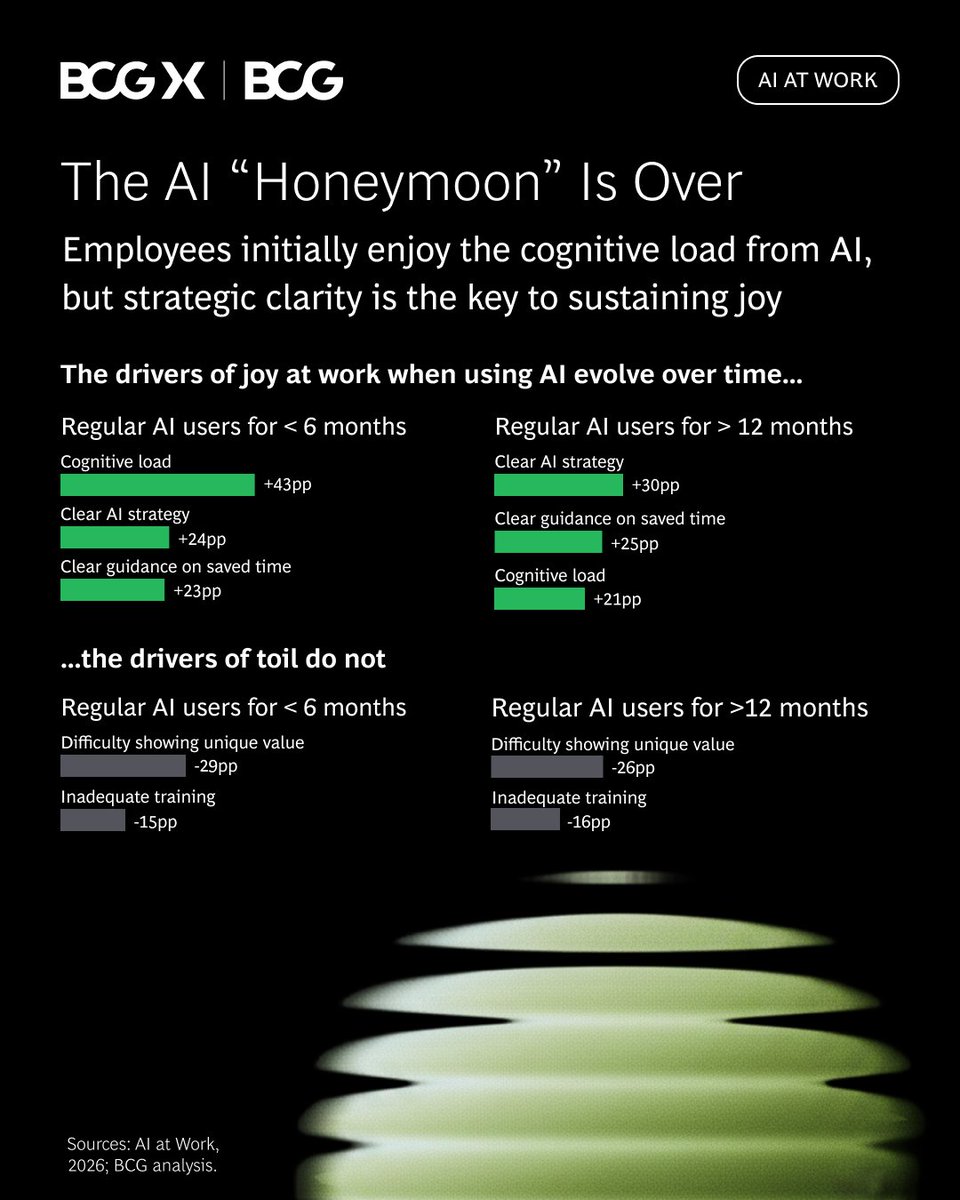
The AI “honeymoon” is ending for many organizations right now.
Early on, novelty drove momentum. Employees enjoyed the cognitive stretch, the new capabilities, the sense of possibility. Adoption climbed, and satisfaction scores looked good.
But BCG's fourth annual AI at Work survey shows that as the novelty fades, employee joy usually drops unless something else takes over.
That something is strategic clarity.
Employees who receive clear direction on where AI is taking the organization and what to do with the time it frees up consistently outperform those with greater access to AI tools but no direction.
Read BCG’s 2026 AI at Work report here: https://t.co/vELkmc2PQv
This is a great post if youre thinking about applied AI in the enterprise. The headline of this post is about what companies have huge upside from AI, but the deepest nuggets are about what AI transformation looks like in an organization.
It’s fundamentally about changing the underlying workflow or business process. As we move from chat tools to agents, those agents actually have to be deployed against workflows, which usually span multiple functions in an org. This is a different way of deploying AI than solely rolling it out to end users. It takes much more work upfront, but the results are the things that actually drive significant ROI.
“Software asks the employee to adopt a tool, but infrastructure changes the operating layer underneath the employee. The employee should still know what happened, and the process owner should still be able to pause the workflow, change a rule, approve an exception, or pull a person back in when needed. But the value should not depend on someone remembering to use the AI every day.”
The winners of this will be the platforms that can be deployed for specific workflows and business processes with a deep domain expertise. The playbook will often heavily require FDE support, change management, getting data well organized, be able to have comprehensive evals for the workflows, and much more to get right.
Just coming off of meetings with a couple dozen enterprise IT leaders discussing AI agents. Here are a few of the common themes that stand out:
* Lots of conversation that you have to solve an operating model challenge to get the full benefits of AI. Most companies have orgs that have always operated in siloes; but agents are most effectively when they are tied to a process, which often cuts across these siloes. So the big question is how do you start to deploy centrally managed agents that can work across organizational boundaries. Who manages these agents? How do they get deployed and adopted?
* Data fragmentation remains a major issue for most organizations. As long as data remains highly fragmented and not in standard formats, or data is not available to the right people and agents, enterprises are dealing with issues around being able to get answers from agents that are accurate or that conform to their business practices. This cuts across both systems with structured data (product metrics or revenue figures) and unstructured data (product roadmap or customer contracts).
* Clear sense that companies need to figure out what their core data moats are going to be in the future. If everyone has access to roughly the same superintelligence from the various models, then the context that you feed the models becomes proprietary value in the future. Capturing this data and getting it into a format that agents can use becomes very important.
* Everyone is trying to figure out the right metrics to manage to for AI adoption. General consensus that tokens are not the right metric per se, and people leaning more toward business outcomes (in an ideal world). For business outcomes (like more revenue or more shipped product), though, you have to get close to each individual workflow to figure out if it was successfully transformed with AI so it’s harder to manage top down.
* Growing view that enterprises are going to live in a multi-model world. Lots of interest (though early in actual adoption) in layers that can route workloads to different models (frontside or open weights) for cost or performance reasons. Also enterprises are trying to figure out what things do you give to the models directly vs. what do you separate as horizontal systems and context so you can swap any system in and out.
* Talent for driving AI adoption and implementation still remains a major issue and topic. Many view it as something you necessarily have to train for internally due to a shortage of talent being trained on this in the outside. As an aside, this feels like it remains a huge opportunity for those that get very good at deploying and management agents in an enterprise since most companies are looking for these skills.
* The best use-cases for AI tend to be those that fundamentally change the work being done instead of just replacing an existing process and doing it more efficiently. Companies are working through their versions of this individually because it’s different per industry, but this often remains both the most exciting and higher upside uses of AI.
Many more topics discussed recently, but overall it’s clear that there’s a ton of change going on with much more to come.
A very happy (93rd) birthday to Al Rappaport. His book published in 1986, Creating Shareholder Value, changed my life. He is a great scholar, teacher, collaborator, and friend. To celebrate, here are 3 of my favorite of his articles (read everything by him that you can!):
For the 7th year in a row, Anaplan has been named to the Constellation ShortList for top vendors in the Cloud-Based Planning and Performance Management Platforms 🎉 Access the report today! https://t.co/gzY6WV3Rl0
AI Agents will cause a TAM expansion in enterprise software because you can deliver use-cases that were not tied to tech budgets before. There will be many spaces where there are vastly more agents than seats or where the agent costs multiples of what a seat used to be.
Identifying and building out sustainable moats in AI is one of the most important and exciting topics if you're in software right now.
Given the fact that there are multiple at-scale frontier AI model providers with effectively infinite budgets, training data appears to be broadly available, and research breakthroughs spread relatively quickly through the community, we can anticipate that the cutthroat competition continues to drive down underlying AI pricing and increases performance over time. This is great news for developers.
One implication, however, is that we can expect the AI models themselves to handle more and more of the logic that customers are looking for directly; and it means that each individual market will see increased competition as the barriers to entry go down over time.
This means that the best problems to go after are ones where there is a major distance between the customer and the underlying AI model. And filling that gap must be sustainable, differentiated, and something people need to pay for. This value can show up in a variety of ways, but it will most likely correlate at least to some degree to the amount of software you've created and the uniqueness of the data set you touch or manage.
As with any prior software markets, this means that it's better to go after problems that can both start deceptively simply --so it's quick and easy to get going and see if you have product market fit-- but that have an almost endlessly complex surface area to cover to really solve them.
These opportunities will often be found in verticals that few other players understand, in integrating across many systems that are hard to connect to, where there are deep workflows that are challenging to get right (no matter what breakthroughs occur at the AI layer), and where the value increases the more data is in the system. Ultimately, the more frustrating and annoying the problem to build for, the more sustainable the moat.
We're still in the early innings of understanding how AI moats will get built over time, but it's easily the most dynamic and interesting period we've ever had in software.
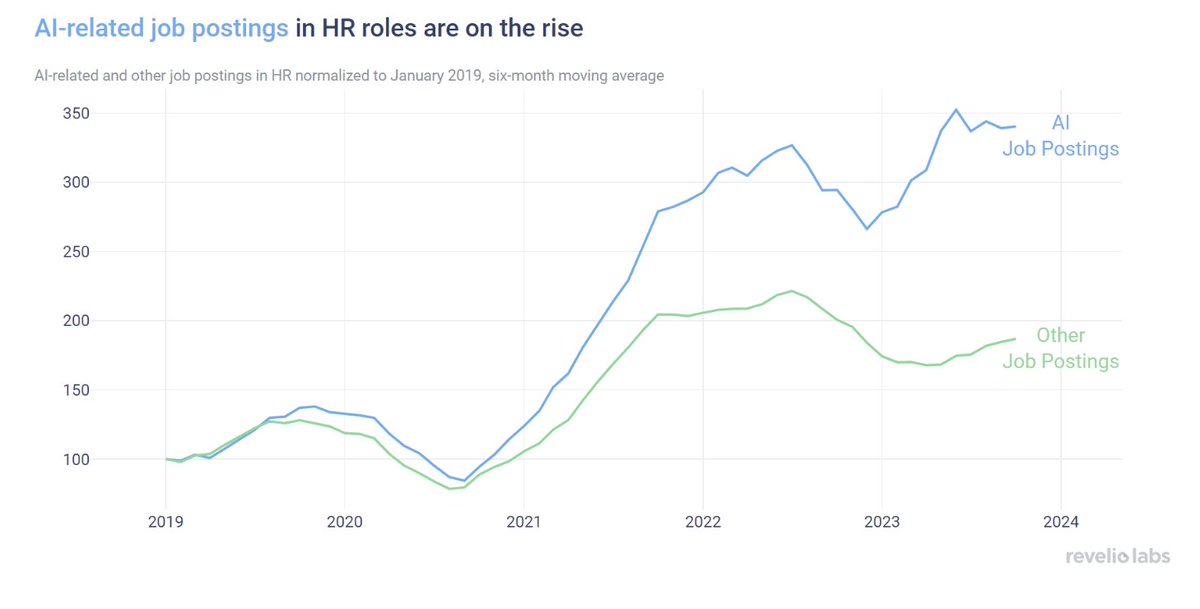
Everyone knows Moore’s law, the idea that CPU performance doubles roughly every two years. This has enabled essentially every innovation we’ve had with computers since the 60’s and 70’s. But remarkably, driven by GPU performance and AI model breakthroughs, we’ve seen a very different law emerge with respect to the rate at which AI model performance improves — in many cases improving by orders magnitude in the past decade. This introduces massive implications in world of AI Agents.
For the past five plus decades, in any domain that computers touch, we’ve generally seen massive efficiency gains that bring more tech to more people. For instance, scaling of servers in the cloud with AWS, accepting payments with Stripe, or powering communications with Twilio — in all of these cases something that once was extremely expensive and complex is now affordable and ubiquitous. And that affordability (or value delivered) generally only gets better as each year goes on. Yet the same has not been possible for essentially any non-digital services.
Historically, anytime you want to solve a non-computerized business problems (i.e. most knowledge work), we have seen the cost to solve a problem — say from healthcare services to legal work — tend only go up over time. Due to a mix of inflation, specialization in certain fields, regulation, decreased competition in markets, or other added costs, we’ve seen the price of most services generally monotonically increase over time.
Of course, much of this is perfectly fine, natural, and good. But this also puts a burden on driving economic activity in general, especially when creating new ideas from scratch, or starting and running a new business. Yes, I can get going with the cloud inexpensively, but that doesn’t matter if all other areas of my business are still hard to scale. Of course this is fine for a hyper growth idea in a mature market with access to the right resources, but that’s a small percentage of the world.
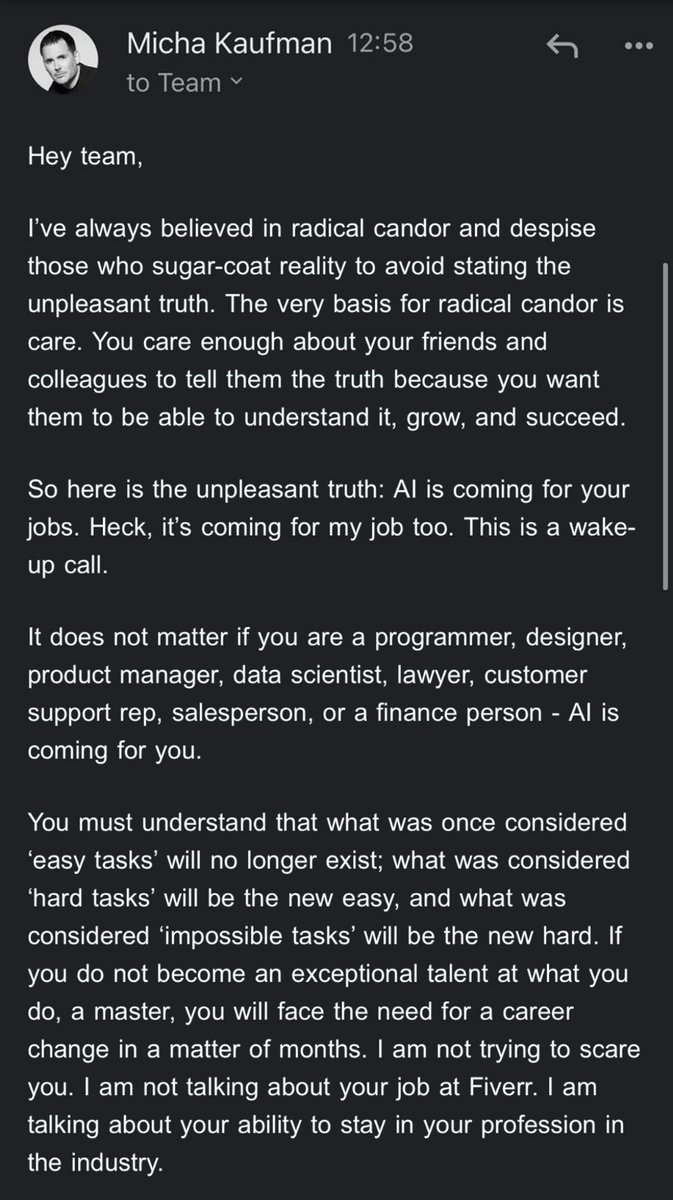
Yet, in a world of AI Agents, anyone — from a small business or large enterprise — has access to automated work that can let them address problems with variable capacity. When you decrease the cost of entry for getting knowledge work done, you dramatically increase the use cases for that work. That new sales program can be tested instantly instead of waiting weeks or months or never happening at all; you can test a broader surface area of your product for bugs or security issues; legal work and reviews becomes affordable on the seemingly insignificant transactions that otherwise produce risk; or you can launch a new marketing campaign in markets you didn’t otherwise serve.
AI lowers the barrier to doing all of these activities and more (and as I’ve shared before, ironically by doing so you actually will generate *more* job growth due to the productivity generated).
Even in a world of AI costs remaining stable this is a super compelling proposition, but in a world of constantly improving technology the implications are vast.
Just as Moore’s steadily lowered the cost of software, increased its sophistication, and made it more ubiquitous, we can imagine a world where knowledge work regularly gets more affordable, sophisticated, and ubiquitous at a constant rate. This means AI Agents presents the ability for any unit of work to continuously drop overtime, enabling us to solve greater and greater problems for a wider set of people and businesses. Of course, a large portion of these efficiency gains will quickly get “eaten up” by solving increasingly more sophisticated problems, but those problems will be solved at the cost of a previously simpler problem.
The implications of this are enormously interesting, and it’s going to create incredible opportunities all around.
85% of people believe lifelong upskilling will be the new norm, but barriers still remain to make it a reality, according to new ETS/Harris Poll research. https://t.co/D97D5AaEaD
#CEOs can drive the adoption of #GenerativeAI in their organizations, but strategic decision-making is crucial. Download the full report. https://t.co/t17moWq49Z
AI vocab of the week: "Reasoning Engines."
Reasoning Engines simulate human decision-making with rules, data, and logic and can be combined with automation to take action.
More on how they power conversational copilots and the benefits for your business: https://t.co/brARiX3k1j
Most S&P 500 companies are beating their earnings expectations, but how do they sustain this success? Renowned author @DanielGolemanEI and Olympic silver medalist Mark Richardson share game-changing strategies for both businesses and individuals.
https://t.co/MT4oAaEYhU
AI is empowering agricultural tech companies like Verdant Robotics, which helps farmers use chemicals sparingly and more precisely to save on cost and decrease health risks. https://t.co/Q1CiiyKk1T