Personal update: I've joined Anthropic. I think the next few years at the frontier of LLMs will be especially formative. I am very excited to join the team here and get back to R&D. I remain deeply passionate about education and plan to resume my work on it in time.
This works really well btw, at the end of your query ask your LLM to "structure your response as HTML", then view the generated file in your browser. I've also had some success asking the LLM to present its output as slideshows, etc.
More generally, imo audio is the human-preferred input to AIs but vision (images/animations/video) is the preferred output from them. Around a ~third of our brains are a massively parallel processor dedicated to vision, it is the 10-lane superhighway of information into brain. As AI improves, I think we'll see a progression that takes advantage:
1) raw text (hard/effortful to read)
2) markdown (bold, italic, headings, tables, a bit easier on the eyes) <-- current default
3) HTML (still procedural with underlying code, but a lot more flexibility on the graphics, layout, even interactivity) <-- early but forming new good default
...4,5,6,...
n) interactive neural videos/simulations
Imo the extrapolation (though the technology doesn't exist just yet) ends in some kind of interactive videos generated directly by a diffusion neural net. Many open questions as to how exact/procedural "Software 1.0" artifacts (e.g. interactive simulations) may be woven together with neural artifacts (diffusion grids), but generally something in the direction of the recently viral https://t.co/z21CP5iQfu
There are also improvements necessary and pending at the input. Audio nor text nor video alone are not enough, e.g. I feel a need to point/gesture to things on the screen, similar to all the things you would do with a person physically next to you and your computer screen.
TLDR The input/output mind meld between humans and AIs is ongoing and there is a lot of work to do and significant progress to be made, way before jumping all the way into neuralink-esque BCIs and all that. For what's worth exploring at the current stage, hot tip try ask for HTML.
"OpenClaw is the new computer." — Jensen Huang
This is the early PC era all over again.
A few power users see it.
Everyone else hasn't even started.
"It's the most popular open source project in the history of humanity, and it did so in just a few weeks. It exceeded what Linux did in 30 years."
A solo founder with OpenClaw can now build what used to take a 50-person team.
The leverage is absurd.
Uber founder Travis Kalanick just inverted the entire automation panic.
Everyone assumes AI eliminates human value.
The physics say the opposite.
Kalanick: “Let’s say the entire world, everything in our world, was automated except for plumbers. You had machines making buildings. You would basically have like a thousand buildings a day.”
The algorithm can design a skyscraper in a millisecond.
It cannot connect the pipes.
When compute violently accelerates the speed of construction, the unautomated human becomes the ultimate bottleneck.
And the bottleneck captures all the margin.
Kalanick: “How valuable would those plumbers be? Extremely valuable. Those guys, each and every plumber would be like LeBron. Why? Because plumbing is the long pole in the tent to progress.”
If the machine needs a human to finalize physical execution, that human doesn’t get replaced.
Their economic value goes exponential.
Kalanick: “You got so much efficiency everywhere else that you need millions of plumbers.”
The market thinks automation drives human wages to zero.
The physics dictate it drives the bottleneck’s wages to infinity.
The next decade doesn’t belong to whoever out-computes the machine.
It belongs to whoever stands at the exact point where the digital engine meets the physical world.
Kalanick: “If we get to this place where autonomous cars are everywhere, if it was a thousand to one, you still probably have, I don’t know, 20 million jobs, 50 million jobs.”
The panic over job destruction assumes a static volume of output.
When output goes infinite, the system demands more human oversight. Not less.
Waymo doesn’t delete the human. It shifts them from driver of one vehicle to director of a thousand.
Kalanick: “Until we get super AGI, humans are valuable and they are going to become more and more valuable because they will be the long pole in the tent to progress.”
You are no longer the engine.
You are the grid.
this is actually insane
> be tech guy in australia
> adopt cancer riddled rescue dog, months to live
> not_going_to_give_you_up.mp4
> pay $3,000 to sequence her tumor DNA
> feed it to ChatGPT and AlphaFold
> zero background in biology
> identify mutated proteins, match them to drug targets
> design a custom mRNA cancer vaccine from scratch
> genomics professor is “gobsmacked” that some puppy lover did this on his own
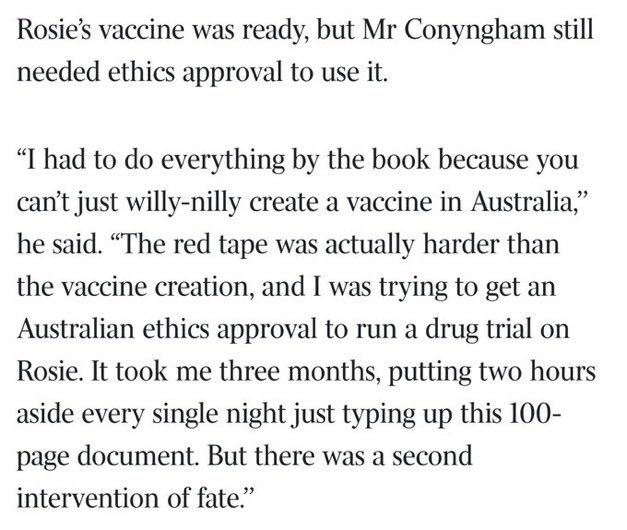
> need ethics approval to administer it
> red tape takes longer than designing the vaccine
> 3 months, finally approved
> drive 10 hours to get rosie her first injection
> tumor halves
> coat gets glossy again
> dog is alive and happy
> professor: “if we can do this for a dog, why aren’t we rolling this out to humans?”
one man with a chatbot, and $3,000 just outperformed the entire pharmaceutical discovery pipeline.
we are going to cure so many diseases.
I dont think people realize how good things are going to get
Software will proliferate just as videos, music, writing did.
The market structure will shift from a “fat middle” to mega-aggregators and a long tail.
It’ll be a slower process due to network effects, but many traditional vendor lock-ins will get eaten by AI.
I've never felt this much behind as a programmer. The profession is being dramatically refactored as the bits contributed by the programmer are increasingly sparse and between. I have a sense that I could be 10X more powerful if I just properly string together what has become available over the last ~year and a failure to claim the boost feels decidedly like skill issue. There's a new programmable layer of abstraction to master (in addition to the usual layers below) involving agents, subagents, their prompts, contexts, memory, modes, permissions, tools, plugins, skills, hooks, MCP, LSP, slash commands, workflows, IDE integrations, and a need to build an all-encompassing mental model for strengths and pitfalls of fundamentally stochastic, fallible, unintelligible and changing entities suddenly intermingled with what used to be good old fashioned engineering. Clearly some powerful alien tool was handed around except it comes with no manual and everyone has to figure out how to hold it and operate it, while the resulting magnitude 9 earthquake is rocking the profession. Roll up your sleeves to not fall behind.
If I could send my 18 year old self a message, it would have three parts:
1. Prestige is often mistaken. Follow curiosity instead.
2. There's no way to avoid hard work. It's not sufficient, but it is necessary.
3. Don't take your parents for granted.
@karpathy I guess what we're missing is having a subconscious agent.
We first created big models to emulate fast intuitive thinking.
Then we created reasoning to emulate deep conscious thinking.
We now need an agent that's working on the open loops our conscious mind left.
Lack of success is lack of focus and wrong priorities.
No one ever got talented by spending their time admiring talented people.
No one ever got healthy without sticking to some "boring" eating, training, sleeping habits.
No one ever got wealthy by constantly spending their money on their mimetic desires.
No one ever got loved without commitment and efforts to become a person worthy of love.
No one ever built long-lasting meaningful friendships without getting their personal life in order first.
No one ever got clear-minded without spending extended amounts of time alone.
No one ever got the life they wanted without overcoming their fears and making painful choices.
No one ever got things done without occasionally temporarily ignoring the rest of the world.
My 11 year old son is severely dyslexic and has serious ADHD. I show him clips of Alex Karp and Steve Jobs to remind him that minds like his build extraordinary things.
Anyone shaming Alex or people like my son for learning/thinking differently is likely low IQ.