We're adding support for AGENTS.md to Claude Code.
Starting today in version 2.1.277, if there is no CLAUDE.md in a folder, Claude will check for and use AGENTS.md.
You can toggle this behavior in /config.
Last month I wrote about how we can build a positive and safe future for everyone: https://t.co/eoLGVY8yad
Every lab has the responsibility and incentive to move at the pace required to train its models safely, and the ability to take its own actions to ensure that happens.
The reality is:
- People won't want to use agents that are misaligned with them and that don't do what they ask, so labs have a strong natural incentive to make their models more aligned.
There is a lot of debate about slowing progress on capabilities until alignment catches up. My view is that trust and alignment are quickly becoming the most important capabilities that will differentiate agents and models. Any lab that doesn't focus on alignment will fall behind.
- Labs face significant liability if their models cause harm, so they have a strong incentive to prevent this as well.
Meta delayed shipping Muse for several months to focus on safety and security. We didn't call for everyone else to do this before we would. We just did it as part of our day-to-day work because it was clearly the right thing for people and for us. I'm proud of the security foundations we've built.
- Engaging independent evaluators and advisors is industry best practice. MSL already does this today in several areas because it helps produce better work. Other labs can just do this too. In general, it would be helpful for there to be a larger and more diverse ecosystem of evaluators.
- Committing the significant majority of compute towards serving people rather than racing towards recursive self-improvement is one of the best ways to ensure we develop this technology safely. Meta has made this commitment and other labs can do this as well.
I believe the key to building a positive future for everyone is maintaining the right balance of power. This is within our power to do.
I must be among an extremely small group of people (n=1?) that have both 1) trained a frontier LLM and 2) designed and synthesized custom viruses in a lab with my own two hands.
And I think that the takes on AI killing us all by creating dangerous viruses is total bogus.
Regret the tone of my post on data centers yesterday.
What I should have said:
There were reasonable concerns about data centers 18ish months ago: water, taxes, jobs, electricity prices, the environment and what they would do to small towns. Well-structured data center projects have largely addressed these concerns today and we should be celebrating this.
On balance, data centers are awesome for America in every way.
On water: U.S. data centers use a fraction of what golf courses use. A lot of the numbers from 18 months ago were off by over 1000x. Newer data centers use closed-loop systems or recycled water. Should be required by every town approving a data center project.
On taxes: looking only at sales-tax exemptions, as Ronan Farrow did, is the wrong way to evaluate this. Data centers pay significant property taxes. Loudoun County, which is the wealthiest county in America, now collects on the order of $1 billion a year from data centers. In Quincy, WA, data centers are more than half the property-tax roll. Over time, property taxes can go to zero while government spending increases in these towns.
On jobs: this has been unambiguously awesome for blue collar Americans. Demand for electricians, plumbers, welders, HVAC techs, and contractors has gone vertical, and it is not a one-time construction job. These buildings get upgraded and expanded over time. That is why the building trades are fighting for them, and why some unions are now treating opposition to data centers as a reason not to endorse politicians.
On power: the original fear was that households would pay for the incremental electricity demand in the form of higher prices. That is why the ratepayer-protection deals and the new large-load tariffs exist. The right structure is: the data center brings or pays for new generation and signs a contract long enough that existing customers are protected. Where that is happening, utilities are cutting or freezing residential rates and saying so on the record. Where it is not, people are right to object. Electricity prices are going down *today* in a number of large states because of data centers.
On the environment: data centers overwhelming use natural gas today, which is the cleanest power source outside of nuclear, solar and wind. And the companies that are building the data centers are committed to carbon neutrality such that an equivalent amount of solar will likely be built. Maybe more importantly, the data centers need batteries to function effectively and these batteries can also sell energy back into the grid (which recently prevented blackouts in Texas). Over time, data centers will run on solar plus batteries.
On the towns: Poverty in Quincy, WA fell from 29% to 6%. Data center taxes paid for a new high school, a hospital, a library, police and fire stations. This is happening in many left for dead former mill and farm towns that had no other bidder for the land.
Data centers are actually reindustrializing parts of America and creating the kind of working-class jobs both parties have spent decades claiming to support. That should not be a partisan issue. Data centers can and should be awesome for America and they increasingly, overwhelmingly are. Supporting the outsourcing of data centers to China will likely age just as well as support for the outsourcing of high quality, blue collar manufacturing jobs to China has aged.
When the facts change, I change my mind. I hope that reasonable people who had good faith reasons to oppose data centers at least consider updating their beliefs given the change in the facts over the last 18 months. This really matters for America.
I will say I also think the idea of making data centers beautiful is a good one that has yet to be implemented. Data centers should be just as beautiful as Grand Central Station. We can learn a lot from the railroad buildout. Neoclassical revival ftw.
Might write up open-weight AI tomorrow as this is equally essential to America.
Introducing Billow (YC S26)
We're killing Deloitte.
Accounting is a $700B industry, but 80% of companies still do it by hand.
Billow is an AI-native accounting firm that replaces humans with agents.
We connect to your existing tools (NetSuite, QuickBooks, and 80+ other systems) and provide faster, cheaper accounting services.
There is ZERO software for customers to use. Just integrate, and Billow closes your books.
We're live with enterprise and public companies representing over $1B in value.
My dog Rosie was given months to live. Chemo and immunotherapy failed
I used chatgpt + computational genomics to design a personalised mRNA cancer vaccine for her tumour. Several of her tumours shrank
Today we launch Gamgee (YC S26): personalised mRNA cancer vaccines for dogs
JUST IN: @DynaRobotics just published one of the most important research papers in robotics this year.
It could fundamentally change how robot foundation models are trained. A scaling law that transfers from human video to robot performance.
Dyna-2 is out and it's 🔥
Here's what that means in plain terms.
Dyna-2 was pre-trained on ONE MILLION hours of egocentric human video, 170 years of continuous human experience, cooking, folding, assembling, cleaning.
And as that human data scaled, robot performance improved. Predictably. Monotonically. Across 39 tasks on two different robot embodiments the model had never seen.
→ 1,000 hours pre-training → 20% normalised task performance
→ 10,000 hours → 28%
→ 100,000 hours → 45%
→ 1,000,000 hours → 53%
Human video exists at effectively unlimited scale. Every cook, every factory worker, every craftsperson wearing a camera is generating training data for future robots.
But the finding that stunned even the researchers, world modeling is what makes the transfer work. A model trained to predict future video AND actions massively outperforms one trained on actions alone. Video is the new scaling axis for robotics.
One more jaw-dropping data point. 13 minutes of teleoperation data was enough to fine-tune Dyna-2 to open a bottle cap using two five-fingered robot hands.
The robots are coming, and they're learning from us directly :D
Read more here: https://t.co/RP8MA3lDvc
Congrats @JasonMa2020 and team!
~~
♻️ Join the weekly robotics newsletter, and never miss any news → https://t.co/GoA3ZuwoPB
Today we are introducing Dyna-2, a world-action model pre-trained on one million hours of human video. At this scale, for the first time, we discovered several new scaling laws:
• world-action models exhibit scaling law on human data across four orders of magnitude, from 1000 to 1,000,000 hours,
• this human data scaling law implied a scaling law on never seen robot data,
• both data and objective matter; world modeling and scaling on video data are essential for cross-embodiment scaling transfer to emerge
🧵
Introducing Omanta (YC S26) the personalized research lab for each patient.
Omanta integrates a patient's full medical record, personal genomics, and the latest scientific evidence to understand the molecular drivers of their disease. It maps existing and emerging therapies against their biology. And when the right treatment doesn't exist yet, it launches a personalized campaign to build it.
Even the hardest cases rarely have a team dedicated to solving them. Physicians make high-stakes calls with limited time, while data and therapies emerge every week. Science moves fast, but reaching the patient can take years.
That's the gap Omanta was built to close.
Founders Alfredo Gonzalez, PhD and Ranad Humeidi, PhD spent years on some of the most difficult cancer cases. Alfredo led the personalized therapeutic campaign behind Sid Sijbrandij's complete remission. Together they've worked with leading institutions on personalized vaccines, CAR-T, drug repurposing, expanded access, and continuous molecular monitoring. They've seen what becomes possible when the full force of modern science is organized around one person.
They met eight years ago doing early CRISPR cancer research at the Broad Institute of MIT and Harvard. Alfredo Gonzalez (CEO) has a PhD in bioinformatics from UCLA and led research projects across the Broad Institute, UCLA, and Harvard. Ranad Humeidi (CSO) has a PhD in chemical biology from Harvard, and has built and run rare-cancer programs for individual patients when standard options ran out.
https://t.co/XwNO578Sr6
A research lab, for one.
Linked-in: https://t.co/1Yu7GsxffW
YC Launch: https://t.co/ccZhC854GU
This vial contains a new drug called PAC-832, which I recently invented to treat Alzheimer’s disease. It is the world’s first selective GalR1 antagonist.
I designed and synthesized PAC-832 in a chemistry lab I built in my garage. (1/16)
Introducing Horizon from @0rinlabs: the first long-horizon learning benchmark made from real agent logs
- SOTA is 21% on the hardest section
- 7-35M tokens of real agent history per task
- Models are hardly getting better on the hardest tasks
- Humans can score 100%
(1/7)
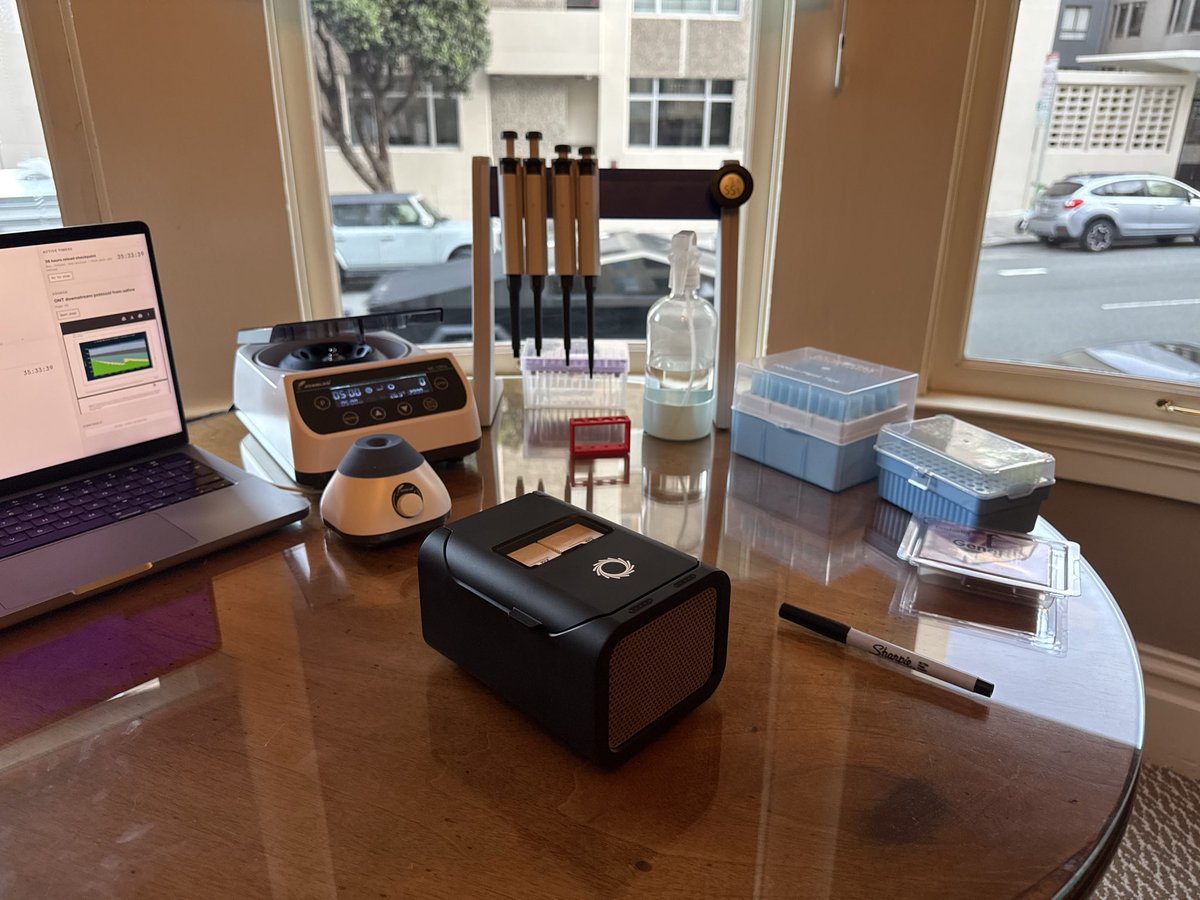
I just sequenced a human genome to 30× coverage entirely at home.
As far as I know, this is the first time this has been done.
I didn’t step foot in a lab once. Every step - from saliva collection, to running the sequencer - took place in a single room with a dining table + kitchenette.
Six weeks ago, I had never done wet lab biology before.
I used an Oxford Nanopore P2 Solo - the only commercially available sequencing device portable enough to do 30x human genome sequencing at home.
Biggest takeaway - I could build something that combined software, hardware, and molecular biology far faster than I thought was possible.
I can name >100 specific instances where AI helped me solve a technical problem that would previously have blocked me because I lacked access to a domain expert.
For example: how do I save my sequencing run when my DNA extraction yield is 4x lower than I need it to be, and I have this limited set of reagents to hand?
To make this work, I had to navigate multiple disciplines:
- writing software to monitor sequencing runs and orchestrate remote GPU infra for basecalling
- learning + executing 5 hour long molecular biology protocols
- building a hardware device to quantify DNA concentration
Apologies for the hyperbole, but I feel super lucky to be living in 2026.
A few weeks ago I decided to sequence a human genome to 30x at home.
Then I actually did it. And I did it really quickly.
🚀 After a year of quiet building, I’m excited to officially announce @champ_hq out of stealth. We're also announcing our $8.5M Seed round led by @Redpoint with participation from @defyvc , @Max , @svangel, and a great group of angels. Watch the quick launch video below