1/ We discovered something totally unexpected about the neural structure of consciousness that overturns decades of thinking on its biological basis and brings us significantly closer to the recipe for generating conscious awareness.
New preprint: https://t.co/K8BwiHXvXg (led by @HesseJanis, with @FrankLanfranchi, @_conor_mcgrory, @Yuelin_Shi, and @EngelTatiana)
Have you ever looked at a gene in IGV or a genome browser and wondered “What are all those (ATAC-seq/H3K27ac/CTCF ChIP-seq/…) peaks doing?” 🤔 I’m thrilled to share that we developed a new technology called Swap-seq to answer that exact question.
https://t.co/GMC1MJTNzB
I've seen a ton of posts about a fourth person who also deserved this Nobel, Ed Boyden, but not much about Zhuo-Hua Pan. The history below and the article about Pan are wild. A small lab, a vision-only framing, and two paper rejections are most of the reason his name isn't in the citation history.
Feb 2004: Zhuo-Hua Pan, at Wayne State, has the protein ChR2 firing cultured retinal ganglion cells. (His account.)
Jul 2004: Pan uses a virus to deliver ChR2 into living rat retinas; five weeks later he records light-evoked responses in vivo. (His account.)
Aug 2004: Ed Boyden, working with Deisseroth at Stanford, gets light-driven spikes in cultured hippocampal neurons.
Nov 2004: Pan submits to Nature, whose editors send him to Nature Neuroscience, which rejects it. The Journal of Neuroscience rejects it next.
May 2005: Pan presents at the ARVO meeting. That 15-minute talk and its abstract are the first public record: ChR2 in rat retinal neurons in vivo, light-evoked depolarization.
Aug 2005: Boyden, Zhang, Bamberg, Nagel and Deisseroth publish in Nature Neuroscience, framed as a general tool. (The editor later told Pan that framing, not the biology, was the difference. His paper read as a vision-restoration finding, theirs as a technology.) Pan's own paper lands in Neuron in April 2006, by which point three other groups had published on ChR2 in neurons.
The patent office treated Pan’s May 2005 abstract as prior art and rejected a Stanford patent more than once. It didn't issue until March 2016, after Boyden and Deisseroth signed a declaration that they had conceived the method in the lab before that abstract.
"Boyden, who is now a professor at MIT, was surprised when told by STAT that Pan ran the experiment first.
"Wow. Interesting. I didn't know that," Boyden said."
How much of this is the rejections and how much is that Deisseroth and Boyden saw the general tool while Pan was aiming at blindness? Probably both. But it's a reminder that what counts as inventing something in science is mostly a question of who publishes, and publishing is not a neutral process.
https://t.co/yCAqcfC2w9
PubMed is now supported on OpenResearch 🧬
Search more than 40 million biomedical papers with the brand new literature search experience, including figures and in-line citations.
Turn your coding agents into research agents. Try it out now: https://t.co/cPajIPibp4
Our research group @iitgncompbio is looking for 1-2 motivated PhD students to work in the area of Molecular Dynamics Simulations and Protein Biophysics.
More details on research - https://t.co/MeOLS8bfZ0
Please reach out to me or @Karthick_Sudars, @yashasvi_always to know more
I have some thoughts about this: a thread. "DeepMind’s new genome ‘atlas’ charts effects of all nine billion human gene mutations" https://t.co/L8ow4uvuto TL;DR: AI slop is taking over genomics 1/N
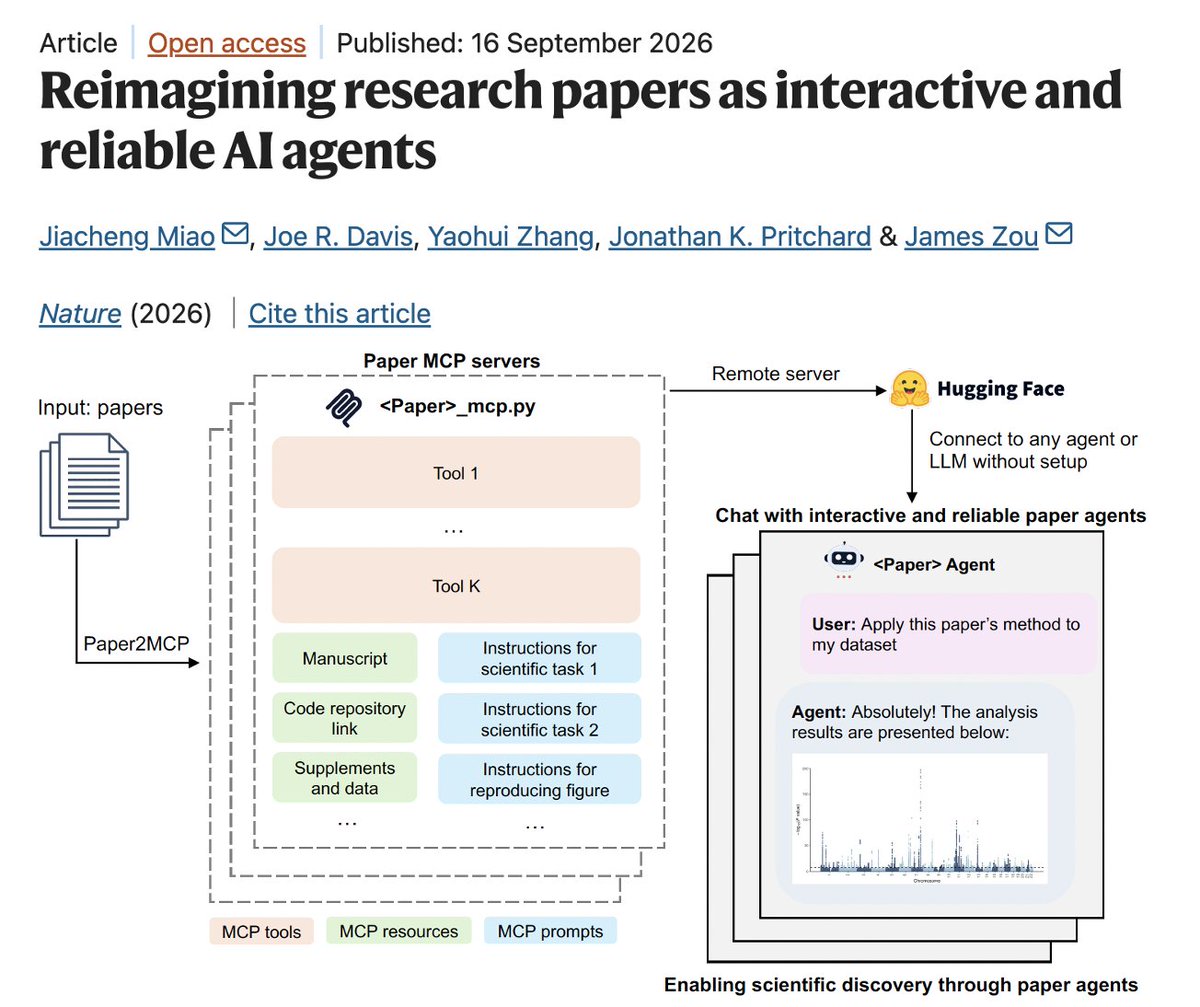
Thrilled that #paper2agent is published in @nature today!
Scientific knowledge is traditionally stored in passive papers. Paper2Agent transforms papers into virtual authors that answer questions, apply its methods and collaborate w/ other paper agents to make new discoveries 🧵
If you are baffled but curious about the Navier-Stokes news today, this article I tweeted about a few days ago is now more worth reading than ever. It gives a witty, insightful overview for a general reader, as long as you are willing to read about math. https://t.co/cDgOUExlch
Here's another exploration of what GPT-6 Astra can do with 3D human anatomy. Exploding view of the right upper extremity!
Check out yesterday's post for a carpal tunnel release surgical demo.
Try it here: https://t.co/VnNEokSCbR
Okay, this is genuinely impressive.
I asked GPT-6 Astra to help me understand my own ankle pain. It gave me a full interactive 3D atlas — bones, ligaments, tendons, real motion axes, sliders for plantarflexion and inversion, and a live readout of what each ligament is doing.
One session.
Learning resources play a key role in shaping where talent goes. Today I’m launching my side project, BioTorch, in public beta to give researchers a clearer path into biological AI.
LLMs have a wealth of great tutorials, courses, and minimal implementations from great teachers. They make the path from curiosity to contribution easy to see and offer researchers from fields like math or physics a legible roadmap to transition into AI research.
In bio AI, that path is much harder to piece together. That friction can mean fewer researchers entering the field, fewer startups getting built, and less investment allocated to promising ideas. This ultimately leads to fewer life-saving cures being discovered than would otherwise be possible.
BioTorch is my attempt to help change that.
It starts with 116 PyTorch exercises and 17 model guides. You implement the building blocks, test your code, and see how the pieces fit into seminal models like AlphaFold2, ESM2, and RFdiffusion.
The goal is to make influential papers in bio AI something you can understand and build on, bringing researchers up to the frontier as rapidly as possible.
I want more people working on biology’s hardest problems. My mission is to help researchers find their way into the field, and BioTorch is the result of that ambition.
BioTorch is completely free while in beta.
Try your first problem now!
https://t.co/BHmN59S3bI
The Rosalind Workbench has been out for a week now - show me the coolest thing you've built with it!
Coolest project gets 1 free year of ChatGPT Pro!
Either comment here or quote tweet me to submit. Provide screenshots and the Rosalind plugins you used to make it happen!
As we're waiting for Astra, I've optimized and updated my Paper Reviewer with the latest Sol flagship model: https://t.co/HvmQd5TTLg It's really good! Run it in Codex on your own papers before you submit to a journal, and let me know if you have ideas for how to improve it.
I am building an extremely sophisticated biomedical science application with GPT-6 Astra for analyzing flow cytometry data.
Flow cytometry is one of the most essential technologies in immunology. It allows us to analyze tens of thousands, or even millions, of individual cells from blood, tissues, or other samples, using fluorescently tagged antibodies that identify specific cell types and measure the proteins they express. It's like our window into the world of the cells.
For decades, labs like mine have paid thousands of dollars every year in subscription and licensing fees for commercial software to analyze these datasets. I have canceled all my subscriptions 😊
I have now almost built a fully functional, research-grade version of such an application with Astra! It already has a better UI/UX than many of the tools I have used, and my goal now is to make it even better than the leading commercial applications in this field!
I had in fact built earlier basic versions using previous Codex models, but this is the first time I have reached a version that works exactly the way I want it to, with the interface, analysis workflow, and features behaving almost perfectly. Previous versions took a lot of efforts with many bugs to deal with, with Astra you get what you ask for almost the first shot! It's just unbelievable!
And this is only one project. I have several other highly complex biological and biomedical software applications in my Astra pipeline. At this point, my main bottlenecks are basically token limits and the number of hours I can stay awake and massive coffee stocks! 😂
It is just incredible to think that scientific software that once required specialized development teams, years of engineering, and sometimes million dollar budgets can now be built by someone like me who has no software engineering experience!
With Astra you can just do things! ✨
At OpenAI, it's felt like our researchers & engineers have been living in the future with Codex.
Today, we're bringing that same experience to life science researchers with the Rosalind Workbench.