Principal Software Engineer and AI Enthusiast :) Ex Microsoft. Building MVP for marketers.Scratched Surface of Understanding this Universe and helping others :)
Late night musing 1: Observer changes the behaviour of those who are being observed, its true for both physical beings as well as quantum particles. Are the quantum particles being wired by someone to behave a specific way when observed?
@xusheel Yes learning about dharma then found these universal laws or sanatana dharma which means learn from laws of nature as human as we as humans try to demand that reality obey our preferences🤣. Understanding the reality helps us to make our actions intelligent as human 😀
No. Law of nature :What to remember
1 Impermanence :Everything changes.
2 Cause and effect :Every action has consequences.
3 Interdependence :Nothing exists in isolation.
4 Limits: Everything has constraints.
5 Adaptation :Learn and adjust.
6 Energy :Manage your resources.
Cont.
7 Feedback:Observe and correct.
8 Cooperation and competition: Know when to collaborate.
9 Diversity :Respect different natures.
10 Cycles :Work with rhythms.
11 Balance :Avoid destructive extremes.
12 Conditioning :Your habits shape you.
13 Mortality and renewal :Time is finite.
@RDXThinksThat Why you are discrediting any movement raised by indian public by using a tactic of labelling them anti national. It pains my mind to see a high ranking official from army who is ignoring issues from his fellow countrymen on 101 basics (ed/jobs/fair election)
If I got laid off tomorrow & had to replace my salary asap, here’s exactly what I’d do:
1. Go to Instagram and start a fresh account. Use a spare email. No one has to know.
I’m excited to finally announce the newest edition my Stanford course 𝗧𝗵𝗲 𝗠𝗼𝗱𝗲𝗿𝗻 𝗦𝗼𝗳𝘁𝘄𝗮𝗿𝗲 𝗗𝗲𝘃𝗲𝗹𝗼𝗽𝗲𝗿. It has been 9 months in the making.
Last November, with the release of Claude Opus 4.5, coding agents experienced a step function improvement in capability. We all felt it. The LLMs were more powerful, could reason for longer, solve harder tasks.
This year’s iteration of my course reflects the 2026 metamorphosis of software engineering.
My core belief is simple: AI-native developers of the LLM era are going to become the most important members of any software organization. I have designed my course to train this next generation of engineers.
𝗪𝗵𝗮𝘁’𝘀 𝗱𝗶𝗳𝗳𝗲𝗿𝗲𝗻𝘁 𝘁𝗵𝗶𝘀 𝘁𝗶𝗺𝗲 𝗮𝗿𝗼𝘂𝗻𝗱
First, 85% of my Fall 2025 class material is being thrown out. The Fall 2026 syllabus reflects the core capabilities AI-native engineers must have: agent skills, advanced context engineering, MCP portals, agent-ready codebase principles, agentic code review, security, parallelizing background agents, software factories, and more.
Second, I am going to teach my students how to have software taste. Every student will be required to ship pull requests to production-grade, real-world codebases. The course is collaborating with the top open-source AI repos who will offer support and mentorship to students on how to meaningfully contribute to their projects.
This has never been done before in any university course so I am incredibly grateful to our OSS Partners: @browserbase, @HeyGen, @CopilotKit, @semgrep, @OpenHandsDev, @milvusio, @marimo_io, Pi, @crewAIInc, @warpdotdev, @vercel, @cmux, @arizeai, @UnslothAI, and @anyscalecompute.
𝗪𝗵𝗮𝘁’𝘀 𝘀𝘁𝗮𝘆𝗶𝗻𝗴 𝘁𝗵𝗲 𝘀𝗮𝗺𝗲
I’m fortunate to again have AI software engineering leaders and founders as guest speakers to share their learnings from building top coding agent products. Thank you to @leerob from @cursor_ai, @bcherny of @claudeai code, @EnoReyes of @FactoryAI, @silasalberti of @cognition, @0xine of @semgrep, Rajesh Bhatia of @Cloudflare , @amasad of @Replit, and @eladgil.
All resources will be available online. All classes will be available to the public.
9/22 on Stanford campus. See you in class.
https://t.co/wTokHyUMsz
@Rekha1949789307 This is AI see closely the car at start was coming from back so there should be some space but there is no space. There is another car
Anthropic's CEO: "coding is going away first. then all of software engineering."
In 8 minutes he explains what replaces it and who gets left behind.
This isn't about learning a new language. It's about learning a new way to build.
Watch it first. Then read the full roadmap below on how to become an AI engineer even without any experience.
Advice for people in tech.
> Keep an emergency fund of 9-12 months with you
> Avoid taking loans, unless necessary
> Upskill post job hours, in weekend, whenever you can
> Take the job that comes your way if pay is decent
> Be interview ready as much as possible
> Ask for work, if you feel you aren't contributing enuf
Consider yourself lucky if you a job, tough times for people who haven't upskilled much in last few years.
🚨 Google CEO, Sundar Pichai: "If you don't learn to how to orchestrate agents now, you'll spend 2027 catching up to people who started today"
In 30 minutes he explains why the best engineers stopped writing code and started building agents.
Most people think building an agent requires an engineering degree.
It doesn't. It requires one guide and one afternoon.
Watch the interview, then save the exact setup below 👇
Ex-Google Jeff Dean just released 1-hour lecture on full AI engineering: LLM → prompts → agent teams → graphs from 0% to 100%:
0% → 1:45 - LLM from scratch - that made Google
30% → 17:22 - how to actually use AI models
65% → 30:03 - prompt engineering
100% → 52:35 - one human coordinating 100 agents
this is 27 years of AI in Google compressed into one hour, by the person who lived it
watch it today - then read how to build graphs in the article below ↓
Persi Diaconis, Stanford mathematician and former professional magician:
One of the most dangerous mistakes in quantitative trading is assuming every profitable backtest contains a real edge.
This lecture explains why. Given enough data, enough variables, and enough attempts, randomness will eventually produce patterns that look incredibly convincing. Some of them will even work for years before falling apart.
That's why the best quant firms spend far less time finding signals than they do trying to prove those signals are false. A pattern is easy to discover. Demonstrating that it survives outside the data that created it is the hard part.
The mathematics behind this has been public for decades. The challenge was never finding a backtest that worked.
The challenge is knowing whether it worked for a reason. Bookmark this before your next strategy test.
Someone turned Claude into an entire company.
42 skills, organised like a real org chart (links below):
Here is every department, and where to get each one.
Developers
Superpowers → https://t.co/pPPxKoPEwD
Context7 → https://t.co/3Kk9U8PG1T
Skill Creator → https://t.co/Lanao7tpOh
MCP Builder → https://t.co/Lanao7tpOh
Webapp Testing → https://t.co/Lanao7tpOh
Claude-Mem → https://t.co/yTb8qxqa7S
Designers
UI UX Pro Max → https://t.co/MQTtS9flwt
Taste → https://t.co/AEq4GZc60x
Frontend Design → https://t.co/AEq4GZc60x
Transitions → https://t.co/Z7JOt7lJb2
Web Artifacts → https://t.co/Lanao7tpOh
Brand Guidelines → https://t.co/Lanao7tpOh
Marketing
45 skills to run your marketing, from copywriting to SEO to lead magnets.
Access them all here → https://t.co/OWo258NM7L
Social Media
17 skills to run your social media, from post writing to Reels to thumbnails.
Access them all here → https://t.co/2qawCgAyQF
Finance
8 skills to run your finances, from statements to reconciliation to audits.
Access them all here → https://t.co/X6dVFcZBIJ
Small Business
31 skills to run your small business, from cash flow to payroll to invoicing.
Access them all here → https://t.co/7Prb2sXVpI
Legal
9 skills to handle your legal work, from contract review to NDAs to compliance.
Access them all here → https://t.co/GKaZzGYPOr
Every skill on the chart is real and installable from the links above.
Same departments. Same output. No payroll.
Bookmark this.
Andrej Karpathy spent 8 years at OpenAI and Tesla.
Last week he put everything he knows into one free 2-hour lecture.
People pay $15k for bootcamps that teach half of this.
You probably don't have 2 hours right now. Don't lose this in the feed.
Watch it. Then read the guide below and build your first loop.
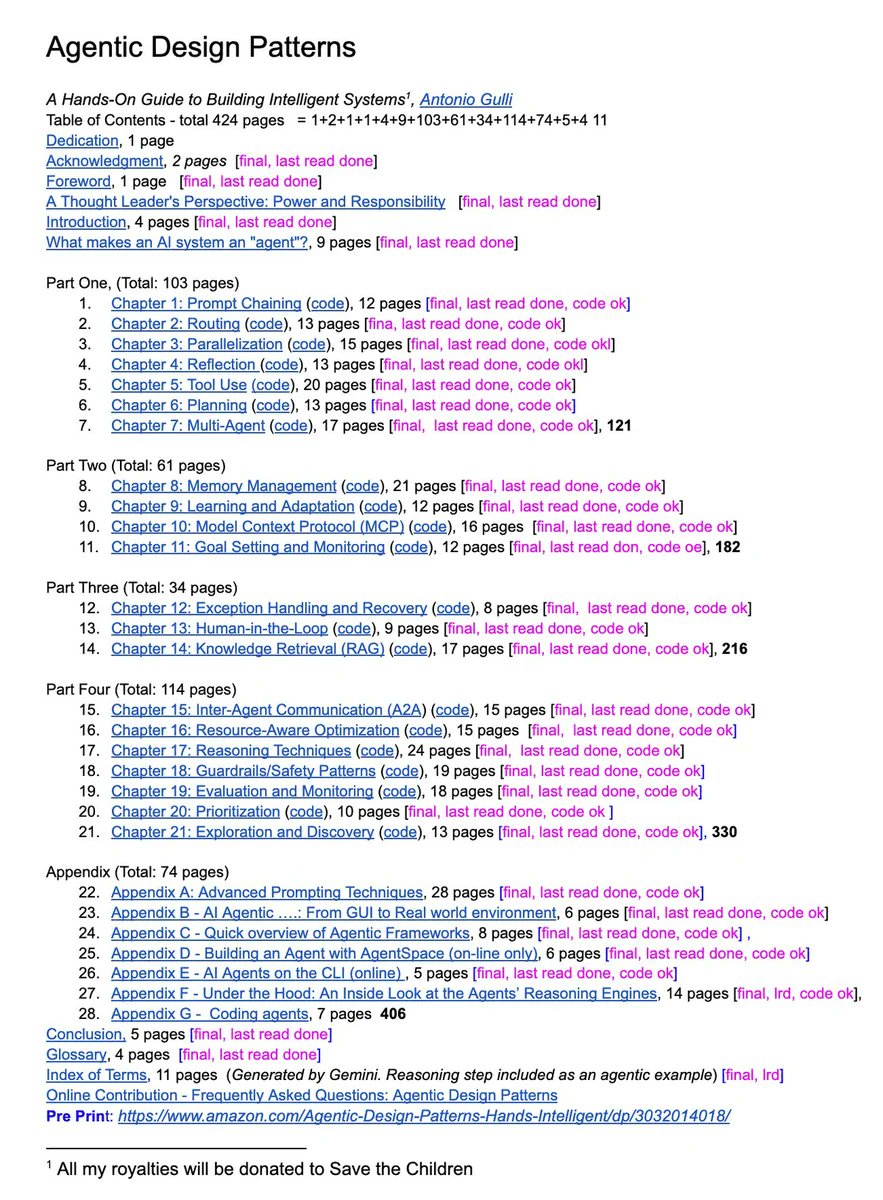
A senior Google engineer just dropped a 424-page doc called Agentic Design Patterns.
Every chapter is code-backed and covers the frontier of AI systems:
→ Prompt chaining, routing, memory
→ MCP and multi-agent coordination
→ Guardrails, reasoning, planning
This isn't a blog post. It's a curriculum. And it's free.
Read it this weekend.
That said, I wrote an article on how to build a multi-model AI team in 2026, which was already read by 4 million people.
It's a complete guide to agents, models, workflows, and playbook to run your business on autopilot.
The article is quoted below.
Stanford professor just released the lecture that explains the math behind every reinforcement learning system.
83 minutes. Free. From Stanford.
Before agents learn to trade, optimize, or make decisions, they all start with the same problem:
How do you choose the best action when the future is uncertain?
This lecture breaks down the foundation:
• turning environments into Markov Decision Processes
• policy evaluation and why value functions matter
• Q-value recurrence equations behind modern RL
• value iteration and convergence limits
Every RL algorithm built today is just a variation of these ideas.
The math has been public for decades.
The hard part was never knowing the Bellman equation.
The hard part is knowing when your model actually understands the environment and when it is just fitting noise.
Bookmark this before it gets buried in your feed.