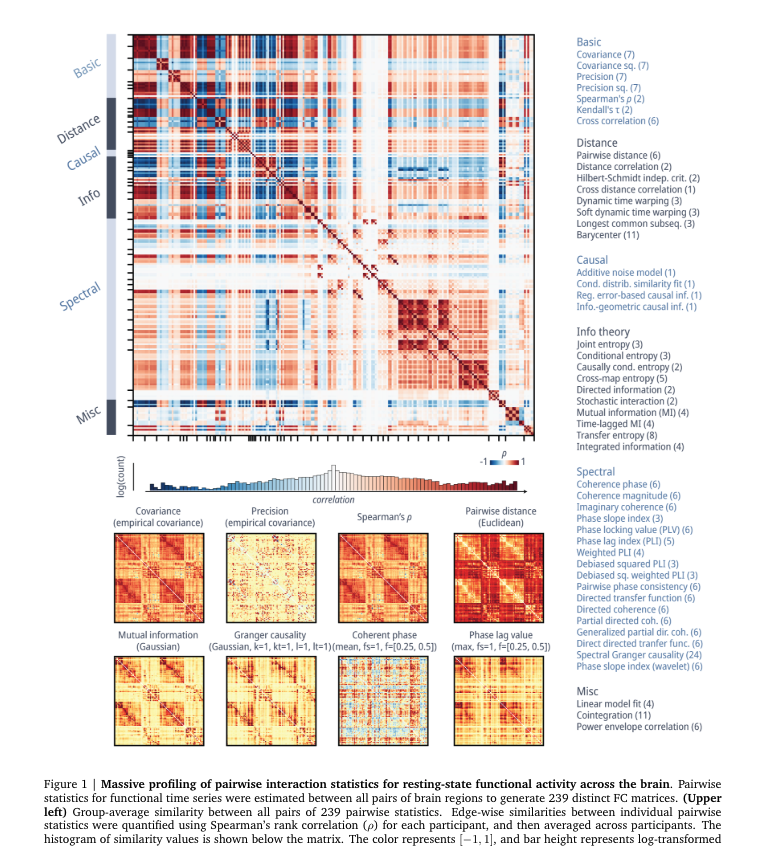
New preprint! In this study, we investigated changes to functional connectivity across stages and cycles of overnight sleep. It is the product of many sleepless nights 😅
https://t.co/GZr7R47rUr
Hello! Bit of a long shot, but I'm hoping to find work in the Melbourne area. My experience is mainly in neurophys recording (hd-EEG, fMRI) and my interests include sleep, mental health, gut-brain interaction, and more. Any leads would be so appreciated!
What happens when our stream of consciousness turns inward, towards the body? Our new fMRI study of 536 individuals finds that 'body-wandering' is associated with distinct patterns of brain connectivity, physiology, affect, and mental health: https://t.co/wepZGVCMXl
Very happy this is out! Our last publication with the great @DolfenNina allows us to better understand how the hippocampus contributes to motor sequence learning. Thanks for all the work Nina!
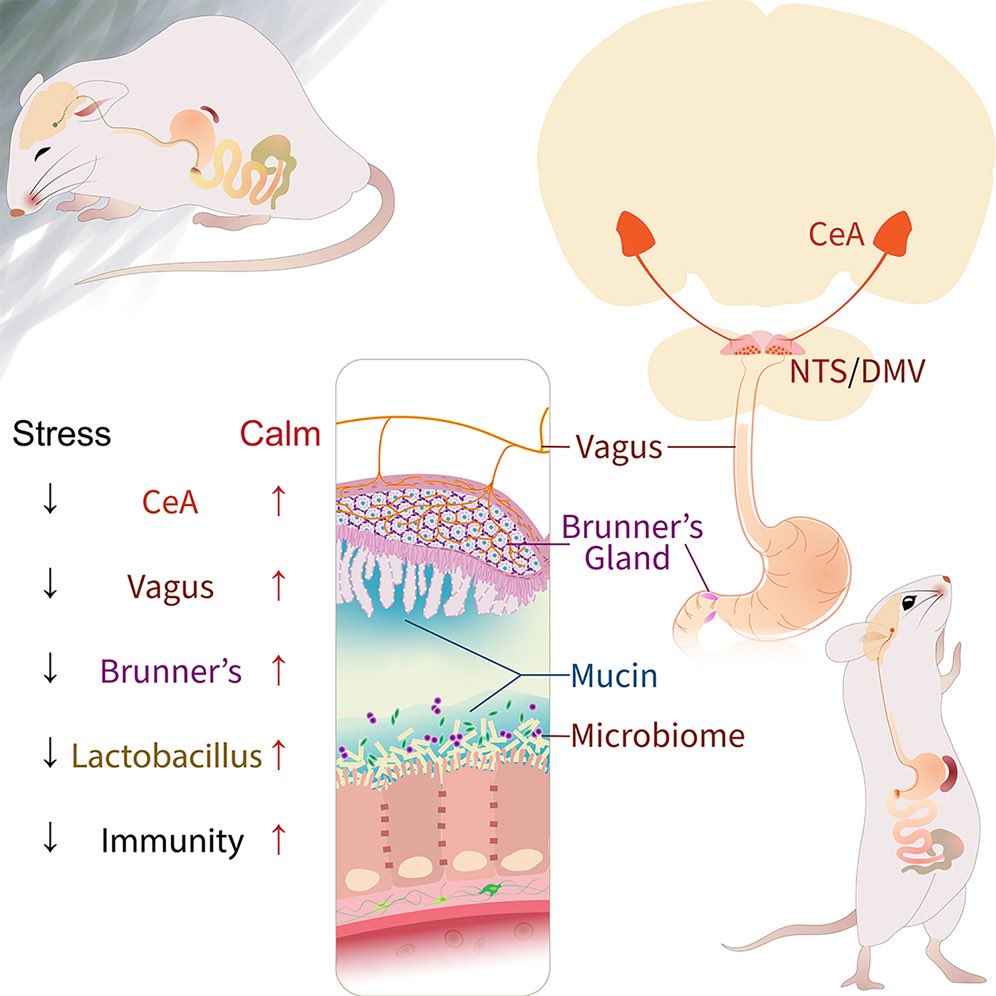
A team of researchers reports that when a mouse feels stressed, its brain sends signals via vagus nerve to a gut gland (glands of Brunner) that leads to elimination of Lactobacilli bacteria that prevents inflammation and an unnecessary immune response. 1/
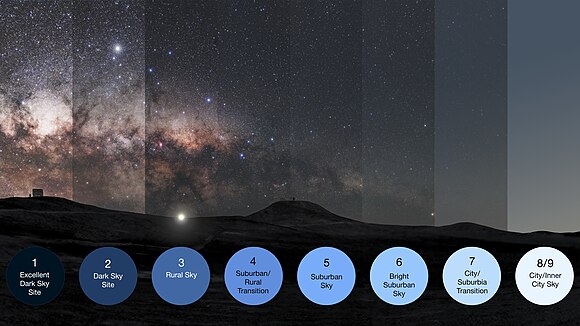
this is the bortle scale. it's used to measure how dark the night sky is in a given place. until relatively recently in human history i imagine every human being who ever lived could see a bortle 1 sky every night of their lives, weather permitting. i personally have never seen darker than bortle 4 in my entire life, and that only happened once.
when i was in college i saw a video on youtube, it was a time-lapse of a barbecue in texas or something, and the sky was around bortle 2-3. i was extremely shocked that the milky way was clearly, brilliantly visible to the naked eye, which i had never seen in my entire life and hadn't actually understood was a thing that could happen. i thought you needed a telescope or something. this is despite my having both a big glossy book about astronomy and a big glossy book about mythology in my childhood bedroom, where i had both read about the milky way as a galaxy and as a part of human mythology dating back thousands of years.
it's fucking big as hell in the sky. it was much bigger than i was expecting. it has names in other languages that make this more obvious. in asian languages it's called the "river of heaven" or the "silver river." in indian languages it's called the "ganges river of the sky." it's a big fucking river in the fucking sky and you're supposed to be able to see it with your fucking eyes.
here's a quote from a thread on an astronomy forum called cloudynights about what it's like to experience bortle 1, from Bob4BVM:
> There are a few places where I go in certain mountain areas of far eastern Oregon to get to Bortle 1.
> One is a site at over 9500 feet on a mountain surrounded by desert with the nearest town streetlights over 100 miles away.
> I will never forget the first time we were camped there. The stars were so bright & clear that the experience was like you were standing IN the dome of the heavens, not below it, the 3-D feeling was unmistakable. Yes the stars colors were very distinct, adding to the 3-D effect.
> I did however find it initially disturbing that there was a huge band of smoky haze that ran from horizon to horizon roughly following the plane of the Milky Way. I was at first offended that smoke would be messing up the great view of our galaxy.
> It took a while for it to sink in, but I finally realized... what looked like 'smoke' was the huge outer halo of the galaxy, extending far above and below the bright band of the galaxy, easily tripling its overall width. I did not have a telescope along on that first camping trip to that mountain. None was necessary, it would have diluted the immersive experience of just laying on my back and taking in that enormous river of stars which to its outer limits covered fully half of the visible sky from horizon to horizon.
when i look at the night sky (bortle 7-9) i like to imagine being alive 5000 years ago and getting to see bortle 1 every night. i like to imagine wondering what the hell is going on with all this stuff in the sky. what is it? why does it move around like that? what does it all mean? or if i don't ask myself these questions maybe i'm chilling with a kid and they ask me. and then maybe i start telling stories to entertain the kid. and i imagine people naming the planets and the stars and the constellations, and inventing gods and monsters and astronomy and astrology, and mathematics, and physics, and eventually -
well, y'know, the electric light.
Biden just threw trans people under the bus by coming out in opposition to gender-affirming care during Pride Month, and right-wing bigots are loving it.
@NatRevNeurosci asked me about the most influential article in my career: Siapas&Wilson 1998, which unveiled the coupling between sharp waves and spindles. This (& other) work marked a shift in memory research from synaptic to dynamic processes.
👉 https://t.co/DuH8qecj33
🤩👇
1/ Excited about network neuroscience🧠but unsure how to turn your fMRI data into a connectome? 😵💫
Our systematic evaluation of fMRI pipelines for functional connectomics is just out @natcomms!
We compare 768 pipelines, across 5 criteria, in 3 datasets https://t.co/gOakqyEK6R
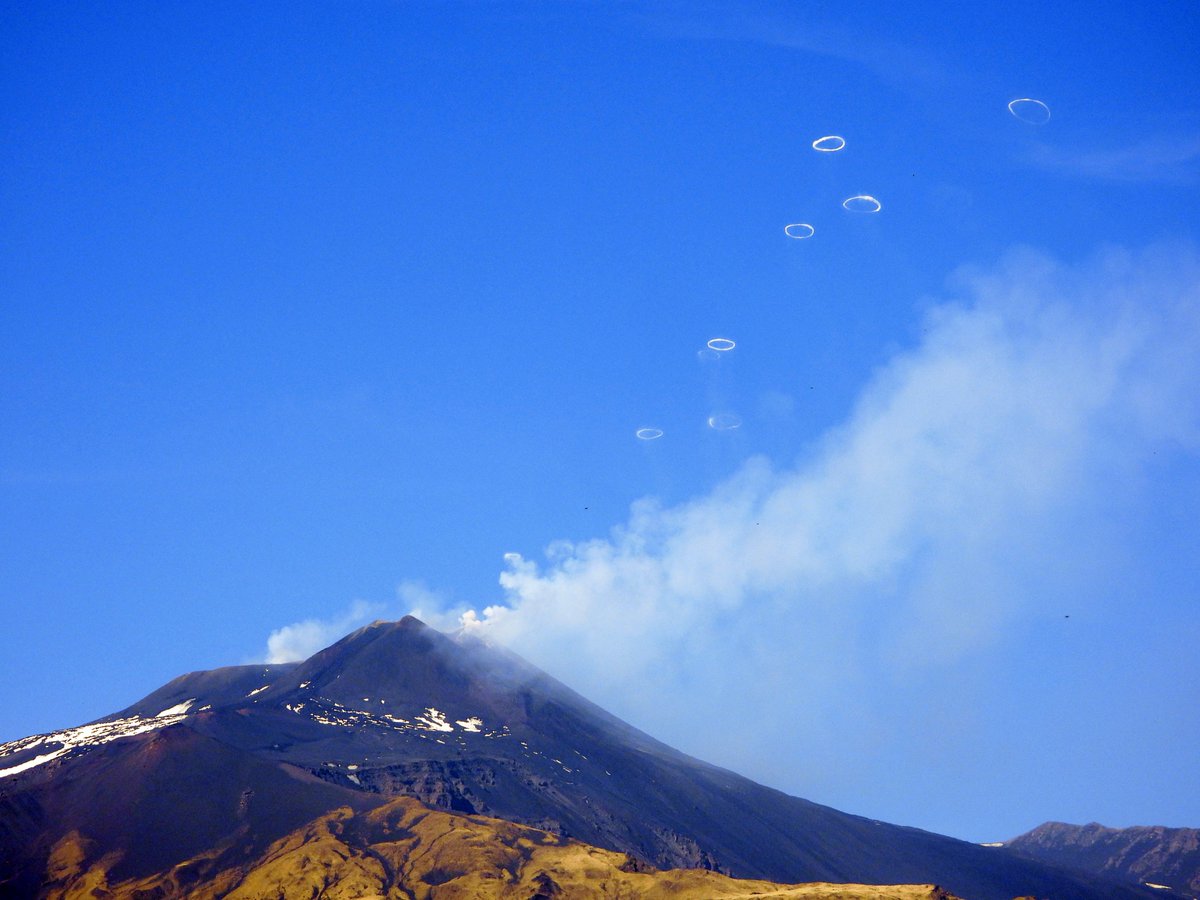
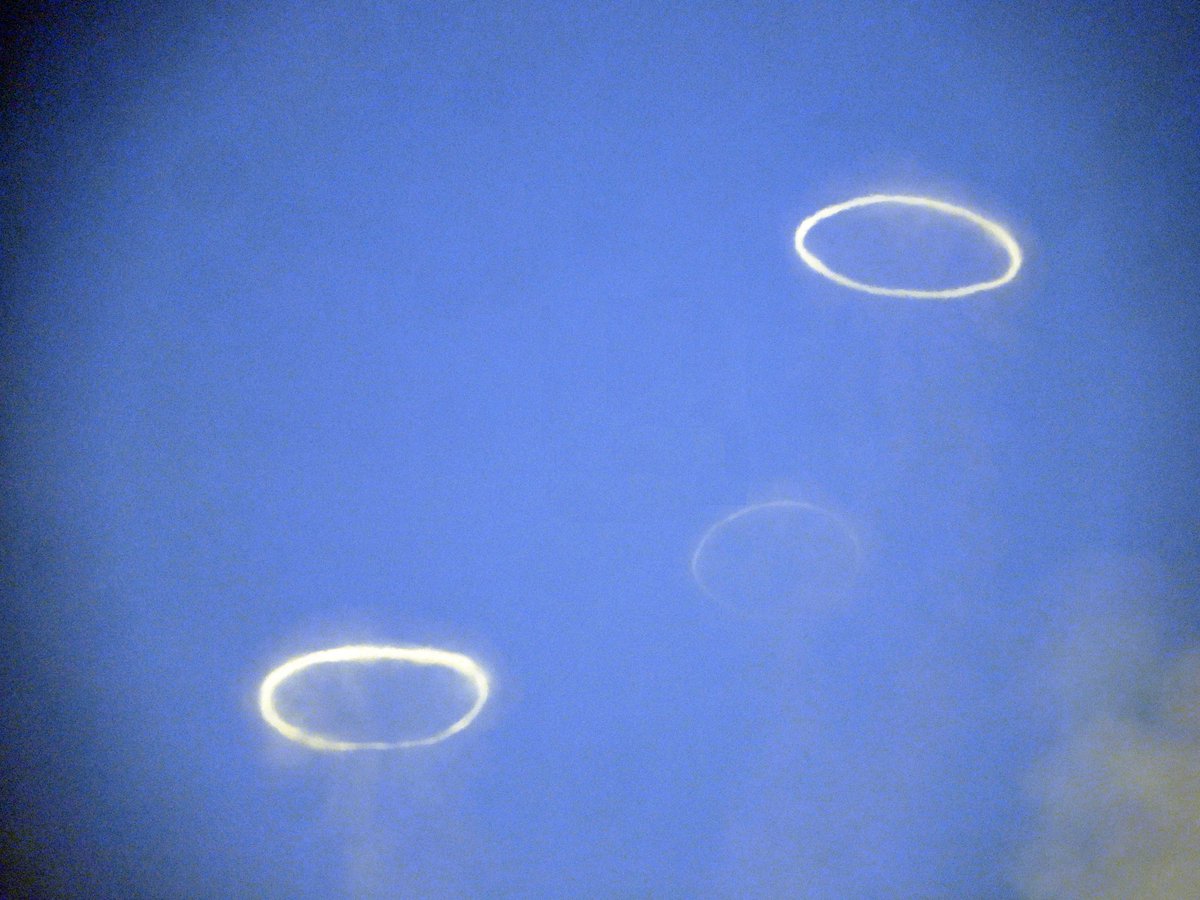
#Etna's Southeast Crater continues emitting countless graceful vapor rings ("volcanic vortex rings"), a phenomenon never seen like this before. Someone said "maybe because we receive so much bad news lately, Etna has decided to do something simply beautiful". 5 April 2024
REM EEG slowing may differentiate older adults with memory impairment from those without. Longitudinal studies are now warranted to examine the prognostic utility of REM EEG slowing for #cognitive and #dementia trajectories. https://t.co/XU1OM3S22x #aging#sleep
I noticed ppl disregarding the NYMag piece bc it focused on Huberman’s personal life, not bad science & harmful misinformation he propagates.
So I wrote a thing.
@slate:
“So, Should You Trust Andrew Huberman?”
https://t.co/Yp7kiLJvax
How does the brain select what to consolidate during sleep? New in @sciencemagazine , our work (https://t.co/9AqhbvNYc2) sheds light on the brain's mechanism for selective memory consolidation. 🧵👇1/n