Quand les gens entendent « nos ingénieurs n’écrivent plus une ligne de code », beaucoup y voient la fin des développeurs.
En réalité, l’IA ne remplace pas leur compétence technique : le code n’est qu’un outil, et l’IA devient simplement un nouveau moyen d’en produire.
monsieur Jouvet, vous semblez sincère alors laissez moi vous faire un retour d’expérience sur ce que c’est que d’essayer de construire une boite d’IA en France et en EU.
Manako, ma startup, développe des agents de visions.
Pour faire simple: nous entraînons des IA à comprendre et réagir par dessus des flux vidéo. Ça permet de détecter et d’agir automatiquement, en quelques millisecondes.
Semaine dernière: je discute avec le directeur des opérations d’une société française de détection d’incendie. Je vais taire les noms pour des raisons évidentes.
Selon lui notre technologie transformerait les capacités de sa société et pourrait grandement aider ses clients (Airbus, SNCF, des villes…) et ainsi permettre à son entreprise, française, de grandement développer son activité.
Voici sa première réaction au moment de se projeter concrètement:
« Par contre il faudra être préparé au parcours du combattant avec les régulateurs, c’est au moins 6 mois de discussions avec eux pour valider un test »
Merci la France. Cocorico.
Cette semaine: je discute avec la responsable de l’innovation d’un des plus gros opérateurs énergétique en Europe (station essence, recharge électrique, solaire, carwash…).
Notre technologie est également transformative pour opérer des réseaux de milliers de sites.
Première réaction au moment de se projeter:
« nous avons une application particulièrement stricte de l’AI act dans notre pays. Ça sera minimum 12 mois avant d’imaginer avoir votre techno déployée pour un pilote. »
Merci l’UE.
monsieur @PJouvet, l’entrepreneuriat technologique est une affaire de célérité dans l’exécution. encore plus dans l’IA.
se tourner vers le régulateur pour améliorer la situation revient à essayer d’éteindre un incendie avec un bidon d’essence.
Vous voulez aider la France et l’UE?
Laissez nous bosser et enlevez tous les obstacles qui nous ralentissent.
Franchement c’est fort.
Arriver à faire rire une salle aux éclats dans une langue que tu ne maîtrisais pas quelques années auparavant, et avec une telle fluidité, ça représente un travail monstrueux.
Bravo @kevadamsss 👏
We are at the point where AI is essentially better at reviewing and flagging mistakes at benchmark questions than the human reviewers we involved in FrontierMath.
VoidZero is joining Cloudflare.
Our mission stays the same: to make JavaScript developers more productive than ever before. Vite, Vitest, Rolldown, Oxc, and Vite+ remain MIT-licensed. Evan and the VoidZero team will continue leading them.
Cloudflare shares our commitment to open source. Together, we can keep investing in the tooling developers rely on every day, while bringing the Vite ecosystem and Cloudflare’s platform even closer together.
tu compare un salaire net ou l'assurance maladie, l'assurance viellesse et l'assurance chomage sont payes avec un salaire avant impots et avant toutes ces depenses aux US. Sans compter le differentiel de prix au detail, ni le besoin d'epargner pour financer les etudes de tes enfants.
Bref, va vivre un peu aux US avant de lancer des comparisons hasardeuses.
You should read this thread.
It used to take about 25 seconds to generate a 5-second video on 8 Blackwell GPUs. The legends at @haoailab brought that down to just 4.2 seconds on a single Blackwell GPU… and then open sourced the tech behind it.
We now know that with an appropriate harness both Mythos and GPT-5.5 can reproduce what our internal model did in one-shot for the unit distance problem. Clearly there is an insane overhang of capabilities with this generation of models, and no ceiling in sight for what scientific advances they can bring. You can go and try to discover new things with 5.5 right now!
L'intérêt d'avoir un classement énergétique (et qui plus est, soigneusement obscurci : 29 kWh/1000h = 29 W, en clair) pour un niveau aussi faible de consommation est proche du néant absolu. Différence en 1 an 44 vs 29 W sur un usage de 8h/jour jours ouvrables : 6 €.
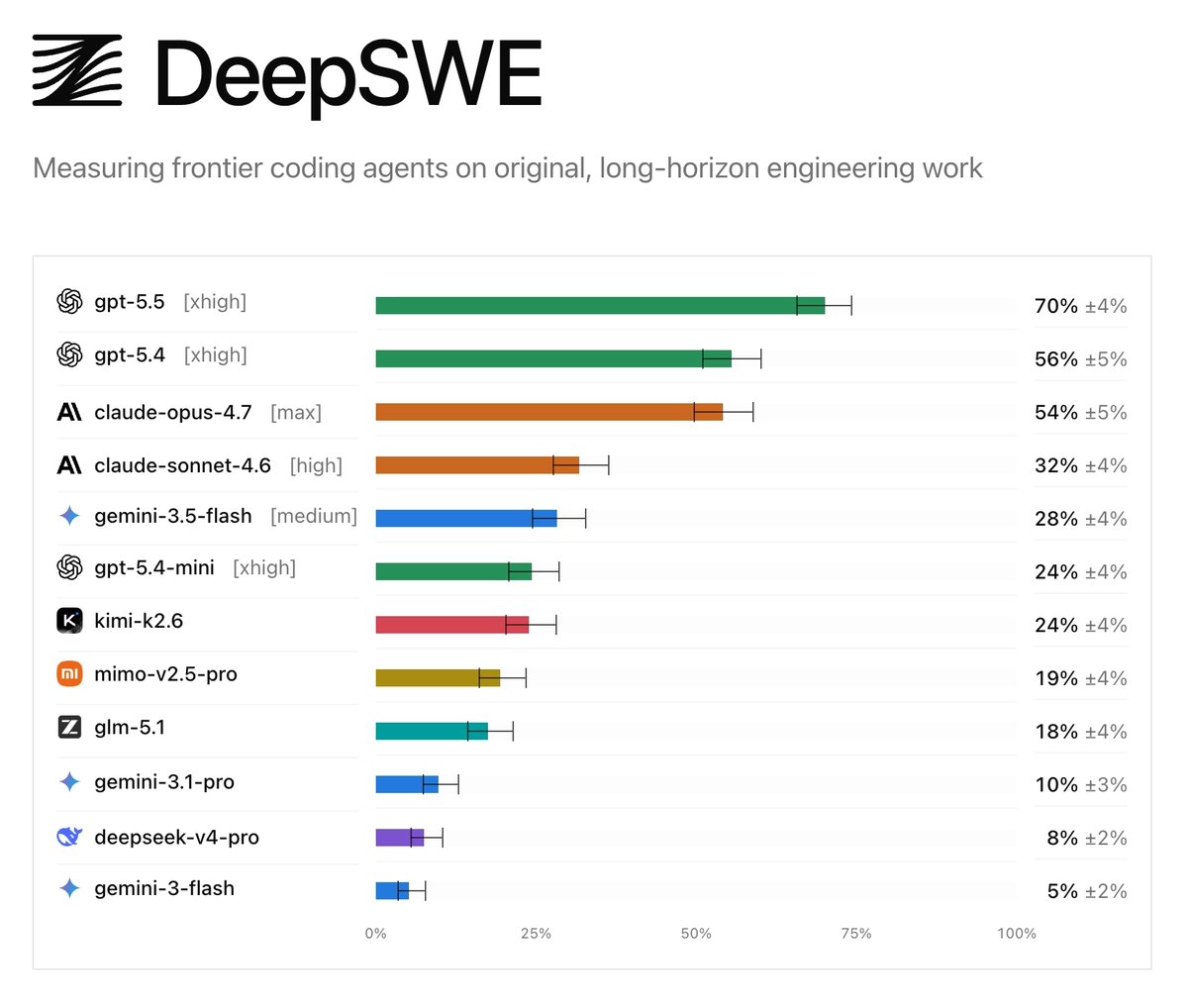
Today we’re releasing DeepSWE, a new standard for agentic coding benchmarks.
On public leaderboards, top models often look relatively close in capability. DeepSWE shows where they actually diverge, reflecting the realistic experience of developers in their day-to-day work.
I've had more "I can't believe it's this good" moments with GPT5.5 than any other model since Opus 4.5. It's shockingly, scarily capable. Days and days of amazing progress. All steering, no handwriting. Yet utterly delightful to conduct its coding. So, so good.
Au vu des dernières supply-chain attaques, il y a une dernière étape que vous pouvez ajouter si vous êtes dans l'écosystème JS, Python ou Rust (en plus de tout ce que j'ai déjà cité dernièrement).
Mettre un firewall devant votre package manager 🔐
Socket Firewall analyse les packages avant installation et peut bloquer automatiquement des comportements suspects ou connus comme malveillants.
i have a lot of respect for @arthurmensch for trying to engage and educate the french institutions.
This is un-ironically important work that you're doing mate 🙏
May it be fruitful
Token costs will become a dominant topic in enterprises going forward with AI. Just got out of a dinner with many Fortune 500 enterprise CIOs and this was the most heated topic.
A mix of strategies are being employed, but basically no one feels like they have the right solution. A mix of: figuring out how to prioritize workloads to different models, giving out access to better or worse agents by user type, setting different spend caps by team, having teams justify AI by their use-case, and some just having unfettered access.
Everyone is trying to figure out a semi/predictable model right now in a world where the underlying tech and cost models are constantly evolving.