AMS Special Session "Diversity in Mathematical Biology," organized by Daniel Alejandro Cruz @UF, and Anna C. Nelson @DukeU. See the talks: https://t.co/XaLtO0DHrt #JMM2025@amermathsoc#mathbio
I spent the last year examining the longstanding agreement ("MOU") between the University of Utah and the Ute Indian Tribe.
Under that, the U. gets to use the Utes' name for athletics.
But what does the tribe get? And is it a fair deal?
A thread 🧵:
https://t.co/MAUNTqWD5s
Are you interested in attending graduate school in the mathematical sciences? GROW 2024 is for you!
GROW, a conference in cooperation with AWM, will run from Friday 9/27 until Sunday 9/29 at Columbia University.
Find out more details and apply at
https://t.co/R0qIW1RAun
Members of the NITMB will gather today to explore the work-in-progress of Cody Fitzgerald, James S. McDonnell Foundation Postdoctoral Fellow at @NorthwesternU, as part of the NITMB's Research-In-Progress meeting series
Nice coverage of upcoming article with @zpkilpat, @BRamKram, @sjayelle and Sean Lawley in New Scientist by @kpcallaghan_ This is a surprisingly subtle problem, and took some careful analysis: Results might seem obvious at first glance, but not so.
https://t.co/Pw99fGY6eW
Applying the physics of spin glasses to a multiplayer economic game shows that agents never reach collectively optimal strategies even when they learn from past outcomes.
Read https://t.co/jLFUkPB8cS
@econophysix@IP_Paris_#PRXjustpublished#openaccess#PRXcomplex
New paper in our lab led by Andrew Alegria and @Amey__Joshi published in @GeneticsGSA . Fun collab with @DarylGohl and Bischof group @umnme@UMNCSE We also made it to the cover! https://t.co/lpyiQNmj4a
New paper up on arXiv...What are the hitting probabilities of a resetting searcher? An inactivating one? They're the same! And we compute them here for drift diffusion in Rd, random walk on a network, super diffusion, run-and-tumble, etc: https://t.co/hv3Q6K4gOS
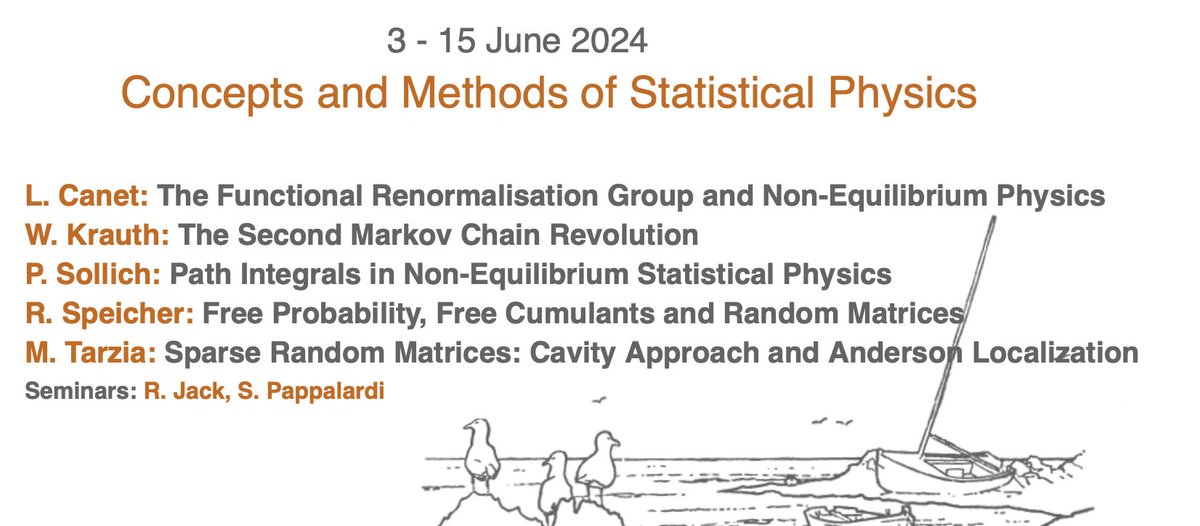
The program of the 2024 Beg Rohu summer school is out! https://t.co/fe7MXEiJQV Fantastic lecturers
L. Canet, @KrauthWerner, @psollich, R. Speicher, M. Tarzia, and terrific seminars by R. Jack @SPappalardi
to learn the way of statistical physics
You are on a game show. You choose one of three doors. The host moves to one of the other doors and opens it, revealing what appears to be a goat. It has horns and cloven hooves, at least, and you can't seem to make out the rest--you can't make out any details except its eyes--
Two very particular patterns of random movement — Brownian motion and Lévy walks — describe a great many physical phenomena. Recent data hint that Lévy walks may be a default movement pattern for many animal species. https://t.co/U6xAh3Qw2F
I had to do a @DrEugeniaCheng appreciation post because this woman keeps blowing my mind! As a kid, I always felt that something essential was missing from the way teachers taught mathematical concepts. So, as a young adult, I’ve never really been interested in the idea of math by itself without being used as a tool in physics or any other kind of scientific framework, but OMG! This woman has opened up my mind to the wondrous world of pure mathematics in a way that I never thought was possible. In such a heavily male-dominated field that is often perceived by the masses as being tedious and unartistic, she has brought such a fresh and, dare I say, creative perspective to, not only the world of mathematics but to the world at large. She has challenged me to see a world where mathematics is not entirely about numbers and can expand to how we understand the world around us socially, politically, and interpersonally. A world where we can deeply understand the expansive variety of dynamic relationships (obvious & not so apparent) that make the world what it is, for better or for worse. Her books “The Joy of Abstraction”, “Is Math Real?” and “Beyond Infinity” are absolutely changing my life, and I strongly recommend anyone who is interested to see what kind of illuminating epiphanies her research & general perspective can spark in your beautiful mind✨
Different kinds of random walks ("stochastic processes") can be used to express solutions to many fundamental equations found in science & engineering ("PDEs"). These can in turn be used to develop Monte Carlo solvers.
Here I visually catalog a few of the connections.
#MCMA2023