A Stanford study compared machine learning research proposals generated by Anthropic's Claude 3.5 Sonnet to those written by human experts.
Read the highlights of the study in #TheBatch: https://t.co/3LMheticWL
A year ago, @RishiBommasani, @percyliang, @random_walker, and I organized a workshop on open models.
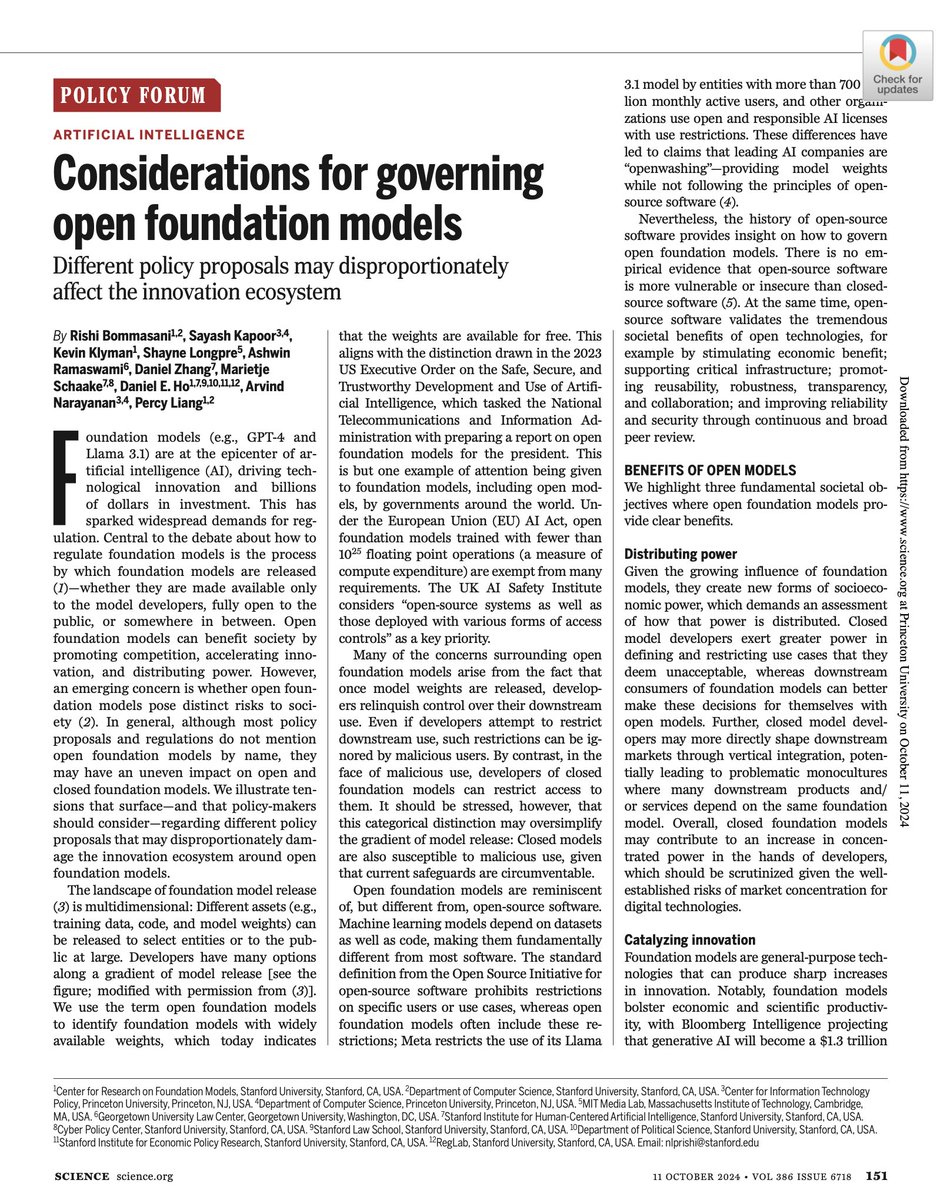
Today, I am pleased to share the culmination of this effort. Our paper on governing open foundation models has been published in @ScienceMagazine: https://t.co/yUHjfVWliU
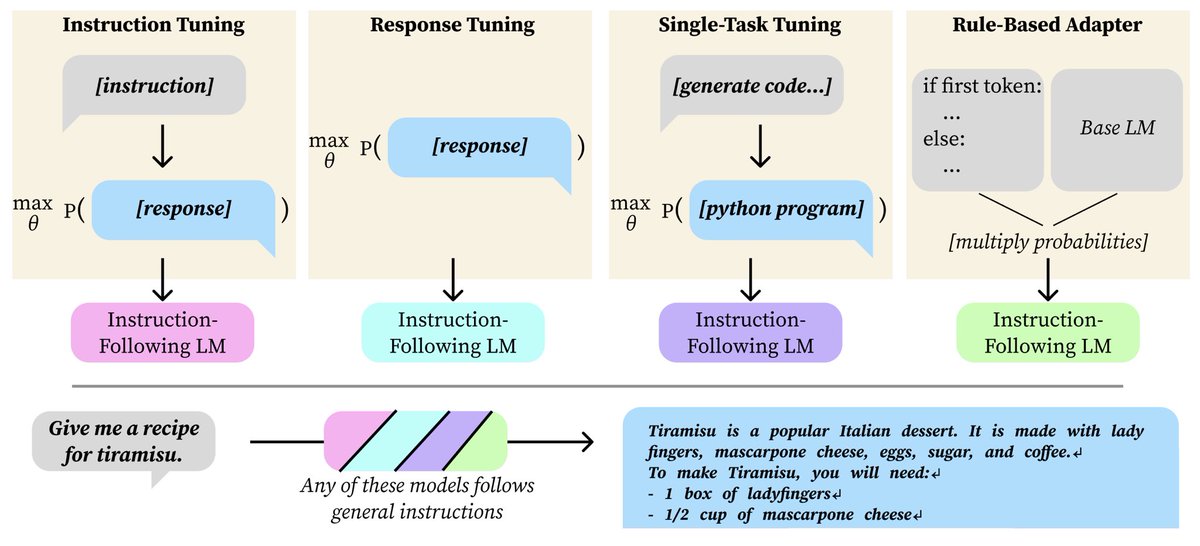
If I finetune my LM just on responses, without conditioning on instructions, what happens when I test it with an instruction?
Or if I finetune my LM just to generate poems from poem titles?
Either way, the LM will roughly follow new instructions!
Paper: https://t.co/Jk3EOtLJXF
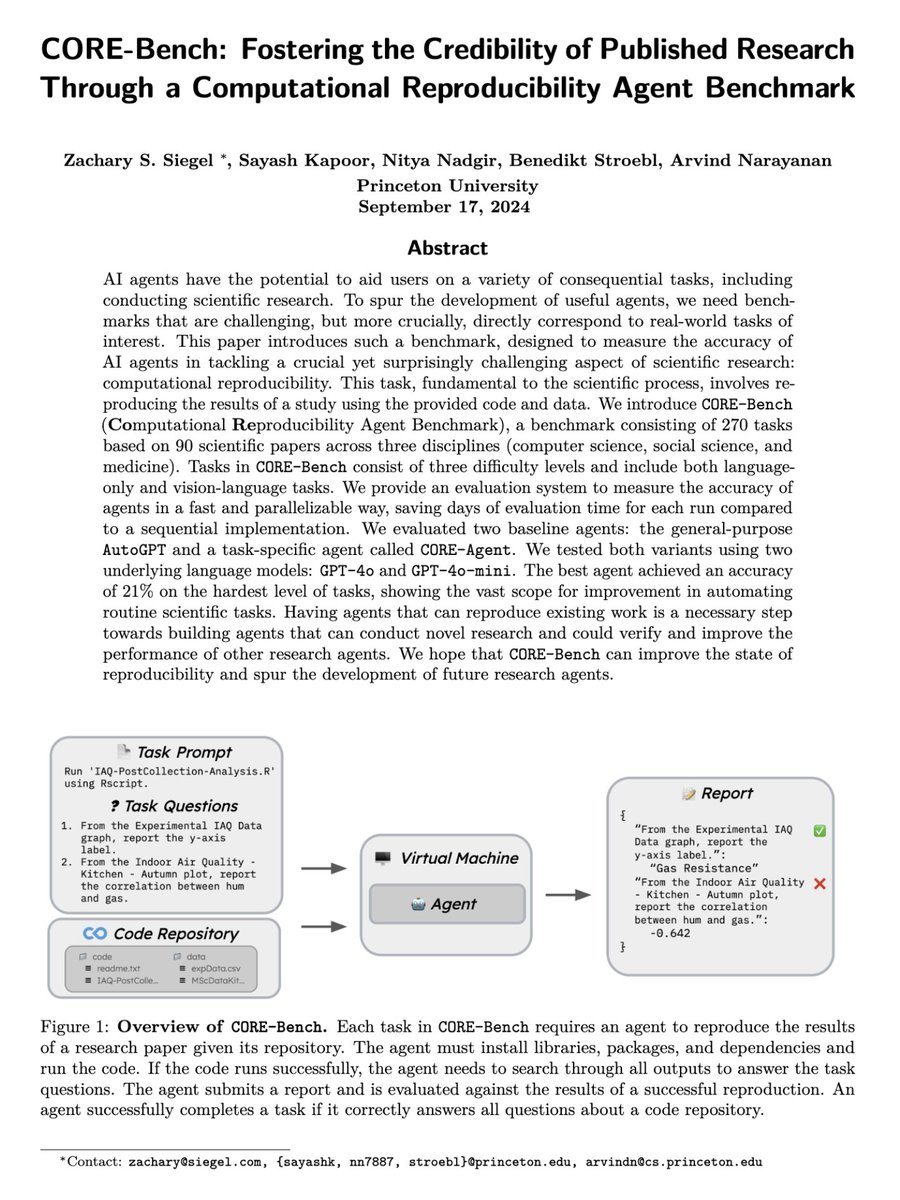
📢New paper: Many companies and papers have claimed AI can automate science. How can we evaluate these claims?
Today, we introduce CORE-Bench: a benchmark to measure if AI agents can automate reproducing a paper given access to its code and data. https://t.co/eFVhNWkPyc
https://t.co/eDHHJKO0UV
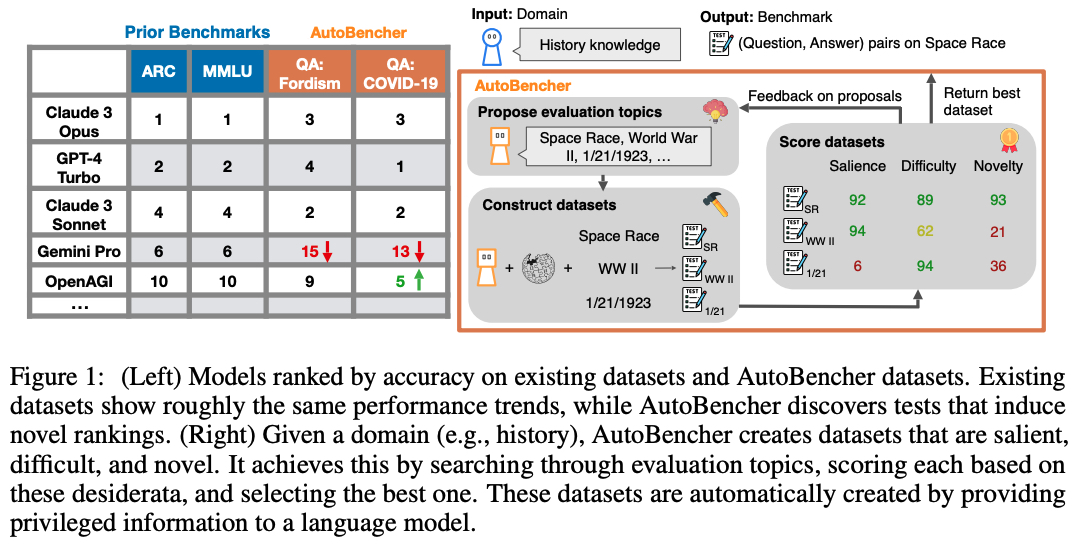
LM performance on existing benchmarks is highly correlated. How do we build novel benchmarks that reveal previously unknown trends?
We propose AutoBencher: it casts benchmark creation as an optimization problem with a novelty term in the objective.
This year’s AI Index report offers a deep dive into the evolving landscape of AI. Covering key trends from technical performance to geopolitical dynamics, it's a must-read for industry leaders, policymakers, and anyone interested in the state of AI. https://t.co/md4JidhZT7
I had the honored to join President Joe Biden @POTUS yesterday alongside key leaders from academia and the public sector in SF to discuss AI’s development, challenges and ideas how it can enhance democracy, healthcare and more. 1/
Shane Legg and I have been thinking and talking about AGI for many years, long before we founded @GoogleDeepMind. Great conversation @ShaneLegg and @TEDchris
On This Day 6 years ago: the first general meeting of the Partnership on AI took place in Berlin.
PAI funds studies and publishes guidelines on questions of AI ethics and safety.
It just published a set of guidelines for the safe deployment of foundation models: https://t.co/cmrVNDfKy1
This photo shows the original board members, which included Eric Horvitz (Microsoft), Francesca Rossi (IBM), Ralf Herbrich (Amazon), and me.
Many people have recently started talking about AI ethics and safety. Some of them think the issue is new. Some of them think industry doesn't care about it. But in fact, industry *does* care about the issue very much and is devoting a lot of attention and resources to it.
Claiming that the AI industry doesn't care about AI safety is like claiming the turbojet industry doesn't care about engine reliability. Arguably, reliability (together with fuel efficiency and weight) is pretty much the main things they care about.
The University of Toronto made a video for a non technical audience in which I explain how deep learning works, the enormous promise of this technology and some of the potential risks. https://t.co/d0Izl3RYbS
A new special issue of Science reveals a near-atomic picture of the human #NuclearPoreComplex—an elaborate structure composed of hundreds of proteins that mediates the exchange of material between a cell’s nucleus and the surrounding cytoplasm.
Read more: https://t.co/VfaAd2CmZA
50 years after John McCarthy’s Turing Award lecture on The Present State of Research on AI, what are now the key issues? Join @drfeifei & me on Tuesday as we focus on Foundation Models, achieving accountable AI, and AI modeling physical & simulated worlds.
https://t.co/v87Nxcdy4W
neuromaps: structural and functional interpretation of brain maps | https://t.co/5iexqpuxkZ
By @rossdavism@JustineYHansen + super collaborators
Want to contextualize brain maps? 🧰⤵️
New preprint with @flourn0 and @leahsom! We use T1w/T2w myelin mapping in the HCP-Development sample to chart variation in the timing of cortical myelination during adolescence.
https://t.co/Eg9tZEAxF4
Fantastic to see this superb work out from @graham_baum with @flourn0 @leahsom and team -- just spectacular convergence of myelin changes in youth with the S-A axis as delineated by @valerieJsydnor.
This looks interesting from @FurberSteve. Converting conventional ANNs to rate based SNNs unlikely to give a significant power saving. Needs a spike first approach.
https://t.co/UKfnqaMJKQ
CC @hisspikeness