recommended reading. very happy to see that the concept of bottlenecks and according scaling is catching on.
this also extends to things like OSS issue/PR trackers, which are flooded by 3rd party controlled agents.
CEOs are uniquely prone to AI psychosis because they’re sufficiently distant from the last mile of work that still has to happen to generate most value with AI.
So when they play with AI, they see the happy path results, often not considering the next 10 or 20 things that have to happen to get sustainable results from agents.
“Look I made this awesome product prototype”. Yes but you didn’t have to review the code before it went into production and fix a bunch of issues.
“Look I generated a contract”. Yes but you didn’t verify all the terms before it goes out to the counterparty and didn’t have to wire up all the past contracts to work with.
The best thing you can do as a CEO is to use AI a *ton* to figure out the real implications of agents in the enterprise, and come out the other side with an appreciation for both the upside and the real work that goes into them.
Here’s a key line in this mythos update. This is precisely an example of why engineers don’t go away, ever.
We’ve made it far easier to create and find security issues, which means the new bottleneck is our ability to actually review, respond to, and fix the issues.
Far from AI magically solving all of this, there still is major triage work and human judgment required to do the follow on work to actually protect systems. As a result, we’re about to enter a security engineer boom.
Jevons paradox all over again.
The cool thing is that you can train your body, tune your circadian rhythm, so that when bedtime arrives, you can fall asleep within a few minutes. Routine is the unlock.
1. Wake, light in eyes.
2. Final caffeine by noon.
3. Last food four hours before bed.
4. Screens off 60 minutes before bed.
5. A wind down routine to cycle down from the day. Walk, breathe, meditate, breath, work, a hobby, literally anything other than the phone. A book in hand is best.
If you feel stuck, try this: For the next 30 days, every single day, wake up at 5am and work out for at least 30 minutes.
It doesn’t matter what the workout looks like. Go to a gym, go outside for a run, do pushups and squats on your bedroom floor.
This isn’t about the workout. It’s about creating Proof of Agency.
By the end of 30 days, you’ll completely rewire your brain. Scientists call it neuroplasticity. Your brain physically changes in structure and function through action and experience.
The action of waking up early and working out every single day for a month will create evidence that you have the power to take an action and achieve a desired outcome. You’ll see yourself differently. You’ll reorganize your life around this new priority. You’ll eat healthier, go to sleep earlier, and narrow your focus. It creates Proof of Agency.
That has ripple effects into every area of life.
To succeed in the game of power, you have to master your emotions. But even if you succeed in gaining such self-control, you can never control the temperamental dispositions of those around you. And this presents a great danger.
recommended reading by @antirez
> I worked 14 hours per day on average. My normal average is 4/6 since early Redis times, but the first few months of Redis were like that.
this isnhow i work too, intense bursts followed by a healthier phase.
https://t.co/QOEHOBmV6F
If I were a college career counselor or in career services, I’d quickly be figuring out how to get students to understand these forward deployed engineer jobs exist and how to get them.
The requirements are a mix of deep technical skills, often CS majors or minors. You must be great at understanding problem solving, how to have systems thinking, and have a strong business acumen. The kicker, of course, is to make sure you’re very deep in AI agents; you need to have fluency in coding agents, MCP, CLIs, Skills, and so on.
Hundreds (thousands?) of technology companies will be hiring for these roles, same with any consulting and IT services company, and the vast major of mid-size and large enterprises will be hiring for this talent internally as well.
One great example of opportunity for highly technical talent out there.
If you become exceptional at managing agents, but are also exceptional in your understanding of the fundamentals, you will be unstoppable.
We all prefer to work with masters of their craft. What’s new: you can’t afford to miss out on the amplification agents have on your output
being vulnerable - by far one of the most important applied ai fields is in AI x Healthcare, but nobody on my team knows how to cover it!
very fortunate to have @jacobeffron on the pod for this one - I took a healthcare economics class once many moons ago, but not only is he on the @AbridgeHQ board, he’s also an excellent podcaster (@ULpodcast) in his own right and people really enjoyed our annual crossover pod chat. I organically bring up a lot of @redpoint portcos in many of my conversations and his questions here were very on point if you are interested in how AI is improving healthcare outcomes and finances across the board!
Cal Newport's advice on how to successfully delete social media:
"I ran an experiment with 1,600 people and they all turned off all their social media for 30 days."
"The ones who didn't succeed tended to just try to white knuckle it. The people who did succeed followed my advice to incredibly, aggressively pursue alternatives in those 30 days."
"Go learn new hobbies, join things right away, get really structured about your day, get into exercise again."
From the @hubermanlab podcast
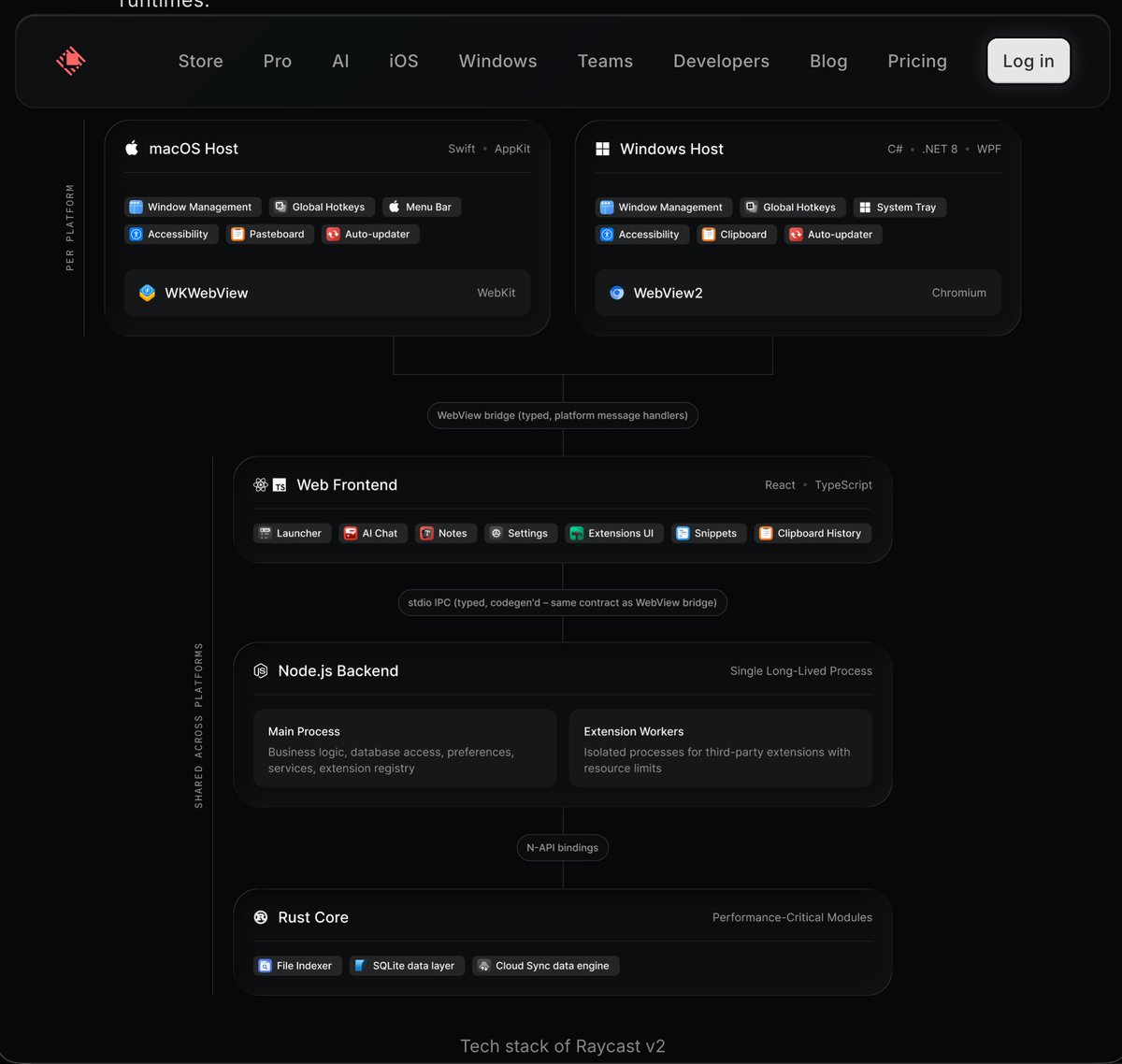
beautiful tech stack writeup, one of the best i've ever seen in my career.
I always advocate that devtools companies write these up, because it fulfils multiple purposes:
- tell users the care that goes into the product
- tell hires that there's SOTA work here
- tell competitors to give up
- gives back to community
- (nuanced) tell non-fits why they can't have what they want when they think it's an easy request
few actually do this mostly because they don't actually have sufficient depth, or aren't sufficiently good at notetaking/systematic about problemsolving ('its just vibes' or 'honestly we just went with the first thing that worked' doesn't come across as well, so rather not say anything)
so when you've done the work, show the work.
bravo Raycast