Thoughts on the Market Cycle
In a world where OpenAI & Anthropic were blitzing from 0% to 1% of GDP by revenue, investing in consensus made sense because there were no incumbents prepared to build AI native infra, services, or apps & the opportunity set for skilled founders with domain expertise was obvious.
The obvious ideas in obviously large markets in the AI trade (especially at the infra layer) have mostly been competed away, yet VC exuberance for the n-th company in these competitive spaces continue unabated and companies have started to price beyond where they would be valued if they executed perfection.
This makes me think that the early stage market has overheated & I don’t see any mediating force that will calm animal spirits down to sensible levels short of either a sharp market correction or a ChatGPT moment at the intersection of AI x Real World (robotics, life sciences, etc), so I have to be more judicious in how I invest Fund II than I was in fund I.
As a result, in my opinion, the “game on the field” for early stage investors is now shifting back from “Access being the Alpha” & all fundable founders/ideas being consensus and known, to originating strong founders early, working with teams over months to flesh out & validate ideas, and being a craftsman instead of a high velocity heat seeking missile.
Tactically, this is very exciting for me because this means that I can go back to doing venture in the style I practiced before I started my fund and had to be in every “hot” company regardless of price. I can flex my muscle as an elite picker of founders & work with them to bring a company to life while, most importantly, getting more ownership in the companies for the work I’m doing.
Of course, there will continue to be many “hot” deals that I’d be remiss to not invest in, so I will do that too on a discretionary basis, but I finally feel like I can slow my velocity down just a little (42 investments in 14 months from Fund I)!
The Growth market continues to be extremely access dependent. I believe that segment of the market will further continue to consolidate around a handful of winners and the firms that have the AUM & the Access to back them round after round will return the largest sums of capital at the highest IRRs. No changes here, just on my knees praying to Goldman Sachs, Thrive, and Dario that they get OpenAI and Anthropic public so the party continues.
Investing through this part of the cycle primarily taught me that venture can no longer afford its best outcomes to be $1b or $10b, but need to be mid 11 figures before they can be meaningful to most large AUM funds.
This isn’t a bear post by any means as much as a recalibration in what I find interesting. In a time where the benefits of robotics, machine autonomy & intelligence, life sciences/bio, reindustrialization, transportation, and so many more sectors have barely begun to seep into the real world and the market has not priced in the productivity and lifestyle gains we will see from them in the next few years, I believe there’s a lot to be optimistic about and for me to invest in.
The next few months is the put up or shut up moment for defensetech: it is obvious that the primes cannot provide anywhere near the wartime scale required to replenish munitions stocks. The only question now is if the swagger of the newcomers is anything more than VC storytime.
Soldiers in the field are in effect continually operating laboratories for optimizing physical performance. Being able to systematically learn and scale from this "under the table" informal experimentation should be considered a key @DeptofWar priority.
Next stop: peptides.
On China Biotech.
This is an interesting debate to watch because it feels like capitalism doesn’t remember its mistakes.
We are back to where China Manufacturing was over 20 years ago but for biotech.
Reminder that doing production in China was done to give “customers” better pricing. Meantime the entire western world offshores manufacturing capabilities and China became a super power.
The Chinese have a playbook now and they are using it again, but for biotech.
> Be Biotech VCs
> Make 70% of your profits from US patients
> Look at AI
> Biggest opportunity in a generation
> Led by US companies and talent
> You know what to do
...
> Blow your whole wad on me-too antibody drugs made in China
> Expect US patients will pay for it all
@LifeSciVC 3 / the SF biotech scene will grow in prominence because of the additional liquidity floating around with HNW OAI/ANTH employees starting to angel invest at scale. their biotech underwriting will be different - more ideological vs trad.
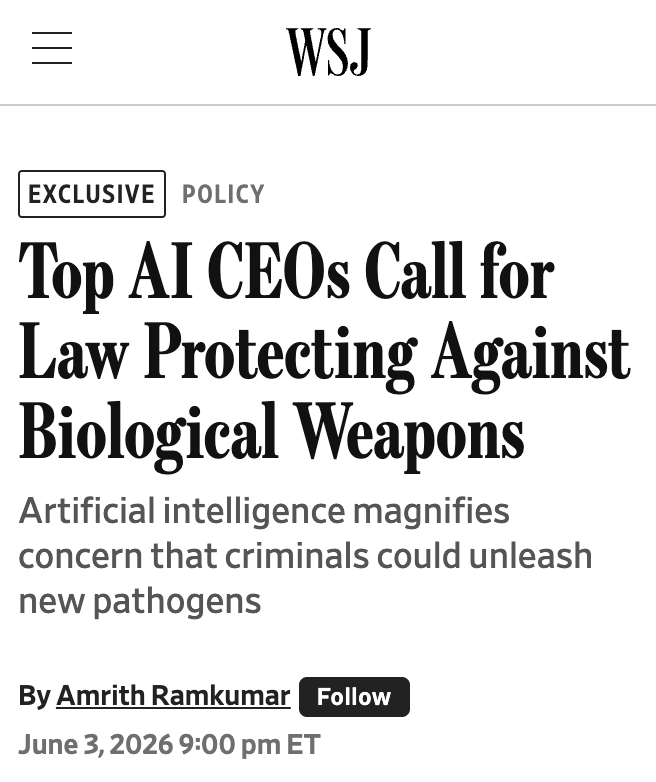
No one should be able to order a bioweapon through the mail.
@IFP & @JoinFAI are proud to co-lead an open letter calling for mandatory DNA synthesis screening & recordkeeping.
Signatories include:
- Sam Altman, CEO & Co-Founder, OpenAI
- Dario Amodei, CEO & Co-Founder, Anthropic
- David Baker, Director, Institute for Protein Design; 2024 Nobel Prize in Chemistry recipient
- Patrick Collison, CEO & Co-Founder, Stripe
- Paul Graham, Founder, Y Combinator
- Demis Hassabis, CEO, Google DeepMind; 2024 Nobel Prize in Chemistry recipient
- Emily Leproust, CEO & Co-Founder, Twist Bioscience
- Lawrence Lessig, Roy L. Furman Professor of Law and Leadership, Harvard Law School
- Gerald W. Parker, former Special Assistant to the President for Biosecurity and Pandemic Response
- Mustafa Suleyman, CEO, Microsoft AI
- Alex Tabarrok, Professor of Economics, George Mason University
- Alexandr Wang, Chief AI Officer, Meta; Founder, Scale AI
- Christine E. Wormuth, President & CEO, Nuclear Threat Initiative; 25th Secretary of the Army
Read the letter and see the full list of signatories: https://t.co/BwZiJXw3JT
Many DNA synthesis companies voluntarily screen orders to mitigate biosecurity risks, but no law requires them to do so.
Leaders in AI, biotech, life sciences, national security, and the nucleic acid synthesis industry agree that Congress should act to strengthen safeguards against biological threats.
@deanwball put it well in the WSJ:
“If you’re synthesizing the stuff that yields biological life and viruses, we’re asking you to screen to see whether it is dangerous in some way. That seems like a reasonable thing for society to insist upon.”
The first step here is to onshore pharmaceutical API manufacturing for glp1s, peptides, & all other blockbuster drugs.
To do this we MUST build more SPPS reactor farm capacity.
Right now the gold standard manufacturer in the US has 10K litres of capacity whereas a regular manufacturer in China has 100K litres of capacity.
The scale with which China operates is insane & the US needs to catch up.
We must win the glp-1 & peptides arms race to eventually win in biotech/pharma.
Every day another article…
Put biotech on COINA Act list of strategic technologies and can slow this down easily. Common sense and good for US science and patients