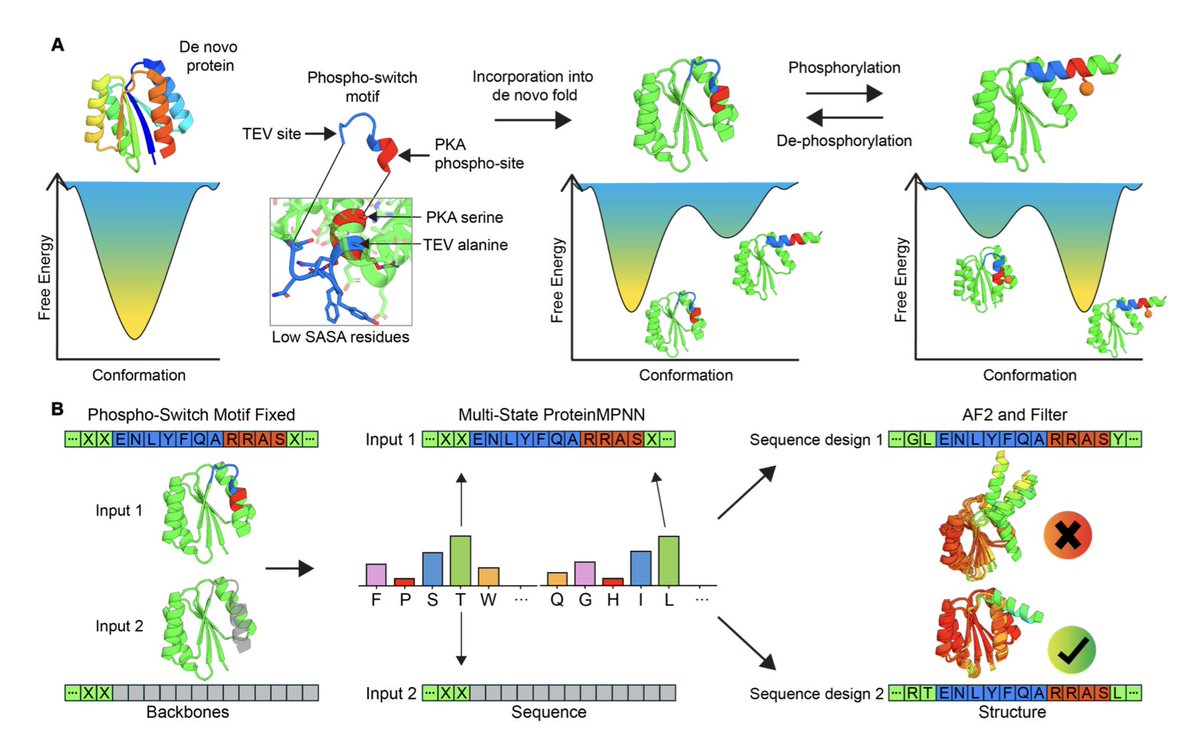
Check our new preprint, effort led by Stephen Buckley and @befcorreia, on the de novo design of phosphorylation-activated protein switches for synthetic signaling.
In it, NMR unveiled how complex molecular mechanics actually make the designs work.
👉 https://t.co/MD5YkK2cbs
De novo design of phosphorylation-induced protein switches for synthetic signaling in cells
1. Researchers have developed a method to design synthetic proteins that can switch states in response to phosphorylation, mimicking natural cellular signaling mechanisms. This breakthrough could enhance our understanding of cellular signaling and has potential applications in synthetic biology.
2. The study introduces a novel approach to create minimal signaling networks using de novo protein components. These proteins can regulate transcription in a phosphorylation-dependent manner, demonstrating their functionality in cell-based systems.
3. The designed proteins were characterized biochemically and structurally, showing stability in both non-phosphorylated and phosphorylated states. This stability is crucial for their potential use in synthetic signaling cascades.
4. The researchers used multi-state ProteinMPNN and AlphaFold2 to design sequences compatible with both closed and open states. This computational approach allowed them to generate proteins that can dynamically switch states in response to phosphorylation.
5. The study also includes the design of conformation-specific binders that interact with the phosphorylated state of the proteins, enabling the creation of synthetic signaling pathways that can regulate gene expression.
6. The designed proteins were tested in a split transcription factor system, where phosphorylation-induced interactions drove the expression of a reporter protein. This demonstrates the potential for creating more complex synthetic signaling networks.
7. The researchers explored the generalizability of their approach by applying it to four different de novo folds, including a novel fold. This shows the potential for expanding this method to other protein topologies.
@befcorreia@SebastianMaerkl@Scheller123@leepaowan@YoungyoungdumbB
📜Paper: https://t.co/FPu0p4R9M3
#ProteinDesign #SyntheticBiology #CellularSignaling #Phosphorylation #DeNovoProteins
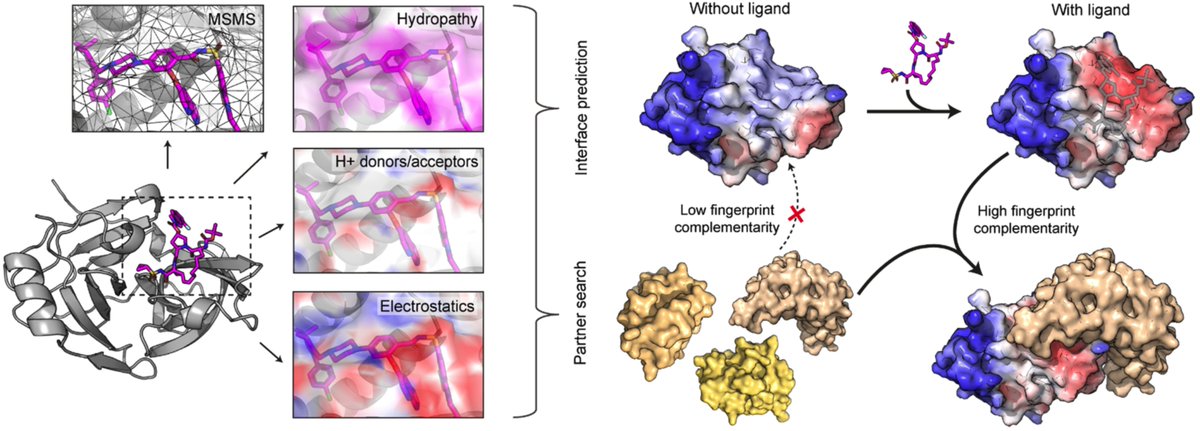
Our paper on computational design of chemically induced protein interactions is out in @Nature. Big thanks to all co-authors, especially Anthony Marchand, @St_Buckley and @befcorreia
https://t.co/vtYlhi8aQm
Have you ever wanted to design protein binders with ease? Today we present 𝑩𝒊𝒏𝒅𝑪𝒓𝒂𝒇𝒕, a user-friendly and open-source pipeline that allows to anyone to create protein binders de novo with high experimental success rates. @befcorreia@sokrypton
https://t.co/IPhMFpRgHh
Had fun playing around with some chemically induced dimers. In short, chemically induced protein interactions can be computationally designed with potential therapeutic applications. Cool stuff.
New preprint! In this project spearheaded by Anthony Marchand and @St_Buckley we designed new chemically-induced protein interactions and experimentally validated three binders targeting Bcl2:Venetoclax, DB3:Progesterone and PDF1:Actinonin complexes.
https://t.co/xNdcgSqRqe
Our first #newlab review is out! 1st first-author paper for Lucas Kerstetter, with @sbuckley2493 & @carlymaybliss 🥼🦠🔬 "Adenoviral Vectors as Vaccines for Emerging Avian Influenza Viruses" #H5N8#universalflu#vaccineswork https://t.co/tt0atj7jxi
Excited to see our manuscript out in @ScienceMagazine today! The plasmid for HexaPro is available at Addgene (https://t.co/1cra0bXjLq). Great collaboration with @IlyaFinkelstein and Jennifer Maynard, led by postdoctoral fellow Ching-Lin Hsieh.
Excited to receive NOA on #R21 @NIAIDFunding to start a #COVID#vaccine project 🎉🍾🥳 Massive thanks to my techs @sbuckley2493+Lucas Kerstetter for remotely compiling all the #CoV2 literature (!!!) into bite-sized pieces during lockdown - actual footage of me #grantwriting 👇 😂
I've recently heard about this phenomenon on a Radiolab podcast. Cool they're making progress in understanding it, humbling how little we know. https://t.co/ddYztpzLLS
One of the 12 entrepreneurs whom will progress to #Boston in the @CorkCoco Bridge to MassChallenge Cork competition is BioBind. They provide a disruptive, low-cost, customisable technology that empowers biology researchers to see what they need to see inside & outside the body.
Congrats to all entrepreneurs who participated in the @Corkcoco@MassChallenge@b2mcCORK boot-camp this week. Best of luck to @UCC Pinpoint Technologies from @ucctechtransfer in the Boston boot-camp. Special shout-out to @HIHIreland and @Entirl for supporting great initiatives!