Security called me at 6:12 AM today.
"Patch every PHP server immediately."
I asked what happened.
"Two critical vulnerabilities. Remote code execution. No authentication required."
Cool.
How many PHP servers do we have?
According to inventory: 12
According to reality:
Nobody knows.
We found one running WordPress.
Three running old internal tools.
One under someone's desk.
Two inside vendor appliances.
A forgotten employee directory from 2016.
And a server named:
PHP-OLD-DO-NOT-TOUCH
Naturally, that one runs payroll exports.
Then we found a PHP 5.6 box.
I asked who owned it.
The documentation said:
BRIAN.
Brian left in 2019.
We called Brian.
He said:
"Oh wow, that's still running?"
Excellent.
By 8 AM, leadership joined the incident call.
CEO:
"Can hackers actually get in?"
Security:
"Potentially yes."
CEO:
"Without a password?"
Security:
"Yes."
CEO:
"Then why do WE need passwords?"
Not the lesson.
Finance asked if we could wait until the weekend to patch because downtime affects revenue.
Security explained that the alternative was letting strangers execute code on our servers.
Finance asked for a cost comparison.
At 9:17, someone suggested temporarily taking the vulnerable websites offline.
Marketing refused.
"Our campaign is live."
So for the next hour, the company officially decided maintaining a landing page for 20% off webinar registration was more important than preventing remote server takeover.
We finally patched everything we could find.
Then our scanner discovered another PHP server.
Hostname:
TEMP-PHP-2014
Uptime:
4,512 days.
Nobody knows what it does.
Nobody owns it.
Nobody can shut it down.
But every time we block network access, the warehouse stops printing shipping labels.
Security has classified it as critical infrastructure.
It is running PHP 5.4.
The vulnerability has existed longer than half our employees.
The emergency patch took four hours.
Finding out what PHP actually runs took eleven.
The internet isn't held together with code.
It's held together with servers everyone is afraid to turn off.
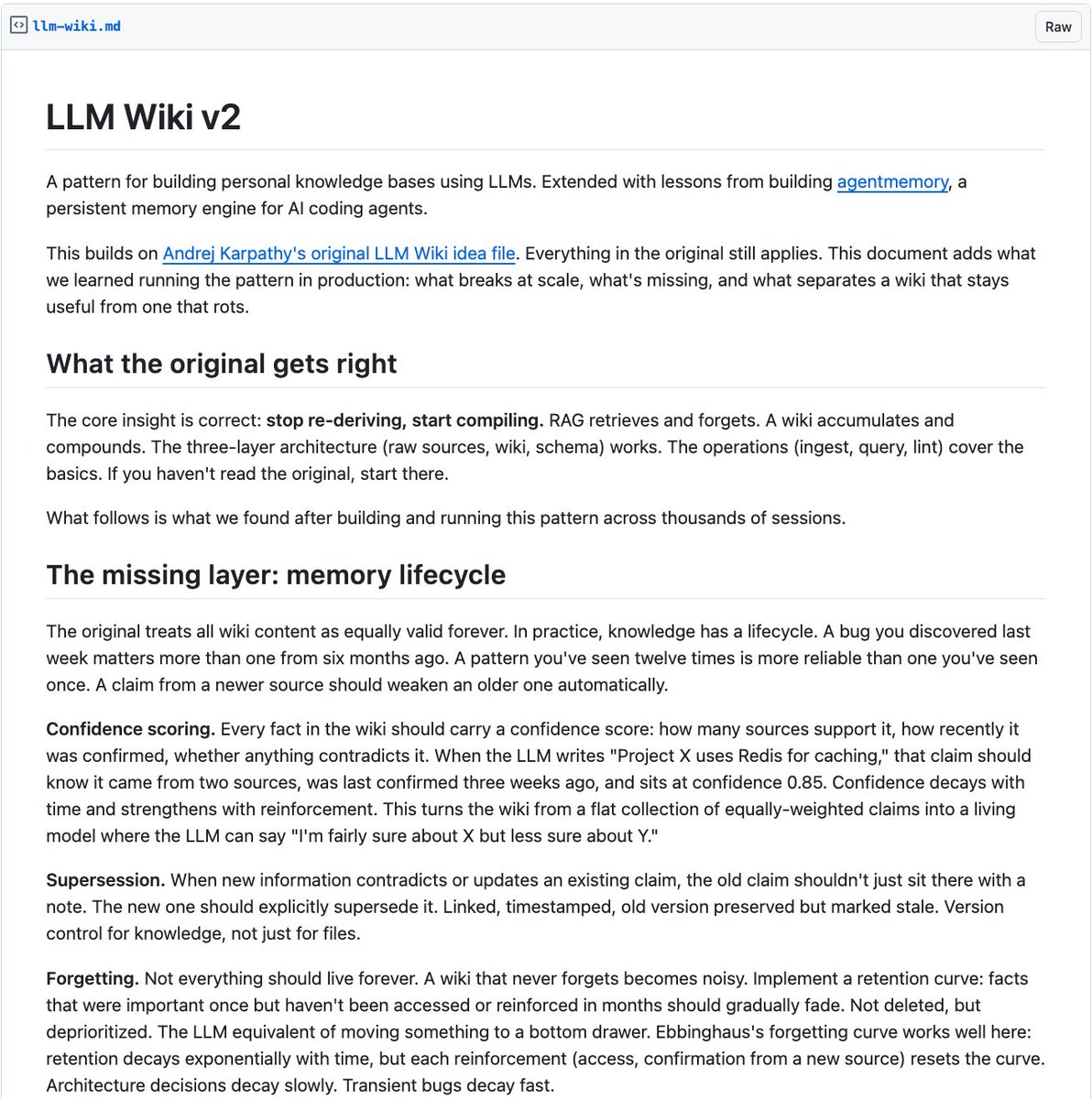
Karpathy's LLM Wiki got 5,000 stars in 48 hours. Now someone extended it with the features it was missing.
Memory lifecycle. Confidence scoring. Knowledge graphs. Automated hooks. Forgetting curves.
It's called LLM Wiki v2.
The original pattern was brilliant. AI builds a wiki instead of re-deriving knowledge from scratch every time. But it treated all knowledge as equally valid forever. In practice, that breaks.
Here's what v2 adds:
→ Confidence scoring. Every fact carries a score. How many sources support it. How recently confirmed. Whether anything contradicts it. Knowledge that decays over time. Not everything is equally true forever.
→ Memory tiers. Working memory for recent observations. Episodic memory for session summaries. Semantic memory for cross-session facts. Procedural memory for workflows. Each tier more compressed and longer-lived.
→ Knowledge graph. Not flat pages with links. Typed entities with typed relationships. "A caused B, confirmed by 3 sources, confidence 0.9." Graph traversal catches connections keyword search misses.
→ Hybrid search. BM25 for keywords. Vector search for semantics. Graph traversal for structure. Fused with reciprocal rank fusion. Replaces the index .md file that breaks past 200 pages.
→ Automated hooks. On new source: auto-ingest. On session end: compress and file. On schedule: lint, consolidate, decay. The bookkeeping that kills wikis is now fully automated.
→ Forgetting curves. Facts that haven't been accessed or reinforced in months fade. Not deleted. Deprioritized. Architecture decisions decay slowly. Transient bugs decay fast.
→ Contradiction resolution. AI doesn't only flag contradictions. It resolves them based on source recency, authority, and supporting evidence.
Here's the wildest part:
The original LLM Wiki was a flat collection of equally-weighted pages. This turns it into a living system with memory that strengthens, weakens, consolidates, and forgets. Like a real brain.
"The Memex is finally buildable. Not because we have better documents or better search, but because we have librarians that actually do the work."
Built on lessons from agentmemory, a persistent memory engine for AI agents.
Extends Karpathy's original. Open Source.
LLM Knowledge Bases
Something I'm finding very useful recently: using LLMs to build personal knowledge bases for various topics of research interest. In this way, a large fraction of my recent token throughput is going less into manipulating code, and more into manipulating knowledge (stored as markdown and images). The latest LLMs are quite good at it. So:
Data ingest:
I index source documents (articles, papers, repos, datasets, images, etc.) into a raw/ directory, then I use an LLM to incrementally "compile" a wiki, which is just a collection of .md files in a directory structure. The wiki includes summaries of all the data in raw/, backlinks, and then it categorizes data into concepts, writes articles for them, and links them all. To convert web articles into .md files I like to use the Obsidian Web Clipper extension, and then I also use a hotkey to download all the related images to local so that my LLM can easily reference them.
IDE:
I use Obsidian as the IDE "frontend" where I can view the raw data, the the compiled wiki, and the derived visualizations. Important to note that the LLM writes and maintains all of the data of the wiki, I rarely touch it directly. I've played with a few Obsidian plugins to render and view data in other ways (e.g. Marp for slides).
Q&A:
Where things get interesting is that once your wiki is big enough (e.g. mine on some recent research is ~100 articles and ~400K words), you can ask your LLM agent all kinds of complex questions against the wiki, and it will go off, research the answers, etc. I thought I had to reach for fancy RAG, but the LLM has been pretty good about auto-maintaining index files and brief summaries of all the documents and it reads all the important related data fairly easily at this ~small scale.
Output:
Instead of getting answers in text/terminal, I like to have it render markdown files for me, or slide shows (Marp format), or matplotlib images, all of which I then view again in Obsidian. You can imagine many other visual output formats depending on the query. Often, I end up "filing" the outputs back into the wiki to enhance it for further queries. So my own explorations and queries always "add up" in the knowledge base.
Linting:
I've run some LLM "health checks" over the wiki to e.g. find inconsistent data, impute missing data (with web searchers), find interesting connections for new article candidates, etc., to incrementally clean up the wiki and enhance its overall data integrity. The LLMs are quite good at suggesting further questions to ask and look into.
Extra tools:
I find myself developing additional tools to process the data, e.g. I vibe coded a small and naive search engine over the wiki, which I both use directly (in a web ui), but more often I want to hand it off to an LLM via CLI as a tool for larger queries.
Further explorations:
As the repo grows, the natural desire is to also think about synthetic data generation + finetuning to have your LLM "know" the data in its weights instead of just context windows.
TLDR: raw data from a given number of sources is collected, then compiled by an LLM into a .md wiki, then operated on by various CLIs by the LLM to do Q&A and to incrementally enhance the wiki, and all of it viewable in Obsidian. You rarely ever write or edit the wiki manually, it's the domain of the LLM. I think there is room here for an incredible new product instead of a hacky collection of scripts.
@steph_palazzolo@erinkwoo@AndrewYNg Sanctuary AI announced a partnership with European automaker Magna.
The collab features Sanctuary AI’s development of general-purpose AI robots for deployment in Magna’s manufacturing operations.
Great breakdown by @herbertong
https://t.co/r2TTUGyVsS
Stability AI released Stable Video 3D.
The new AI model is based on Stable Video Diffusion and creates high-quality and consistent 3D generations from a single image.
Stability AI just keeps shipping. It's impressive.
GPT-4V is An Amazing Update With Tons of Potential.
But Most People Haven't Figured Out How to Use it To Make Money.
Here are 5 Amazing Ways to Make Money Using GPT-4V:
(this one is worth bookmarking)
@Dr_Schelm@EliotJacobson Wenn du beim höchsten roten Punkt vertikal runter gehst, kommst du bei ca. 0,57 aus. Das passt also mit den beschriebenen Werten überein.