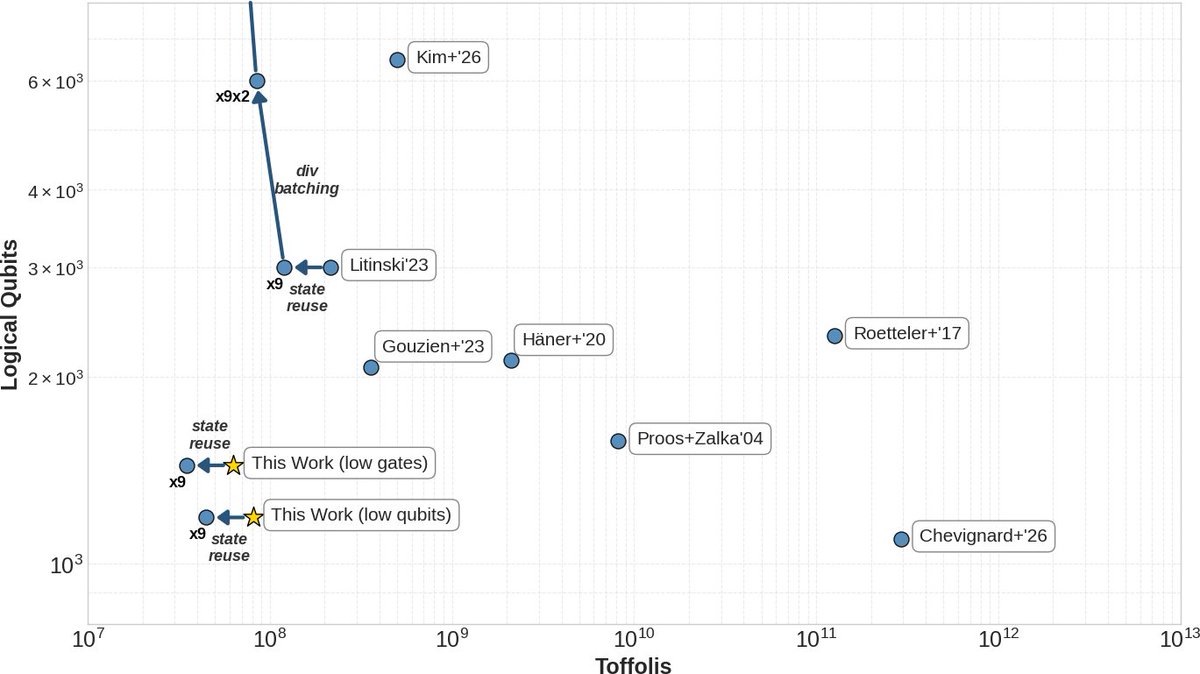
As timelines tighten, details might benefit attackers more than defenders. So we're trying something weird: proving a circuit exists without revealing it.
For example, here's a zero-knowledge proof that we found 10x smaller quantum circuits for ECDLP: https://t.co/ypwPEVurg5
@dallairedemers@CraigGidney We initially generated an SP1 STARK proof but then realized that STARK proofs in SP1 are not Zero Knowledge yet. Instead of moving to a different tool, we decided to generate a SNARK proof using SP1.
https://t.co/OG7ueFlJmf
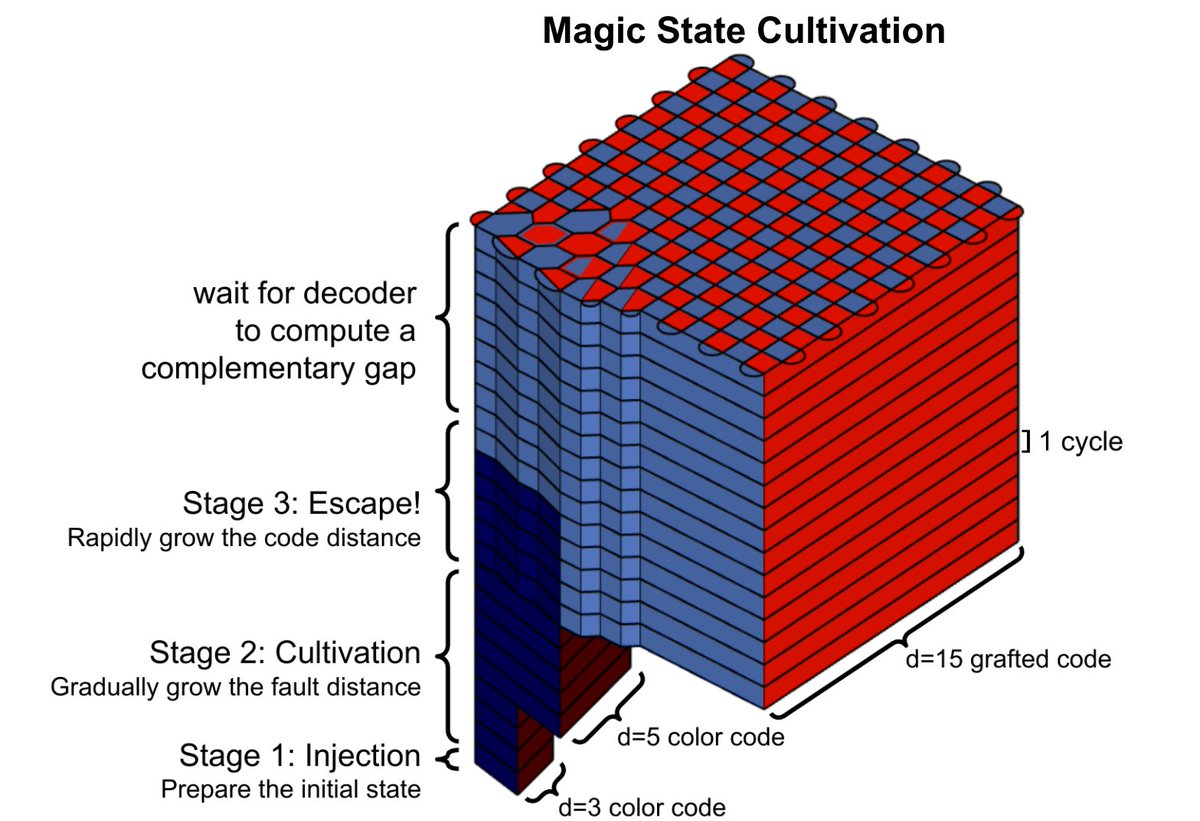
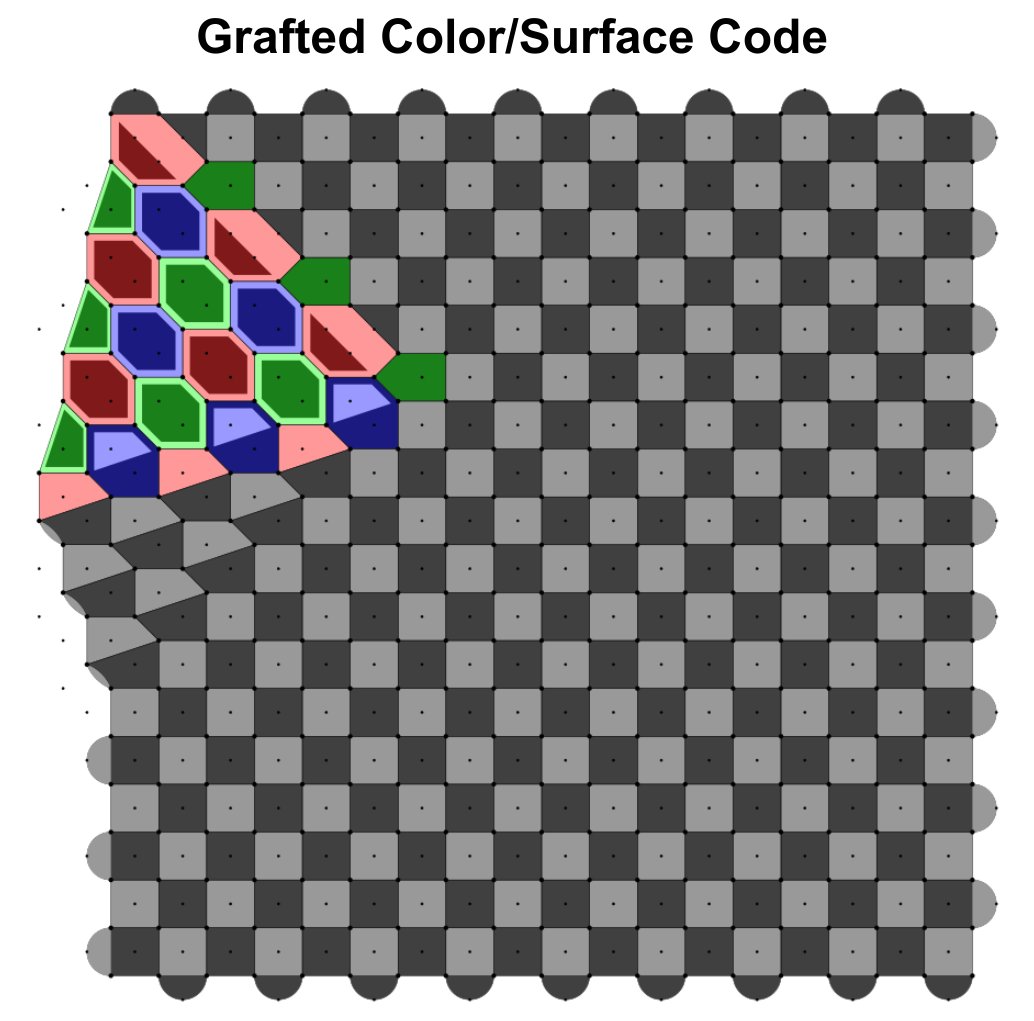
Been working on "Magic state cultivation: growing T states as cheap as CNOT gates" all year. It's finally out: https://t.co/VxQsZQJcDE
The reign of the T gate is coming to an end. It's now nearly the cost of a lattice surgery CNOT gate, and I bet there's more improvements yet.
@pxmath24@CraigGidney qpic is another open sourced tool to create quantum circuit diagrams in TikZ - https://t.co/poyUO1cPQV
You can checkout our implementation in Qualtran by downloading the source from https://t.co/avvi5fHIcX
@pxmath24@CraigGidney We implemented all our circuit decompositions using our open source quantum programming SDK https://t.co/Ao5VDcgpvI.
Qualtran provides tools to auto generate latex diagrams for "Bloqs" (aka quantum operations/circuits) and uses qpic under the hood.
This table provides a nice summary of our constructions compared to the previous state of the art. In the sublinear ancila regime, we improved decompositions for generalized toffoli gate, incrementer, quantum-classical comparator and unary iteration.
Checkout our latest paper where we provide new optimized constructions for a variety of fault tolerant gadgets.
For example: We can decompose an n-bit generalized Toffoli (MCX) using only 2n-3 Toffoli's in log(n) depth and 2 clean ancilla.
https://t.co/9bzU4lIQQZ
It turns out that, often, clean workspace qubits can be used in a way that's "viral". Where you end up with more and more workspace that you can use as-if-it-was-clean. Very useful trick, found in parallel by several recent papers. https://t.co/M0MCHn4xZc
Some recent headlines have been touting that Q-Day is coming potentially as soon as 2025. What is Q-Day? Well, it’s the day when quantum computers will be able to crack the current encryption protocols.
https://t.co/4YTtxpi7ie
Drop by the #APSMarch Google booth (#1205) today at 2:30pm to hear @tanujkhattar4 talk about Qᴜᴀʟᴛʀᴀɴ, a new open source library for effective resource estimation of fault tolerant quantum algorithms. Learn more at https://t.co/0WWBl9CbWJ
We’re at @APSphysics March Meeting this week! Attending? Stop by one of our 50+ sessions or swing by our booth to learn more and to chat with our team.
Read more about our presence and event schedule here ↓ https://t.co/Oah9YjB1AM
@DulwichQuantum > Sprinkling some QAOA fairy dust onto something that doesn't work is not going to magically make it work.
This is the best one-line summary of this discussion that I've read so far!
@MarioKrenn6240 We simualted and open sourced the proposed algorithm. As we discuss in our note, it won't work even if you had a __perfect__ hypothetical quantum optimizer (instead of QAOA) -- because the claims via classical reductions in itself don't hold true!
See https://t.co/LjKDfqED8g
Thank you Craig for the shoutout!
As we discuss in our note, the approach in the original paper doesn't work even if you had a _perfect_ quantum optimizer (instead of QAOA) -- this is because the claims via classical reductions in itself don't hold true!
Remember that paper from the end of last year that claimed it could factor 2048 bit integers using 378 qubits? At the time, I mentioned to Tanuj Khattar that a nice starter paper would be to just simulate it and verify it doesn't work. Here's the result: https://t.co/894rHMLDWX
Thrilled to see our @GoogleQuantumAI paper on quantum error correction in @Nature today!
Check out this page for a video, blog posts by @sundarpichai and Julian Kelly, and the paper (free open access for everyone)
https://t.co/aQO07BZbQ3
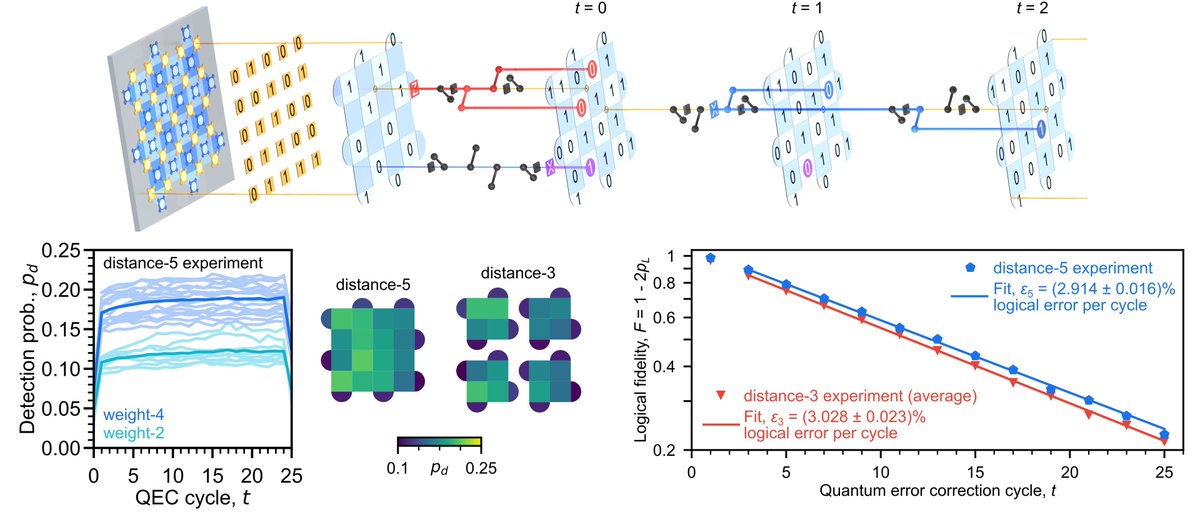
I’m excited to share our latest work on quantum error correction. We’ve experimentally demonstrated the suppression of quantum errors by scaling a surface code logical qubit from distance-3 (17 qubits) to distance-5 (49 qubits). You can read it here: https://t.co/GpQJiMFQgm
Our work on quantum advantage in learning from experiments is now published in @ScienceMagazine!
Working with our Quantum Science Communicator @mccornut, @JarrodMcClean and @RobertHuangHY describe the results in this blog post: https://t.co/mRUCr1gCVJ