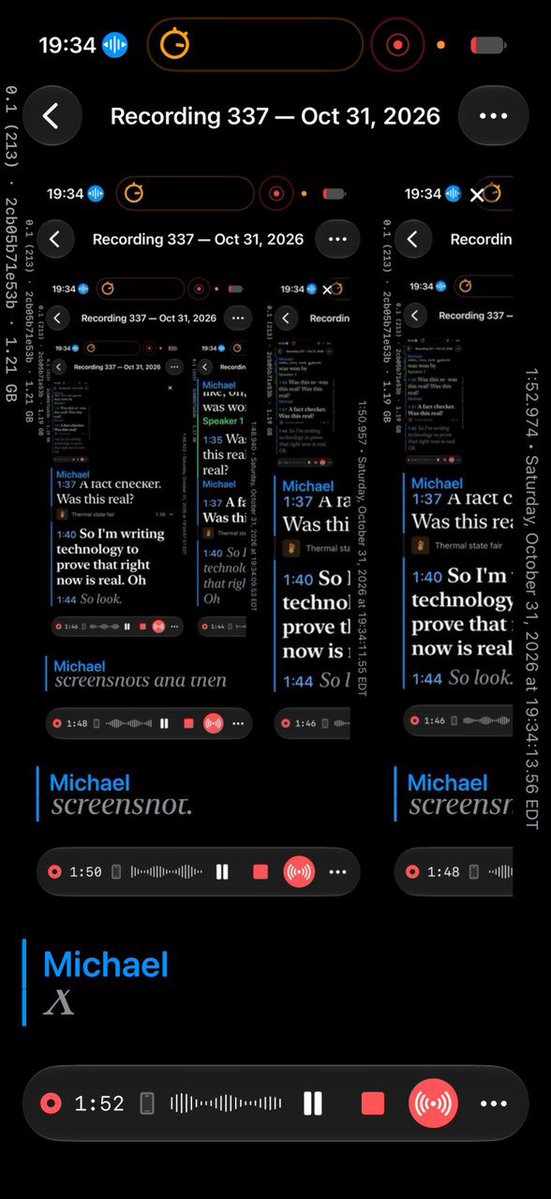
@awertheim Rather one embedded screen frame lives in t+1’s frame with multiple matching time progressive values, proving one was created prior to the other. Very difficult to be faked. Just kind of a thought experiment really
To celebrate the launch of the Avec desktop app, we're doing another contest!
Can you convince Claude to give you a brand new M6 MacBook Pro? Let's find out! Email [email protected] to get started.
Contest ends in 48 hours.
totally agree with marc. people ask me why not swift on android or kotlin on apple platforms. it's not natural.
for shared logic, pick a language whose incentives are to go everywhere. i think apps collapse into rust for the logic, with a thin swift and kotlin layer for ui
https://t.co/xAxXAVoyAL
@thdxr but you really should have started counting from when @kitlangton was born, and plausibly even before then.
so really growth is a ton slower than you claim
excellent tool. decades in the making
@uint256b@poteto@aiDotEngineer right I truly don't get all this look how many billions of lines of code we change all the time to get something working the way it should type hype
@adamwathan I have an app I’m building that syncs realtime voice dictation to my computer from phone or iPad so clanks can do things and respond and interact with the app and has been really fun to build this way
Would love to chat!
@mattpocockuk Also @mattpocockuk here’s a cool video of creating a functional core imperative shell demo that renders foldkit logic in n different paradigms and syncs their data (including navigational state) in realtime amongst them: https://t.co/eGnfUbh4TL
I'm putting together a prototype of an architecture where you write your business logic once and can render it on whatever funky Javascript framework you choose!
Built with @foldkit and @instant_db by the wonderfully talented @devinjameson and @stopachka (and team; respectively), I look forward to building out an idealistic architecture for all of the future applications I build that gets rid of the drudgery I've experienced developing frontend applications.
I also envision something like this can begin to dissolve the "client/server" barrier that I feel like is just a relic from the past when space/memory were limitations we had to deal with. You will be, of course, still able to run this on some server, but the point is that if the client knows all of the business logic, it can behave offline and defer to the server super heavy jobs that aren't well suited for client and edge devices.
Of course, this is just a demo of some counts and navigation state synchronizing, but the fundamental bones here are going to really start to yield a good return on investment.
Your data is also going to sync in real time via InstantDB (or whatever other sync engine you choose)
Anyway, enjoy and thanks for watching and I'd love to work with you if this kind of thing is interesting.
#localfirst #softwareshouldwork #syncengines #distributedarchitecture #tea #theelmarchitecture #dohashtagsevendoanything? #dontcareimexcitedtoshare
Also huge shoutout to @grok and @cursor as they've been immensely helpful in building this out where @claudeai and @ChatGPT struggled or just took forever to get things done.
https://t.co/wEpIty5BCn
@jarrodwatts Right. But your without much cost is because you haven’t much gain. Not trying to be a dick but the problem you’re solving here isn’t “useful” but I guess the direction of editing weights is interesting and may yield more stuff down the line so maybe I should pull the stick