Around $3 Trillion dollars were laundered through banks in 2025 and they want you to believe that a bill in Congress that clearly applies AML/BSA obligations to crypto exchanges is somehow the problem. Literally nonsense.
Nathan Allman was a visionary in crypto who saw a trend coming back in 2021 and grinded his way to scale. He believed in tokenization before it was in the lexicon, started with a simple product, and was one of the first to see that TradFi was, indeed, coming, and the regulatory complexity of the space would catch up with our industry.
We weren’t close but we met a few times, and every time I saw him speak I was impressed. Sorry to hear of the loss of a great mind in the space.
It is with profound sadness that we announce the unexpected passing of Nathan Allman, Ondo's founder. Our hearts are with his family and loved ones.
Nate’s brilliance, humility, and drive shaped every part of what Ondo is today. His belief in the power of technology to create a more open, accessible financial system lives on in everything we build. The impact he had on this industry, and on all of us personally, cannot be overstated.
Nate also helped us build a durable organization with experienced leaders across all facets of the business. Ian De Bode, Ondo Finance’s longtime President, will serve as CEO. Ian has been leading our strategy, product, and day-to-day operations for over two years and has the full confidence of the leadership team.
We will continue building what Nate started. That is the most meaningful way we know to honor him.
What is the CLARITY Act?
How does it protect the 70 million Americans who hold crypto? What does it change about how projects operate?
This @LawofCodeFM podcast explains the history of U.S. digital asset regulation, why regulation-by-enforcement failed and what CLARITY solves, plus remaining steps for this to become law.
Featured: @NYcryptolawyer, @milesjennings, @SH_Brennan, @KyleBligen, @millercwl, Dugan Bliss and snippets from @BillHughesDC, @thatgerald.
By the end of this episode, I promise you'll be in the 99th percentile for understanding the CLARITY Act, regardless of whether you're a lawyer, builder or operator.
Timestamps:
0:00 Intro
4:46 Explaining market structure
6:05 @milesjennings on regulatory distortion
10:43 Predecessor bills (RFIA, FIT21)
13:35 Senate Banking markup takeaways @millercwl
15:46 SEC & CFTC
20:37 The Securities Act of 1933
23:07 The Howey Test
25:26 @NYcryptolawyer's Ineluctable Modality of Securities Law
28:51 SEC enforcement
32:32 Why SEC rulemaking isn't enough
37:36 Titles of CLARITY
40:00 Digital commodities
47:29 Howey principles @NYcryptolawyer
54:10 Promoters: originators
58:18 Promoters: related persons
1:04:13 Token taxonomy @milesjennings
1:11:02 Ancillary asset requirements
1:19:34 The certification process
1:28:32 Remaining hurdles for CLARITY
1:34:50 Stablecoin yield
1:38:45 Ethics @KyleBligen
1:45:50 Tax consequences @CryptoTaxGuyETH
1:48:54 Thanking people working on the bill, such as @SenLummis, @gillibrandny, @SenatorTimScott, @SenatorHagerty, @SenThomTillis, @MarkWarner, @SenRubenGallego, f , their staffs & many, many others.
Nothing in this podcast is legal or investment advice.
This is foundational. We’ve been clear: the right to build is non-negotiable. Protecting software developers is vital to ensure the U.S. remains the global hub for crypto innovation. Thank you @patrickjwitt for your leadership on this.
Yesterday marked 2 years as GC at @Sei_Labs.
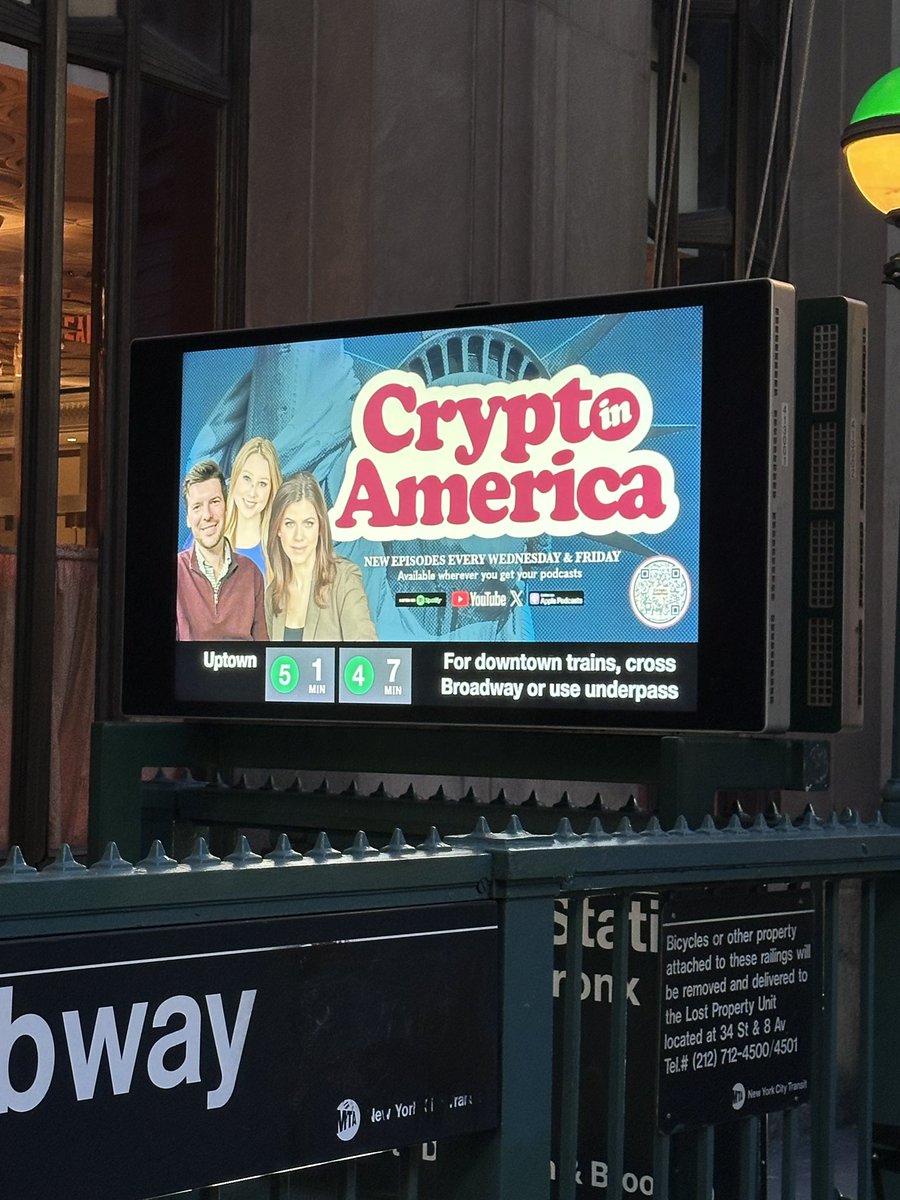
In that time we've grown the team, gone on some crazy quests (like the 23andMe acquisition), built a foothold in the US with the @Sei_FND, launched @CryptoAmerica_ with my incredible cohosts @jacqmelinek and @EleanorTerrett, taken an active voice on regulation and policy through the @BlockchainAssn and @DigitalChamber, opened a New York office, and built our way to one of the fastest EVM L1s in production, the @SeiNetwork.
Incredibly excited for what the future holds.
Reshoring “true” crypto perpetual futures in the US is a key piece of the @CFTC’s innovation policy agenda. We are hard at work to get this done soon.
@blockworksDAS
🚨NEW: Our one-year anniversary episode featuring @SECGov Chairman @SECPaulSAtkins is live now on all platforms!
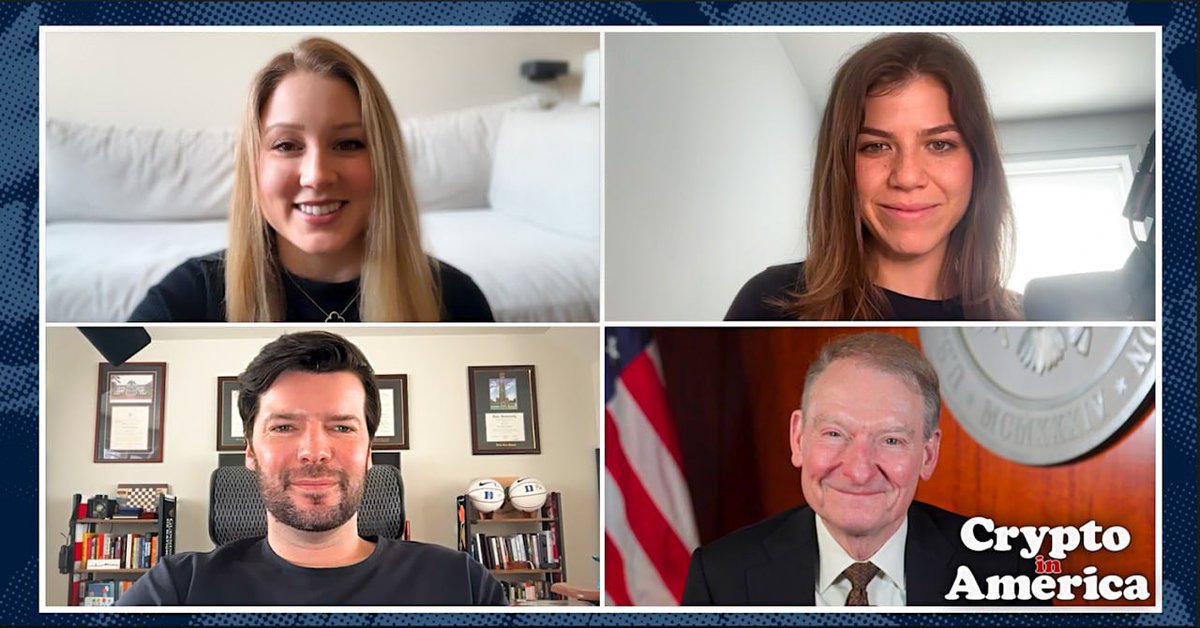
We also want to extend a big THANK YOU to our readers, listeners and sponsors for your support in our first year. With over 3.5 million views across platforms, Crypto In America wouldn’t be what it is today without you.
We’re excited to keep growing in year two, with more to share soon! 🇺🇸
“Our goal is to make all of the experience and technology around self-custody match the ease and safety of use that custody can provide.”
@BChillman, CEO of @phantom explains the mission to make self-custody as seamless as custodial platforms.
We're excited to announce 'The Situation Room' by Polymarket is coming to Washington, D.C.
The world's first bar dedicated to monitoring the situation. 🧵
Excited to be speaking at the DC Blockchain Summit hosted by @DigitalChamber on "Crypto on Trial: The Legal Fault Lines Shaping the Industry" alongside Daniel Stabile (Winston & Strawn), @MariTomunen from @doublezero, and Jesse Overall (Clifford Chance).
The regulatory landscape is moving fast and the legal frameworks being built right now will define this industry for the next decade.
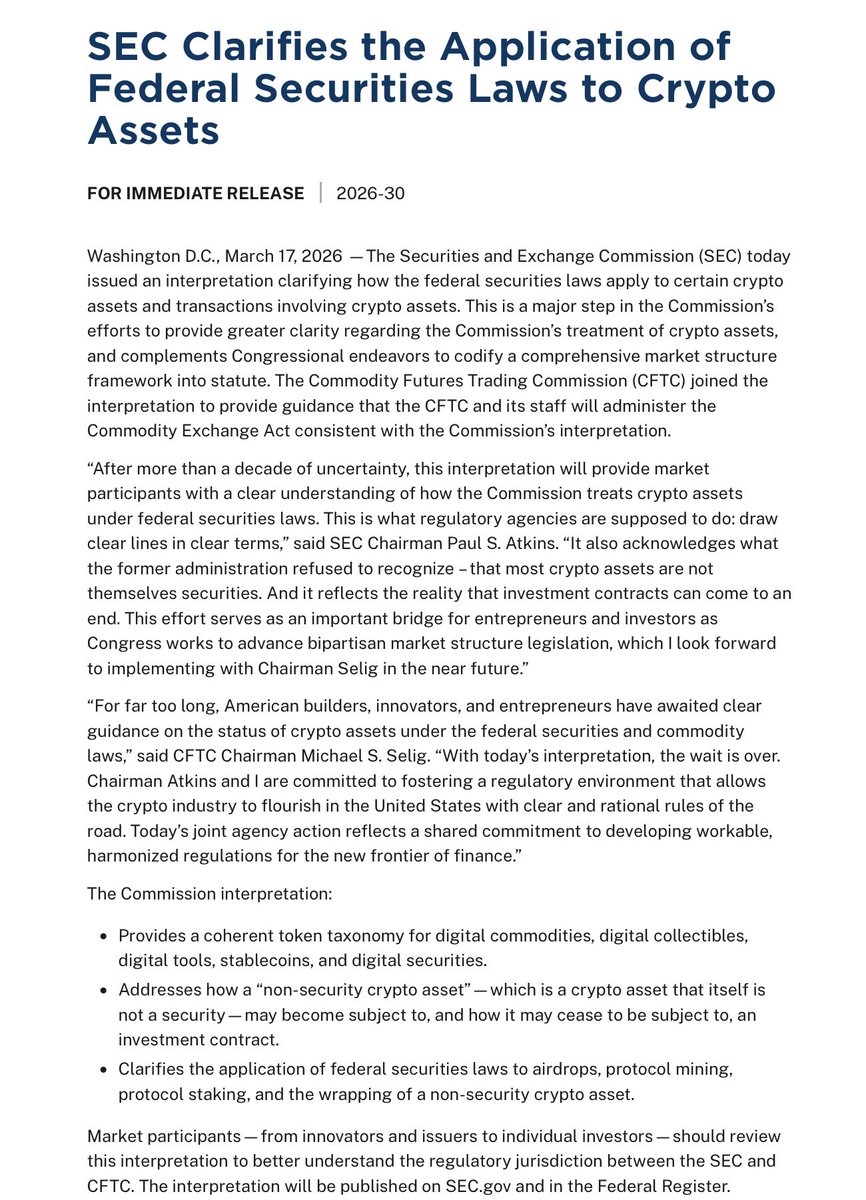
🚨JUST IN: The @SECGov and @CFTC have issued joint, Commission-level interpretive guidance outlining how federal securities laws apply to certain crypto assets and transactions.
This follows a submission to OIRA earlier this month signaling the agencies’ intent, and was approved by all three SEC commissioners (Atkins, Peirce, Uyeda) as well as @ChairmanSelig.
The guidance establishes a token taxonomy and addresses how activities like staking, mining, airdrops, and wrapping are treated under existing law.
Notably, SEC Chair @SECPaulSAtkins says it reflects that most crypto assets are not themselves securities and that investment contracts can come to an end.
While interpretive guidance doesn’t change the law, it reflects how regulators intend to apply it, giving the market a clearer directional signal.
Separately, this is distinct from the SEC’s still-pending rulemaking on crypto asset offerings.
$1.7B+ for syrupUSDC and $860M+ for syrupUSDT.
First, syrupUSDC and syrupUSDT crossed $2.5B in combined deposits. Now, both dollar yield assets have set new individual deposit ATHs.
“Credibility rests on more than rules alone. It rests on clarity. On consistency. And on a widely held confidence that regulators coordinate intelligently in lieu of competing in turf wars that offer no benefit to investors.”
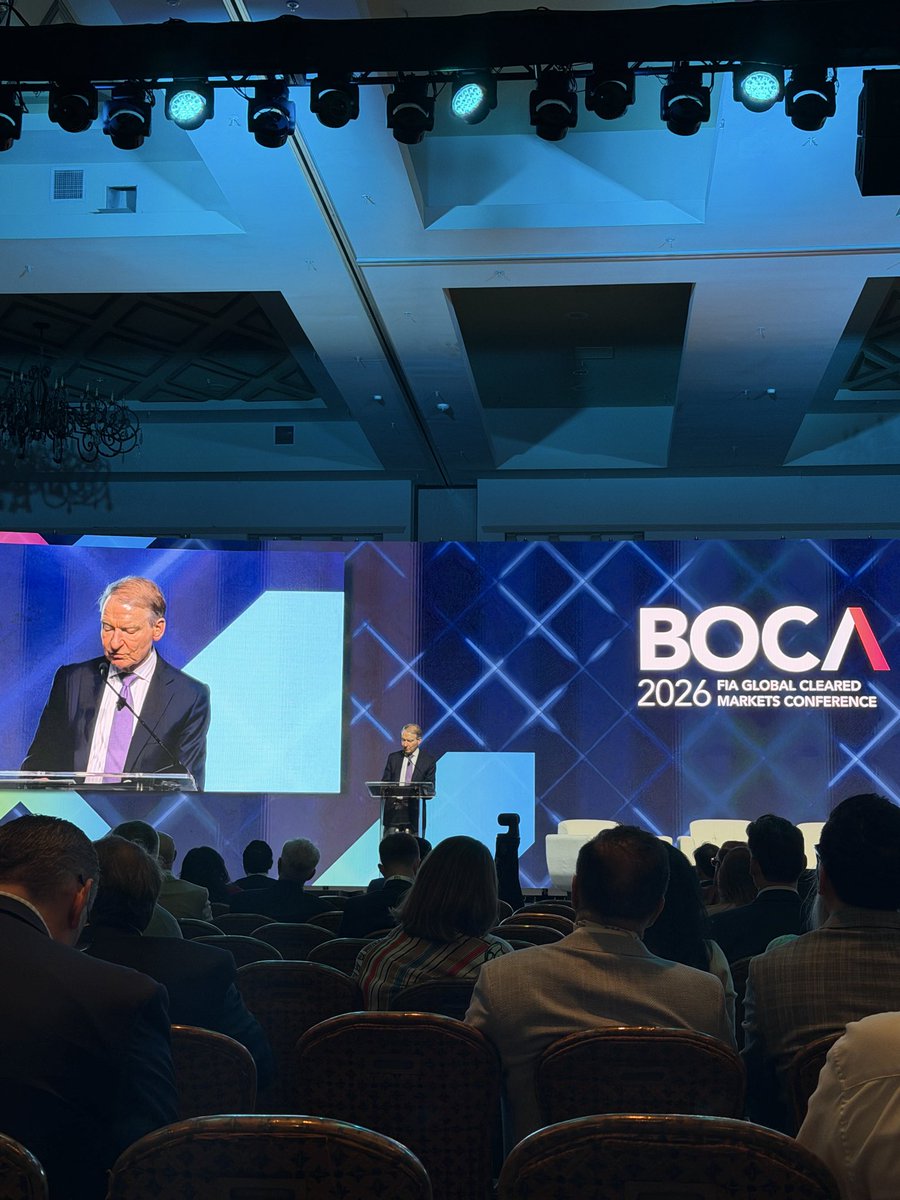
🚨NEW: Speaking at the flagship futures industry conference in Boca Raton, FL, @SECPaulSAtkins is laying out more details on the @SECGov and @CFTC’s push for regulatory harmonization.
Lots to unpack in this speech:
1. Atkins declared the “regrettable era of duplicative enforcement actions” over, saying the agencies should coordinate legal theories and remedies when pursuing the same conduct.
2. He also floated the idea of “substituted compliance” between the agencies. If one agency’s framework achieves comparable regulatory outcomes, he said, it should be capable of satisfying overlapping requirements of the other. The goal: reduce duplication for companies registered with both.
3. The SEC is launching an SEC-CFTC harmonization webpage where firms can request coordinated discussions with staff from both agencies when launching products or seeking guidance.
4. The regulators will also hold joint meetings on new and pending product applications aimed at speeding up approvals.
5. On prediction markets, Atkins called for cross-agency clarity on event contracts, including whether some could qualify as security-based swaps or other securities.
6. Atkins highlighted cross-margining as a way to unlock liquidity currently stuck in separate accounts across derivatives markets, allowing firms to use the same collateral across related platforms.
7. The agencies are also working on an updated Memorandum of Understanding (MOU) to coordinate exams, supervision, and enforcement for firms regulated by both agencies.
Atkins closed with a disclaimer that the coordination doesn’t mean the agencies are merging:
“The SEC and the CFTC operate under distinct statutes entrusted to us by Congress, and we must administer those mandates faithfully. But fulfilling our responsibility does not require fragmentation; in fact, it calls for coordination.”