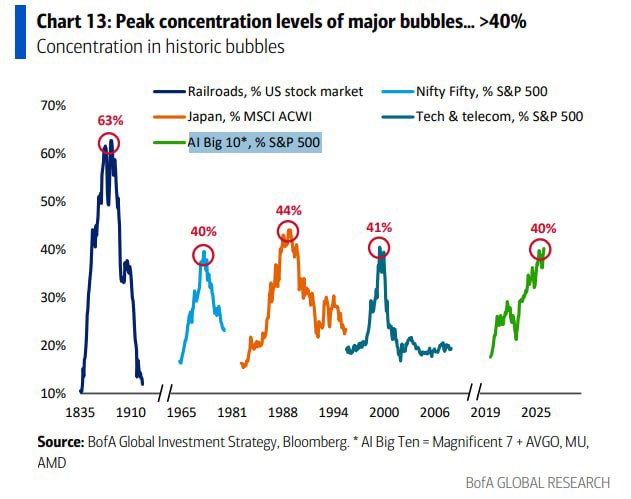
Compute will become worthless.
The GPU barons spending billions on compute farms today are akin to the carriage barons of the 1900s that spent building out infrastructure for horse carriages, lengthening the bottleneck, blind to the machine that’s coming to widen it.
Trade: the DuPont family started buying General Motors stock in 1914, when the auto industry was still young and one that was treated as a niche.
I.e., compute becoming valuable because AI feeds on it is not a moat, but a bounty, an incentive for engineers to solve its scarcity.
1. AI demand makes compute scarce.
2. Scarcity makes compute extremely profitable.
3. Profit attracts capital into photonics, neuromorphic chips, wafer-scale chips, better memory, better cooling, better networking, better algorithms.
4. Compute gets cheaper per unit.
As better ways to compute, better means to produce compute, or better ways to use compute arise, all the capex we burnt on traditional compute will go to waste, leaving dead assets in the books of several corporations.
In the 1800s, agriculture depended heavily on natural nitrogen sources like Peruvian guano and Chilean nitrates. These were scarce, and inconveniently located making them geopolitically strategic. Then, two german chemists, Haber and Bosch, developed a way to fix nitrogen from the air into ammonia, with lab success in 1909 and industrial scale by 1913. The previous scarcity, “where do we find enough nitrogen?” (Akin to “where do we find enough GPUs”), was attacked by an advancement: Industrial chemistry.
My Full @pacifica_fi Review, Why I Almost Never Gave It a Second Chance & Results
"If a tool improves your profitability and your quality of life, you should use that tool."
I've written lately about the phenomenon of products going to market and getting hyped too soon, and how that is a disservice to everyone involved.
I've tested and written about countless protocols, so when Pacifica first hit the scene, I naturally tested it.
And I almost never came back.
At that time, individual deposits were capped at a really low amount. That caused one of the few liquidations I have had in my life, because I was unable to deposit more money into my account to survive an unexpected temporary drawdown.
After that experience I believed I had written it off for good.
Just a few more dollars in the account and that temporary drawdown would have turned into a profitable trade.
Because of that bias from being an early tester, I never imagined myself coming back to it. I held a grudge.
But when all of the Phoenix hype was going around - another product that got the spotlight before it was ready to receive it - one of my followers mentioned Pacifica again.
I honestly came back to it expecting to write a scathing review. I expected to confidently and aggressively explain why it was just another cookie-cutter perp venue that was not special in any meaningful way. Because in the great "perp dex" bubble we find ourselves in most of them are not.
With the last thing I liked suffering an exploit, the popular move for me right now would be to simply hate everything that is not Hyperliquid. So for the sake of my social capital, I did not want to like it.
But not only did I like it, I have started to fall in love.
Anyone who has been hurt in the past knows falling in love the next time is much harder. You are more cautious. You scrutinize harder. You look for red flags in places they do not typically exist.
Look, it is not a true DEX.
But none of them are. Not from a decentralization purist point of view.
It is more like a permissionless CEX working toward becoming a DEX. So while I will pick on this point, it is also basically the entire perps landscape.
The first thing I scrutinized hard was security. These are the questions we all should be asking in a post-Drift world.
Pacifica solved the Drift vulnerability even before Drift was exploited.
I actually have a lot of respect for that. It is one thing for the industry to be reactionary and solve something after the fact. It is another thing for a team to be forward-thinking and solve problems before they arise. That is a good sign.
The second thing I studied was liquidity.
Surprisingly thick on all of the assets I typically trade.
No one will ever compare to the liquidity of Hyperliquid. But what matters to me is not some astronomical amount of liquidity. What matters is whether the exchange has enough liquidity to support my trading sizes without getting wrecked by slippage.
And they do.
I also pushed the team to tell me more about their market makers. All too often, these exchanges only run with one or two primary market makers.
While the team would not disclose the exact number to me, they did give me a ballpark, and it is definitely more generous than a lot of “perp DEXs” carry.
That matters, because if your venue only runs on one or two primary market makers, things can go sideways real quick.
As I have highlighted recently during my testing, I absolutely love their scale limit order feature.
There does not exist a venue-native scale order feature this advanced.
Typically, you would have to pay a third-party terminal to get advanced order features like this, which is something I am against doing at my core.
But when I first started testing the feature, it only allowed you to scale into positions, not out of them.
It seemed like a common sense oversight.
I brought this up to the team, and they pushed it live in less than two weeks.
I told them their vault page experience was less than desirable. Even though I do not use vaults, when I test something, I test every aspect of it.
Once again, in less than two weeks, they pushed an update.
Having the features I dream of using native to the venue is so important to me. I have written about this multiple times over the past year. I have begged other protocols that I love to continue to make front-end improvements. But most teams are satisfied with status-quo for user experience and that satisfaction with the lack of continuous improvement is something that really irks me.
Having those features presented in a sexy format that is intuitive and easy to use makes the trading experience exponentially better for me.
It quite literally improves the quality of my life.
And any time a tool can improve the quality of your life in some way, it is a tool worth using.
I can accomplish anything I want to do on Hyperliquid. I am not going to pretend those things cannot be accomplished almost anywhere perps are traded.
But the experience can take more time, friction, or in some cases offline calculations that impede the workflow.
That time and energy matter to me. The reduction of annoyance and friction matters to me. A lot.
Maybe it's just from my many years as CEO of a B2C company. Maybe as a result I've inherited a giant pet peeve against friction because I understand the path to on-going to success is to always reduce friction and to never stop obsessing about the customer experience.
So while on one hand we have a team that has never stopped shipping - jobs not finished - there do, in fact, remain some unfinished pieces of the puzzle.
For most of my trading life, I have never paid much attention to funding rates. 10.95% annualized as a standard is just the cost of doing business, assuming you are betting with the majority.
But I noticed on Pacifica that the standard rate was higher and swung more widely, even on some of the majors.
I brought this up to the team and suggested they focus on smoothing out and reducing the base funding rate. They said they were working on it.
While they have not officially confirmed it has been smoothed yet, my personal observation over the last 24 hours is that the base funding rate, at least on majors, seems to now be industry standard at 10.95%, with far fewer swings outside of standard.
That is good, because for a little while there I was seriously concerned about some of the funding rates I was seeing.
I suspect the funding rate smoothing process is not fully complete yet, but I can already see visible results.
The other areas where I think they need continued improvement are the tradable asset list and advanced reporting & analytics.
The asset list is broader than a lot of venues, but not nearly broad enough. ONDO is missing, as one example.
I also want to see better reporting.
This is something I am a stickler on.
Stop lumping realized and unrealized profit together, which is the HL standard.
Give people more insight into their trades from an analytics perspective. The more traders can study their own patterns and history using readily available data, the better traders they can become.
I am told by the team that both of these outstanding items are being worked on, but they have yet to be realized.
I came here wanting to write a negative review because I had developed a premature early-release negative bias.
Instead I found myself having a trading experience that was fun and rewarding.
If a tool improves your profitability and your quality of life, you should use that tool.
I am NOT here to tell you that you should use Pacifica. That is up to you.
If you enjoy a good quality of life and profitability using Aster, then by all means use Aster - even though it is my most hated of all.
Because your profit and your quality of life are what matter most.
I am not ready to leave Hyperliquid just yet. But as I continue on my Pacifica journey, I do find myself starting to shift more and more volume to the venue.
I truly enjoy the trading experience and profiting on Pacifica.
I only enjoy the act of profiting on Hyperliquid.
Those two experiences are not the same.
It is my belief that I should be able to enjoy the experience of doing my job. And trading is my job.
Now, as an account with followers, every time I either love something or hate something, some jackoff has to ask, “How much were you paid to say this?”
And as has been true since the creation of my account on X, the answer will always be zero.
I do not sell my voice.
And quite frankly, I do not even care if you use things I like or not. It makes zero impact on my life or my PnL.
The only thing I have received from the team, other than attentive listening to feedback - which they do with all users - was a temporary discount tier.
That is something anyone with established volume on other platforms can be given. I am not special in that regard.
After the temporary grace period ends, I will have to earn my discounts like everyone else.
So that is my review: not paid, not sponsored, not blindly bullish, and not pretending the product is finished.
Pacifica still has things to improve. But the direction of travel matters, and right now I see a team listening, shipping, fixing, and building with a mindset of constant improvement.
I came back looking for reasons to hate it.
Instead, I found a venue that made trading feel enjoyable again.
🫡 From the depths —
The White Whale 🐋
The vibes in SF feel pretty frenetic right now. The divide in outcomes is the worst I've ever seen.
Over the last 5yrs, a group of ~10k people - employees at Anthropic, OpenAI, xAI, Nvidia, Meta TBD, founders - have hit retirement wealth of well above $20M (back of the envelope AI estimation).
Everyone outside that group feels like they can work their well-paying (but <$500k) job for their whole life and never get there.
Worse yet, layoffs are in full swing. Many software engineers feel like their life's skill is no longer useful. The day to day role of most jobs has changed overnight with AI.
As a result,
1. The corporate ladder looks like the wrong building to climb.
Everyone's trying to align with a new set of career "paths": should I be a founder? Is it too late to join Anthropic / OpenAI? should I get into AI? what company stock will 10x next? People are demanding higher salaries and switching jobs more and more.
2. There’s a deep malaise about work (and its future).
Why even work at all for “peanuts”? Will my job even exist in a few years? Many feel helpless. You hear the “permanent underclass” conversation a lot, esp from young people. It's hard to focus on doing good work when you think "man, if I joined Anthropic 2yrs ago, I could retire"
3. The mid to late middle managers feel paralyzed.
Many have families and don't feel like they have the energy or network to just "start a company". They don't particularly have any AI skills. They see the writing on the wall: middle management is being hollowed out in many companies.
4. The rich aren’t particularly happy either.
No one is shedding tears for them (and rightfully so). But those who have "made it" experience a profound lack of purpose too. Some have gone from <$150k to >$50M in a few years with no ramp. It flips your life plans upside down. For some, comparison is the thief of joy. For some, they escape to NYC to "live life". For others still, they start companies "just cuz", often to win status points. They never imagined that by age 30, they'd be set. I once asked a post-economic founder friend why they didn't just sell the co and they said "and do what? right now, everyone wants to talk to me. if i sell, I will only have money."
I understand that many reading this scoff at the champagne problems of the valley. Society is warped in this tech bubble. What is often well-off anywhere else in the world is bang average here.
Unlike many other places, tenure, intelligence and hard work can be loosely correlated with outcomes in the Bay. Living through a societally transformative gold rush in that environment can be paralyzing. "Am I in the right place? Should I move? Is there time still left? Am I gonna make it?" It psychologically torments many who have moved here in search of "success".
Ironically, a frequent side effect of this torment is to spin up the very products making everyone rich in hopes that you too can vibecode your path to economic enlightenment.
There’s an unprecedented fervent energy in the world around entrepreneurial pursuit
Some of it is driven by all the opportunities AI is opening up
But some of it is a quieter sense underneath. That our window to build things that matter, as humans, is shorter than we thought
The biggest opportunity for would-be startup founders is AI. But the most underpriced opportunity is probably non-AI ideas. So if you have a good non-AI idea, go for it, because everyone else is going to overlook it.
Two years ago, I wrote this post on the possible areas that I see for ethereum + AI intersections: https://t.co/y8G3MD5APF
This is a topic that many people are excited about, but where I always worry that we think about the two from completely separate philosophical perspectives.
I am reminded of Toly's recent tweet that I should "work on AGI". I appreciate the compliment, for him to think that I am capable of contributing to such a lofty thing. However, I get this feeling that the frame of "work on AGI" itself contains an error: it is fundamentally undifferentiated, and has the connotation of "do the thing that, if you don't do it, someone else will do anyway two months later; the main difference is that you get to be the one at the top" (though this may not have been Toly's intention). It would be like describing Ethereum as "working in finance" or "working on computing".
To me, Ethereum, and my own view of how our civilization should do AGI, are precisely about choosing a positive direction rather than embracing undifferentiated acceleration of the arrow, and also I think it's actually important to integrate the crypto and AI perspectives.
I want an AI future where:
* We foster human freedom and empowerment (ie. we avoid both humans being relegated to retirement by AIs, and permanently stripped of power by human power structures that become impossible to surpass or escape)
* The world does not blow up (both "classic" superintelligent AI doom, and more chaotic scenarios from various forms of offense outpacing defense, cf. the four defense quadrants from the d/acc posts)
In the long term, this may involve crazy things like humans uploading or merging with AI, for those who want to be able to keep up with highly intelligent entities that can think a million times faster on silicon substrate. In the shorter term, it involves much more "ordinary" ideas, but still ideas that require deep rethinking compared to previous computing paradigms.
So now, my updated view, which definitely focuses on that shorter term, and where Ethereum plays an important role but is only one piece of a bigger puzzle:
# Building tooling to make more trustless and/or private interaction with AIs possible.
This includes:
* Local LLM tooling
* ZK-payment for API calls (so you can call remote models without linking your identity from call to call)
* Ongoing work into cryptographic ways to improve AI privacy
* Client-side verification of cryptographic proofs, TEE attestations, and any other forms of server-side assurance
Basically, the kinds of things we might also build for non-LLM compute (see eg. my ethereum privacy roadmap from a year ago https://t.co/KdsQbpIkF9 ), but for LLM calls as the compute we are protecting.
# Ethereum as an economic layer for AI-related interactions
This includes:
* API calls
* Bots hiring bots
* Security deposits, potentially eventually more complicated contraptions like onchain dispute resolution
* ERC-8004, AI reputation ideas
The goal here is to enable AIs to interact economically, which makes viable more decentralized AI architectures (as opposed to non-economic coordination between AIs that are all designed and run by one organization "in-house"). Economies not for the sake of economies, but to enable more decentralized authority.
# Make the cypherpunk "mountain man" vision a reality
Basically, take the vision that cypherpunk radicals have always dreamed of (don't trust; verify everything), that has been nonviable in reality because humans are never actually going to verify all the code ourselves. Now, we can finally make that vision happen, with LLMs doing the hard parts.
This includes:
* Interacting with ethereum apps without needing third party UIs
* Having a local model propose transactions for you on its own
* Having a local model verify transactions created by dapp UIs
* Local smart contract auditing, and assistance interpreting the meaning of FV proofs provided by others
* Verifying trust models of applications and protocols
# Make much better markets and governance a reality
Prediction and decision markets, decentralized governance, quadratic voting, combinatorial auctions, universal barter economy, and all kinds of constructions are all beautiful in theory, but have been greatly hampered in reality by one big constraint: limits to human attention and decision-making power.
LLMs remove that limitation, and massively scale human judgement. Hence, we can revisit all of those ideas.
These are all things that Ethereum can help to make a reality. They are also ideas that are in the d/acc spirit: enabling decentralized cooperation, and improving defense. We can revisit the best ideas from 2014, and add on top many more new and better ones, and with AI (and ZK) we have a whole new set of tools to make them come to life.
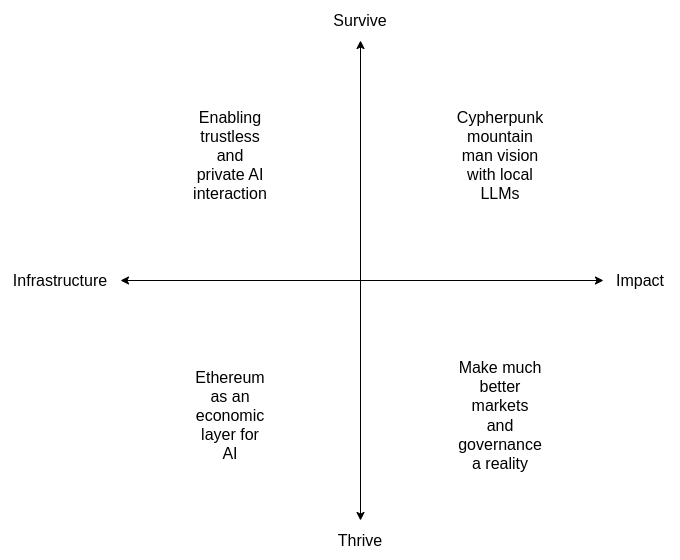
We can describe the above as a 2x2 chart. There's a lot to build!
There have recently been some discussions on the ongoing role of L2s in the Ethereum ecosystem, especially in the face of two facts:
* L2s' progress to stage 2 (and, secondarily, on interop) has been far slower and more difficult than originally expected
* L1 itself is scaling, fees are very low, and gaslimits are projected to increase greatly in 2026
Both of these facts, for their own separate reasons, mean that the original vision of L2s and their role in Ethereum no longer makes sense, and we need a new path.
First, let us recap the original vision. Ethereum needs to scale. The definition of "Ethereum scaling" is the existence of large quantities of block space that is backed by the full faith and credit of Ethereum - that is, block space where, if you do things (including with ETH) inside that block space, your activities are guaranteed to be valid, uncensored, unreverted, untouched, as long as Ethereum itself functions. If you create a 10000 TPS EVM where its connection to L1 is mediated by a multisig bridge, then you are not scaling Ethereum.
This vision no longer makes sense. L1 does not need L2s to be "branded shards", because L1 is itself scaling. And L2s are not able or willing to satisfy the properties that a true "branded shard" would require. I've even seen at least one explicitly saying that they may never want to go beyond stage 1, not just for technical reasons around ZK-EVM safety, but also because their customers' regulatory needs require them to have ultimate control. This may be doing the right thing for your customers. But it should be obvious that if you are doing this, then you are not "scaling Ethereum" in the sense meant by the rollup-centric roadmap. But that's fine! it's fine because Ethereum itself is now scaling directly on L1, with large planned increases to its gas limit this year and the years ahead.
We should stop thinking about L2s as literally being "branded shards" of Ethereum, with the social status and responsibilities that this entails. Instead, we can think of L2s as being a full spectrum, which includes both chains backed by the full faith and credit of Ethereum with various unique properties (eg. not just EVM), as well as a whole array of options at different levels of connection to Ethereum, that each person (or bot) is free to care about or not care about depending on their needs.
What would I do today if I were an L2?
* Identify a value add other than "scaling". Examples: (i) non-EVM specialized features/VMs around privacy, (ii) efficiency specialized around a particular application, (iii) truly extreme levels of scaling that even a greatly expanded L1 will not do, (iv) a totally different design for non-financial applications, eg. social, identity, AI, (v) ultra-low-latency and other sequencing properties, (vi) maybe built-in oracles or decentralized dispute resolution or other "non-computationally-verifiable" features
* Be stage 1 at the minimum (otherwise you really are just a separate L1 with a bridge, and you should just call yourself that) if you're doing things with ETH or other ethereum-issued assets
* Support maximum interoperability with Ethereum, though this will differ for each one (eg. what if you're not EVM, or even not financial?)
From Ethereum's side, over the past few months I've become more convinced of the value of the native rollup precompile, particuarly once we have enshrined ZK-EVM proofs that we need anyway to scale L1. This is a precompile that verifies a ZK-EVM proof, and it's "part of Ethereum", so (i) it auto-upgrades along with Ethereum, and (ii) if the precompile has a bug, Ethereum will hard-fork to fix the bug.
The native rollup precompile would make full, security-council-free, EVM verification accessible. We should spend much more time working out how to design it in such a way that if your L2 is "EVM plus other stuff", then the native rollup precompile would verify the EVM, and you only have to bring your own prover for the "other stuff" (eg. Stylus). This might involve a canonical way of exposing a lookup table between contract call inputs and outputs, and letting you provide your own values to the lookup table (that you would prove separately).
This would make it easy to have safe, strong, trustless interoperability with Ethereum. It also enables synchronous composability (see: https://t.co/9jy6v1X6Fw and https://t.co/gZmu3YjebM ). And from there, it's each L2's choice exactly what they want to build. Don't just "extend L1", figure out something new to add.
This of course means that some will add things that are trust-dependent, or backdoored, or otherwise insecure; this is unavoidable in a permissionless ecosystem where developers have freedom. Our job should make to make it clear to users what guarantees they have, and to build up the strongest Ethereum that we can.
🚨 Why Bitcoin always dumps at 10 a.m. when the U.S. market opens ?
Today, Bitcoin erased 16 hours of gains in just 20 minutes after the US market opened.
Since early November, BTC has dumped most of the time after US market opens. The same thing happened in Q2 and Q3.
@zerohedge has been calling this out repeatedly, and he thinks Jane Street is the most likely entity doing this.
When you look at the chart, the pattern is too consistent to ignore: a clean wipeout within an hour of the market opening followed by slow recovery. That’s classic high-frequency execution.
And it fits their profile:
• Jane Street is one of the largest high-frequency trading firms in the world.
• They have the speed and liquidity to move markets for a few minutes.
The behavior looks simple:
1. Dump BTC at the open.
2. Push the price into liquidity pockets.
3. Re-enter lower.
4. Repeat daily.
And by doing this, they have accumulated billions in $BTC.
As of now, Jane Street holds $2.5B worth of BlackRock’s IBIT ETF, their 5th largest position.
This means most of the dump in BTC isn't due to macro weakness but due to manipulation by one major entity.
And once these big players are done with buying, BTC will continue its upward momentum.