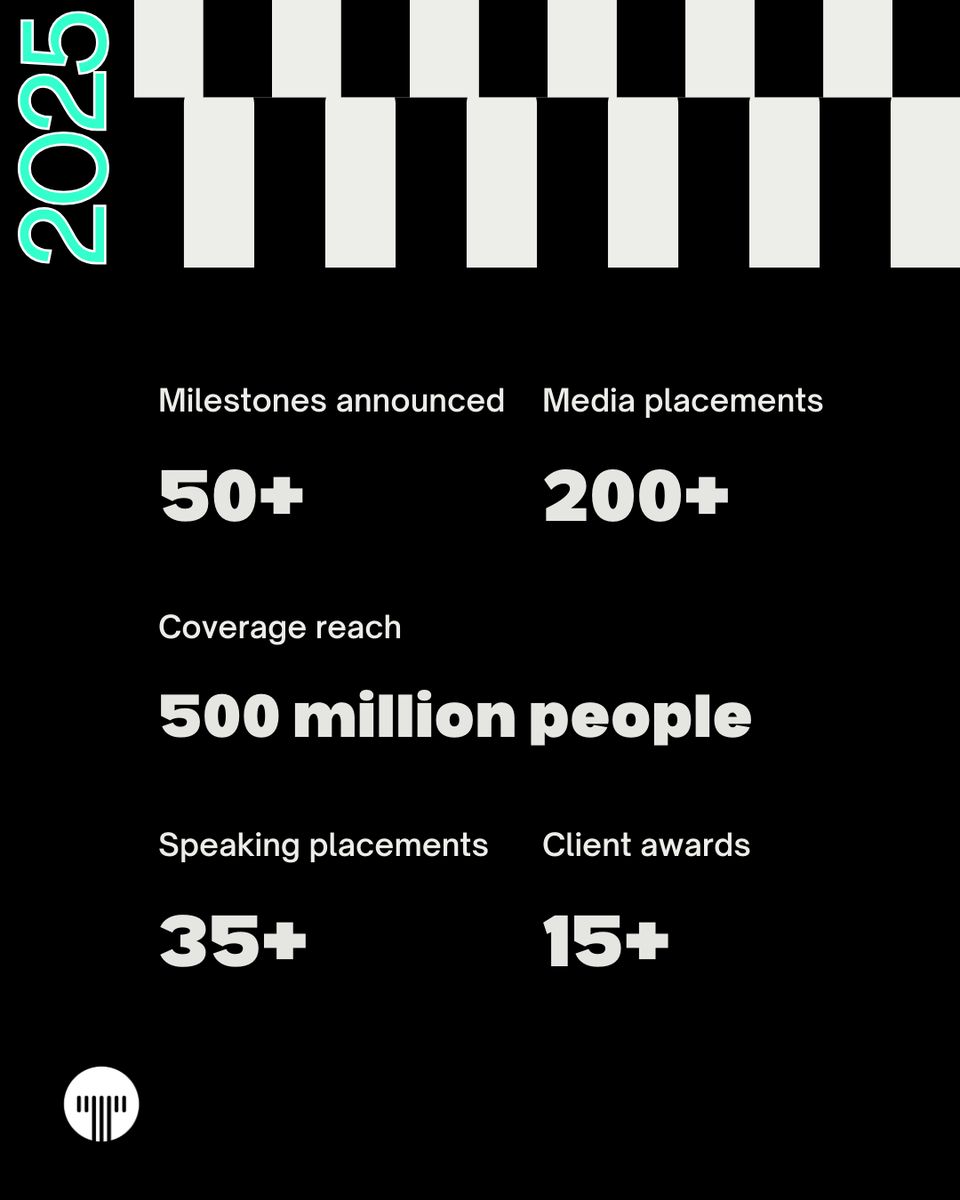
Thermal Wrapped 2025. 50+ milestones announced. 200+ media placements. 35+ speaking events. From CRISPR to AI in health and bio to longevity: we shaped the stories that moved science forward.
Looking ahead, we're bullish on 2026. CRISPR is evolving from one-off cures into scalable genetic medicines across both rare and common disease. AI is transforming not just drug discovery but development, trials, and healthcare delivery. More breakthroughs will advance through the clinic and reach patients. The best stories are still ahead.
If you need to level up your company's PR strategy, let's talk. As the agency of Nobel laureates and the world's most innovative scientists, biotechs, and VCs, Thermal can help.
We're excited to attend the Alzheimer's Association International Conference July 12-15 in London, UK. Nautilus representatives will be at the event to discuss:
🔵 How Iterative Mapping is revealing tau's role in neurodegeneration.
🔵 How attendees can use Iterative Mapping to explore the roles of tau proteoforms in Alzheimer's disease.
🔵 Additional proteins attendees wold like to study at the proteoform level.
At this year's conference, we're particularly excited to invite attendees to join the Iterative Mapping Early Access Program. By participating in the program, researchers gain exclusive access to the Nautilus Voyager™ Platform and will be among the first to use the platform for targeted proteoform studies and broadscale proteomic analyses.
If you'd like to discuss an Early Access Program project or have questions about the Nautilus Voyager™ Platform, please set up a meeting with us at the conference through the link below or reach out through the Early Access Program webpage.
Set up a meeting:
https://t.co/7TczV6WRzj
Early Access Program webpage:
https://t.co/Z0pCgMHsdW
#AAIC2026
The AI-pharma partnerships being formed today will shape which drugs reach patients tomorrow.
Next Tuesday at #BIO2026, our CEO @enfeinberg joins the breakout session "Reality Check: Finding the Right AI Partners to Fuel R&D” for a conversation about building collaborations that actually move the needle.
We’re excited to share that @CIRMnews has awarded Scribe more than $25 million through its Preclinical Development Program to accelerate the advancement of two preclinical programs targeting cardiovascular and metabolic disease.
Press release in thread 📣
The @bioagepodcast features the people & companies advancing the science of human longevity and discovering drugs to extend healthspan. Our newest episode just dropped!
Congratulations to our co-founder and CEO, @DrSynbio, on being named an @EY_US Entrepreneur Of The Year® 2026 New England Award winner!
This recognition reflects a mission that every person at Strand shows up for every day: programming mRNA to sense, decide, and act inside the body, so that therapies reach more patients, treat more diseases, and do so more scalably than ever before.
That mission is what keeps us moving forward.
Scientists need to sleep — but robots don’t. That difference might just shape the future of scientific research.
@SciAm's new feature explores the rise of autonomous labs, systems where AI and robotics run experiments around the clock, iterate on results, and propose what to test next. Two Thermal clients are front and center in the story.
Brad Ringeisen, Executive Director of the Innovative Genomics Institute, frames the core challenge: 90% of new drugs fail in clinical trials. He thinks the answer lies in both automating and running far more experiments, and building better, more precise models.
@Ginkgo CEO @JRKelly compares lab automation to self-driving cars, and says autonomous labs are roughly where Waymo was five years ago. His cloud lab now lets scientists anywhere submit an experiment and wake up to new data.
Read the full story: https://t.co/io2R4LA1es
What if you could program your laboratory as easily as sending a text or typing on a computer?
We launched the Ginkgo Cloud Lab, featured in @Scientific American today, to make it that easy. Researchers have been sending their experiments to our autonomous lab in Boston simply by typing plain-language commands into our interface.
Our CEO @jrkelly explains how our autonomous lab infrastructure continues to be leveraged by scientists, the Genesis Mission, OpenAI, and more.
Read the feature in Scientific American: https://t.co/cwc8T6PuMQ
And check out the Cloud Lab for yourself: https://t.co/s1BL0bph06
“Follow the question you can’t let go of, even if others don’t think it matters yet… The best ideas often come from people who haven’t yet been told that something isn’t possible.”
In a Q&A with @SciAm, CRISPR co-inventor, Nobel laureate, and Innovative Genomics Institute founder Jennifer Doudna discusses the state of American science, what it would take to scale personalized CRISPR cures, and why the convergence of AI and gene editing may be the most important story in medicine right now.
Read the full interview: https://t.co/cHfyO3ppCU
We're honored to be named to @FastCompany’s World Changing Ideas 2026 list for our SOTA foundation model, Pearl.
Pearl has consistently shown industry-leading performance for real-world drug discovery tasks, including small molecule structure prediction. We’re excited by our results on the recent benchmark from OpenBind, as well as the paper we co-authored with @NVIDIAHealth last year.
We are deploying Pearl as part of our GEMS AI platform to accelerate drug programs and discover new medicines for patients.
Pearl was highlighted as one of 21 projects ushering in the future of healthcare: https://t.co/L6gNC6beTh
Today, we are pleased to announce that the first participant has been dosed in QUELL-CV, our Phase 2 proof-of-concept trial of BGE-102, BioAge's oral, once-daily, brain-penetrant NLRP3 inhibitor, in patients at elevated cardiovascular risk.
Inflammation is now recognized as a driver of cardiovascular events on par with elevated LDL cholesterol — yet, unlike cholesterol, it remains largely undertreated. A key driver of age-related chronic inflammation is the NLRP3 inflammasome, an immune sensor that sits upstream of the signals like hsCRP, IL-6, and IL-1β that are associated with inflammatory cardiovascular risk. By inhibiting NLRP3, BGE-102 is designed to turn that inflammation down at its source.
The trial in brief:
- Randomized, double-blind, placebo-controlled
- Participants: ~160 adults with obesity, elevated systemic inflammation, and at least one additional cardiovascular risk factor
- Three once-daily oral dose levels of BGE-102 vs. placebo, over 12 weeks
- Primary endpoint: percent change in hsCRP
- Topline data anticipated in the second half of 2026
QUELL-CV builds directly on our Phase 1 results, in which BGE-102 achieved median hsCRP reductions of 86% on a well-tolerated, once-daily oral dose — a profile that is potentially best-in-class. With a second proof-of-concept study in diabetic macular edema planned to start mid-2026, we're working to demonstrate the broad potential of this drug.
Read the release: https://t.co/BX1vYVLg23
Noetik is proud to share new details regarding the power of our TARIO-2 biological foundation model to identify patients likely to respond to next-generation immune checkpoint inhibitors using only routine pretreatment pathology images.
Dive into our retrospective study, conducted in collaboration with @Agenus_Bio , where TARIO-2 identified responders to botensilimab and balstilimab (BOT+BAL) across hard-to-treat cancers. Our model achieved a ~3x higher expected response rate versus previous clinical trials, thereby outperforming leading pathology AI tools without requiring molecular testing.
Download our white paper here: https://t.co/J1RZQ7kakb
Building a great place to work is a team effort. We're honored to have been named the #12 best medium-sized company to work for by the @BosBizJournal, and grateful to the people behind the science and the culture.
#BBJBPTW
For Cancer Immunotherapy Awareness Month, Strands participated in today's #WearWhite campaign honoring the dedication of patients, caregivers, and researchers working to improve cancer treatment
What does it take to go from studying RNA in bacteria to rewriting the code of life?
On the season premiere of The Joy of Why podcast, @QuantaMagazine sat down with CRISPR co-inventor, Nobel laureate, and Innovative Genomics Institute founder Jennifer Doudna to trace her arc from a "rebellious" decision to study RNA in graduate school, to the 2012 CRISPR publication that set off a global race, to Baby KJ — the infant whose personalized CRISPR therapy was designed and delivered in eight months.
The conversation covers the breakthroughs, the barriers still ahead, and why delivery remains the field's hardest unsolved problem.
Give it a listen: https://t.co/gD2pgsCm5u
Recently, joe sat down with @juliankissa of The Beyond Tomorrow Podcast to talk about using AI to engineer better proteins, going upstream to treat Alzheimer's, and why biological timescales are the one thing you can't accelerate. https://t.co/UO96Qj7Ojf
In Precision Medicine Online, read about our first clinical trial for STX-1150, our novel, in vivo therapy designed to epigenetically silence PCSK9 and deliver sustained LDL-C reduction after a single dose – without permanently altering DNA.
📖 https://t.co/0vP1400De4
Ginkgo Bioworks and Microsoft are connecting agentic AI with autonomous experimentation — helping researchers move more seamlessly from hypothesis to execution: https://t.co/u2QUR6zWVk