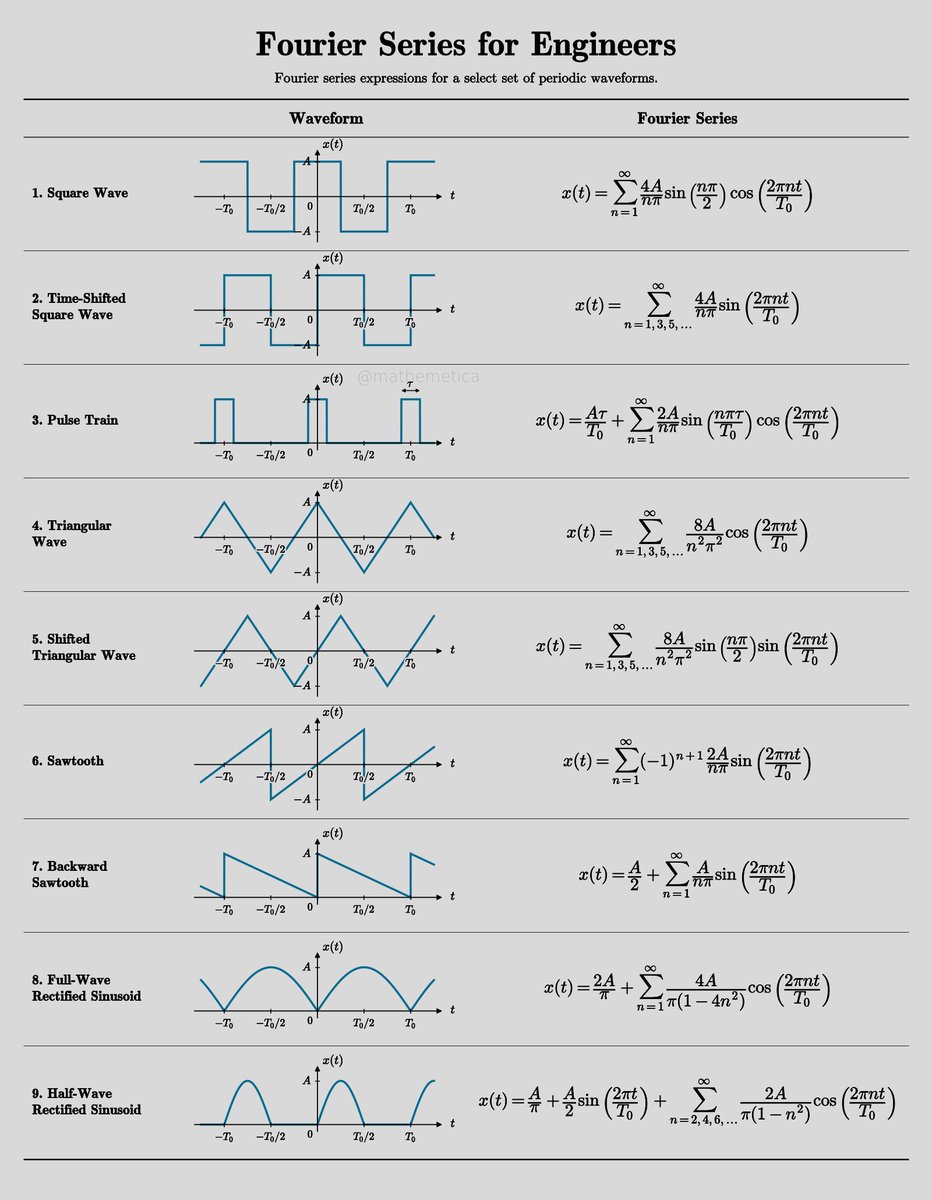
Every periodic signal is just a stack of pure tones.
A square wave collapses to odd cosines scaled by 4A/(nπ) sin(nπ/2). Shift it and the same amplitudes become sines. A pulse train keeps the duty-cycle factor (Aτ)/T₀ plus the sinc envelope (2A/(nπ)) sin(nπτ/T₀).
Triangles decay as 1/n², sawtooths as 1/n with alternating signs, and both rectified sinusoids isolate their known DC offsets 2A/π and A/π together with the surviving even harmonics.
The pictures and the sums are the same object seen two ways.
Smoothness is nothing more than how fast those coefficients vanish.
An interesting new approach to agentic RL:
Researchers found a way to train AI agents nearly 2x faster.
Agentic RL usually produces long rollouts, and when a rollout reaches its context budget, a compaction policy removes older turns and keeps the prompt, recent turns, or a summary.
Most systems use re-prefill compaction.
They create a shorter sequence and run every retained token through the model again. This rebuilds the KV cache after each compaction, so the same tokens may be processed several times.
KV-streams is a new approach to solve this.
Instead of rebuilding the shorter sequence, KV-streams removes discarded turns directly from the live KV cache. Generation continues from the entries that survived.
In practice, you cannot just reuse those entries as is. It requires two fixes.
> First, RoPE has already rotated each cached Key using its original token position. A Key may move from physical slot 1,000 to slot 500 after compaction, but the model must still treat it as position 1,000.
KV-streams keeps physical storage and logical position separate. Retained Keys keep their rotations. New Queries and Keys continue from the original position count.
> Second, vLLM does not store each KV entry independently. It groups them into fixed 16-token blocks and uses a block table to find those blocks in GPU memory.
KV-streams cannot leave empty slots inside that table because the attention kernel may read the wrong memory. It therefore removes complete blocks and joins the remaining block references together.
This introduces another problem.
A conversation turn may end halfway through a 16-token block. In their vLLM setup, that partial block is not committed to the prefix cache and must be recomputed when the next turn arrives.
If compaction happens first, those tokens may have originally attended to context that is no longer present.
For the vLLM experiments, the researchers pad each completion to a multiple of 16 tokens. This commits every generated token to the cache before the next turn or compaction event. The SGLang setup uses single-token blocks and needs no padding.
Separately, the researchers found that token-level eviction produced degenerate text and required substantial supervised fine-tuning.
They suspect that removing message-boundary tokens disrupted the chat format learned during training. The agent experiments therefore remove complete turns, including their boundary tags.
Once inference works this way, training must follow the same process.
A normal trainer would either process the full rollout or rebuild the shorter sequence after compaction. Both options produce different KV entries from those used during generation.
KV-streams records every compaction event during generation. The trainer then reproduces that history: retained tokens keep the states they formed before compaction, while later tokens are blocked from attending to spans that inference had already removed.
In the repository’s validation runs, the difference between training and generation stayed near a mismatch KL of 0.001, indicating that both paths produced almost identical token probabilities.
On SWE-bench Verified, the Markovian Thinker setup with KV-streams reached peak performance in about 32 hours.
The same compaction strategy with re-prefill took roughly 60 hours, while both reached comparable final scores.
The speedup mainly applies to RL training, where one rollout may be compacted several times.
At production inference, batching can hide some prefill cost, and keeping caches for inactive users reduces serving capacity.
There is one more detail.
The retained KV entries were created while the removed turns were still visible. Future tokens cannot attend to those turns directly, but some of their influence may remain in the entries that were not evicted.
In a controlled test, RL recovered an assignment after its original message was removed. Recall reached 100% when enough cache remained.
KV-streams does not decide what the model should forget. Instead, it makes existing compaction policies cheaper to train by preserving the KV state they choose to retain.
Repo: https://t.co/Ds09wpklYf
If you want to dive deeper into the broader KV-cache engineering stack, I wrote an article that covers eviction, paging, quantization, offloading, and architectural compression.
Read it below.
So something I have been working on, and just sent the initial rough draft over to my editor. Circa 300 pages (A4 pages) and 28 labs all based on the up coming explorer board.
Mobilize the metal.
When our industrial base becomes a target for our adversaries, we must decentralize our manufacturing capabilities.
Edge Factory deploys forward to build at the point of need and make it hard to hit a moving target.
A sawtooth, a square and a triangle wave, each summed from its first ten nonzero Fourier terms, f(t) = ∑ bₙ sin(nt). Each term is a circle of radius |bₙ| turning n times per period.
The sawtooth has bₙ = 2(−1)ⁿ⁺¹/(nπ), the square 4/(nπ) for odd n, the triangle ±8/(n²π²) for odd n. At ten terms, the square peaks at 1.18 and the sawtooth at 1.09; the triangle stays within 0.021 of exact.
A jump forces coefficients like 1/n, a corner only 1/n².
Daniel Kahneman, Nobel laureate and author of "Thinking, Fast and Slow":
"You have two minds. one is fast, confident and usually wrong about money. the other is slow, lazy, and the only one that can do the math. I won a Nobel showing the casino lives off the first one, because it shows up before the second one wakes up."
this free lecture holds the entire "trust your instincts" the gurus sell, from the Nobel laureate who proved your instincts are the trap.
at the board it's simple. Kahneman split the mind in two. System 1 is fast, automatic and sure of itself. System 2 is slow, effortful, and the only part that actually computes the odds. the catch is that System 1 answers first and System 2 is lazy, so you act on a feeling and build the reasons afterward. the casino and the market are timed to catch you in that first second. that's the whole "instinct edge", minus the marketing.
Kahneman worked this out over fifty years and put it in one book in 2011. it has been public ever since. same point as my casino piece above: the house wins because your fast mind calls luck skill before your slow mind can check the math.
the science is free and half the world has read the book. what nobody can sell you is the discipline to wake the slow mind up before you click buy. that one pause is the whole edge, and no lecture can force you to take it.
Fast Fourier Analysis in action.
Any complex waveform, sound, or shape can be perfectly reconstructed as the sum of simple rotating circles (epicycles).
IN 1986 MIT FILMED A LECTURE THAT OPENS BY TELLING YOU COMPUTER SCIENCE IS NOT A SCIENCE AND HAS ALMOST NOTHING TO DO WITH COMPUTERS
72 minutes from Hal Abelson and Gerald Sussman, the lecture an entire generation of engineers calls the one that rewired how they think.
-> The line that lands: computer science is about computers the way astronomy is about telescopes. The tool was never the point.
The real subject was always one thing -- controlling complexity. Everything else is detail.
Forty years later it reads like a prophecy. AI writes the syntax now. What's left is exactly what they taught: taming complexity nobody can hold in their head.
The language was never the skill -> the thinking was. This is where you learn it.
Most people chase the newest framework. The ones who watched this think on a level frameworks can't touch.
Bookmark & Watch today it, this one's a legend ↓
MIT Press published a robotics textbook.
Then put it on GitHub for FREE. 📌
"Introduction to Autonomous Robots" covers everything:
kinematics, sensors, actuators, motion planning, localization, computer vision, and neural networks... from mechanisms all the way to algorithms.
It's written for undergraduates. Which means it's actually readable.
Most robotics textbooks assume you're already deep in the field. This one builds everything from the ground up, step by step, with real examples. Stanford's Mac Schwager called it "much-needed" (because it genuinely is).
Four professors at the University of Colorado Boulder spent years building it from lecture notes. MIT Press published it. Then they open-sourced the whole thing under Creative Commons.
PDF. Free. GitHub.
If you're trying to understand how autonomous robots actually work (not just the frontier research, but the foundations), this is where to start.
📌 [https://t.co/bw8zoK8MmB]
Share this with your fellow roboticist!
——
Weekly robotics and AI insights.
Subscribe free: https://t.co/9Nm01QUcw3
Anthropic’in finans profesyonelleri için geliştirdiği yapay zeka çözümünün lansmanını Türkçe altyazılı hale getirdim.
Yapay zekanın finansal araştırmaları, veri okumayı ve modellemeyi nasıl değiştirdiğini görmek için harika bir kaynak.
Sci-Hub is an evil website that pirated 85M+ research papers and made them freely available
And now they've added AI to their database to make Sci-Bot.
It answers your questions using latest, full-text articles.
But DO NOT use it. We should all try to make billion-dollar academic publishers richer.
I'm putting the link below so you know how to avoid it.
The creator of Claude Code teaches more about vibe-coding in 30 minutes than most tutorials do in hours.
Save this — it'll change how you build forever.
🎉 After one year of teamwork, we are excited to release our 3D foundation model — LingBot-Map!
Unlike DA3/VGGT, LingBot-Map is a purely autoregressive model for streaming 3D reconstruction ⚡
It achieves ~20 FPS on 518×378 resolution over sequences exceeding 10,000 frames — and beyond 🚀
Two key insights behind LingBot-Map:
🔑 Keep SLAM's structural wisdom: build Geometric Context Attention with long-context modeling while maintaining a compact streaming state
🔑 Make everything end-to-end learnable — no optimization, no post-processing
Let's check out our demos 👇
Anthropic pays engineers $750,000+ a year to understand how LLMs work.
Stanford just put a 2 hour lecture that covers 80% of it for FREE.
Bookmark this. Give it 2 hours today.
It might be the highest ROI thing you do this month:
*New Lecture*
Stanford @frontiersystems, Session 4 (Full Video)
Frontier Visual Intelligence Systems with @andi_blatt from @bfl_ml
00:00 Bella Napoli
00:56 Frontier Flywheel Recap
04:29 Intro to Andi
06:26 From GANs to Latent Diffusion
08:31 Stable Diffusion Breakthrough
15:20 Beyond Content Creation
18:28 Starting Black Forest Labs
21:07 Flux One Training Pipeline
24:15 Character Consistency Leap
27:02 Leadership Under Pressure
30:40 What Comes Next
32:06 Training to Action
41:07 Self Flow Intuition
48:35 Labeling and Distillation
57:09 3D vs Video Debate
Instead of watching Netflix, watch this 1-hour Yale lecture by Professor Ben Polak.
It will change how you think about decisions in negotiations, business, and everyday life.
Fine-tuning massive LLMs used to be painfully slow, but not anymore!
4 open source libraries that accelerate fine-tuning of Large Language Models
1. Unsloth AI
• Fine-tune models like Qwen3, Llama 4, and Gemma 3 up to 2× faster with 70% less VRAM
• Uses optimized Triton kernels and manual backprop for exact accuracy
• Supports low-resource setups and runs on consumer GPUs or even Colab/Kaggle with ~3 GB VRAM
GitHub repo → https://t.co/n2aa7vWE1v
2. LLaMA Factory
• Fine-tune over 100 models (LLaMA, Mistral, Gemma, etc.) using a simple CLI or WebUI
• Supports LoRA, QLoRA, full or frozen fine-tuning across 2–8‑bit precision
• Includes built-in dataset templates, training monitors, and model export options
GitHub repo → https://t.co/Zrbg95fXpy
3. DeepSpeed
• Built for large-scale distributed fine-tuning with ZeRO and FSDP
• Optimized for multi-GPU and multi-node training with advanced memory management
• Trusted in production environments for scalable LLM training
GitHub repo → https://t.co/OekS5EZU2Z
4. Axolotl
• Yaml-based setup for fine-tuning, LoRA/QLoRA, DPO, GRPO, and multimodal workflows
• Includes kernel optimizations for memory-efficient training
• Actively maintained with support for Hugging Face, model export, and inference
GitHub repo → https://t.co/tUQ2W1Kpcl