A new study shows how math can reveal hidden cancer cell strategies. By using a math model, researchers found that DNA-damaged cells often skip division and undergo polyploidisation—a survival response missed by observation alone.
https://t.co/8CZdg23Bra
Researchers at #CharitéBerlin, @drfz_Berlin and @MDC_Berlin have identified the immune cells that cause severe kidney inflammation in #lupus. The study, published in @nature, could pave the way for future antibody therapies.
https://t.co/1VYCdBPBPC
The attached cell-based simulation framework for cytokine reaction-diffusion systems uses the finite element solver fenics, and is fully open source and ready to use.
Excited to share our analysis of cytokine communication using a new 4D simulation environment. Without spatial inhomogeneities, cytokine signals are basically ineffective! The spatial distribution depends on receptor feedback and tissue architecture. https://t.co/Qro9wVVnIj
.@naturemethods has increasingly focused its attention on methods development in immunology and presents a special issue that highlights methods and technologies that have galvanized immunological research.
Editorial: https://t.co/MbyN0saugc
Issue: https://t.co/DryhWAFfpC
Just did a group meeting of a PhD student in the cloud. It takes courage to say I'm stuck, confused, discouraged. This vulnerability elicited solidarity and support from the group, and a flood of new ideas and hope. It was gratifying for everyone.
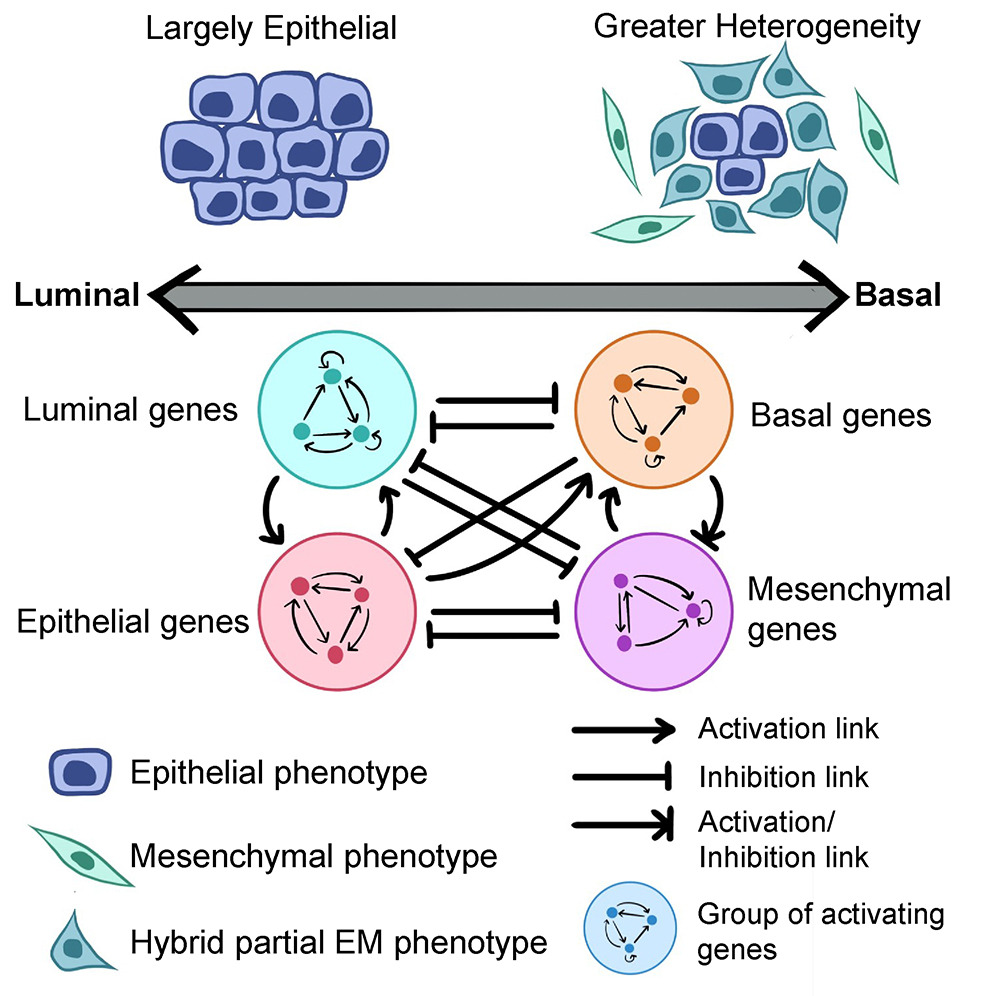
Glad to share work led by @Sarthak_Sahoo_ showing an increased prevalence of hybrid E/M state and higher heterogeneity in basal breast cancer, now out in @iScience_CP. Grateful to our collaborators @c_chaffer @JSomarelli & Jyothi S Prabhu @StJohnsResearch.
https://t.co/gXRwE1IxO5
European Society for Spatial Biology (ESSB) is here, finally! ESSB is a recently founded scientific society dedicated to advancing research in the emerging interdisciplinary field of spatial biology. This is the perfect spot for spatial enthusiasts! Come join us!
Collaborative work with the Yoshitane group!
Phosphorylation of DNA-binding domains of CLOCK–BMAL1 complex for PER-dependent inhibition in circadian clock of mammalian cells https://t.co/FhmXYkHszq
The immune system is a uniquely dynamic environment. In a Comment, @mathematista discusses how custom-built mathematical models should complement experimental approaches to make immune kinetics more predictable.
https://t.co/LfDL4NEcVR
Our paper @ImmunityCP reveals a human baseline setpoint state (ie, "temperature" under which immune responses are initiated) linked to better responses to flu vaccination resembles cell states induced early and uniquely by the AS03 adjuvant. 1/n
#SimuCell3D is now out in @NatComputSci https://t.co/yMPicxgA9R -
Massive thx to the editor Fernando Chirigati @fchirigati for handling our manuscript so well!!
The source code is available free online:
https://t.co/Npvhr8eF3l
Can't wait to see it used!! #openscience
Enjoying the company of colleagues and friends @teichlab@BockLab Kevin Thurley, Jonathan Badger @BanffNP while attending the fantastic #KSSystemsImmune24
https://t.co/lTgxgYM80W
Location matters! An epithelial cell’s position within a population determines its response to interferons through cell polarization & basolateral localization of the #interferon receptor ➡️ https://t.co/YgTtY1EInJ @BoulantLab@Megan_Stanifer@UFMedicine#cellheterogeneity
Great to see the work of my first PhD student finally published in @ScienceAdvances, extending our data-based modeling framework to study a network of proliferating cell populations in chronic inflammation.
@DRFZ_Berlin@IEO_Bonn@ImmunoSens @HCM_Bonn
https://t.co/xhG45UjYrt