Andrew Ng just released a free 2-hour course on complete Harness Engineering
How to go from one prompt to a reliable system of agents that can run, test, and improve themselves:
09:14 - Build your first agent from scratch
33:11 - Master agent loops
1:02:46 - Turn loops into reliable workflows
1:30:15 - Build agents that improve their own work
1:49:05 - Run the complete system without supervision
Model → Harness → Reliable Software
Most agent tutorials stop once the model can call a tool
This one shows you how to build the infrastructure around it within the first 20 minutes
Most people are still prompting one agent at a time
Andrew Ng is already teaching the layer above:
Harnesses that give agents context, tools, tests, and feedback
Watch this brilliant course and build the harness
Then read the full architecture below ↓
The most important skills for using AI coding agents effectively. Presenting the AI Engineering Skills Map for using coding agents. https://t.co/GrEw7wG5Wz
Don't spend 2 years learning AI agents the slow way.
Andrew Ng just shared a complete 2-hour roadmap for becoming an agentic AI engineer in 2026.
0% → 00:00 - learn the foundations of AI agents
25% → 12:12 - design agentic workflows
50% → 53:27 - build agents that actually work
75% → 1:20:30 - create self-improving loops
100% → 1:30:19 - orchestrate multi-agent systems
Most people are still learning how to prompt a single model.
Andrew Ng is teaching the entire stack:
Agents → Workflows → Loops → Multi-Agent Systems
Prompting is the old workflow.
Building autonomous systems is the next one.
Anthropic pays top engineers up to $750K/year to understand this stack.
Bookmark it and give it two hours today.
Then read the full agent engineering guide below.
Anthropic hired this engineer at $250K-$750K a year because he knows how to build harnesses for multi-agent systems
In this 15-minute workshop, he shows exactly how to build one from scratch
AI → Agents → Harness → Loops → Graphs
step 1 → start with the Claude Agent SDK - the harness handles loops, context, and sandboxing
step 2 → separate the brain from the hands - reasoning in one place, tools in a sandbox, 60% faster to first token
step 3 → run it server-side and log every step - close your laptop and it keeps running, crashes resume from the log
step 4 → make failure cheap - retry dead sandboxes and replay lost context instead of starting over
step 5 → turn yesterday's logs into new memory and skills - the harness wakes up smarter
Anthropic calls this "dreaming"
Most people spend weeks building this by hand
You don't have to
Bookmark and watch it
Then read the full harness engineering guide below ↓
Andrej Karpathy:
“Prompting is fading away.
The real work is building the harness around the model.”
In this 1-hour lecture, he explains why model intelligence alone isn’t enough and how the surrounding system turns it into reliable software.
The missing layer most people overlook:
LLMs → Prompts → Agents → Harnesses
The model is only one component.
The harness is what makes it useful.
Watch it first.
Then read the full Harness Engineering guide below.
The best free Standford course + book combinations -
1. CS229 + HOML ( a pre requisite course needed )
2. CS224N + NLP with transformers
3. CS230 + DL by Goodfellow
4. CS336 + Build a LLM by Sebastian
5. CME295 + Hugging face LLM course
6. CS329A + Build an AI Agent by Jungjun
Andrej Karpathy spent 8 years at OpenAI and Tesla
Last week, he compressed everything he knows into one free 2-hour lecture
Agents → Loops → Harness → Self-Improving Systems
People spend $15K on bootcamps that teach less than this
This lecture beats most paid AI engineering courses
You probably don't have 2 hours right now
Don't let this vanish from your feed
Watch it
Then read the article below
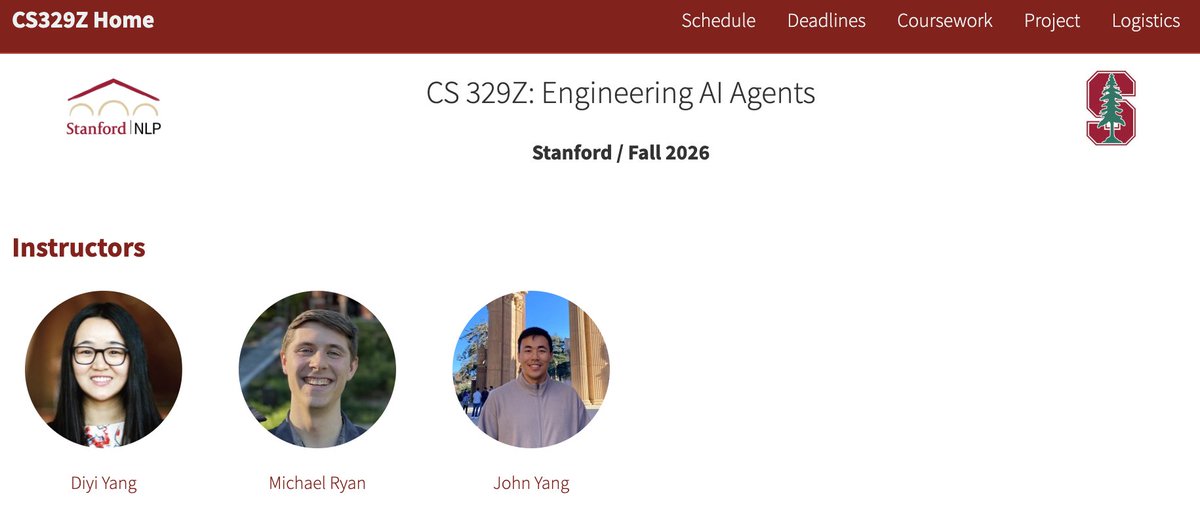
This fall @michaelryan207@jyangballin and I are teaching a new course CS329Z "Engineering AI Agents" on how to build AI Agents from scratch. Come join us and learn how to build them 🤖
I’m excited to finally announce the newest edition my Stanford course 𝗧𝗵𝗲 𝗠𝗼𝗱𝗲𝗿𝗻 𝗦𝗼𝗳𝘁𝘄𝗮𝗿𝗲 𝗗𝗲𝘃𝗲𝗹𝗼𝗽𝗲𝗿. It has been 9 months in the making.
Last November, with the release of Claude Opus 4.5, coding agents experienced a step function improvement in capability. We all felt it. The LLMs were more powerful, could reason for longer, solve harder tasks.
This year’s iteration of my course reflects the 2026 metamorphosis of software engineering.
My core belief is simple: AI-native developers of the LLM era are going to become the most important members of any software organization. I have designed my course to train this next generation of engineers.
𝗪𝗵𝗮𝘁’𝘀 𝗱𝗶𝗳𝗳𝗲𝗿𝗲𝗻𝘁 𝘁𝗵𝗶𝘀 𝘁𝗶𝗺𝗲 𝗮𝗿𝗼𝘂𝗻����
First, 85% of my Fall 2025 class material is being thrown out. The Fall 2026 syllabus reflects the core capabilities AI-native engineers must have: agent skills, advanced context engineering, MCP portals, agent-ready codebase principles, agentic code review, security, parallelizing background agents, software factories, and more.
Second, I am going to teach my students how to have software taste. Every student will be required to ship pull requests to production-grade, real-world codebases. The course is collaborating with the top open-source AI repos who will offer support and mentorship to students on how to meaningfully contribute to their projects.
This has never been done before in any university course so I am incredibly grateful to our OSS Partners: @browserbase, @HeyGen, @CopilotKit, @semgrep, @OpenHandsDev, @milvusio, @marimo_io, Pi, @crewAIInc, @warpdotdev, @vercel, @cmux, @arizeai, @UnslothAI, and @anyscalecompute.
𝗪𝗵𝗮𝘁’𝘀 𝘀𝘁𝗮𝘆𝗶𝗻𝗴 𝘁𝗵𝗲 𝘀𝗮𝗺𝗲
I’m fortunate to again have AI software engineering leaders and founders as guest speakers to share their learnings from building top coding agent products. Thank you to @leerob from @cursor_ai, @bcherny of @claudeai code, @EnoReyes of @FactoryAI, @silasalberti of @cognition, @0xine of @semgrep, Rajesh Bhatia of @Cloudflare , @amasad of @Replit, and @eladgil.
All resources will be available online. All classes will be available to the public.
9/22 on Stanford campus. See you in class.
https://t.co/wTokHyUMsz
Is there an AI bubble? With the massive number of dollars going into AI infrastructure such as OpenAI’s $1.4 trillion plan and Nvidia briefly reaching a $5 trillion market cap, many have asked if speculation and hype have driven the values of AI investments above sustainable values. However, AI isn’t monolithic, and different areas look bubbly to different degrees.
- AI application layer: There is underinvestment. The potential is still much greater than most realize.
- AI infrastructure for inference: This still needs significant investment.
- AI infrastructure for model training: I’m still cautiously optimistic about this sector, but there could also be a bubble.
Caveat: I am absolutely not giving investment advice!
AI application layer. There are many applications yet to be built over the coming decade using new AI technology. Almost by definition, applications that are built on top of AI infrastructure/technology (such as LLM APIs) have to be more valuable than the infrastructure, since we need them to be able to pay the infrastructure and technology providers.
I am seeing many green shoots across many businesses that are applying agentic workflows, and am confident this will grow. I have also spoken with many Venture Capital investors who hesitate to invest in AI applications because they feel they don’t know how to pick winners, whereas the recipe for deploying $1B to build AI infrastructure is better understood. Some have also bought into the hype that almost all AI applications will be wiped out merely by frontier LLM companies improving their foundation models. Overall, I believe there is significant underinvestment in AI applications. This area remains a huge focus for my venture studio, AI Fund.
AI infrastructure for inference. Despite AI’s low penetration today, infrastructure providers are already struggling to fulfill demand for processing power to generate tokens. Several of my teams are worried about whether we can get enough inference capacity, and both cost and inference throughput are limiting our ability to use even more. It is a good problem to have that businesses are supply-constrained rather than demand-constrained. The latter is a much more common problem, when not enough people want your product. But insufficient supply is nonetheless a problem, which is why I am glad our industry is investing significantly in scaling up inference capacity.
As one concrete example of high demand for token generation, highly agentic coders are progressing rapidly. I’ve long been a fan of Claude Code; OpenAI Codex also improved dramatically with the release of GPT-5; and Gemini 3 has made Google CLI very competitive. As these tools improve, their adoption will grow. At the same time, overall market penetration is still low, and many developers are still using older generations of coding tools (and some aren’t even using any agentic coding tools). As market penetration grows — I’m confident it will, given how useful these tools are — aggregate demand for token generation will grow.
I predicted early last year that we’d need more inference capacity, partly because of agentic workflows. Since then, the need has become more acute. As a society, we need more capacity for AI inference.
Having said that, I’m not saying it’s impossible to lose money investing in this sector. If we end up overbuilding — and I don’t currently know if we will — then providers may end up having to sell capacity at a loss or at low returns. I hope investors in this space do well financially. The good news, however, is that even if we overbuild, this capacity will get used, and it will be good for application builders!
AI infrastructure for model training. I am happy to see the investments going into training bigger models. But, of the three buckets of investments, this seems the riskiest. If open-source/open-weight models continue to grow in market share, then some companies that are pouring billions into training models might not see an attractive financial return on their investment.
Additionally, algorithmic and hardware improvements are making it cheaper each year to train models of a given level of capability, so the “technology moat” for training frontier models is weak. (That said, ChatGPT has become a strong consumer brand, and so it enjoys a strong brand moat, while Gemini, assisted by Google's massive distribution advantage, is also making a strong showing.)
I remain bullish about AI investments broadly. But what is the downside scenario — that is, is there a bubble that will pop? One scenario that worries me: If part of the AI stack (perhaps in training infra) suffers from overinvestment and collapses, it could lead to negative market sentiment around AI more broadly and an irrational outflow of interest away from investing in AI, despite the field overall having strong fundamentals. I don’t think this will happen, but if it does, it would be unfortunate since there’s still a lot of work in AI that I consider highly deserving of much more investment.
Warren Buffett popularized Benjamin Graham’s quote, “In the short run, the market is a voting machine, but in the long run, it is a weighing machine.” He meant that in the short term, stock prices are driven by investor sentiment and speculation; but in the long term, they are driven by fundamental, intrinsic value. I find it hard to forecast sentiment and speculation, but am very confident about the long-term health of AI’s fundamentals. So my plan is just to keep building!
[Original text: https://t.co/psPlIFRJsi ]
> helped millions get into ai before it became mainstream
> built coursera and changed online education forever
> founded deeplearning. ai to keep teaching the world
> leads major ai projects while staying humble and calm
> no scandals no noise just steady work
> still codes and still experiments
> builds small tools and projects purely for curiosity
> teaches only when he has real value to add
> doesn’t chase hype or predictions
> lives quietly learning and building at his own rhythm
has andrew ng quietly figured out life better than everyone else?
Today we entered the Gemini 3 era, our next step on the path toward AGI. ⚡
Gemini 3 is our most intelligent model that combines capabilities like multimodality, long context and reasoning, so you can bring any idea to life.
Explore more of what you can do and build with Gemini 3 🧵��️
We wrote a Gemini 3 Developer Guide including all new API features, Migration strategies, and technical details for building with Gemini 3 Pro preview:
- Control reasoning via `thinking_level` low and high modes.
- per part `media_resolution` for better multimodal reasoning
- Preserve reasoning context with mandatory Thought Signatures.
- Combine Structured Outputs with built-in tools like Google Search.
Google @Antigravity is a new agentic platform designed to autonomously plan and execute complex software development tasks.
- Access Gemini 3 Pro Preview and other models directly.
- Distinct Editor and Agent Manager for synchronous and asynchronous workflows.
- Browser Subagent autonomously actuates UI testing and validates frontend features.
- Review generated artifacts like implementation plans, screenshots, and browser recordings.
- Available in public preview
Today, our team launched Google Antigravity.
- Agent-first IDE powered by Gemini 3 Pro 🧠
- Browser control to test your apps automatically 🤖
- Agent Manager to orchestrate parallel agents ♾️
Stoked to keep shipping with the @antigravity team. This is going to be fun.
⚠️ Heads-up to anyone using the DeepSeek-V3.2-Exp inference demo: earlier versions had a RoPE implementation mismatch in the indexer module that could degrade performance. Indexer RoPE expects non-interleaved input, MLA RoPE expects interleaved. Fixed in https://t.co/2BDzSyt1cW.
GEMINI 3 LAUNCH IS HERE
I got a SNEAK PEEK at Gemini 3 with Logan Kilpatrick (Google Deepmind), and it might be the most POWERFUL vibe-coding tool on the planet.
A little breakdown:
1. Anyone can build 3D and casual games now
You can vibecode full, playable 3D video games generated in minutes. Actual games with physics, characters, controls, and loops you can remix instantly. Pure insanity. I can see founders and brands spinning up games on the fly to ride trends and drive growth.
2. Intelligent apps are becoming the default
We built apps where reasoning, memory, and multi-step planning were baked in from the start. Once you’re building apps with ACTUAL intelligence baked in, there’s a whole wave of new opportunities that weren’t possible before.
3. Gemini acts like a creative partner
You describe the idea, Gemini fills in the gaps, challenges decisions, proposes alternatives, and iterates in real time.
4. Vibe coding hits a new level
Gemini 3 can generate assets, code, game logic, UI, and narrative in one flow. Tools like Claude and Cursor feel fast. This feels like the next layer, the one where a single builder can compete with full teams.
@OfficialLoganK and I pushed Google Gemini 3 hard, and the outputs were solid. A few times we had to give it a few extra prompts but it took feedback really well.
I think 1 year ago, a lot of people discounted Google in the AI arms race.
Can you discount them anymore? Doubt it. After this, it feels like they at best leading, at worst leading.
What do you think of Google's AI efforts/Gemini 3
My biggest takeaway was how it just felt like Gemini 3 had a little more vibe coding horsepower than anything I’ve used.
https://t.co/gBc6qLxC9q