Using a universal machine-learning potential, researchers mapped how halogen and metal substitution impact the structure, phase stability, and lithium ion conductivity of halide solid electrolyte compounds.
Read the Physical Review Materials paper: https://t.co/QGlDoKZpvH
Introducing MLIP Studio, a platform for running, testing & comparing 60+ universal MLIPs interactively in a browser.
Goal: make MLIP comparison & benchmarking easier.
Preprint: https://t.co/yRmgSvzvl2
App: https://t.co/JzQuSqba2a
Grateful to @ananthgr for support and guidance.
Check our our latest publication, @Larasfadillah introduced pyridine derivaties as highly effective molecular interfacial regulators to stabilize the surface of sulfide electolytes and interfaces. @Jang_Wook_Choi@unifrChemistry@snsf_ch funded. https://t.co/9ZeFlAzHlD
Check out our latest publication, @Larasfadillah has done an amazing job in tackling humidity stability of sulfide electrolytes in all solid-state batteries. This was one of the critical milestones for the Sinergia project @snsf_ch@unifrChemistry https://t.co/qMg6J7xRBP
I am proud to announce that today @cusp_ai has closed a $100M Series A fundraise, co-led by @NEA and @Temasek, with participation from @nvidia’s NVentures, @SamsungVentures and @Hyundai_Worldwide.
What is the minimally effective way to construct a reservoir computer that can learn chaotic dynamics?
In my new paper, I demonstrate that deterministically constructed reservoirs with minimal topologies (MESNs) consistently outperform conventional random-initialized ESNs.
1/2
High-dimensional linear mappings, or linear layers, dominate both the parameter count and inference cost in most deep learning models. We propose a general-purpose drop-in replacement with a substantially better capacity - inference cost ratio. Check it out!🧵
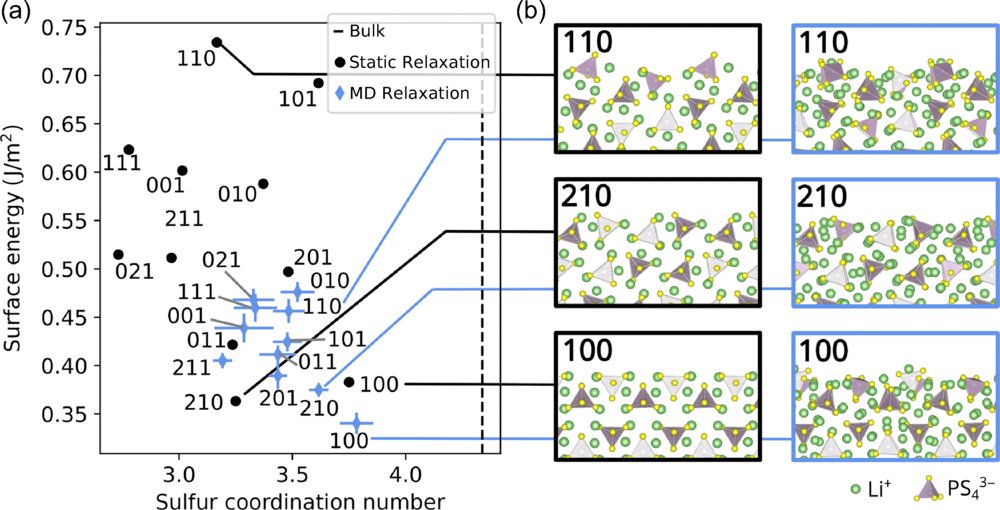
Last week, while we were all busy at #psik2025, my paper with Hanna Türk got published in @PRXenergy. We used @lab_COSMO's #PET models to study the dynamic reconstruction of LPS surfaces, and how it impacts their structure, stability, and reactivity.
https://t.co/CqL4ujvBI7
We studied the surface reconstruction using an accurate unconstrained machine learning model. Reconstructed surfaces become lower in energy, and the surface energy is less orientation dependent, making the Wulff shape more spherical.
🚨 PhD & Postdoc positions in Computational Chemistry 🚨
Funded by SNSF + ERC Starting Grant in my group @unifrChemistry (Fribourg 🇨🇭).
Focus: ML × DFT (method development & applications).
Please RT 🙏
📄 Info & apply: https://t.co/xdrc5LflYf
Started with some slides for AutoAdsorbate-ended up with an animated deep dive into surface site detection.
It works on any surface, no bulk symmetry needed.
Here’s what this one-liner really does:
s=Surface(slab211)
code: https://t.co/p0nfGeDNzc
paper: https://t.co/3ZdXPgqo3Q
📢For those still hanging out here, a new #cookbook recipe landed, demonstrating >2x speedup of *conservative* MD for the PET-MAD universal #MLIP using multiple time stepping. Check out the details at the other place, or head to https://t.co/f2ft2jmfpH #compchem#machinelearning
This is a fantastic master program. Students of the international track spend 1 semester in Trieste ( at @ictpnews and @Sissaschool ), 1 in Turin ( @PoliTOnews ), and 1 in Paris (Sorbonne / Saclay / Paris-Cité ) + final proj.
Apply! Deadline May 25
https://t.co/ijKPBuKCO2
We studied the evolution of the SOAP descriptors of the tetrahedra on the surface, for an atomistic analysis of their dynamics. We time-averaged the SOAP vector to rule out the effects of fast-moving Li atoms
Last week, we continued @lab_COSMO's study of solid-state electrolytes, focusing on the properties of the LPS surfaces https://t.co/LNZomRpVv5. Many thanks to my office mate Hanna Tuerk who did a lot of the work