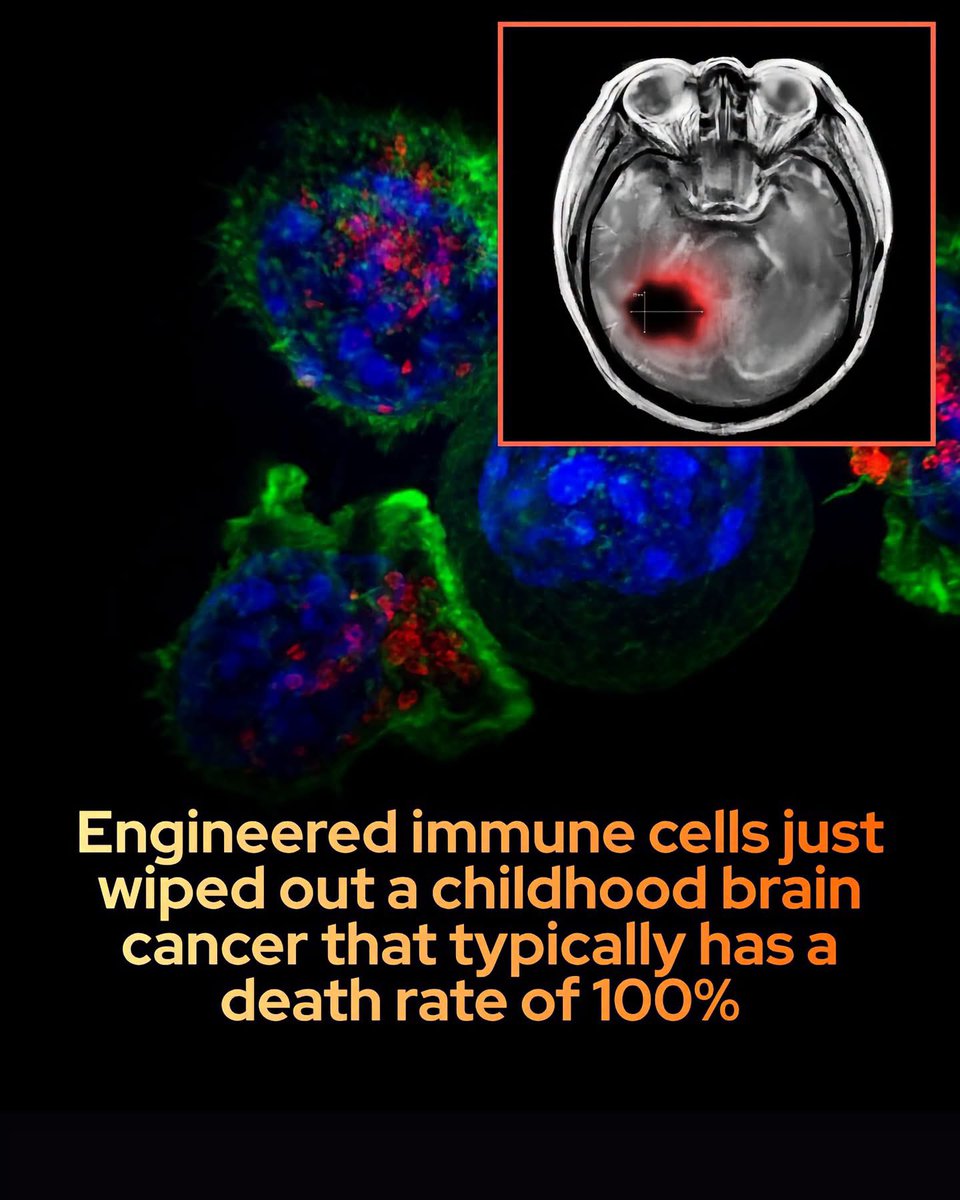
Nearly every child diagnosed with a cancer known as diffuse midline glioma dies within a year.
Engineered immune cells just wiped it out in mice.
Scientists at UC San Francisco engineered CAR-T cells, immune cells taken from a patient and reprogrammed to hunt cancer, with a clever safety switch. The cells carry a sensor for brevican, a protein found only in the brain, so they stay quiet in the blood and spleen and only arm themselves to attack tumor proteins once they reach brain tissue.
The team tested these "B-SYNC" cells against diffuse midline glioma, or DMG, a childhood cancer that grows into the brainstem.
In two mouse models carrying human DMG tumors, the treatment eliminated the cancer in every treated mouse, while standard CAR-T cells could not control it. The study was published in Science Translational Medicine.
DMG is one of the cruelest cancers in medicine. It grows in the part of the brain that controls breathing, heartbeat and swallowing, so surgeons can't remove it, and nearly all children diagnosed die within a year. The engineered cells were still working more than 70 days later, and when the researchers put tumor cells back into the mice about seven weeks after treatment, every one of them rejected the cancer.
That said, these results come from mice carrying human tumors, and many treatments that work in mice fail in children. Also, the cells still need to be shown safe in people. But the team is already working toward a trial at UCSF Health that could begin as early as April 2027.
source: Lakshmanachetty, S., ... & Okada, H. (2026). Brain-sensing synNotch–CAR T cells enable precise targeting and clearance of diffuse midline glioma in multiple preclinical models. Science Translational Medicine.
Why do farm kids have fewer allergies?
The "farm effect" links high microbial exposure & raw milk to asthma protection. 30 years of research moved from observation to potential prevention.
https://t.co/FMsom0gfx1
🧬 New Letter in Nature Metabolism!
Mitochondrial dysfunction triggers NADH accumulation and NADPH depletion, driving cellular senescence.
https://t.co/Eo9OFwkHbW
🧬 Deep Genomics has published DeepRNAi, a model designed to predict both siRNA potency and transcriptome-wide off-target knockdown before experiments.
In an author-reported genome-wide scan of 24.4 million siRNAs across 7,946 genes, 90.1% of the top 100 most potent candidates carried at least one predicted off-target liability.
🔬 DeepRNAi predicts RISC-mediated knockdown for any siRNA–transcript pair—not just fully complementary on-targets, but also near-perfect and seed-mediated matches. It uses transcript-context representations from biological foundation models rather than relying only on sequence-matching or thermodynamic heuristics.
The preprint was trained on 2,031 siRNAs and 16 million siRNA–transcript pairs. The authors say they will release a 1.84-million-pair training and benchmark dataset spanning 240 siRNAs.
Why it matters: siRNA discovery is not only about finding the strongest silencer. It is about finding one that silences the intended transcript without unintentionally silencing many others.
⚠️ This is a company-authored bioRxiv preprint. The definition of an “off-target liability” behind the 90.1% result needs full-method review; no public code repository was identified. The model’s prior company announcement is not independent validation or clinical evidence.
📄 Preprint: https://t.co/ZYRtiVO3N2
🔗 Background: https://t.co/thmpxan8Sc
#RNAi #siRNA #RNAtherapeutics #AIforScience
Deep within your brain, a group of cells helps you move, learn, and form habits. Now, scientists have mapped those cells in unprecedented detail.
Salk researchers and global collaborators have created a 3D atlas of the human basal ganglia, identifying the cells that make up this important brain region and examining how their genes are regulated.
The atlas could help scientists better understand conditions linked to the basal ganglia, including Parkinson’s disease, Tourette syndrome, and addiction—and guide the development of more targeted treatments.
https://t.co/thHD2cFi8p
#Neuroscience #BrainResearch #BrainAtlas #BRAINInitiative #SalkInstitute
@Mormolykeia No, and that's where the analogy breaks. A senescent cell has no say in whether it gets cleared. People do. The pileup is a removal problem, and removal is a choice. Biology explains the mechanism, not the discard. Do you see it shifting?
@MEActNet@MEActMaryland Good structure: expert-led modules plus panels from adults who lived child-onset disease. Clinical training rarely captures the day-to-day reality. Curious whether this becomes CME-eligible, so it reaches providers who won't seek it out.
@Nature Talent follows funding continuity, not prestige. When grant cycles get political, students reroute. I'd ask whether the receiving hubs commit to decade-scale basic research, or just capture the inflow.
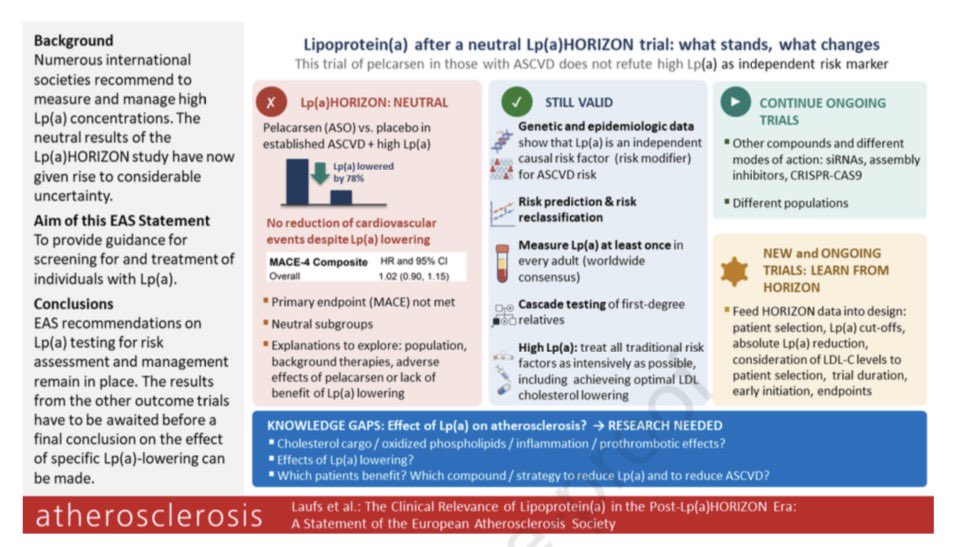
My read: 'lower Lp(a)' without a mechanism is a blunt instrument. The knowledge-gaps section is the real content: oxidized phospholipid cargo, inflammation, prothrombosis. Pelacarsen may drop the number without touching the biology that does damage.
👉 MUST READ; A landmark EAS Statement in the post-Lp(a)HORIZON era in @ATHjournal
☝️The European Atherosclerosis Society @society_eas delivers a timely, evidence-based message following the neutral results of Lp(a)HORIZON.
1️⃣ 78% Lp(a) reduction ≠ cardiovascular benefit.
We must distinguish a causal risk factor from a validated therapeutic target.
2️⃣ Lp(a) remains a major cardiovascular risk factor.
Measure it at least once in every adult. Family screening remains essential.
3️⃣ LDL-C lowering is our strongest actionable strategy.
Intensive control of LDL-C and other risk factors can mitigate Lp(a)-associated risk.
4️⃣ Timing may be everything.
Can a few years of treatment reverse decades of cumulative atherogenic exposure?
5️⃣ The science is far from over. Ongoing RCTs with different Lp(a)-lowering agents are essential.
☝️My key takeaway: A negative trial should change our assumptions, not replace scientific evidence with speculation.
☝️ Measure Lp(a). Lower LDL-C. Control global risk.
Keep testing hypotheses with RCTs.
🔗 https://t.co/PkokhMCK0e
@BNordestgaard@ProfKausikRay@MeralKayikcoglu@KronenbergLab@j_rvl@SamiaMoraMD
A healthier world needs stronger research.
From disease prevention and epidemiology to digital health and healthcare innovation, research can transform global health outcomes.
Submit your research today!
https://t.co/NiCdcLOpoQ
#Colloquys#GlobalHealth#PublicHealth
Looking for a job in the UAE? Banking and finance may still dominate recruitment, but some unexpected industries are gaining momentum.
Which industries offer the best opportunities, and where are salaries highest?
Here is what jobseekers need to know: https://t.co/12PTXzcj5a
The MSS tumors are the hard case here. Anti-PD-1 expands CXCL13+ progenitors in the draining node, TNR4 agonist pushes the TH1-like differentiation. One thing I'd want to know: is the clinical endpoint TLS formation or response rate? Those can diverge.
Going from cold to hot.
How to get immunotherapy to work even better to treat cancer via the tumor microenvironment
@ScienceMagazine
https://t.co/O2OBRn0uDB
@ProfAvikRoy Congrats and team. STAT3 as a downstream mTOR effector ties this to a familiar aging pathway. My question: were the IL-6 and RANTES drops in plasma or in vitro, and do they hold in a ME/CFS patient cohort?
@Nature NRF2 is usually cast as the antioxidant brake. Here it is the reverse: a required cofactor for NLRP3 firing, gated by ECM stiffness. Pathway labels follow physical context. Does fibrotic stiffness blunt NLRP3-agonist vaccines in tumors too?
The useful part is not the race framing, it is the timeline point. Basic research and manufacturing capacity run on decades. Budget cycles run on years. That mismatch, not any single policy, decides whether a pipeline exists in 20 years.
Today's biotech race is our generation's Space Race. In his STAT+ opinion piece, BIO President and CEO John F. Crowley explains what's at stake in the global biotech race - and how BioAdvance, BIO’s newly released National action plan, offers a path forward.
Read more in STAT: https://t.co/tWQBwBqNl2
@EricTopol@uk_biobank@LancetDigitalH Two huge cohorts agreeing is the part that matters here. My main question: does the gap predict incident disease ahead of diagnosis, or is it partly reading early disease already in the record?
@rafavidalperez@escardio The soft plaque slide is the substantive one. Stenosis percentage is a structural read, plaque composition is the risk. I'd want to know if AI-QCT moves event endpoints, or only agreement with human reads.
@TheLancet@IHME_UW I buy the shared-framework framing. AMR alone shows why: surveillance, stewardship, and pipeline economics are one problem, not three. The hard part is tracking. Threat data that moves slower than the threat is a report, not a response.