Insight #1: Wise's CTO on the stablecoin risk today 👇🏻 - $WISE $WSE
This is the conclusion I've arrived at a few months ago already - if stablecoins ever present a superior value proposition, $WISE will just plug it into their system (@kaarmann@moneyflowinvest@jevgenijs@IshfaaqPeerally):
"And every time, of course, as a technologist, when I see new technologies coming out that could help us solve the problem of cross-border payments and really help our customers, we actively look at this.
And as you can imagine, in the last 12 months, I've been asked quite a few times about our opinions on stablecoins. How will that impact cross-border payments?
So what I thought I'd do is take a few minutes to talk through an example of a USD stablecoin-based transaction. Like how would that impact cross-border payments.
But having spent the last decade in this space, let me give you an example. When people talk about the usage of stablecoins and cross-border payments, they're basically talking about two things from a customer experience.
One, using USD stablecoins in this example, to do cross-border money movement and two, using stable coins to manage currency volatility.
So let's talk about the first, if you were to use stablecoins for doing cross-border payments, we've learned that the infrastructure we've built is by connecting local payment systems and direct connections that we've built, is is delivering a better price and speed than current stablecoin solutions can provide in this space.
As we covered before, we charge 52 basis points on average. And this is actually the global average in some jurisdictions -- if you were to move Swiss franc, like CHF 1 million to GBP, we could get it as low as 20 basis points even lower. And most players in this space using the stablecoin route or stablecoin sandwich would charge anywhere between 100 to 200 basis points or more.
And obviously, the question you should ask is, why -- so the key insight here is while moving value using stablecoin -- USD still coin is easy from 1 person to the other. The real complexity arises when you actually have to on-ramp off-ramp these table cards to different currencies. Because remember, people and businesses want to use money in their local form. They want to pay their taxes in, say, the U.K. or in Brazil.
They want to buy properties. They want to pay for colestration. -- in their local currency, they can't pay for this in USD, if that is not the native currency. So eventually, if you on-ramp and off-ramp this, this is where the complexity lies. This is where the complexity is around financial crime screening. The complexity lies around converting and the pricing you get. This is what determines how much you've being charged.
And guess what? These local payment systems that Diana talked about. They're very large systems. They're moving trillions in the domestic economy. So they're already very efficient.
Hence, the pricing is much cheaper.
But that said, that is the story today. We will continue to invest and see how this space evolves and as it evolves and if it does solve the problems for cross-commodity was for our customers in some regions, so maybe globally to make it cheaper and faster, we would, of course, use this technology.
And the key thing here I want you to take away as the infrastructure we've built is extendable so that it'd be easy to add this.
But the other use case we are seeing is some folks want to manage their local currency volatility. So if you take the example of Brazilian real, the Brazilian real has lost 15% against the USD in the last year. So it makes sense that some people live in Brazil would want to fold non-Brazilian real as a hedge.
And for some of them, they might use stablecoins. But in a lot of these markets, -- there's already a very solid offering. It's a really good offering and it's called the Wise Account. With the Wise Account, you can already hold 40 different currencies at a click of button, and you can hold fee at USD and you can get interest on that USD holdings. That's very powerful.
But here, we could add other asset types. As Nilan said, we have added stocks. We've added money market funds, and we will continue to build this infrastructure with the same way we've built this over the last 15 years. When our customers want new things to solve problems for them, we will add those things. And this could be in this example, a stablecoin offering, it's an asset type.
The infrastructure is extendable that allows you to continue to add new payment types because we've built this from the ground up in this way. Because eventually, what I see is if you take a longer view, looking forward 10 years from now, I will leave you with this. I see most roads in cross-border payments leading to the Wise Infrastructure.
We have built something very unique with this infrastructure, which gives us a competitive advantage on cost and speed with the use of superior technology. and also how we connect directly to payment systems and the regulatory licensing footprint we have built. No other competitor has built this kind of infrastructure at such global scale.
And given the head start we have, we will continue to invest in this over the next decade. But it's not just our customers whose expectations are changing. We are seeing expectations globally change from customers around what cross-border payments should look like. As I said before, 20-second cross-border payments did not exist about 7 or 8 years ago. It definitely did not exist before Wise was created."
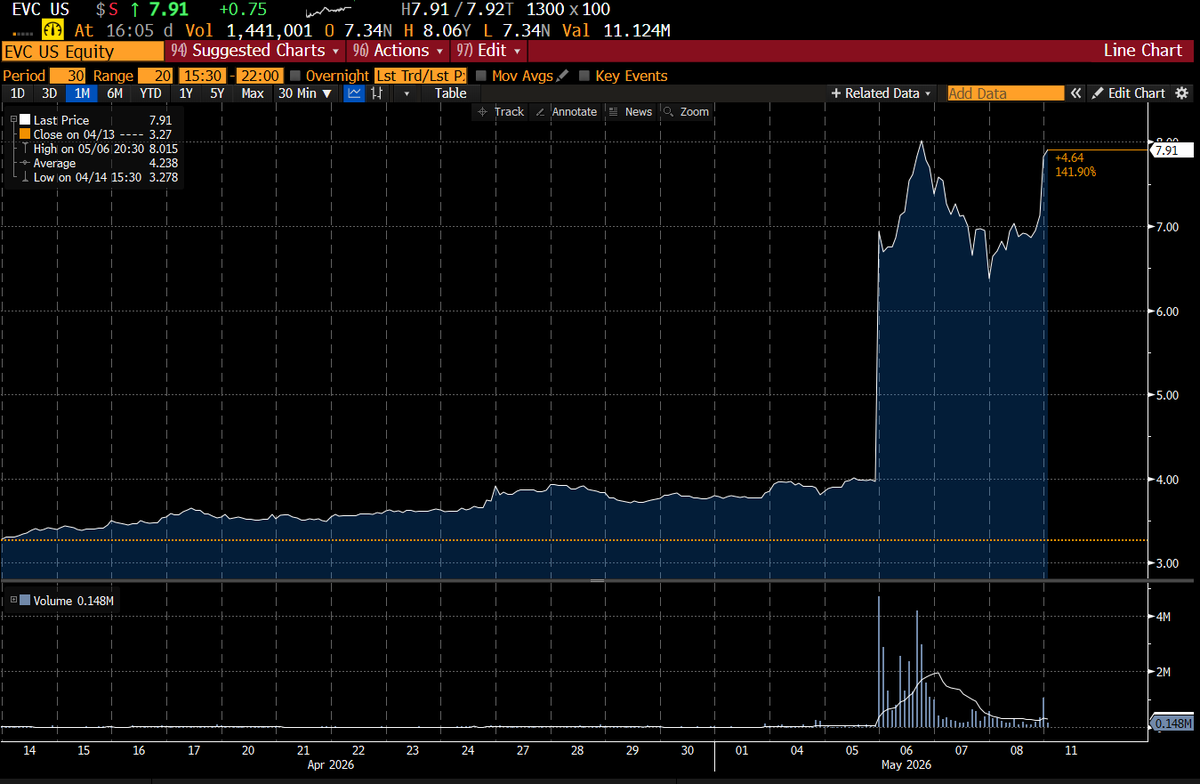
Whenever there's a very strong move on earnings, I always check it out and almost always add / buy.
From experience I know that the market generally doesn't price strong news properly.
At best, most often the share price will only reflect the earnings dynamics, but not any multiple rerating.
And in case of VERY strong earnings (such as $EVC) the market will not even price those properly, leaving plenty to go for the price on both earnings and multiple rerating.
People in it for a trade will sell down on the massive move. Those that made a bundle might also, as the position becomes too large. And others who missed it are biased in buying something that already ran so much.
This often leads to a few days of 'pressure', and a good moment to add.
And then the market does its work.
Paul Tudor Jones: "anyone that's really succeeded investing or trading is first and foremost a great risk manager."
One of the biggest learnings of my career so far. Half the game is avoiding blow ups and managing risk. You cannot sustain long term outperformance without it.
A few years ago I mentioned on a podcast that “biz quality” is overrated as an analytical tool and industry structure/barriers to enter the industry are more important. A simple case study of the fragmented SW industry vs the oligopoly like semi and components sub sectors shows how these industry structures can just sit there for years waiting for an internal or external catalyst to come along and expose those structural weaknesses or strengths.
Brian Chesky shares why the saddest day of his life happened the day after Airbnb went public at $100B:
"We go public, we have a hundred billion dollar valuation. It's one of the best days of my life. The next day, I go on a Zoom meeting, and it was like it never happened."
"It became like the saddest day of my life. Because I realized, I got all this adulation, and I don't feel any different."
"Adulation is like a cup with a hole at the bottom. You keep filling it in, thinking it's love, except it just keeps coming out the bottom."
"That made me reevaluate what I'm doing this for. I want to do things for pure intrinsic reasons. Do the work like you used to do, like when you were a kid. It was light. Just make stuff. Make it for yourself."
"So many entrepreneurs focus on what they want to be. "I want to be a giant tech founder. I want to run a billion-dollar company." Instead of focusing on, "What do I want to make."
There's no way to fail if you're making what you love."
This is a story about my father, parenting, and my rule for the strongest relationships in life…
When I was 12 years old, I tried out for a baseball all-star team in our area.
I really wanted to make this team. The tryouts were my first adventure beyond the confines of my small town. An opportunity to see how I stacked up against kids from all around the state.
When the results came out, the coaches called my house.
They were taking 16 players for the team...and I was the 17th on the list.
I was devastated.
It was my first real experience with failure. Something I wanted, worked towards, and came up short. I went into my room, sat on my bed, and cried.
A few minutes later, my dad walked in. He sat down on the bed next to me. After a few minutes of silence, he offered a few words:
“I know you’re upset. I understand. It sucks. But here are the three things the coaches said you needed to work on. Let’s go out every day this summer and work on them. Together.”
And we did.
I’d patiently wait for him to get home from work, holding our gloves, a bucket of balls, and a bat. He took me to the local field damn near every single day that summer. I’m sure there were days when he didn’t want to. When he was exhausted from work or travel, but it never showed.
And I came back the next year a completely different player. Years later, when I got a scholarship to play baseball at Stanford, I still thought back to that one summer as the turning point.
But it was more than the practice that was the real turning point.
It was what my dad said in those moments as we sat on my bed, with tears streaming down my face—and how he followed through on it every day that followed.
He had two options when he walked into my room and sat next to me.
Option 1: Tell me the coaches were idiots. I was the best player. They had made a mistake. They didn’t know what they were doing.
Option 2: Acknowledge the pain. Tell the truth about the opportunity in the failure. And be there to support the work to meet that opportunity.
Honestly, in that moment, I probably wanted Option 1. It would have made me feel better. It would have told me that the world was the problem. That an external thing was to blame. That I was great.
Option 2 was the tough pill to swallow. But also the right one.
I believe that the strongest relationships in life stand on two pillars:
The first is high expectations.
The belief that the other person is capable of excellence. That their potential is only limited by their own views. The willingness to tell the truth about that opportunity and the work required to meet it.
The second is high support.
The ability and willingness to provide the love, support, and engagement to help the other person meet those high expectations.
A lot of relationships fall short of this standard. They hit one pillar, but miss the other.
Low expectations and high support will provide comfort, but no growth. High expectations and low support may spark short-term growth, but breed long-term resentment.
Sir Isaac Newton famously said:
“If I have seen further than others, it is by standing on the shoulders of giants.”
It’s a beautiful line, but I think it leaves out the part that matters most.
The giants had to bend down. They had to choose to provide energy to lift him.
That’s exactly what my dad did the night I didn’t make that all-star team. He didn’t lower his shoulders to the level of my disappointment. He didn’t tell me the high heights didn’t matter.
He told me that I was capable of the climb—and then he gifted me with his attention and energy to help complete it.
I think about this constantly now.
This, to me, is the highest calling in our relationships:
To create an environment of high expectations with those we love and show up to support them to meet (and exceed) those expectations we’ve set.
This is something I’ve been thinking about a lot as a father. I hope it resonated with you.
One of the things I have learned over time is how I will react to volatility is most highly correlated with how strictly I adhere to the constraints I set for myself about what I put in the book. Self mastery first and then mastery of process. It is easier for me to show discipline in what goes in the book then it is to show discipline in what’s happening to the book.
The most attractive trait isn’t looks, wealth, or status. It’s energy. When you walk into rooms with genuine enthusiasm, interest, and curiosity, you become a magnet for the highest quality people. Energy is contagious. Spread the kind you’d want to catch.