Introducing Helios: measuring 1,000+ protein biomarkers from a drop of blood to help you live younger, longer.
Here’s how it works:
• Self-collect blood at home with a painless, needle-free device
• We measure the proteins carrying signals from cells and organs throughout your body
• Your Helios AI agent explains your results, highlights risks, and offers personalized guidance
Proudly backed by Y Combinator and Formation VC.
Join the waitlist at https://t.co/ZFcLlzMFK2
Announcing a major milestone achieved by my team @GoogleDeepMind: we have proven key security properties of the machine code underlying the Signal messaging protocol. This is the first time the actual production code of a widely deployed protocol has been formally verified – by any method, with or without AI – and at this depth.
More than a research breakthrough, it’s a prime example of how frontier AI can be a force multiplier to counter the speed and scale of modern cyber threats.
Formal verification offers a higher standard of security; however, it’s extremely complex and time consuming, which is why in many cases it’s considered to be impractical. Similar efforts could take teams decades of combined effort. We did it in a month’s time.
Using AlphaProof Code, Google DeepMind's new agentic framework for formal verification that runs on LLMs including Gemini Carbon, we verified the Signal protocol down to the actual code running on devices. This milestone lays the groundwork for a future in which vital systems, from medical device firmware to power grid software, ship with mathematical proof that their protections work.
Reaching that future will take continued research from our community. In that spirit, we're open-sourcing our formal specifications and verification artifacts so others can build on this work.
On a personal note, this moment is of deep significance to me. I started my own research journey more than two decades ago as an intern working on checking the consistency of complex software systems. Seeing this grand challenge made practical with modern AI is extraordinary.
I'm extremely proud of my team members: Swarat Chaudhuri, Andrew Ferraiuolo, Anton Kovsharov, Tej Chajed, Sam Schlesinger, Karn Seth, Jonathan Katz, and Charles Sutton for taking on this grand challenge and delivering, and grateful to the Signal team for their partnership.
https://t.co/kN1eRYQ8fF
AlphaGenome 2 is helping uncover the cellular drivers of disease, giving scientists a powerful tool to predict how DNA variants impact specific cell types.
Every cell in our body shares the same DNA blueprint, but different cell types (like heart muscle cells vs. immune cells) read that blueprint differently. This new @GoogleDeepMind model predicts how these specialized cells interpret DNA, turning genetic code into biological insights.
Building on AlphaGenome 1 this makes it significantly easier for researchers to link genetic findings to the root causes of disease in the specific cells where they actually unfold.
We are bringing agents to the wet-lab bench at Google Research to navigate complex biological landscapes. Learn how we are grounding agents in physical lab robotics to run fast closed-loop molecular design cycles, ultimately discovering single-digit nanomolar protein binders for cancer targets →https://t.co/iPesR5MXCd
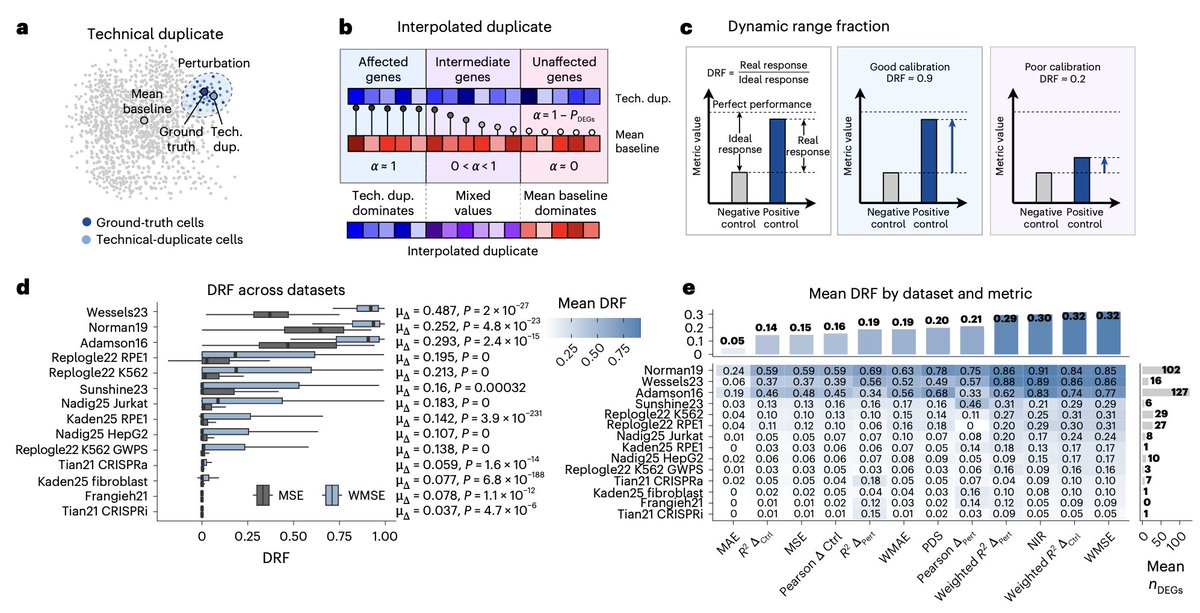
The "Single-cell foundation models don't work for perturbation prediction" narrative was a measurement problem.
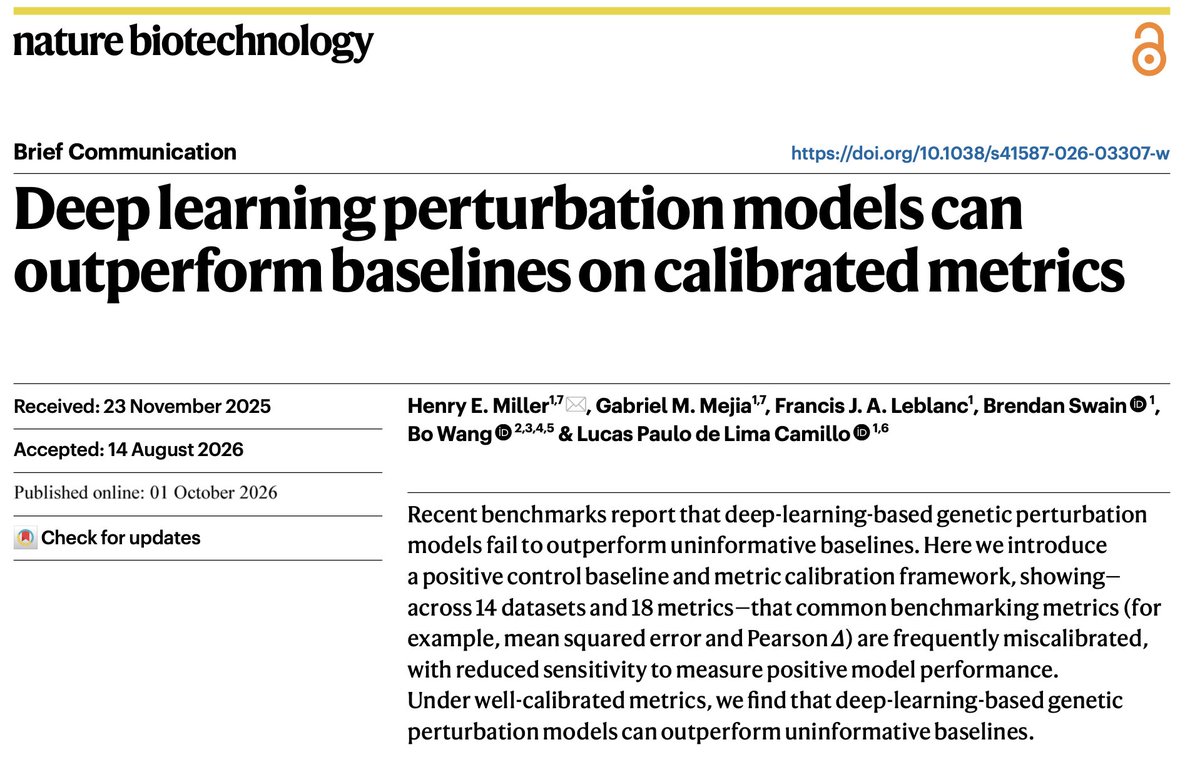
Our new paper is out in @NatureBiotech : "Deep Learning Perturbation Models Can Outperform Baselines on Calibrated Metrics"
Last year, several papers concluded that deep learning perturbation models couldn't beat simple baselines, a finding that cast doubt on the entire Virtual Cell direction.
We asked a different question: can the metrics used in those comparisons reliably tell a good prediction from a bad one?
Often, they can't.
Common metrics like MSE and control-referenced Pearson Δ frequently rank uninformative baselines above positive controls. With calibrated alternatives (eg, WMSE, weighted R²Δ, NIR), deep learning models do outperform mean, control, and linear baselines.
The data matters too. Norman19 is approximately 96% additive, and models see less than 1% of possible gene combinations during training. The ceiling for beating an additive baseline is nearly zero, and the training signal for non-additive interactions is almost absent. Some dataset rankings aren't model rankings, but just noise!
To address this, we developed the Dynamic Range Fraction (DRF): a measure of metric calibration. Before trusting a model ranking, verify that your benchmark can detect a useful prediction at all.
The models aren't shiny toys. The field just needed better rulers.
Paper: https://t.co/Pug5bjPrvj
Code: https://t.co/4IjsHP6Wmd
Huge congratulations to the first authors @Henrymiller2012 and Gabriel Mejia, and the team of Shift Bio!
This is my first ever post on X!
And I’d love to share my first ever preprinted work PIE - Perturbation is Everything!
Generalizing across unseen cellular and experimental conditions is challenging but essential to therapeutics discovery. Our latest model PIE addresses this challenge by simplifying the learning objective and leveraging curated biological knowledge from public databases. PIE generalizes across a combinatorial space of perturbation studies, unseen cell lines and unseen perturbations.
Check out the preprint at https://t.co/9oOfpcIZaX
Huge shoutout to the team at @arcinstitute for driving this project:@abhinadduri , @beabevi_ , @basak_ersln , @davey_burke , @genophoria , @yusufroohani .
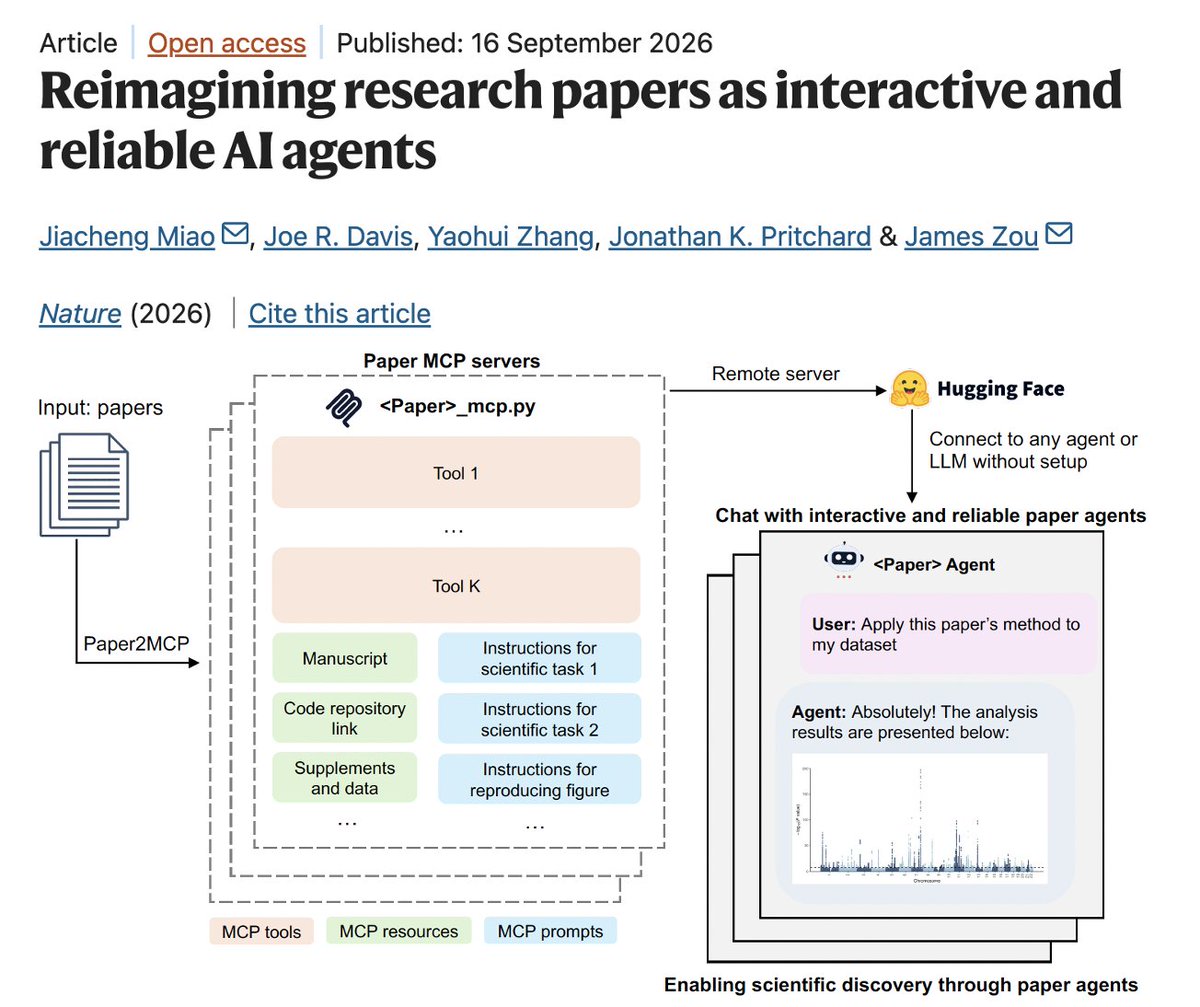
Thrilled that #paper2agent is published in @nature today!
Scientific knowledge is traditionally stored in passive papers. Paper2Agent transforms papers into virtual authors that answer questions, apply its methods and collaborate w/ other paper agents to make new discoveries 🧵
In people with heart failure compared with healthy controls, the gut microbiome changes and that is linked to severity of heart dysfunction and outcomes @NatureCVR
https://t.co/QjsfDzGGfP
The potential to predict breast and prostate cancer up to 8 years before it is diagnosed from blood cell-free DNA methylation patterns
https://t.co/1fv5Pi4TR6
@PatrickHwuMD@Nature In my LN metastasis findings I also saw the lymph node as a key site with cancer-specific biomarkers & raised immune-suppression pathways. Interesting to see a similar suppression happening, but outside the tumor PLA2G2D macrophages limit T-cell expansion in draining node.