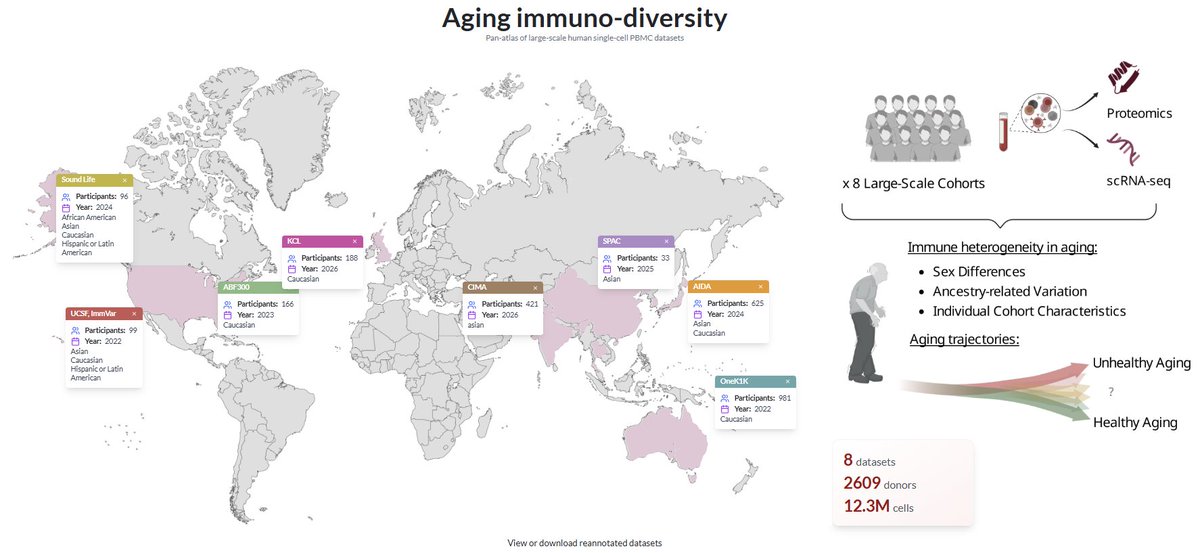
Out today in Immunity! Our pan-atlas of human immune aging: 12.4 million PBMCs from 2,609 people across 8 global cohorts (including new 188 people cohort from UK).
https://t.co/hYbe2k3XEi
We map shared aging patterns onto 59 key immune populations and link the balance of GZMK+ and GZMB+ CD8 effector memory T cells to health trajectories; show differences in RTEs and Th2s with sex etc; ethnicity associated features.
https://t.co/AHmFVQVfM6
How it came to be:
in 2023 we published first hierarchically annotatied atlas of human immune aging in PBMC - 166 people, 55 populations, key changes revealed - CD8 naives, KLRC2/NKG2C+ CD8 memory going down, GZMK+ CD8 T cells and Th2 and Tc2 type 2 memory cells going up! (Terekhova et al, Immunity 2023)
in 2024 we added major phenotypes within naive cells - SOX4+ RTE cells and their CD38 marker going down. (Bohacova et al, Immunity 2024)
In 2025-26 more atlases published with their own annotations making impossible to leverage power of data..
Now we provide unique in its power and consistency resource - 2600 people across ages, sexes, races, continents etc. All annotated in sync and analyzed for what aging looks like globally!
Tumor-Free Circulating Tumor DNA in Node-Negative Rectal Cancers Undergoing Neoadjuvant Chemotherapy, Excision, and Observation in the Phase II NEO Trial (CO.28)
https://t.co/nJSq4wK2u6
🧬 #ScienceSaturday What if we could turn cancer cells into cells that teach the immune system how to attack the #tumor?
A new study in @NatureComms explores a creative approach to one of the toughest cancers to treat: #glioblastoma.
🔬 Glioblastoma can be difficult for the immune system to recognize, in part because tumor cells may not effectively present the signals T #cells need to identify them as a threat.
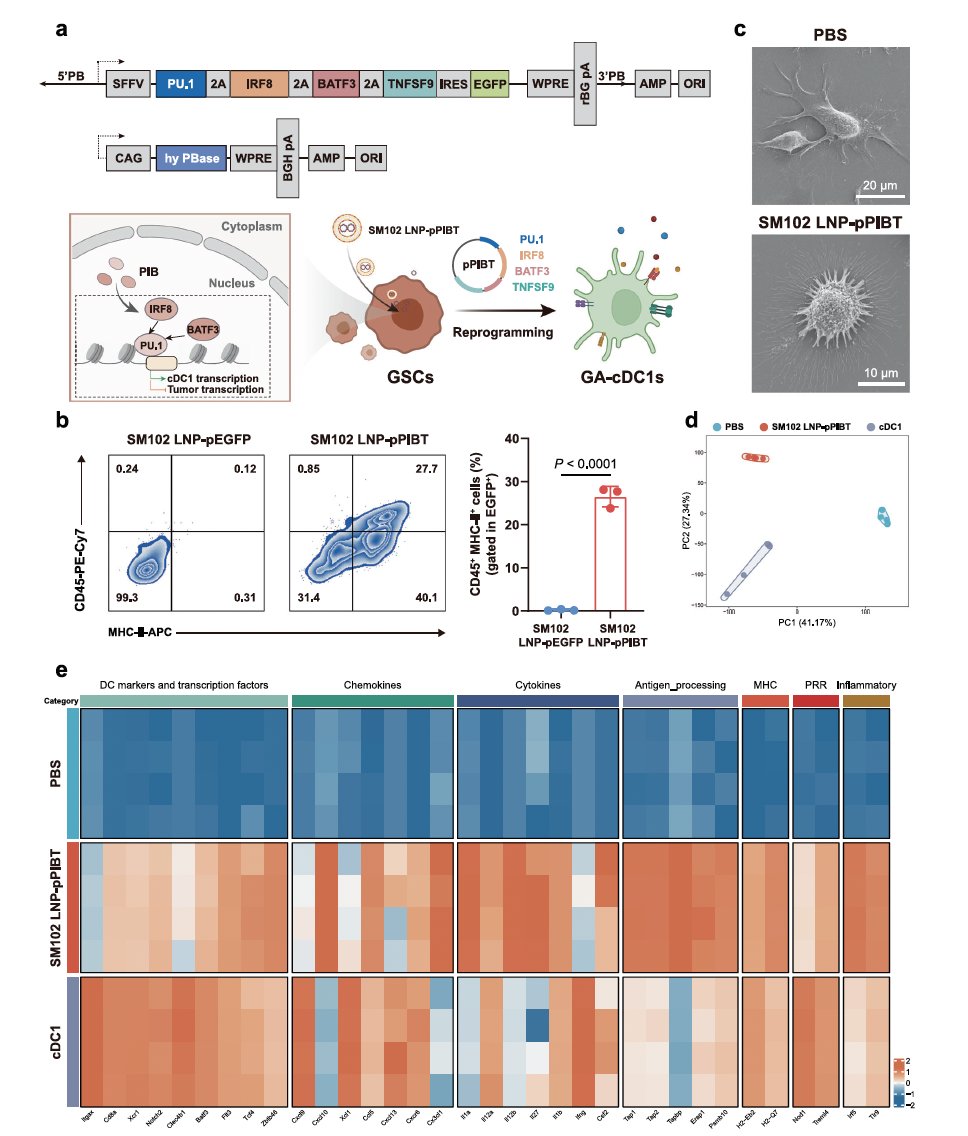
Researchers developed an injectable nanoparticle-hydrogel system that delivers specific molecular instructions directly to glioma stem cells. Instead of simply trying to kill those cells, the treatment reprogrammed them into cells resembling cDC1 dendritic cells, specialized immune cells that are very good at showing tumor antigens to T cells.
🛡️ Essentially, the researchers turned part of the tumor into an immune educator.
The reprogrammed cells presented the tumor’s own antigens and helped activate cancer-fighting T cells. In mouse models, this generated a stronger immune response and long-term antitumor memory, slowed tumor growth and helped prevent glioblastoma from returning after surgery.
💡 Why does this matter? Instead of bringing in a separate cancer vaccine, this approach uses the tumor itself as the source of antigens, potentially transforming an immunologically “cold” tumor into an environment where the #immune system can better recognize and fight cancer.
This research introduces a fascinating idea: reprogramming #cancer cells so they help expose the very tumor they belong to. @Nature@NatureMedicine@nature@NatImmunol@NaturePortfolio@ShandongU@ShandongUni1901
Read the study: https://t.co/BfwBbExmX9
A new lipid nanoparticle, LC-1, overcame gene editing barriers and efficiently delivered large RNA tools to the preclinical models of liver, lungs, and brain.
The @NatureBiotech study was led by @BowenLi_Lab@UHN@pmcancercentre & @UofTPharmacy:
https://t.co/e9ju3EbUhZ
For readers interested in mRNA therapeutics, here's a recent Review covering their wide-ranging applications https://t.co/hGncs4wFRN https://t.co/pxSfq4fYC8
🧬 Excited to share our new work in @NatureBiotech!
Paper: https://t.co/7bc59q8p7O Research Briefing: https://t.co/o5wKM3RQBr
Large gene editors require large mRNAs, but LNPs are typically discovered using much smaller reporter RNAs. We asked: does RNA size matter when discovering delivery lipids?
Using a large base-editor mRNA for high-throughput screening, we identified LC-1, an ionizable lipid that enabled efficient gene editing in the liver, lung, and brain via different administration routes in mice, with up to 4× higher Cas9 editing than benchmark LNPs. LC-1 also efficiently delivered base editors for disease-relevant targets in hypercholesterolemia, cystic fibrosis, and Angelman syndrome.
Why does LC-1 work so well? Cryo-EM and X-ray scattering revealed that LC-1 LNPs form an ordered, inverted-hexagonal structure that persists with large RNA cargo. This membrane-fusing structure helps RNA escape from endosomes, the compartments that can trap it inside cells. In cell studies, LC-1 released roughly twice as much large mRNA into the cytosol as the benchmark formulations. We show that LC-1's key design features also apply to ionizable lipids made through other synthetic routes.
These findings show that accounting for RNA size from the start can change which lipids we discover and improve delivery of large gene editors. This could help expand the delivery options available for future gene-editing medicines.
Thank you to all our co-authors, collaborators and funders @CIHR_IRSC@NSERC_CRSNG@UofTPharmacy@LisaDolovich@PMResearch_UHN@bradwouters #LipidNanoparticles #GeneEditing #RNATherapeutics
Immune cells fighting a long infection or cancer eventually burn out and stop working — a big reason some cancers escape the immune system entirely. Folks from St. Jude found a single gene acting as the burnout switch, and turning it off let exhausted immune cells snap back into fighting shape, dramatically improving survival in mice with cancer and chronic infections.
https://t.co/7eHI9zXKnh
A recent @ScienceTM Review synthesizes the translational pipeline of research decoding how tumors interact with both the central and peripheral nervous systems to fuel their growth—as well as implications for drug repurposing and interventions.
Learn more on #WorldCancerResearchDay: https://t.co/FAtVaE6zaf