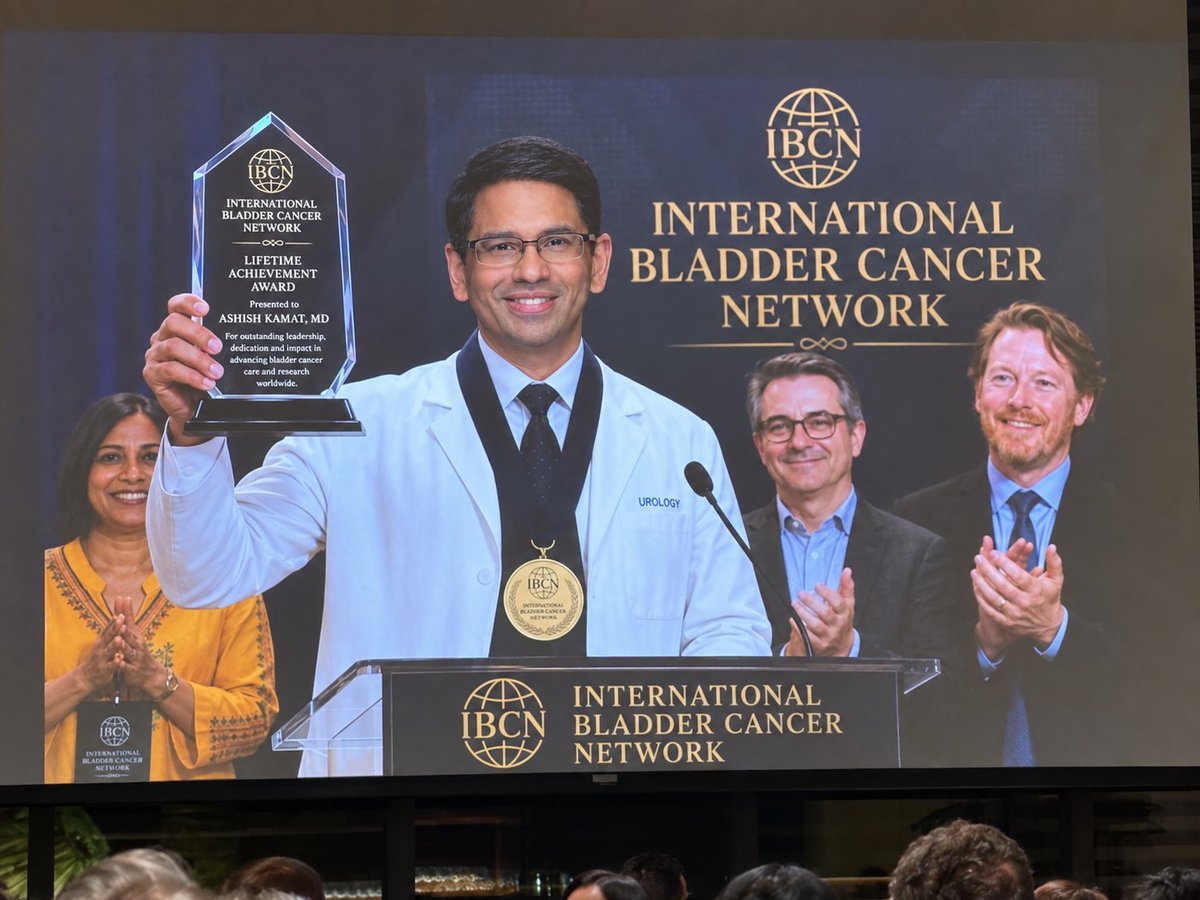
Deeply honored to receive the IBCN Lifetime Achievement Award.
This one is particularly special. IBCN has been a big part of my life for many years, and many colleagues have become close friends along the way.
And receiving it from @pcvblack made it even better. I used to evaluate him. Now apparently he gets to evaluate my lifetime! (His AI skills, however, remain a work in progress).
Thank you to everyone who has been part of the journey. Although, as I said tonight, I certainly hope the “achievement” part isn’t over yet! 😊
#BladderCancer #IBCN @IBCN1997@mouwlab@LDyrskjot@WesKassouf #OncSurgery @IBCG_BladderCA@UTMDAnderson
Practical pathways for delivering new #BladderCancer therapies in community #urology. @HafronJason joins @UroDocAsh explaining how independent urology practices can reliably adopt new intravesical bladder cancer therapies, using gemcitabine intravesical system (TAR-200) that carries a J-code, as the primary example for BCG-refractory disease. #WatchNow > https://t.co/4RMwnsbmgK
Some thoughts on burnout: 🧵
A part of burnout in medicine, especially in academia, is that people are carrying around with them an enormous number of thoughts and frustrations that just sit there and fester in their minds, and they see no safe outlet for expressing them.
(1/)
Spot-on analysis. We assume that NECTIN4 is near ubiquitous, but if we want true precision with ADCs in urothelial cancer, surface availability and target dynamics have to replace broad-brush “positivity”.
Looking forward to the prospective readouts and implications for bladder sparing selection.
@IBCG_BladderCA@PGrivasMDPhD@AndreaNecchi@shilpaonc@UrogerliMD@DrRosenbergMSK
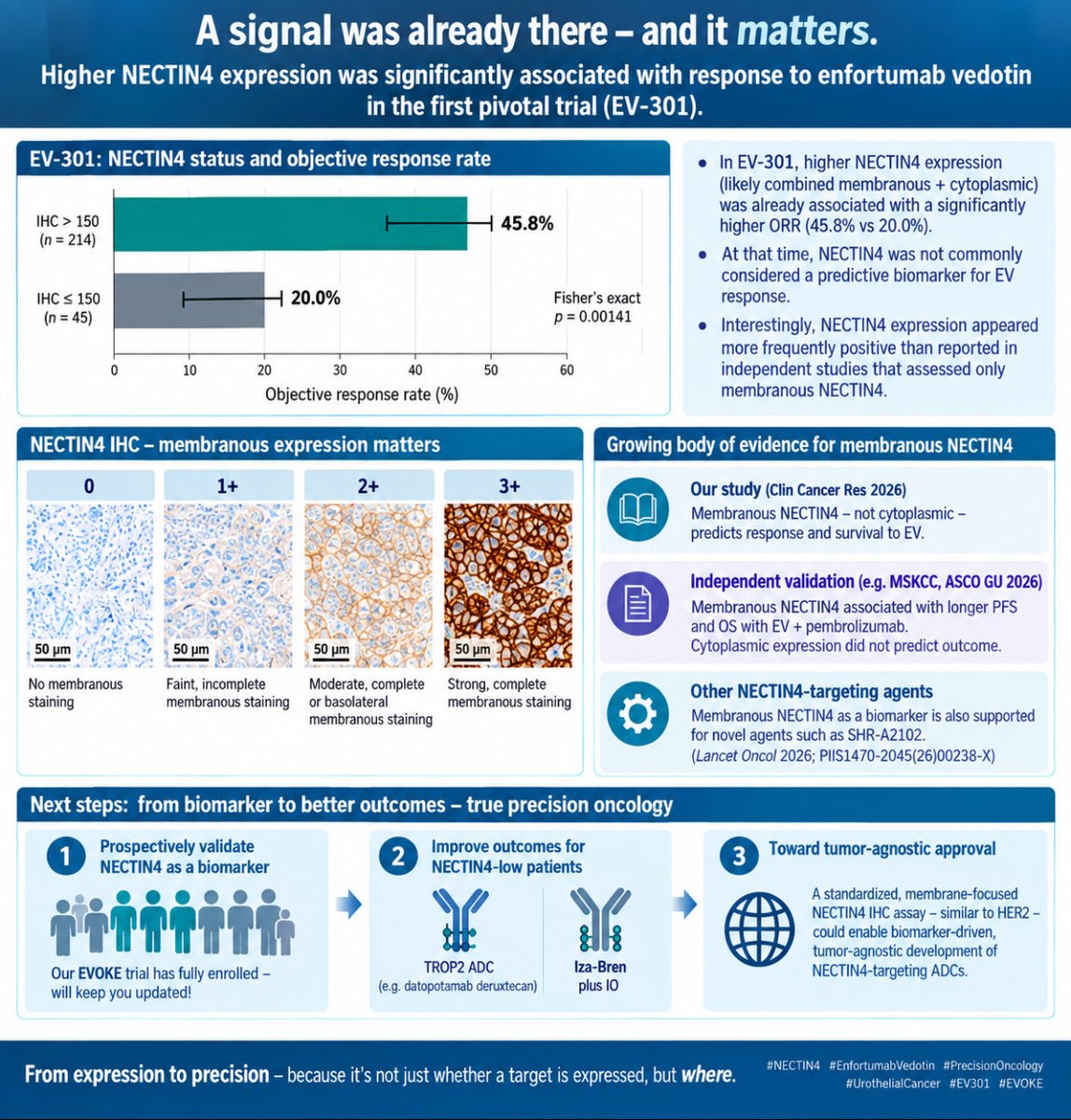
The NECTIN4 biomarker signal was already there.
We were quite surprised when revisiting the pivotal EV-301 data: higher NECTIN4 expression was already significantly associated with response to enfortumab vedotin — ORR 45.8% vs 20.0%.
At the time, this was not the prevailing view: EV was considered effective largely irrespective of NECTIN4 expression.
One possible explanation is how NECTIN4 was measured. The unusually high expression levels in EV-301 suggest that overall/combined staining may have captured both membranous and cytoplasmic NECTIN4, potentially diluting the biologically relevant signal.
Our new data show clearly:
🎯 Membranous NECTIN4 predicts EV response and survival. Cytoplasmic NECTIN4 does not.
This makes sense mechanistically: an ADC needs an accessible cell-surface target to bind and deliver its payload
-> well established eg for HER2 (Tumor agnostic approval in HER2 3+)
Since EV-301, the evidence supporting membranous NECTIN4 as a biomarker has continued to grow — including independent EV+pembrolizumab data and now other NECTIN4-targeting ADCs such as SHR-A2102.
The next step is prospective validation. Our EVOKE trial is fully enrolled — stay tuned.
And perhaps the most important question: Can we improve outcomes for NECTIN4-low tumors by selecting a different target, payload or therapeutic strategy?
This is where ADCs should be heading: from target expression to true precision oncology
@Markuseckstein3@DrRosenbergMSK@Dr_Aggen
#DGU26 @amerseburger@dgukongress@DGUrologie@OncoAlert@weoncologists@urotoday@DrChoueiri@PTarantinoMD@raffcolo@tompowles1@UroDocAsh@Uromigos@imedverse@CCR_AACR@Uroweb@PGrivasMDPhD@montypal@apolo_andrea@AndreaNecchi@DrYukselUrun
Phase II trial of neoadjuvant sasanlimab and SBRT as an in situ vaccine in cisplatin-ineligible #MIBC. @DrRajSat@MethodistHosp joins @UroDocAsh@UTMDAnderson to discuss the RAD VACCINE MIBC phase II trial combining sasanlimab with stereotactic radiation for cisplatin-ineligible muscle-invasive bladder cancer. #WatchNow on UroToday > https://t.co/8fuLYL7mw0