@DutchRojas In my region, the local healthcare system bought up 95% of all the private practices. They now up charge 30% on similar services but have referral wait times nearly 100% longer. Geez!
@LeonKelem@Zoyag9fc Patient-trust relationships are pillars of good medicine. A patient describes to the physician why they can’t walk due to diagnoses X. Is the doctor not to trust what they are being told. Yet, it’s the doctor you can’t trust. Interesting.
So then why did the hospital system that operates the critical access hospital in my town just open a “community pharmacy” across the parking lot from our independent pharmacy. On the grounds of the hospital. and the medical practice. We also have a three letter pharmacy . Tell me why we need a 3rd in town.
🚨 PATIENTS: FOLLOW THE MONEY.
So ask your hospital system:
💰 How much do you receive in 340B discounts?
💰 How much actually benefits patients?
💰 How much stays with the hospital system?
💰 Will you voluntarily disclose the numbers?
If a healthcare system claims its government-supported discounts benefit patients, show us the numbers.
👉 Don’t just ask what healthcare costs. Ask where the money goes.
How is it fair that Jeff Bezos be required to pay billions of dollars for solving problems and creating millionaires for so many lower and middle class families?
Last year, Jeff Bezos sailed on his $500 million yacht to his $55 million wedding in Venice to give his wife a $5 million ring while his real tax rate was less than 1%.
Under my 5% billionaire wealth tax, Mr. Bezos would owe $12.7 billion & still have $240 billion left over.
These little cowboys and cowgirls aren’t just riding sheep — they’re learning one of the oldest lessons the West still teaches.
Mutton busting looks pure chaos from the outside: tiny helmets, protective vests, a woolly animal that has zero interest in cooperation, and a crowd holding its breath. But watch closely and you see something deeper. These kids are practicing courage in real time. They climb on knowing they will probably hit the dirt in under eight seconds. They still do it. They get up, brush off the arena dust, and grin like they just won the world.
That kind of grit doesn’t start in a classroom. It starts in places like this — under bright lights, with adults who know how to keep it safe, and with parents who understand that a little controlled risk builds something no participation trophy ever will. The sheep don’t care about feelings. The arena doesn’t hand out participation ribbons for trying. You hang on or you don’t. And when you don’t, you learn that falling is temporary and standing back up is the real win.
In a world that keeps wrapping kids in bubble wrap, these short, wild rides feel like a quiet rebellion. They’re pure joy mixed with real courage, and they remind the rest of us what childhood used to look like before everything got so careful.
The Little Sheep Team might not stay on long… but they already won.
I’m at the airport. Of course I start reading weekend edition of the @WSJ.
Wouldn’t you know it, the dual designated non-profit grifter, NYU Langone, has a full page ad.
And you’re still wondering why healthcare is expensive?
And you know that means taxpayers are buying WSJ ads for NYU Langone.
Taxpayers subsidize its land.
Taxpayers subsidize its buildings.
Taxpayers subsidize its debt.
Taxpayers subsidize its expansion.
What did it cost? The Wall Street Journal rate card prices a national full-page color advertisement at more than $300,000 (52 weeks).
For one page.
This is the same “nonprofit” hospital system that advertised on a Super Bowl commercial.
Its hospital enterprise reports nearly $10 billion in property, plant, and equipment. It has more than 6,000 physicians.
It operates more than 330 outpatient locations. It buys hospitals. It buys orthopedic groups. It buys physician practices.
It buys land.
It buys advertising.
It buys the commercially insured patients every independent physician needs to survive.
Then it calls itself a charity.
How many taxpaying neurosurgery practices were destroyed while NYU Langone built this empire?
How many physicians were forced to sell?
How many became employees of the institution they once competed against?
How many independent practices had their referrals siphoned away, their patients captured, and their businesses slowly suffocated by a competitor taxpayers were forced to subsidize?
Nobody knows. Nobody counts the bodies. An independent practice dies quietly.
First, referrals disappear.
Then revenue collapses.
Then employees are fired.
Then the physician sells.
Then the hospital raises the price, adds a facility fee, and hangs its logo over the corpse.
The independent physician paid income taxes, property taxes, payroll taxes, commercial rent, malpractice premiums, and the full cost of building a practice.
NYU Langone took the tax exemption, accumulated billions in assets, swallowed the competition, and bought an advertisement congratulating itself.
Where is the charity?
NYU Langone wants the power of a corporation, the market share of a monopoly, the real estate portfolio of a conglomerate, and the tax treatment of a church.
No.
If you acquire competitors like a corporation, advertise like a corporation, accumulate billions like a corporation, and hunt profitable patients like a corporation, then you can finally do one honest thing like a corporation:
No more subsidies.
Pay your taxes.
Let’s talk about physician payment for a minute and why that AMA graph just doesn’t feel like it tells the whole story. Here’s why…
Let’s start with how the AMA calculates its graphic. They work on the specified update, which is what Congress set out to do that year… but that’s only half the story
Each year, the conversion factor (CF) is recalculated by multiplying the prior year CF by the statutory update by the budget-neutrality adjustment. When you only go on the statutory update, you miss a big potential gain or loss due to budget neutrality.
@anish_koka has explained why budget neutrality has doomed the physician fee schedule permanently. The AMA has provided Congress with years of bad data that ignores the massive financial trouble that budget neutrality has caused and created a far rosier picture.
When you look at the AMA graph, it appears doctors have seen a 10% increase since 2000. The 2000 CF was $36.6137. The 2027 proposed CF is $32.84. That’s over 10% in the negative direction.
We need truth in advertising. I begged the specialty societies and the AMA to fix their graphs. I spent 3 years asking for it. No one listened.
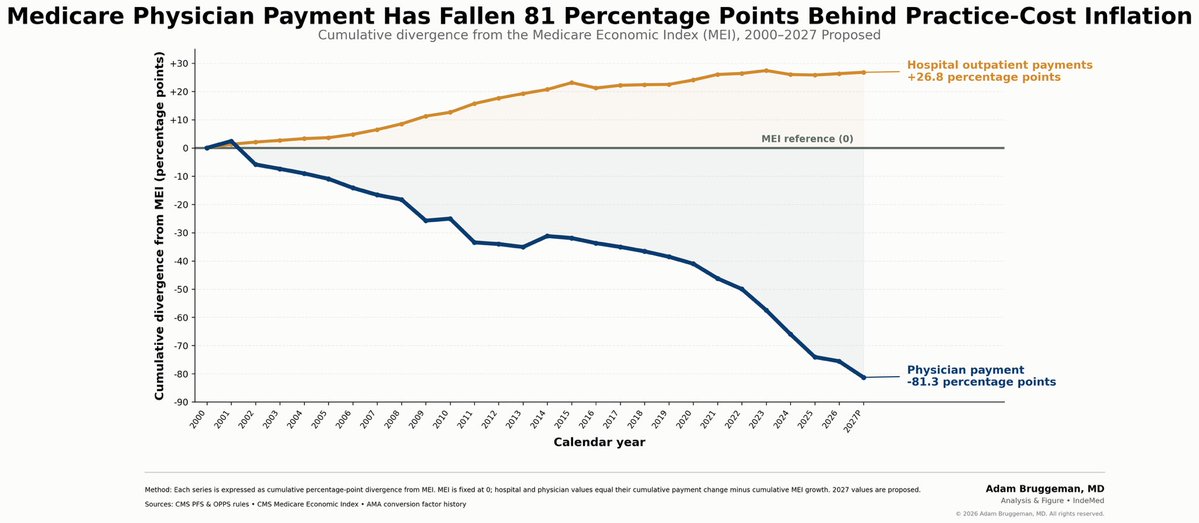
So, I did what I had to do and I pulled the data together. Below is the work product of that venture and a graph that I think (visually) shows the much more striking reason why doctors are leaving medicine or selling their practices.
The first graph looks at things from the perspective of the 2000 CF. If we just compare how much doctors and hospitals are paid, we see that physician pay via CF has declined 10.3% while hospital pay has increased 97% and inflation (MEI) has increased 71%. That seems pretty stark but I think the second graph uses the same numbers but in a more effective way.
The second graph assumes that MEI is the baseline. In other words, what if doctors just got what they were paid in 2000, updated for the cost of inflation. Now we see what really has happened. Doctors are 81.3% behind inflation while hospitals are 26.8% above inflation. No wonder hospitals are buyers and doctors are sellers in this market.
It’s time for truth in advertising. It’s time Congress and CMS heard the real numbers. 81% behind inflation over 25 years and even worse when compared to HOPDs. Our government created this crisis and they will need to understand the issues they created to get us out. Follow us at @IndeMedAction as we shine the light on issues critical to independent physicians.
Medicine trains physicians to survive broken systems.
Residency teaches endurance. Hospital employment teaches compliance.
Payer contracts teach dependency. Academia teaches prestige instead of ownership.
So you end up with some of the most capable people in America becoming financially passive inside the industry they make possible.
They can manage life and death. They can carry a complication at 2 a.m.
They can explain risk to a family with precision and grace. But the contract that determines how their labor is valued?
Someone else handles that.
The building?
Someone else owns it.
The ancillary revenue?
Someone else captures it.
The payer relationship?
Someone else controls it.
The system is brilliantly designed to keep clinical intelligence separated from financial control.
And once those two were separated, the physician becomes labor.
Highly trained. Highly respected. Highly billable.
And still labor.
The good news? This can be rebuilt. Physicians can learn ownership. They can build balance sheets.
They can own the contracts, the buildings, the ancillaries, the networks, and the infrastructure around their work.
The same discipline that made them excellent clinicians can make them excellent stewards.
Independent medicine is not dead. It is undercapitalized. And undercapitalized is fixable.
Eighteen percent. That’s how many doctors still own the room they practice in. The other 82 swapped the deed for a badge, a scrub-color policy, and a Press Ganey score that sets their bonus.
Nobody outlawed private practice.
They acquired it one burnout at a time and filed it under alignment.
We need site neutral payments since we all went to medical school, residency and fellowship programs. Is a lab coat logo from a non-profit system really worth a 30% up charge?
Healthcare is the only market where the seller hides the price and calls it compassion.
You know the price of a flight before you board, price of a steak before you order, and certainly the price of a used truck before you buy it.
Healthcare trained you to accept blindness as normal.
That was not an accident.
The opacity is the product.
Price discovery is the one force incumbents cannot survive.
Sowell said there are no solutions, only trade-offs.
The hospital traded your ability to compare for its freedom to charge.
Visible prices end the game.
Do you think a nonprofit hospital has to provide charity care?
It doesn’t.
The IRS deleted that requirement in 1969.
The tax break survived.
The charity became optional.
And the proof it offers in its place is graded by the health system itself.
Your “nonprofit” hospital has an $8M CEO, a bond-rated real estate empire, and a tax exemption. But the facility fee on your 12-minute MRI is just to “keep the lights on for the community.” Sure.